Sunday, September 6, 2015

Don't Make a Scene: Diner

The Story: No, it pre-dates this. Passive-aggressive mooching has been going on for millennia. In fact, I'm sure I heard one of the man-apes in 2001 say "You done with that clavicle? I can use it for somethin'."

No, I'd heard it before. "You done?" "You gonna eat that?" "You savin' that potato salad?" "You done with that?"

"If you're not gonna eat that..."

"I mean....really...if....

The past being prologue meant that encountering this little drama in Diner just made it that much funnier. And bitter-sweet. You could relate.

And you could relate to the sub-text. Of course, it's a set-up. "C'mon, ev-er-y time!" Yes, it's a set-up. They're all in on it. They're all against you.

And why not? You're Steve Guttenberg!

Okay, at the table is The Goot, Paul Reiser (up-and-coming comedian and future creator of "Mad About You"), Daniel Stern (the voice of "The Wonder Years" and a fine character actor—Home Alone, City Slickers) and they're one degree from a very young Kevin Bacon, a couple movies away from his break-through role in Footloose. In the wings are Tim Daly, future star of "Wings" but current brother of Tyne, and Mickey Rourke, who'd been in bit parts in 1941 and Body Heat, and that's about it. And Ellen Barkin in her first movie.

Great cast. Great movie about the clueless cruelty of adolescents pretending they're men.

The Set-Up:
It's another night at the Diner for four Baltimore hot-shots, Modell (Paul Reiser), Eddie (Steve Guttenberg), Shrevie (Daniel Stern), and the guy who just walked in with the scraped knuckles, Fenwick (Kevin Bacon). They're at a lull in the conversation....

Action!

Modell: What is that, roast beef?
Eddie: Don't ask me this anymore, Modell. Yes.
Modell: You gonna finish that?
Eddie: Yeah, I'm gonna finish it. I paid for it. I'm not gonna...I'm not gonna give it to you.
Modell: If you're not gonna finish it, I would eat it. But if you're gonna eat it, you're gonna...
Eddie: What do you want? Say the words.
Modell: Naw, you go ahead. You're gonna eat it. You eat it. That's all right.
Eddie: Say the words. "I want the roast beef sandwich." Say the words and I'll give you a piece.
Shrevie: Would you guys cut this out? I mean, every time, and he...
Eddie: Well, he doesn't talk! He just...
Shrevie: Well, you know what he means, right?
Eddie: Yeah, I know what he means, but he beats around the bush! If he'd say the words, I'd give him a piece.
Modell: If I wanted it, wouldn't I...wouldn't I ask you?
Eddie: Then ask! You know you want...
Shrevie: Will you just let it go?
Eddie: You know he wants it.
Shrevie: You're annoying as hell.
Eddie: I'm annoying?! I'm annoying!? I'm trying to eat a meal by myself.
Shrevie: If you want to give him the sandwich, give him the sandwich. If you don't want to give him the sandwich. then don't give...
Eddie: I don't wanna give...
Shrevie: Well, then just eat the sandwich and shut up.
(Fenwick laughs)
Eddie: Well, look at his eyes!
Modell: I ask one simple question, and you get...You know what your problem is? You don't chew your food. (Fenwick snorts) That's why you get so irritable here. You have lumps...you have roast beef in your heart that just stays there.
Eddie: Oh, Modell, you're really, really getting me mad now! My blood is boiling!
Shrevie: I'll take the sandwich. (Shrevie takes the sandwich from Eddie's plate)
Eddie: No, don't!
Shrevie: Fine! I'll take the sandwich.
Eddie: See?! See what you do? Every goddamn...
Modell: Why're you blaming me? He took the sandwich. I'm just sitting here. I'm having a cup of coffee. That's it.
Shrevie: Want this?
Eddie: Not now! No, no, no!
Shrevie (to Modell): Want this?
Fenwick: I do. (Shrevie takes a tentative bite)
Eddie: I can't believe you're eating the sand...
Eddie: You know, you two play against me. That's what the problem is! You're both on each other's side.


Diner

Words by Barry Levinson

Pictures by Peter Sova and Barry Levinson


Diner is available on DVD from MGM Home Entertainment.


Okay, I'm done with that....

Saturday, September 5, 2015

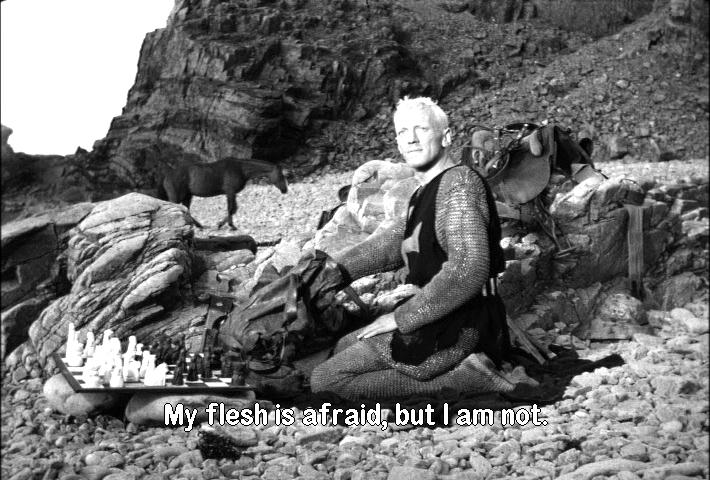
Olde Review: The Seventh Seal

This was part of a series of reviews of the ASUW Film series back in the '70's. Except for some punctuation, I haven't changed anything from the way it was presented, giving the snarky, clueless kid I was back in the '70's a break. Any stray thoughts and updates I've included with the inevitable asterisked post-scripts.

The Seventh Seal aka "Det Sjunde inseglet" (Ingmar Bergman, 1957)

An odd combination of films await those in
130 Kane this Saturday night: Ingmar Bergman's The Seventh Seal and Ken Russell's The Devils.

For those of you whose only experience with
Ingmar Bergman is his wildly splintered and heavy film Persona from last quarter's ASUW series, The Seventh Seal will seem to be made by another man. At this time, Bergman wasn't so experimental, so strange. He was, as he is now, alive and vibrant with the charm of film-making and his '50's films (The Magician, Wild Strawberries, Through a Glass Darkly) although dealing with "heavy" subjects of God and Death and self still possessed a lightness in the telling, a lightness that carried over from his beginnings in films and was lost in the dark broodings of his late '50's and '60's films. There was a time for comedy, and time for deep-think in the space of the best Ingmar Bergman films.

There are many characters in The Seventh Seal, but at the film's hub are two. The most important is The Knight, who is played Max von Sydow, the supreme brooding actor. The Knight is home from the religious wars where the quest for God has been fruitless—where the point of the quest, after the year's ox-killing has been lost. But the quest for God continues. It has to. God can't be in the war, but can he be found outside amidst plague, witch-burnings and ignorance?
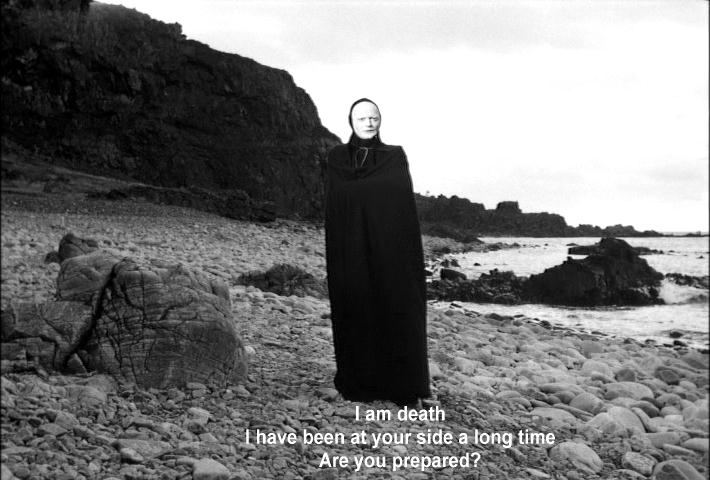
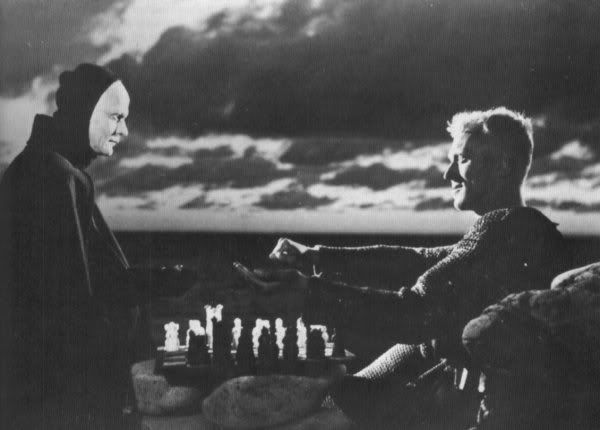
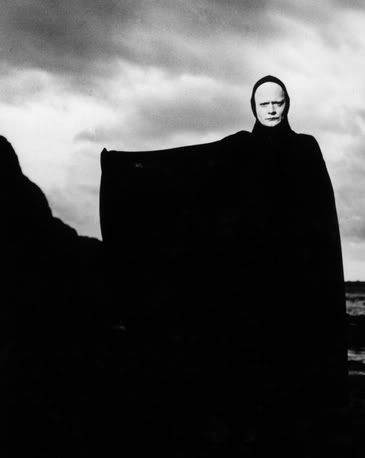
The answers are hard to come by, and even harder to come by while being pursued by another hold-over from the wars, the second most important character being Death. Death pursues the Knight and they engage in continuing battles of wits and of chess. The two opponents are only the hub of the story. There are others: the Knight's man-servant whose musings are concerned more with life that what is beyond; a troupe of actors; a wood-cutter and his adulterous wife. Bergman combines them all in a film that wheels between light and heavy in tone, but always excellent in quality.

Broadcast on KCMU-FM on January 8th, 1976 

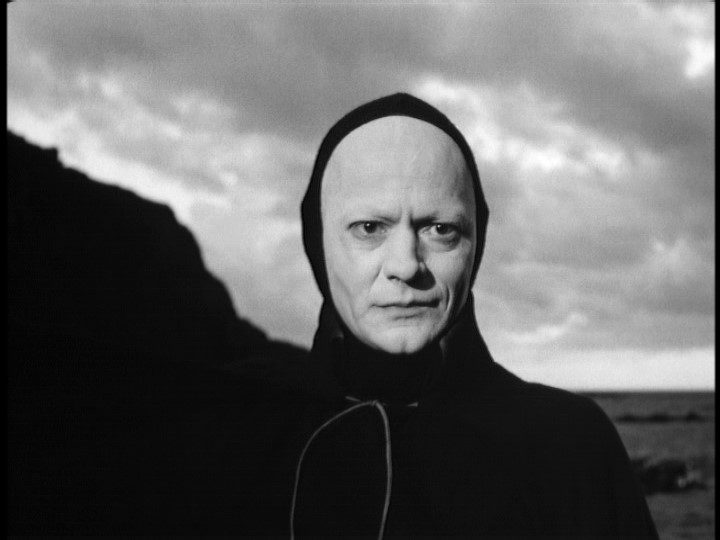
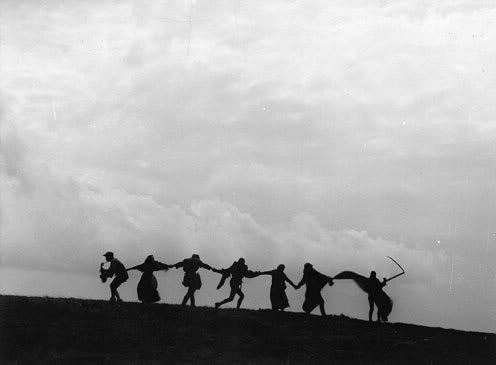
Sounds like I ran out of time there at the end--I usually only had two or three minutes per film to talk. So, I didn't even mention the stark black-and-white photography that has become so iconic, along with Bergman's simple personification of Death--an actor dressed entirely in a black cassock, with just his face appearing...in sharp contrast. And the image of The Knight playing chess with Death has been copied, parodied, purloined and done...well, to death. In Bill and Ted's Bogus Journey, they played "Battleship."

It sounds bleak, and it is—it is the Plague-Years, after all. But the film ends with a touch of hope and sacrifice, that even after all the Knight has seen—and not seen, as in the form of God—he can still cling to ideals. 
One last thought inspired by the film after a recent viewing (again): Is religion a balm for the weak and superstitious as so many think, or is faith an act of bravery in a world of tangible horror? If God has an answer, he's not telling. Wise.


Friday, September 4, 2015

Now I've Seen Everything Dept.: Harry Potter

Harry Potter & the Declining Rate of Returns

It's been a long, bumpy train-ride from Harry Potter and the Sorcerer's Stone to HP7.2. A lot of dropped sub-plots and dead-dropped characters And because of the voluminous nature of J.K. Rowling's writings, the movies had to give everything a quick once-over in order to fit into each 2.5 hour time-frame. You could be assured that if a character dropped out of sight from the film series, should they return, they were probably going to snuff it (Alas, poor Dobby, see ya "Mad Eye"—oh...I guess we won't). One by one, Harry's supporters and protectors were dispatched by the demon-spawn of He Who Must Not Be Named, and one wondered at what point Harry was going to man-mage up and do what a man-mage's gotta do.

After all, it only took Hamlet one play to make up his mindAnd Luke Skywalker loved his sister. Everybody's got a breaking point. When was Harry going to stop running and act? Who else had to die for him to say "This stops now, Snake-Eyes?" The series started out strong, but began to suffer from a sameness and lethargy, despite the slew of creatures and SFX fireworks, and the movies revealed the baby-steps it was taking to advance the story, free of the books' engaging detail and ephemera.

With the series complete, and emerging the highest earning film franchise of all time, its time to go back and look at the films in the series, year by year.

Averto Vicis.

Lumos Maxima...


Harry Potter and the Sorcerer's Stone (aka Harry Potter and the Philosopher's Stone) (Chris Columbus, 2001) Year one at Hogwarts.11 year old orphan Harry Potter (Daniel Radcliffe) lives in a cupboard underneath the stairs at his Aunt (Fiona Shaw) and Uncle's (Richard Griffiths). Life sucks. Then a letter in the post turns life upside down and the extended Dursley family goes into hiding—it is a personal invitation to Harry to attend the very exclusive (VERY exclusive) Hogwarts School of Witchcraft and Wizardry.  Harry, it seems, is a born wizard, quite famed in that world as an heir apparent, "The Boy Who Lived" in an encounter with the Dark Lord Vol...(shhhh)...an encounter that killed his parents. No wonder the Dursleys want to avoid the wizard world.

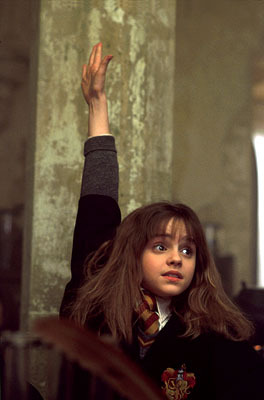
But, once the truant officer shows up (Hagrid the gamesman, played in all the films by Robbie Coltrane) and Harry gets his school supplies, he takes the train to Hogwarts where he meets his nearly constant companions for the rest of the series, Ron Weasley (Rupert Grint) and Hermione Granger (Emma Watson), as well as Professor Albus Dumbledore (Richard Harris), Professor Minerva McGonagall (Dame Maggie Smith), the suspect and suspicious Severus Snape (Alan Rickman, in the best performance of the series) who takes an instant dislike to Harry (for some reason...), and Ian Hart in the first of guest-starring profs who will appear and disappear. Lord Voldemort tries to make an in-road to the living at Hogwarts (why?), but is defeated by Harry. Lesson learned: There's a big world out there if it is not suppressed.

Columbus' film is loud, big and brash, with wall-to-wall music by John Williams (Williams never learned that there can be too MUCH music), but fills the screen with everyday magical effects—floating candles in the Dining Hall, passing phantoms, "alive" portraits, moving staircases—that other directors forgot or just didn't bother with.  The kids are great, but Radcliffe has the weirdest smile—like he's just learning to, which given Harry's past could be true. An amazing cast—something that would be true of all the films. A very good start.

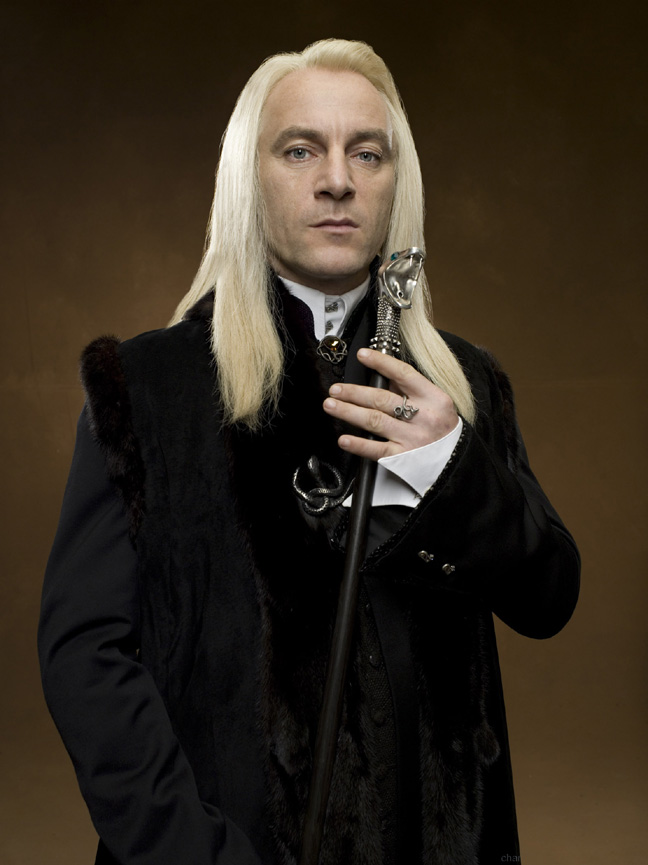
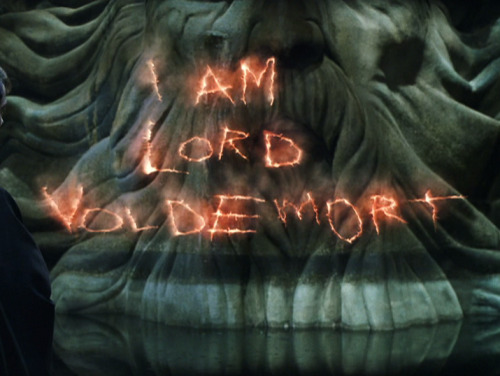
Harry Potter and the Chamber of Secrets (Chris Columbus, 2002) Year Two at Hogwarts. New Teacher: Gilderoy Lockhart (Kenneth Branagh)  Harry meets Dobby the House-Elf (voiced by Toby Jones), Lucius Malfoy (Jason Isaacs) and Ron's sister Ginny (Bonnie Wright), who is suspected of opening the dread Chamber of Secrets, releasing an evil that has killed students in the past. Several students including Hermione are "petrified" and it's up to Harry to save them. Turns out Ginny was possessed by the diary of one Tom Marvolo Riddle, which forced her to open the Chamber and release a basilisk—the evil causing all the damage. Harry confronts the spirit of Riddle, realizing that it is Voldemort's second recent attempt at killing Harry (why?), and nearly loses his life in the process. Lesson Two: Harry has a choice in the direction he can go in life.

If the books have a weakness, it is that Harry is born to be a wizard, and everything seems to come easy for him..until somebody actively tries to stop him. With this film, that "ease" already becomes a bit too familiar, and the action is ratcheted up a notch. The attacks on Harry start to affect his friends and he begins to take a more active role in protecting them, even at the risk of himself, although he's always had a penchant for breaking rules. Columbus would move on, taking a producer's credit, and handing the director's wand to an unlikely candidate.


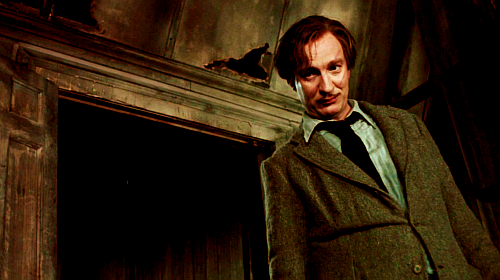
Harry Potter and the Prisoner of Azkaban (Alfonso Cuarón, 2004) Year Three at Hogwarts and the kids are already starting to look grown up. New teachers: Remus Lupin (David Thewlis) and Sybil Trelawney (Emma Thompson)...and Michael Gambon replaces the deceased Richard Harris as Dumbledore  Sirius Black (Gary Oldman), rumored to have betrayed Harry's parents to Voldemort, has escaped Azkaban Prison, and so the Ministry of Magic guards Hogwarts with the soul-eating Dementors—who have a crippling effect on Harry. Initially vowing to kill Black, Harry finds out that it wasn't Black—who turns out to be his godfather—but Peter Pettigrew (Timothy Spall) who gave the information to the Dark Lord. Lesson learned: Think before you act, and don't make hasty judgments based on rumor (and the best person to save you might be yourself).

It's immediately clear there's another director in charge. Cuarón, whose work includes Y Tu Mamá También and A Little Princess, makes short work of the Dursleys in the prologue, the film is a bit darker in tone and a manic quality exemplified by a literal "Magical Mystery Tour" is introduced. Cuaron speeds things up and fills them out, even more than Columbus did, with FX shots in nearly every frame.


Harry Potter and the Goblet of Fire (Mike Newell, 2005) Year Four at Hogwarts. The kids are getting scruffy looking.  New teacher: "Mad Eye" Moody (Brendan Gleeson), and lots of new characters, as Hogwarts is visited by two other wizarding schools for the Tri-wizard Tournament, a sort of magical Olympics. For "some" reason (and that usually involves Voldemort), Harry's name is added as a fourth participant in the games, relationships get frazzled during the Christmas Ball, and Voldemort (a very snaky Ralph Fiennes) returns from the dead. One character dies. And oh! Robert Pattinson's in this one. Lesson learned: Sacrifices must be made.

The films are getting considerably darker, tonally and image gradient and color-wise, taking on a denatured quality—in fact, from here on out, I wouldn't see any of these movies at a drive-in theater, as the two levels of murk would make things pretty much unwatchable. The appearance of Voldemort (and the casting of Ralph Fiennes in the role) is a definite highlight, but there is one significant death that affects Harry and makes for an extended grieving scene that doesn't work—for the mere fact that the character is only briefly introduced in the film. This will become an increasing problem for the series as more people die in ways that underplayed dramatically. It's a little mystifying.


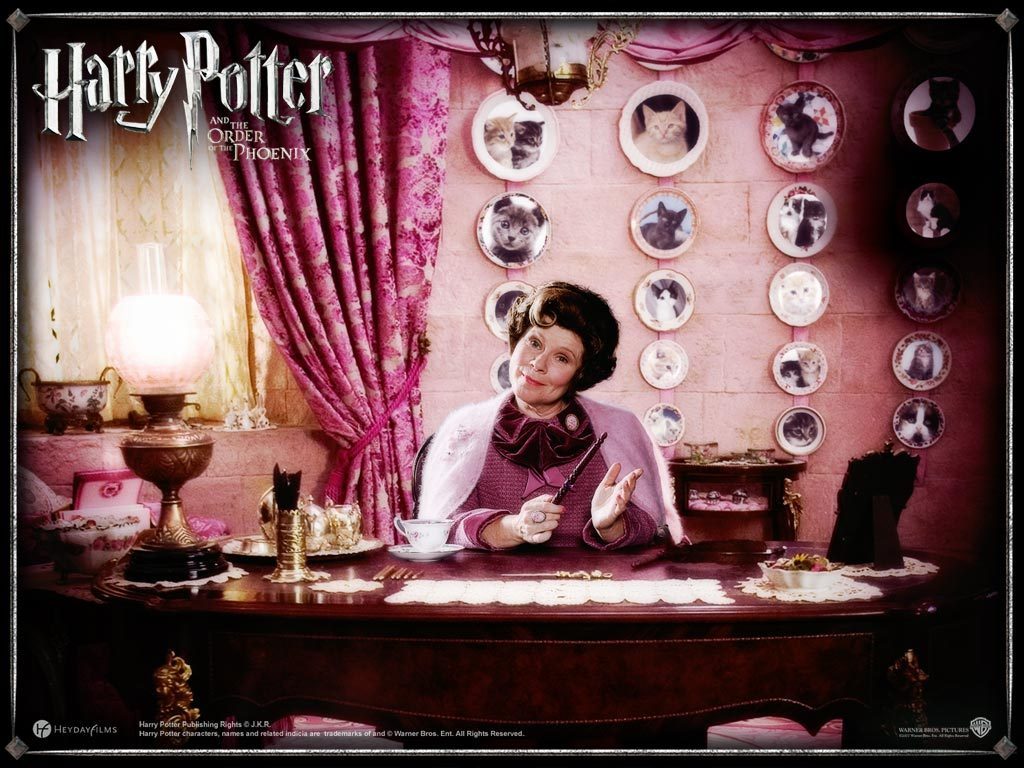
Harry Potter and the Order of the Phoenix (David Yates, 2007) Year Five at Hogwarts, and things get political. New teacher: Dolores Umbridge (Imelda Staunton). Nobody believes that Voldemort is back—especially the Press which begins a smear campaign against the young mage, and the Ministry of Magic appoints Umbredge to keep a watch on Dumbledore and Harry to make sure their "lies" don't get out of hand. In an effort to keep the "children" under control, the prim Ms. Umbredge refuses to teach practical magic and forbids its use. Things are turning decidedly fascist at Hogwarts, and so Harry and friends form a "study group"—"Dumbledore's Army"—to share spells and practice their skills. Lesson learned: a little revolt is good every now and again. 

Harry gets his first kiss (for the 'shippers), is haunted by nightmares connected to Voldemort, and given a spell to protect himself from Voldemort's influence, the learning of which leads to the knowledge that his father used to bully Snape. Big battle happens when Dumbledore's Army is captured by Voldemort's forces (including Bellatrix LeStrange, played in full crazy mode by Helena Bonham Carter—she's offset on the good side by Luna Lovegood, played spacily by Evanna Lynch), only to be rescued by Sirius, Remus and other members of The Order of the Phoenix.  Another of Harry's allies is killed, but...again...it barely registersIt's the first film in the series of David Yates, who would finish them off (so to speak), and although he gets good work out of the actors, visually, the film's a little dull...with the climactic death oddly not resonant.


Harry Potter and the Half-Blood Prince (David Yates, 2009) Year Six at Hogwarts. New teacher: Horace Slughorn (Jim Broadbent, and seeing how ubiquitous the actor is these days, it was only a matter of time). The sticky relationships get sorted out, and we learn about horcruxes—dastardly little things that contain a bit of Voldemort's soul for safe-keeping.  Destroy them all, and Voldemort becomes mortal and can be killed. We've seen a couple already, and Harry vows to take his last year of Hogwarts off to track down the remaining ones to dispense with Voldemort, once and for all. However...

Voldemort is also approaching his end-game, attempting to find a way into Hogwarts and dispense with the one thing standing between himself and Harry.  Lesson learned: Death is inevitable, no matter how powerful, no matter how close, no matter how needed.


Harry Potter and the Deathly Hallows Part 1 (David Yates, 2010) Year Seven at Hogwarts, interrupted when The Three drop out and go on the run to protect Harry and find those pesky little horcruxes. The decision to split Deathly Hallows into two films seems unnecessary, given how little really happens in this film: the Three take a look at the situation—Voldemort controls the Ministry of Magic and is even making his influence known in the Muggle World (something that just isn't done), their most powerful allies are dead, and even the Safe Harbour of Hogwarts is vulnerable. They are given three bequests (which will come in handy) and run from Voldemort and his forces, which even includes Professor Severus Snape, now in charge at Hogwarts. The Three are in charge of things that mess up their heads (not unlike the Ring in the Lord of the Rings trilogy) and those ramifications are explored in Part 1—a final test of loyalty before The Big Battle. Will they hold it together as a team, or be splintered apart (Well, what do you think?) Meanwhile, Voldemort finds the wand he needs to accomplish his final goal—killing Harry Potter.


Harry Potter and the Deathly Hallows Part 2 (David Yates, 2011) Given how Part 1 is one big set-up and the most lethargic and disappointing of the films, the series had nowhere to go but up for a Final Blowout.  And it delivers. Everybody still alive makes a cameo (except for Fudge played by Robert Hardy, and Julie Christie and Kenneth Branagh), and even some of the ones who died get some screen-time. Everything is explained, no magic stones left unlevitated, and no wands kept in their holsters. After a brief moment to catch breaths—the film doesn't even start with the Warner Brothers logo, but just begins where the last one left off, —the Three go undercover in a nice, dizzying episode, and end up back where it all began—Hogwarts—to make a last stand. Lesson learned: Love and family make the difference in a life, power is a worthless goal, and Sacrifice is the measure of a man. I could only smile at the final sentiment of one of the returning dead in agreement "You wonderful boy. You brave, brave man." And thus endeth the Labours and Education of Harry James Potter. Life goes on.


So...now what? Well, it was a good first attempt. As one of my fellow bloggers mentioned, there's enough material in the books that was left unused that the Potter Saga could easily be turned into an "Upstairs/Downstairs" British mini-series to flesh things out and solve the pacing/emotions problems of the films (but can you imagine the cost of such a thing?). 

But, this will do. There will be a couple films that one can skip over—there's actually a nice bridge between 3 and 7.2—but for now this will do. Give the snitches and broomsticks a rest.

Nox.
The Crest of Hogwarts.  The inscription: "Never tickle a sleeping dragon."

Thursday, September 3, 2015

Fantastic 4

"It's CLOBBERIN' Time!"
or 
"This Movie!...This Monster!"

The latest Marvel superhero movie to come out is the third attempt to make a viable tent-pole of one of the comics line's most venerable titles—the first to be published by Marvel, The Fantastic Four. Four friends who, on a space mission, are turned into super-heroes by a bombardment of radiation, the four—"Mr. Fantastic" (Reed Richards), who can stretch, "The Invisible Woman" (Sue Storm) who can turn invisible, "The Human Torch" (Sue's brother Johnny), who turns into a flying human fire-ball, and "The Thing" (Ben Grimm), who is turned into a super-strong rock-like bi-ped. Together, "they fight crime" (as the cliche goes), but for this relatively human team, the challenges were more cosmic and more mind-bending as they had to contend with threats from other galaxies and other dimensions (drawn from the seemingly endless imaginative ink-well of Jack "The King" Kirby), while, at the same time, serving up the mandatory Marvel "soap opera" quotient with Reed and Sue's love story, Johnny's hipster hot-head, and Grimm's impenetrable angst over being an unlovable freak. With its combination of mind-blowing themes and (*choke*) tear-duct-blowing melodrama, it became a big hit with teens and the college-crowd.
Reed, Sue, Johnny and Ben as rendered by Jack Kirby
It was self-trumpeted (a bit prematurely on the cover of issue #4) as "The World's Greatest Comic Magazine!" but the appeal of the FF couldn't be denied. Attempts were made in 1994 (under the producing of Roger Corman and is the ONLY film in his low-budget exploitation career that was NEVER released) and revived again in 2005 (with Jessica Alba, Michael Chiklis and a flaming Chris Evans, as well as the guy who got crushed by a container on the Golden Gate Bridge in San Andreas) in two films (Fantastic Four and Fantastic Four: Rise of the Silver Surfer) that were a bit premature in the new wave of CGI mounted comic-book films. Those two FF movies are consigned to "The Zero Zone," along with Ben Affleck's Daredevil movie.

The 90's FF (Hyde-White, Staab, Underwood and Smith) and the 00's FF (Alba, Gruffud, Evans and Chiklis)


But, it seems there must be a "Fantastic Four" movie attempted every decade from now on. The latest, Fantastic 4, is no improvement on the others. The cast is younger, more diverse (despite fan-boy grumbling—the most conservative of critics), the effects improved, and an attempt has been made to update the story and make it more hi-tech for the 21st century. That it ultimately fails leads one to question if it's one of those properties that just doesn't work in any other medium than the four-color comic. Or it makes one question if any other studio than one working in tandem with Marvel can produce anything decent. The director of this one, Josh Trank (who made the interesting Chronicle) has gone public, grousing that studio interference messed up his vision of Lee and Kirby's vision.
The origin story does need some updating, however, now that we're out of the 1960's of the Four's re-birth and into the 21st century. Instead of doing some experimental space-travel, the four and their co-worker Victor Von Doom (an eye-rolling name that, if anything needed to be changed, should have been a priority), instead, are exploring matter transference—a working "transporter" being a dream project of Richards' (in this case, Miles Teller) since he was a boy. At a science fair where he demonstrates a break-through, he's invited by Dr. Franklin Storm (Reg E. Cathey, in a performance that is quite...well, "restrained" would be a nice way of putting it) to join a team involving his son Johnny (Michael B. Jordan), adopted daughter Sue (Kate Mara), and banished upstart Von Doom (Toby Kebbel) to see the project through to completion. But before a NASA administrator (Tim Blake Nelson) can start trials, Reed, Johnny, Victor and Reed's boy-hood chum Ben Grimm (Jamie Bell—remember him as Tintin in Steven Spielberg's film?  Of course you don't—you won't remember him in this, either, as his part is mostly motion-capture) who's there for some inexplicable reason, decide they're going to test it on themselves first. The mission does not go well, affecting the travelers in variant and horrific ways—it also alters Sue Storm, who is left back at the control room for some reason, but suffers the consequences, anyway.
Sue, Johnny, Dr. Storm and "Vic" von Doom.
Von Doom is left on the "Zero Planet" (as it's called), while Reed's body is turned malleable, Johnny erupts in flames, Sue turns invisible, and Ben is changed into a rock-like monster. It is horrific for all, but the NASA suits see them as an opportunity for weaponization (after some experimentation), but Reed slithers out of his shackles and escapes the complex they're being held in against their will, vowing he will free the others and turn them back to normal. For those left behind, Reed is simply a turncoat and to the government he's a threat. This takes a good hour to set up and less than that to resolve, including a return to the Hell-Planet, where the four confront Von Doom who is constructing one of those Marvel movie things that throw off an energy stream that shoots up into the sky, but you have no idea why.*
A lot of it looks good—there's a subdued color palette and a tendency to dimly light things that give it the look of a good old fashioned horror movie, which when you have people disappearing, disfigured and on fire isn't much of a stretch (hey, I just described everybody's powers in one sentence!). But, there is an awful lot wrong with it. One could nit-pick over dialogue and acting and failures in logic and potential throughout this movie. But, simply put, there are four key errors in this Fantastic 4 that makes it unique among bad super-hero movies.
1.  Consider the Source: The Fantastic 4 are superheroes at their most puerile, designed to impose a family structure on disaffected little boys. They are instantly recognizable as Mom and Dad (Reed and Sue) and the bickering kids (Ben and Johnny). Whatever conflicts they go through (and they go through a lot internally and externally), the family dynamic pulls them through. That's one thing that's consistent about the Fantastic Four and part of its basic DNA. In this film, however, "family" is given lip service. The group is quarantined after the accident and restrained by the NASA industrialists and the four turn into factions—Johnny and Sue against Ben and everybody against Reed, "the turncoat," who has escaped and seemingly abandoned the other three. Nobody trusts anybody and its every man and woman for themselves until Dr. Doom (Bwa-ha-HA!) serves as an over-arching threat that unites them. Up until the last few minutes of the film, they're not even a team at all and are actually pissed at each other. This is so fundamentally opposed to the appeal of the original concept, it may be the biggest mistake of the film. If you're going to make a superhero film about a creation that's 55 years old, at least realize what it is that's made it last so long.
2. Did You Know That You're My Hero?: That's the thing about super-heroes. They are us but better. Smarter, faster, stronger, and certainly more altruistic to the point where the whole genre might be considered science-fiction, given the proclivities of the populace. They train themselves to make use of their gifts in the service of others, and if something should befall them—a spider-bite, a lightning strike, or a birthright—they seek its use for the betterment of their neighbors. Sure, the Fantastic Four may have turned into embodiments of the four elements: Earth, Air, Fire and..Rubber, but rather than grieving, drinking and saying "how do I fix this?" they use their new handicaps, and in that very tendency they are heroes. That's not what you get here. You don't get heroes, you get victims. The explosion of the transporter makes everybody helpless and easy prey for the militarists hoping to exploit the four by "helping" them. And Reed is so beset by guilt, he wants to "fix it."** So he runs away to become a super-genius Ted Kaczynski in the woods. The victimization of the Fantastic Four here aligns them with most of the other Marvel heroes—and not just the Marvels, but others of the sub-genus—making the origins part and parcel of the cause they fight for. But that was never the Fantastic Four in the comics. There was not too much brooding to be done over their conditions (except for Ben), not when there were whatzit's to invent and cosmic crises to insert themselves into. The 4, for the most part, accepted what happened and moved on, making the most of the situation.  It would be nice to see more of that.
3. Sometimes Origin Stories Don't Matter: The origin of The Fantastic Four is completely unremarkable and gives no purpose to their being—an accident that changes them and inspires them to make lemonade out of lemons. In the comics, they are all gifted in some way (even Ben Grimm is a test-pilot, which is why he's on board the doomed space-ship) and their instincts are to use those gifts for some greater purpose. That origin does not make a mission—to find the person responsible, to prevent the same thing from happening to others or such. And yet the "How-They-Came-To-Be" story is trotted out like that's the thing to do. Unfortunately, that story (which provides no "hook" to a franchise) takes up more than half the movie, time that could have been better spent on anything else. Like story or character or "Something Big." It would have been far better to start in media res—assume the group simply is and concentrate on something world-shaking that they have to overcome. As it is, the movie is extraordinarily lop-sided, the majority of it being Origin Story followed by 15 Minutes of Action, and rather negligible action at that. Really, all they do at the end is beat Dr. Doom up and turn his "Whatever-It-Is" against him. If you're going to make a superhero movie...
4. Make it ABOUT Something, Damn It!:  There isn't much of a story here besides the origin, a quick confrontation with the motivation-less villain, and then the movie ends without the group having a purpose...merely a headquarters. Maybe that's to make the whole thing seem more in line with The Avengers, but that group has a goal before they decide to move in together, and without that there is certainly no triumph to the ending, merely a mortgage. There is no reason for the team to exist. They beat up Dr. Doom and that's it. What's the point to continuing the series—to find a cure for the mutations, to perfect the errant experiment that caused them, to block it from happening again (as it appears to be a bad place), to establish a support group for Zero Planet victims—what's the job? Hopefully, that HQ has a meeting room with a white-board or something so they can figure it out before the next movie (despite the poor box-office, Fox is already talking one up...for now).

In the end, it's all false advertising—it's not the comics and only resembles it in name and powers—and right down to the name: Not so fantastic.  And if you're into rating movies, only 1 out of 4. 
Reed Richards can make himself look like anything with that stretch-power.
So why does he choose to look so dumpy?

* Marvel Comics was always soft on science—there always seemed to be a scene where the four were looking up at some huge cosmic something-or-other with dialogue that summarized "I don't know what it is, but it sure is BIG!" 

The Marvel movie equivalent seems to be "I don't know what it does, but it sure spits out a lot of sparks!"
"I don't know what it is, but it sure is BIG!"
** Reed does want to help Ben Grimm in the comics, as that character is his friend and the most traumatized by the "accident." Everybody else is fine with their powers and set about how to use them and improving them.