"Gertrude Stein Punched Me in the Mouth" or "L'époque est toujours plus belle de l'autre côté du pont Einstein-Rosen"
I first came to Chicago in the twenties, and that was to see a fight. Ernest Hemingway was with me and we both stayed at Jack Dempsey's training camp. Hemingway had just finished two short stories about prize fighting, and while Gertrude Stein and I both thought they were decent, we agreed they still needed much work. I kidded Hemingway about his forthcoming novel and we laughed a lot and had fun and then we put on some boxing gloves and he broke my nose.
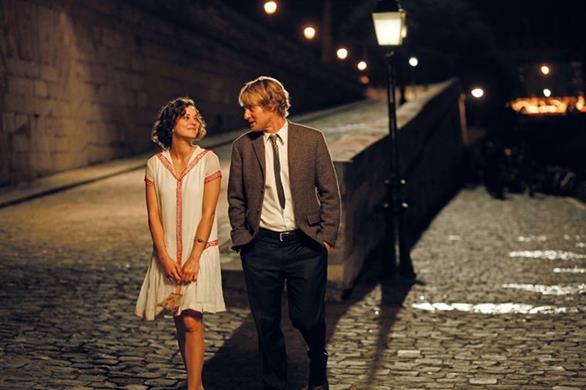
Based on a routine from his stand-up days,*which he later expanded for a piece in "The New Yorker" (see above),Midnight in Parisfollows Gil (Owen Wilson) a self-absorbed, neurotically anxious writer of Hollywood fluff ("Wonderful, but forgettable...sounds like something I wrote"), who is obsessed with death,**as he travels to Paris from Pasadena with fiancee Inez (Rachel McAdams, but it could just as well have been Elizabeth Banks) and her conservative family. Gil is working on a novel, long in the gestation, and is distracted by the vapid shallowness that he is about to marry into. Paris is shops, restaurants, museums and snootiness, and to escape the jejeune de vivre, he takes a late-night walk through the streets of Paris and is approached by a vintage taxi.
Entering the cab for Gil is a magical moment for him, on the same plane-breaking as when Tom Baxter (or is it Gil Shepherd) walks off the screen in The Purple Rose of Cairo. He is instantly transported to 1920's Paris and becomes lost in "The Lost Generation" (without the benefit of having survived World War I), meeting Cole Porter (Yves Heck), Ernest Hemingway (Corey Stoll), Zelda (Alison Pill) and Scott Fitzgerald (Tom Hiddleston), all the heroes of his favorite literary era and time, the 1920's. He's enchanted...and as his novel is about that period of time...inspired. He goes back to Inez, gob-smacked, unable to explain where he's been all night, but "alibi's" his adventures as a dream (as they are, certainly in the aspirational sense). He tries to bring Inez to the party, but the magic doesn't work—she's as unthrilled with Gil's stories as he is with her wine-tasting adventures with acquaintance Paul (Michael Sheen).
So, the two planes of existence for Gil are set up: his modern-day drudgery on the cusp of a marriage of inconvenience; and his fantasy past, where his dreams are reality and reality can make dreams. You know where this is going.
It doesn't matter, though. This is a "feel-good" Woody Allen picture—the kind people like—where the messages are still telegraphed the way they are in "obvious" Allen movies, the coincidences just a little too convenient, but so full of incident, grace and nuance (and quite a bit of humor) that it goes down well (as Allen groused throughout Stardust Memories, audiences "like his earlier, funnier [movies]"). That Gil is such a sunny presence in the past (and as played by Wilson, he has a guileless charm that doesn't sacrifice intelligence—he's the way you'd imagine Jimmy Stewart would play Woody Allen), even his kvetching is charming and not harsh. It doesn't matter that you be a history buff and "get" all the references,***(and we meet Luis Bunuel, Man Ray, Salvadore Dali [Adrien Brody], and on a side-trip, Toulouse Lautrec, Gaugin and Degas).
Of course, Gil is enchanted; he is an era when his heroes are still at the stage he is, becoming themselves, with their best work still ahead of them. His age of magic is their everyday life. The interesting lesson of the film (and what makes it special and wise) is that the knife cuts both ways. The "lesson" is both sour and sweet, but not hope-crushing—a little bit of salt in the creamy fluff.
And no, nobody punches Gil in the nose—but you can't help noticing that Wilson's is a little broken.
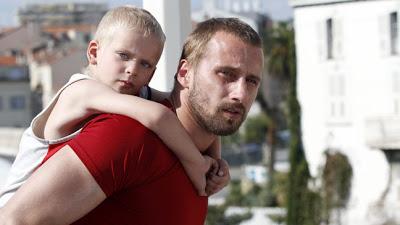
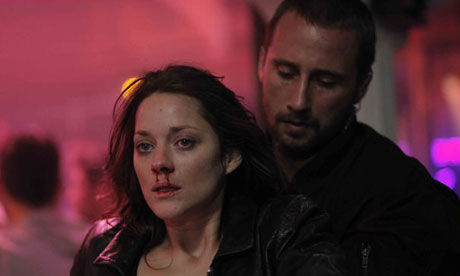
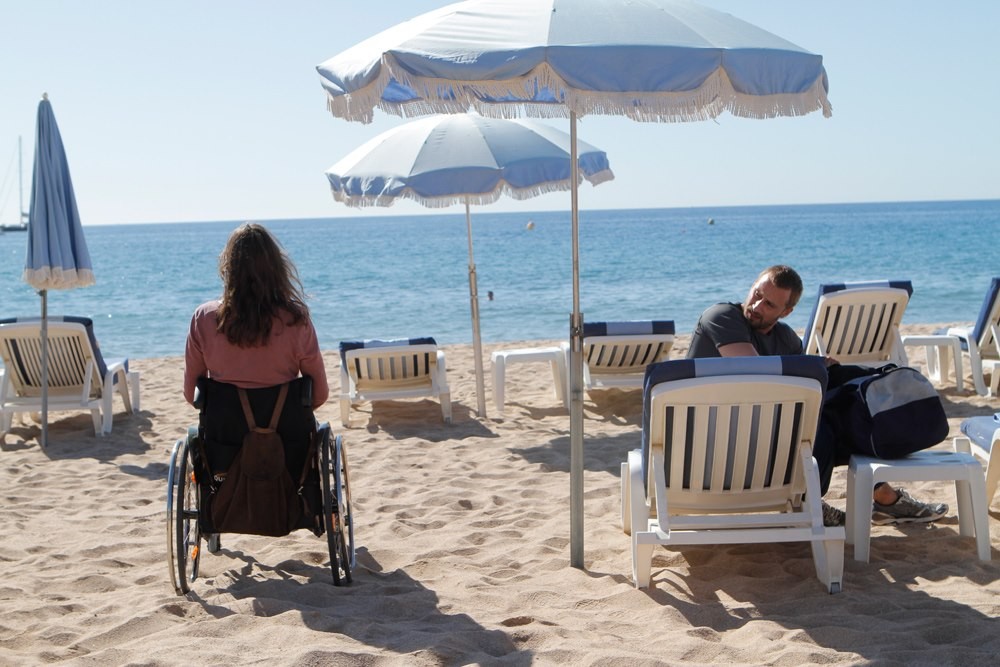
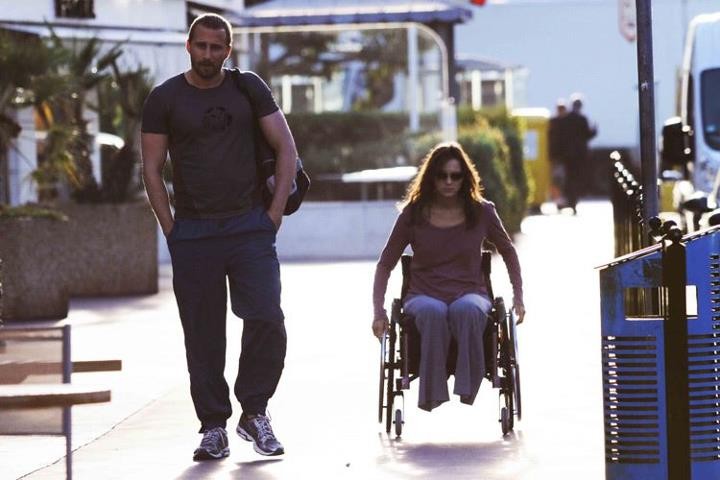
Jacques Audiard's new filmDe Rouille et le D'os(Rust and Bone, in English) is as far afield from his last film, The Prophet, as could be. That film was a mini-Godfather, that showed the traps a criminal puts himself into, whether he's in prison or the King of the Hill. Rust and Bone, though, is a love story about the transitory nature of selfishness and the numbing vacuousness of complacency, which sounds like it'd be a a dull film, or a pedantic English theme. Combine it, though, with kick-boxing and killer whales chewing your legs off, and it becomes a different animal altogether.
She's a performer with a local Marineland park, directing killer whales through stunts and tricks, before a live audience. Everything is going well during one performance when an accident happens and, as a result, Stéphanie loses both legs below the knees. Submerged in depression, contemplating suicide, she calls Ali for help (it would be another of his string of odd jobs to earn money), where he starts to help her with therapy, specifically carrying her down to the wheelchair-inaccessible beach, so she can swim.
Ali is so deeply rooted in his own needs, that almost by osmosis, Stéphanie begins to care more about herself, and stops living in the past. The sex between them helps. But Ali is entirely self-absorbed and wants to keep things casual. For further money, he starts participating in paid street-fight competitions, while Stéphanie takes the plunge and decides that she'll invest in artificial limbs and learn to walk again.
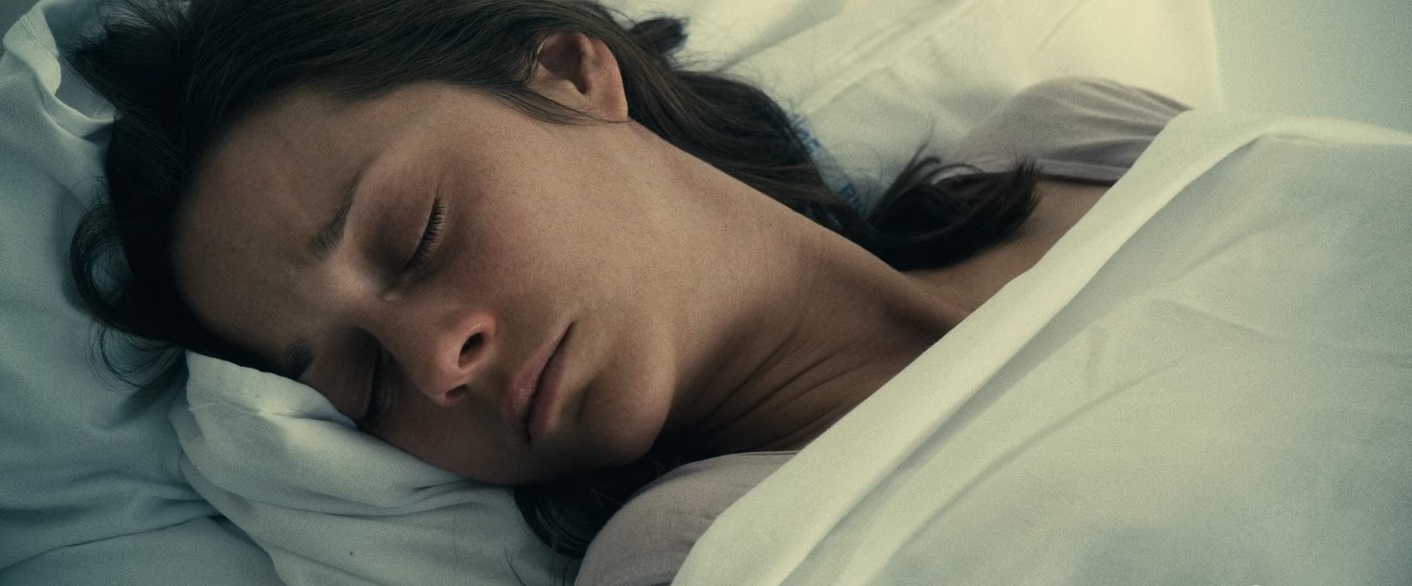
It's such a lop-sided story of co-dependency that it may seem like a frustrating film, but the performances of the two leads, Cotillard and Schoenaerts, go a long way in keeping interest. Cotillard, in particular, seems to be oozing this performance out of some deep, dark place in her core (either that or she didn't sleep for a week) that is painful but fascinating to watch, while Schoenaerts is such a non-expressive performer, you might think that he is so completely internalized that he just walked off the street.
And it's the performances that balance this film out, making the paths the actors take even necessary to sell the circumstances when the movie veers into melodrama, making an emotional course correction to get to an ending that...well, might have a point, even if a conventional one.
Meanwhile, Audiard does some impressive work with merely images, as the character of Ali is somewhat uncommunicative, and subtle shadows over people's faces suggest a shift in attitude between them. And the whole Marineland sequences are like a sensory-overload nightmare—music constantly blaring, a robotic response-non-response from the performers to the audience, the pure, dumb folly of it all is quite an amazing sequence of textures and tones that provide a great deal of foreshadowing, even though you don't know what's coming—you just know that the place is on the knife-edge of panic and chaos.
So, an interesting film once it gets started, but then suffers a shift-tone that leads to some mighty convenient changes of heart, and makes Rust and Bone get all gooey inside, without (thank God) anthropomorphizing the whales.
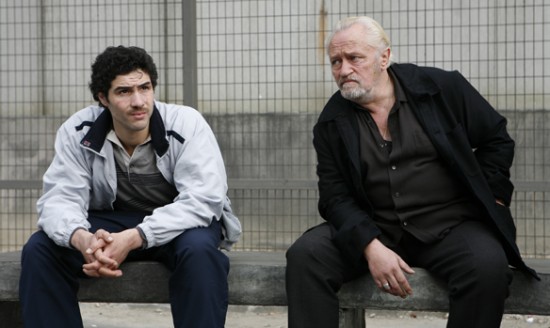
19 year old Malik El Djebena (Tahar Rahim) is arrested and put in prison for beating up a cop. Under-educated and street-dumb, he's easy prey in the French prison system. And Arab-Corsican, he's an outsider in a cell-block population made up of Corsican partisans and Muslim detainees—well, that's what they say, anyway. Malik can only be a "lone wolf" for so long, and soon the Corsicans bring them under their protection—for a price.
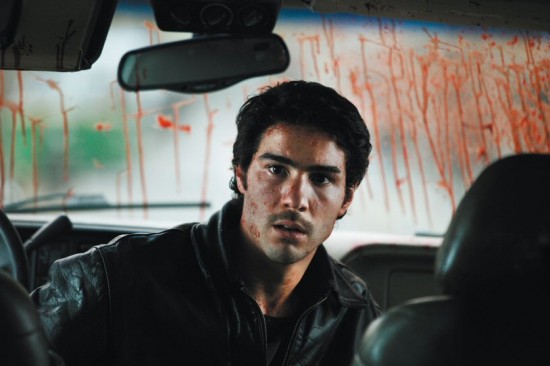
He has to "make his bones" first; he must kill a "just-passing-through" star witness in a racketeering trial against the Corsicans. Once accomplished, done in as grisly a fashion possible ("He's going to bleed a lot, so watch your shoes" is the advice), two things happen: he becomes "the porter" for the leader of the Corsicans, César Luciani (Niels Arestrup) and given certain privileges for his status—the guard system is friendly to the Corsicans; and his victim keeps showing up in his cell in spirit form, initially haunting him. Both connections are very useful in his education.
There's been a lot of mushy verbiage rasped about this film being a French
"Godfather," and there are some surface similarities. But A Prophet owes more to Kurosawa and Shakespeare (aren't the two related?) than to Coppola and Puzo. Sure, it's about a young man's education rising in the ranks of a blood organization, but there the similarities end.
Malik is not born into his "Family," coming from privilege—far from it. He's an outsider, and will stay an outsider (despite very loyal attachments) throughout the entire movie. He's a zephyr, moving between the Corsican and Muslim worlds, a part but apart, just as he becomes a citizen of both the prison and outside worlds once his good behavior buys him some time as a half-way. The connections he makes in prison are the important ones, and he soon finds himself, through a combination of luck, guile and networking the head of a cocaine smuggling ring—while still in prison.
Stylistically, the film is night and day from The Godfather, despite that they both open in darkness. But where Coppola's style is formal and staged, director Jacques Audiard is up-close and hand-held, moving constantly and delving into the surreal with slow motion, and dream sequences (and the occasional pin-hole camera shot). Audiard is also adept at shooting violence, building tension, and then letting loose with gritty sequences that not only get the heart racing, but also make you worry about the protagonist—it's never easy to kill someone, despite what the movies say. There's one bizarre shot of Malik on the floor of a car in the middle of a fire-fight—a fire-fight inside the car, mind you—where he watches in slowest of motions as bullets hit the console around him, never touching him. But be that as it may, one should be mindful of the throat-slashings, the puncture wounds, kitchen utensils under the eyeballs, and the near-occasion of vehicular assault on deer. Not for the squeamish...or the vegan.
Sean Pennsaid the decision to give"Entre Les Murs"(aka "The Class," 2008) the Palme D'or at the Cannes Film Festival was "unanimous."
You can see why.
Based on François Bégaudeau's semi-autobiographical novel, and starring Bégaudeau as the French teacher Mr. Marin, the film perfectly captures the yin and yang, the give/pull-back/resistance that makes up the dynamic of a school class. This is an inner-city Parisian school andthe class is made up of many races, many ethnicities and cultures, and strata of society. The teachers are mostly white and come from various backgrounds. The class' mood is contentious. Marin's is challenging and the sides clash many times inside and out of the too-small classroom where kids consider formal French a dead language.
Marin tries to bring them out, to make them see individual self-worth in encouragement while at the same time suppressing each unique form of acting out. That dynamic is reflected in the attitudes of all the other teachers influencing and interacting with the students. In the meantime there are the bumps in the road of the day-to-day, the small victories and big defeats, the squeaky wheels and the dependable ones and the ones who get lost in the shuffle through simple neglect. Any teacher who's had to write a syllabus knows these heart-aches—whose felt a career highlight when seeing the light of understanding dawn in a student's eyes, or seen the student you assumed was promising fail miserably. Casting Bégaudeau in his own movie was a gutsy move, but so was creating an acting class from which director Laurent Cantet cast his non-professional school-house of natural performers, who seem to be caught in the act of "being" by Cantet's camera, rather than performing a screenplay
It's a brave, unique movie that looks like it was filmed on-the-spot and made up as they went-along, and delivers a close approximation of standing before a hostile audience and wrestling with their resistance to the new.
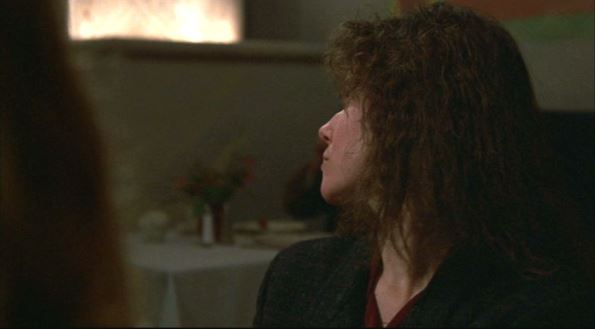
At the time it came out, I was rather mystified as to why it was chosen as "Classic" (even though Allen won the Oscar for Best Original Screenplay for it). It's a lunch conversation between three sisters in different stages of life and success. The younger ones resentful of the older one—who seems to have her act together, enough that it seems to be in stasis. The youngest hasn't "settled" yet, still trying to decide what she's going to become (which, recently, entails being her older sister's husband's mistress) and the middle child is bouncing between ambitions and moods, none of which seems to stick.
It's a classic triangulation with a hidden sub-text that informs opinions and reactions. What I found revealing is in the sub-text, something left out of the magazine article.
The "Premiere" transcript just put in the dialog, but a perusal of the Woody Allen script shows that the author puts in the smallest of details about locations, logistics, camera moves, and inner thoughts of characters. Things are so worked out in the script that the only thing that the director needs to do on-set is figure out where to put the camera.
And this is where the scene is very special. Photographing people talking around a table has always been a sticky problem in movies, especially when the table is a round table; given how these things work, somebody is always going to be out-of-frame of the screen, their face obscured either by being faced away from the camera or blocked by one of the other participants. Also, there is nothing dynamic about people sitting around a table, talking. One last consideration: the scene is all about sub-text, so if you're concentrating on the people speaking, you're missing the reactions of the non-talker...which is important.
Director Allen and his cinematographer Carlo Di Palma (famed for working with Michelangelo Antonioni) solved the problem with a constantly shifting camera circling the table and the actors, with the only dependency being the natural rhythms of the actors while doing the scene. They can talk, hector, interrupt, step on each others' lines, and its up to the camera operators to catch those moments at any time during the circling. They're certain to be within a 120° arc of what is happening.
The agitated conversation has its own energy, and the camera movement reflects that, but also adds to it by concentrating on the high-points and high emotions being generated.
It really is a classic scene.
The Set-Up: As they say "It's Complicated." Hannah (Mia Farrow) has two sisters, Holly (Dianne Wiest, who won an Academy Award for this role) and Lee (Barbara Hershey). Hannah is married to Elliott (Michael Caine, who won an Academy award for his role), but Elliott is carrying on an affair with Lee. Hannah does not know this. Holly is an aspiring actress who isn't involved with anyone because she is a neurotic in a profession where constant rejection only enhances her own insecurities. Got it? Good. Let's have lunch.
Action.
EXT. NEW YORK CITY STREET - DAY
Lee is walking down the street, looking around her. The
sidewalk is fairly crowded with people; the sounds of traffic
are heard. She passes some office buildings, a store's large
display window; she stops when she sees Hannah.
Her sister is waiting outside the Art Deco faade of a
restaurant; she's looking in the opposite direction. Lee
taps Hannah on the shoulder;
Hannah, surprised, turns and
gasps.
LEE
(overlapping Hannah's
gasp)
Hi.
The sisters laugh and embrace each other.
HANNAH
Hi. Where's Holly?
LEE
(overlapping)
Hi. She's auditioning for a
television commercial. She said
she's gonna be a little late.
HANNAH
(sighing)
Oh, yeah? How's she doing?
She turns and walks towards the restaurant entrance.
LEE
(following Hannah
through the
restaurant's doors)
Oh, God, you know Holly. When she's
depressed, she's manic.
(MORE)
LEE (CONT'D)
I think it was a good idea that we
invited her to lunch.
They disappear inside. The camera follows them, cutting to
the restaurant's interior at the same time the sisters walk
in. It's a chic, trendy place, with an Art Deco design and
high ceilings. A waiter in uniform stands near its glass
and metal doors, holding a tray to his chest; a few people
sit at the bar; a large plant in a vase sits in the
foreground. The sisters walk toward the coatcheck area,
deep in conversation.
HANNAH
(pulling off her scarf,
still on the subject
of Holly)
I hope you tell her it was your
idea...
LEE
Why?
HANNAH
(overlapping)
...'cause every time I try to be
helpful, you know, sh-she gets so
defensive.
LEE
(unbuttoning her coat)
Oh, Hannah, she's-she's just
embarrassed in front of you, that's
all.
Hannah walks offscreen, farther into the coatcheck room.
She talks offscreen as Lee alone is seen, reacting and
speaking as well. In the background, a waiter crosses over
to the bar, then walks away.
HANNAH
(offscreen)
So how are you?
LEE
Oh, me, I'm okay.
HANNAH
(offscreen)
Do you miss Frederick?
LEE No.
HANNAH
(offscreen)
I can't believe Elliot and I can't
think of someone nice for you to go
out with, you know--
LEE
(interrupting, her
voice slightly higher-
pitched as she takes
off her coat)
How are you? HANNAH
(offscreen)
I'm okay.
LEE
(overlapping)
You know, how's everything? You
doing okay? How's Frederick?
(laughing)
I mean, Elliot.(You know how it is).
HANNAH
(offscreen, overlapping)
Y-yeah.
Hannah walks out of the coatcheck room without her coat;
it's Lee's turn to disappear and check her things. Now only
Hannah can be seen onscreen as the sisters talk. In the
background, the waiter once again walks over to the bar.
HANNAH
(continuing)
Oh, he's fine. He's-he's, I guess
he's fine. I don't know.
HANNAH(shaking her head,
her arms crossed)
He's been kinda moody lately, the
last few months.
LEE
(offscreen, overlapping)
Really?
HANNAH
Yeah. I-I don't know what's wrong
with him. He's just...kind of distant
and difficult.
LEE
(offscreen)
Oh...
HANNAH
(overlapping, gesturing)
I've been trying to talk to him about
it. He says everything's fine, but
I don't know. Automatically, you
know, I leap to the worst conclusions.
LEE
(offscreen)
Like what?
As Hannah answers her sister, Holly can be seen entering the
restaurant and walking over to the coatcheck area, an unlit
cigarette in her mouth, her sunglasses still on her eyes.
HANNAH
(gesturing)
I mean, I don't know, he's seeing
someone else or something, but...
LEE
(walking back onscreen
without her coat,
reacting)
Oh, no! I mean, everyone thinks
things like that.
Hannah mumbles indistinctly as Holly walks over to her
sisters.
HANNAH
(turning, to Holly)
Hey, hi!
HOLLY
(overlapping)
Well, I just came from an audition...
LEE
(overlapping, leaning
against the coatcheck
wall)
Hi.
HOLLY
(continuing)
...which I did not get.
HANNAH
(reacting)
Awwww...
HOLLY
(overlapping, sighing)
So what's new?
(She takes off her
gloves and scarf,
stuffing them in her
bag)
HANNAH
(helping Holly with
her coat)
Boy--
HOLLY
(interrupting)
They said I was too offbeat looking,
whatever the hell that means.
HANNAH
Oh, what do they know?
Holly gives her coat to the coatcheck person.
HOLLY
(to the checker)
Thanks.
HOLLY
(turning to her sisters)
But guess who was there auditioning?
LEE
April?
The hostess appears, peeking around the corner of the
coatcheck area. She signals for the three sisters to follow
her.
HANNAH
(reacting to Holly's
news)
Oh, gosh.
HOLLY
You got it.
Holly takes off her sunglasses; her cigarette still dangles
from her mouth.
Hannah murmurs her sympathy as the trio
follows the hostess into the dining room.
HOLLY
(gesturing)
I was very polite. I maintained my
poise.
HOLLY(taking out a match
for her cigarette)
I said hello.
159.
The sisters walk to their seats, at a round table in the
middle of the room; the hostess puts down their menus.
LEE
Hmm. I never trusted April, you
know. She has eyes in the back of
her head.
They sit down. The hostess leaves. Other diners are seen
in the background; a waiter is taking the order of a couple
sitting on a banquette; other waiters clear off a table.
Diners walk in and out. A low murmur of conversation, as
well as the faint clatter of dishes, is heard.
The camera
moves closer to the three sisters, circling the table as
Holly speaks.
HOLLY
Yeah, well, she and an architect are
now a very definite item, which I
still cannot believe.
LEE
(overlapping)
Hmm.
HANNAH
Oh, God...
HOLLY
(nodding her head,
holding her cigarette)
Yeah, although it's put an end to
the Stanislavski Catering Company.
HOLLY
Which is why I have to speak to you.
And...
HOLLY(gesturing to Hannah)
you're gonna get impatient, but...I
have to borrow some more money.
HOLLY
(putting her cigarette
in her mouth and
picking up the matches)
HANNAH
(shaking her head)
Well, that...th-that's fine.
HOLLY
(gesturing, her
cigarette in one
hand, her matches in
the other)
But what I decided to do is some
writing. (MORE)
HOLLY (CONT'D)
Yeah, I think I've had it with acting.
You know, these meaningless auditions
at cattle calls. And I can't handle
another rejection.
HOLLY (emotionally)
Now let's face it here. I gotta,
you know, latch on to something in
my life. You know--something with a
future. I'm not sixteen anymore.
HOLLY (lighting her cigarette)
It's just...crazy!
HOLLY (puffing her cigarette)
I've got...an idea for a story.
More than one.
HOLLY And I just need a
few months, you know, or, uh, a year
even.
As the camera slowly circles the table, Hannah is seen
listening to Holly, her hand on her mouth.
HOLLY
I've picked up a lot about dramatic
structure from doing my scenes in
acting class.
Lee, her hand on her mouth, glances briefly at Hannah. As
Hannah replies to Holly, the camera focuses on Lee's face.
She bites her nails; she looks down, involved in her own
thoughts.
HANNAH
(offscreen)
Well, that-that's good.
HANNAH It just,
uh...it just seems to me that-that
six months or a year, if-if you spent
it more productively...
HOLLY
(offscreen, the camera
still focused on Lee)
Well-well, like what?
Lee looks up, her hand still on her mouth, watching Hannah,
as the camera slowly moves off her to show Hannah.
HANNAH
Well, I don't know. We'd uh, uh,
um... Didn't Mom mention there was
something...something at the Museum
of Broadcasting?
HOLLY
(offscreen)
Yeah, that's clerical.
HANNAH
No. She, didn't she say it was,
um...
HANNAH ...she said it was in the publicity
department. That-that can lead to
other things.
The camera is back on Lee. She looks around tensely, barely
listening to the conversation. She fidgets. An empty table
sits in the background.
HOLLY
(offscreen)
Boy, I knew you'd be discouraging.
HANNAH
(offscreen)
I'm not! I'm not! I'm trying to be
helpful.
HANNAH A person doesn't just say
one day, "Okay, now-now I'm finished
as an actress. Now I'm a writer."
I mean--
HOLLY
(offscreen,
interrupting)
Yeah, you mean not at my age.
LEE
(shaking her head,
unable to take much
more)
Oh, please! We all came to have
lunch, didn't we?
HOLLY
(reacting, now in
view)
Yeah, okay, right.
HOLLY
Forget it.
(puffing on her
cigarette)
What's to eat?
Holly abruptly picks up her menu.
LEE
(trying to alleviate
the tension)
Boy...Holly...Holly.
HOLLY
(overlapping)
I just want a salad.
HOLLY
(to Hannah)
You really think I'm a loser, don't
you?
HANNAH
(offscreen)
What do--? You're being ridiculous.
LEE
(overlapping, reacting)
You are, Holly. Stop it.
HOLLY
(to Hannah)
You treat me like a loser.
HANNAH
(offscreen)
How?
HOLLY
You never have any faith in my plans.
You always undercut my enthusiasm.
She puffs intensely on her cigarette as the camera slowly
circles to Hannah's face.
She is equally intense, looking
at both sisters as she speaks.
HANNAH
Not so! No. I...
HANNAH ...think I've been very
supportive. I've...I try to give
you honest, constructive advice.
HOLLY
(offscreen)
Hmm!
HANNAH
(overlapping)
I'm-I'm always happy to help you
financially.
HANNAH I think I've gone out
of my way to-to introduce you to
interesting single men. There's
nothing I would--
HOLLY
(offscreen,
interrupting)
Uh, losers! All losers!
HANNAH
You're too demanding.
HOLLY
(offscreen)
You know, I could always tell what
you thought of me by the type of men
you fixed me up with!
The camera, slowly circling the table, is back on Lee's face.
While her sisters argue emotionally on her right and left,
she is looking down, biting her lip. She is outwardly still,
but her face is registering her seething emotions.
HANNAH
(offscreen)
You're crazy! That's not true. HOLLY
(offscreen)
Hey, Hannah, I know I'm mediocre.
LEE
(interrupting angrily,
looking as if she's
about to cry)
Oh, will you stop attacking Hannah?!
LEE
(interrupting, shaking
her head)
She's going through a really rough
time right now.
HOLLY
(offscreen)
Why are you so upset?
LEE
(sobbing and gesturing)
You know, you've been picking on her
ever since she came in here.
LEE
Now
just leave her alone for a while!
I'm just suffocating.
(sniffing back her
tears)
HOLLY
(leaning over to Lee,
puzzled, reacting to
her sister's tears)
What's the matter with you, Lee?
Why are you so sensitive all of a
sudden?
HANNAH
(offscreen)
Look.
(onscreen, as the
camera circles around
the table)
Listen. Listen.
HANNAH(tapping Holly on her
shoulder and gesturing)
You want to write? Write.
HOLLY
(offscreen, overlapping
to Lee)
What's the matter?
HANNAH
(flinging her hands)
Write! Let's just not talk about it
anymore.
HOLLY
(offscreen)
Good.
HANNAH
(shaking her head)
Take...take a year. Take six months.Whatever you want.
HANNAH Who knows? Maybe
you'll, maybe you'll be sitting with
a good play.
She opens her menu, then turns to Lee, reacting suddenly to
her sister, who is rubbing her forehead, looking terribly
upset.
HANNAH
(to Lee)
What's the matter? What's the matter
with you?
HANNAH
(offscreen again as
the camera circles
back to Lee)
You look pale. You okay?
LEE
(overlapping, nodding
and stuttering)
I'm-I'm okay. Yeah, I-I-I, you know,
I...I'm just, um, I got dizzy all of
a sudden. I'm-I'm...I have a
headache.
HANNAH
(offscreen, overlapping)
Yeah?
LEE
(still rubbing her
forehead, looking
down at the menu)
I think we need to eat.



.jpg)
.jpg)