Wednesday, March 26, 2014

Now I've Seen Everything Dept.: George Lucas

The Emperor of Marin County

It is fan-boyishly pretentious of me to call the career of George Lucas a tragedy:* the man is richer than Croesus; his Lucasfilms production company is completely autonomous; he can, literally, do anything he wants in film-making, and his work bank-rolling the technical aspects of digital creation and photography guarantee that he can do anything in film-making. All hail King George.

And now that he's sold his properties to Disney (for 4.05 billion dollars) he is allowed to continue to fund his Education Foundation (edutopia) and other charitable entities, and leave the day-to-day of making movies to others in Disneyland far, far away.

And it's not fair to compare his story with that of the other "turks" of his generation who've made their own fortunes with film,** Lucas was a pioneer who struck it rich before anybody and showed them how it was done by being practical and investing in the craft.***  But in so doing, the maverick film-maker he was became lost. In the context of his American Graffiti, he wanted to be Curt, but became Steve. And in an Imperial view, he started out as Luke Skywalker, battling the Emperors of established  Hollywood, and ended up as his own Dark Father. In a sense, so do we all.  Lucas knows all about cycles...his third "Star Wars" trilogy was to have been about the fall of the post-Star Wars Trilogy New Republic—we, as an audience, might not have handled that, I think (we'll see what Disney and first directorial lord J.J. Abrams does with it)—so, maybe the circle will be complete. Maybe some day the maverick will return. That is my new hope.

Here are the handful of films directed by George Lucas:


Electronic Labyrinth: THX-1138: 4EB (1967) A virtually silent film (save two words) with a complicated sound overlay, "EL:THX" is a security tape summary of one man's attempt to escape an anti-septic, electronically-monitored society of the future. Performances are uniformly amateurish--it was, after all, Lucas' final student project at USC and everything was volunteer-level. But the ideas are good, and the cumulative effect of watching the story being told visually and aurally is sophisticated and pretty stunning. The one time the sound-track goes into sync actually comes off as pretentious, such is the cumulative effect of the film.

THX-1138 (1971) Lucas' expansion of his student film was the first production of Francis Ford Coppola's American Zoetrope Studios - and nearly sank it. Lucas lucked out being able to use the still-under-construction BART system and tunnels. Good cast headed (baldly) by Robert Duvall and Donald Pleasance. The reverent score by Lalo Schifrin and sound-design/screenplay by Walter Murch all help the look and feel of the production. Lucas' depressive eye for angles and ideas on societal strictures are all an improvement, and if one is bored by the extended sociological tack of the film, they are paid off with an adrenaline-pumping chase, with a suitably triumphant finale. Lucas' "Director's Cut" restores "Buck Rogers" serial footage which over-states the theme of the movie, and adds CGI-enhanced scenes for bigger scale and "coolness" factor, but ultimately they're unnecessary.
Robo-cops chase THX-1138 in the half-hour climax of THX

American Graffiti (1973) "A Midsummer Night's Dream" (as produced by AIP) with its mythical quests, sage mentors and feats of daring-do played out on a small-town high school's last night of Summer, American Graffiti thematically fits snugly and securely into Lucas' other films set in unfamiliar locales in the future, and "a long time ago, in a galaxy far, far way." Having been challenged by producer Francis Ford Coppola to make a film "that people will like," it is Lucas' best film, reaching deeply into his own psyche to connect with his audience, and creating a sweet ode to the 50's while bidding them good-bye forever. 

Smart, funny, sweet and sad, this film, made on a shoe-string, is Lucas' warmest, least pretentious movie. It created a nostalgia craze that never really went away, and launched the careers of a generation of actors (Richard Dreyfuss, Harrson Ford, Suzanne Somers, and Cindy Williams became stars, while Ron Howard dove-tailed into the chronally similar but more generic "Happy Days" and became a director. For an extended look at it, you can go here.  
Mel's Drive-In: the hub of the wheel around which American Graffiti revolves

Star Wars (1977) (Later Retitled: "Episode IV: A New Hope") Making a movie he "wanted to see," Lucas cribbed from the movies, myth and classic sci-fi to make a poly-glot "Flash Gordon" serial with better technology and a smart-ass attitude, while also bowing deeply to the tradition of the square-jawed, comely-maiden school of B-movie-making. Star Wars, one must remember, is a fairy-tale for boys, of rescuing damsels (even if she's hard as nails) and slaying ogres and continuing the family name. (Ulp!). Justifiably spawning an empire of its own, Lucas' original, despite his protestations and tinkerings, still contains more inventive ideas and directorial brio than any of its imitators and sequels. The first three minutes alone are examples of the most bravura film-making (and statement of intentions) than anything seen in the previous 16 years. You'd have to go back to David Lean to find anything so exultant in presenting its ideas. 

And its audience responded in kind (and eventually not-so-kind). The memory of seeing it the second day of its ultimately two-year run at the UA Cinema 150 (R.I.P.) remains to this day.
Around about here was the first "Holy Sith!" moment in Star Wars

Episode I: The Phantom Menace (1999)
Episode II: Attack of the Clones  (2002)
Episode III: Revenge of the Sith (2005) After Lucas' traumatic experiences making Star Wars—only to see it become the most successful film ever made—he took a desk-job producing the sequels and only emerged after investing the millions of dollars in Star Wars-related earnings to perfect the techniques of CGI-centered, high-definition video (which would prove to be the wave of the future for film-makers) to make his epic Star Wars prequel trilogy. Roger Ebert famously said of The Phantom Menace: "If it were the first "Star Wars" movie, The Phantom Menace would be hailed as a visionary breakthrough." But this is the fourth movie of the famous series, and we think we know the territory." A wise comment, that, with some genuine objectivity, as opposed to the blinkered subjectivity that the series' "true fans" brought to it.

However, one must say, that despite the technological advances from frame 00:00;01 to the last, all the tech, design and artistry only services a story that constantly skirts the sophisticated and plays to the cheap seats.
Liam Neeson, Ewan MacGregor, a CGI'd Ahmed Best, Keira Knightley (...yes), and Natalie Portman
The Phantom Menace
  

Somewhere along the way, Lucas lost sight of his audience; instead of aiming for the 25-year old geeks like himself, as he originally did, he chose to aim for the kids (his kids, no doubt) to tell the story of Anakin Skywalker's corruption to become the technoid villain Darth Vader (along with the destruction of the democratic and seemingly benign Galactic Republic). 

A story that dark and depressing he aimed at kids? Kids? Do you want to make a My First Reader version of East of Eden?

There is a lot to like about the prequels—its sumptuous art design, the abandonment of some of the more black-and-white concepts (the Republic is subverted from within to become the Evil Empire rather than, say, invasion, Lucas' brief flirtation with the "Messiah as Asshole" storyline, the full-scale commitment to the "good-girl/bad-boy" story to the detriment of both characters) but ultimately one has to ask: "With all the time and money invested in the movies, shouldn't they have been better?" I'm not talking of the nit-picking "looking-for-a-problem" complaints of racism (so...everybody's supposed to sound British?), or performance (a lot of which is quite good, given it's supposed to emulate the histrionics of '40's movie serials). Lucas had the unique ability to do everything he wanted, and a tough, dark storyline that could have said so much more and been worth much more. 

Now, that is a lot of clones...

But then, would it have been the B-movie-based Star Wars? Would that have been even less of a crowd-pleaser (and let's face facts, the Prequels still managed to make a LOT of money)? As they were, they were grudgingly watched, grumblingly accepted and Lucas' reputation as a film-maker forever tarnished (as if he cared).

Lucas, in interviews around the time of Sith (specifically one with Charlie Rose), was well-aware of the ironies: He had started as a "rebel" film-maker battling the big bad Studio System (seen as stifling creativity) and, in so doing, managed to create his own Lucasfilm Empire with more power and autonomy than any Studio in Hollywood. He became more of a Studio than they were, dictating how they were to market and release his films if they were awarded distribution. And I think he is equally aware that that fate is its own tragedy. His fortunes are tied forever with Star Wars and its ancillary marketing products...and he never managed to completely leave his home-town of Modesto, much like Ron Howard's Steve Bollander in American Graffiti.
Cast-out and cast-in: Darth Vader stands in Revenge of the Sith
The circle becomes complete
The young Lucas would hold the older in complete disdain. But that's what happens when one's goals are for power and autonomy above all else. In completing his "Star Wars" prequels, he told a story that paralleled his own.

* I say this because I've been a fan of the man since way back, when I first saw THX-1138 (on a double-bill with Suylent Green) at the Crossroads Theater with my brother.  Lucas' springing from that film to American Graffiti to Star Wars, while avoiding the pit-falls of the studio system, amazed me, and his insistence on an enveloping, enriching film sound design is THE reason I pursued a career in audio—He inspired me.  So, it may be fan-boyish of me to rail against what Lucas has become—I'm not, I'm as big a fan as ever—but I note the ironies, and I miss the film-making "kid" he was (but, hey, we all grow up).  I could give a shit that "Han shot Greedo first," but I miss the insouciance of the director who first made that call.

** Spielberg has paralleled Lucas' economic model but not his artistic one—sure, there's Dreamworks SKG, but it isn't completely dependent on films, and Spielberg never turned E.T. into a film cash-cow—there's never been one sequel.  Francis Coppola, Lucas' mentor, famously had money troubles all through his film-making career, and then found his roots in wine-making and Italian cuisine, made his fortune, and does the occasional experimental hobby-film to keep his hand in.

*** One of my favorite Lucas anecdotes (and quotes) was reported by Coppola's wife in her book on "Apocalypse Now," in which Coppola, Lucas, and another director (Spielberg?) are on a plane and Coppola is pontificating on the director's art: "Directing is like pursuing a beautiful woman, it must be seduced...but the perfection is always out of reach..." (or some such nonsense).  To which Lucas, shlumpily adds: "Making movies is dumb...like chasing girls." I think that says it all. That line has always endeared Lucas to me.

Tuesday, March 25, 2014

The Hunger Games: Catching Fire

Feeding the Beast
or
To Kill a Mocking-jay

I mocked The Hunger Games rather mercilessly when it came out (as if it would prevent a single sou from entering its coffers), because even though it was a hot publishing phenom' and a breathlessly anticipated movie, the original concept was a bit derivative without being very divergent (yeah, that's a snark for a future film there). So now, the second of The Hunger Games films (of four total) The Hunger Games: Catching Fire has come out (with a new director in Francis Lawrence, he of Water for Elephants and I Am Legend, as a bit of an improvement over Gary Ross, even if he did have Steve Soderbergh assisting) and this one's a slightly better film. For one thing, "this time it's political," and the easy targets of reality TV and the excesses of the rich (with an eye towards the Roman Empire and its parallels of bread and circuses) are a bit less strident, although they haven't completely disappeared. They're just presented a little better this time. And the politico's of the Capitol are being a bit more cagey than they were previously.
Katniss Everdeen (Jennifer Lawrence) now finds herself the most watched human in Panem. Her victory in the 74th Hunger Games along with Peeta Mellark (Josh Hutcherson) has earned her and her family a cushy residence in Victor's Village and the vulture-like scrutiny of Panem's leader, President Snow (Donald Sutherland, as creepily confident as if he were selling you orange juice). He sees the way that Katniss has reached out to Panem's people and now she's the centerpiece of a swelling revolutionary movement. A personal presidential visit amounts to a threat that she'd better be convincing in her devotion to the State. "I'll convince them." assures Katniss. "No." replies Snow slowly.  "Convince me."

And with that, the stakes are raised. A "Victory Tour" is planned for the remaining districts (the ones that haven't been nuked), but at each appearance of Katniss and Peeta something happens that brings out the riot police. At the suggestion of the Capitol's new gamesmaster (check out this name) Plutarch Heavensbee (Philip Seymour Hoffman, keeping a straight face), who comes up with a plan to put more pressure on Katniss and speeding the inevitable moment when the public turns against her. Then, with the next Hunger Games competition occurring (the 75th), it is decided that, rather than having a "Reaping" lottery among the populace, the competition will be between past Victors, considered by the State now to be potential inspirations and inciters to riot.

So now, the Games are between past champions (including Jeffrey Wright, Jena Malone, and Amanda Plummer), some of whom are just as determined to win, while others are angry at being targeted again, but there will be only one survivor. 
It's a better film with more tricks up its sleeve, and the media manipulation is played by all sides—it may be an illusion but Stanley Tucci's teeth actually look whiter this time—with a terrific set-up for the next films that comes out of left field...if you haven't read the books. It's an entertaining change-up from the situations of the original, and promises to be even more interesting next time out.

Sunday, March 23, 2014

Don't Make a Scene: War Horse

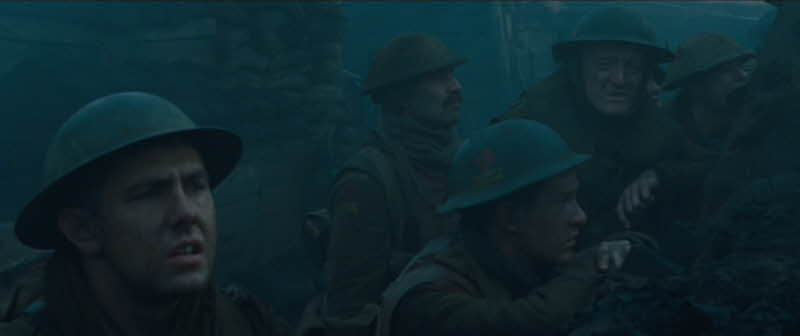
The Story:  Even as this extraordinary scene from War Horse was first un-spooling before me at a theater, I knew it would make a great Sunday Scene. Its combination of grit and humor, of civility set in one of the most misbegotten corners of insanity in History—the No Man's Land of World War I—done casually and conversationally (credit Richard Curtis for that), and with a bizarre tentativeness and a crusty grace, just appealed to me in ways that the more formalistic and almost John Ford-inspired rest of the film did not.*

It's one of the few scenes where the film-makers (and Spielberg and Kaminski's camera) are not focused on the horse—he's at his most vulnerable here—but on the two sides at war who are witness to his suffering, while in the middle of making war on each other.  

It's not some fanciful creation, either—a sugar pill inserted by Spielberg to lighten things up (it's now long past the point in his career where one can accuse the director of having not growing up and making "infantile" films—although there are those who still persisit). In 1914, during the First World War, leading up to Christmas, there were a series of "unofficial" cease-fires between elements of the British and German forces, where the entrenched troops first began to sing carols to each other across "No Man's Land," then to hold joint burials of their dead, and then to exchange gifts. Such activities were discouraged, of course, by the generals, and the next year, it barely happened.

But, it did happen, and the legend of the "Christmas truces" have become a part of History, and used by author Michael Morpurgo for his novel, the subsequent stage-play, and the Spielberg film.

The Set-Up:  From the moment of his birth, "Joey" the Bay Thoroughbred has always been paired with another: his mother; the boy, Albert (Jeremy Irvine), who trains him; Captain Nicholls (Tom Hiddleston), who rides him into battle; Topthorn, the inspirational horse of Major Stewart (Benedict Cumberbatch); German deserters Michael (Leonard Carow)and Gunther (David Kross); young Emilie (Celine Buckens)...and these two trench soldiers (Toby Kebbell and Hinnerk Schönemann), who come into his life namelessly, briefly, and disappear.  

Action!


EXT. BRITISH TRENCH. THE SAME.

GEORDIE SOLDIER (O.S.) Stand to, stand to -
A young soldier, a Geordie, is on look-out duty. He looks through a periscope. He alerts his colleague in his thick, northern, Newcastle accent.
GEORDIE SOLDIER (CONT'D) There's something moving. 
SOLDIER  What the hell is it? 
GEORDIE SOLDIER  It looks like a cow.
He passes the periscope to the second soldier.
SOLDIER  What the hell would a cow be doing out there? 
We see what he sees - nothing but morning mist on the surreal landscape - and something strange. It is Joey in the distance
SOLDIER 2  That definitely isn't a cow. 
SOLDIER (handing over periscope) Well, what is it?
87. EXT. GERMAN TRENCH. THE SAME. 
We see an almost identical scene of several German soldiers looking out at Joey just as the British soldiers had done.
SECOND GERMAN  It can't be a horse. Nothing alive could be out there. 
THIRD GERMAN  It isn't a horse. It isn't a horse.
The first German looks through his periscope. We see what he sees - Joey in the mist: 
SECOND GERMAN  Yes - it's a horse.
The second German looks through the periscope, stunned.
THIRD GERMAN  It's a horse.
A third German (PETER) lowers his binoculars.
PETER  Yeah, it's a horse.
EXT. BRITISH TRENCHES. THE SAME.
Now all the soldiers are gathering to look out at Joey. A CAPTAIN now has the periscope.
BRITISH CAPTAIN  Well, bugger me. It's a horse.
GEORDIE SOLDIER  Lads, we should call him. 
BRITISH SOLDIER  How do you call a horse? 
The Geordie starts clicking his tongue, followed by all of his comrades. 
They all try to attract Joey's attention with tongue clicks.
EXT. GERMAN TRENCH. THE SAME. 
The Germans hear the clicks and respond with a chorus of whistles. 
EXT. BRITISH TRENCHES. THE SAME. 
Now both sides are whistling. 
Even the captain joins in.
88. EXT. NO MAN'S LAND. THE SAME. 
Joey tries to rise, but remains entangled. He whinnies in pain.
EXT. GERMAN TRENCH. THE SAME.
Peter lowers his binoculars.
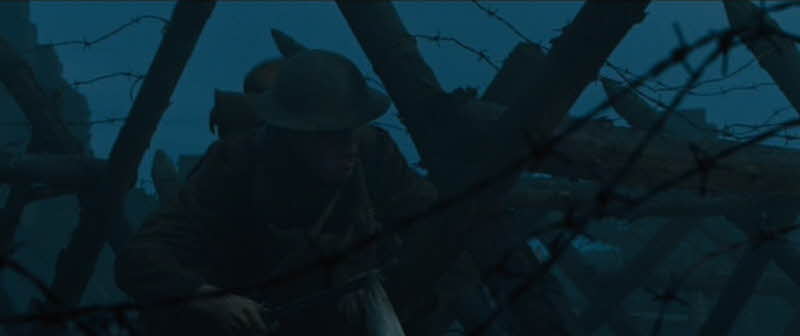
PETER  He's caught on the wire.
EXT. BRITISH TRENCHES, THE SAME.
GEORDIE SOLDIER  Oh sod it... 
Geordie climbs up the side of the trench, and waves a white handkerchief tied to the end of his bayonet.
BRITISH CAPTAIN  What do you think you're doing? 
BRITISH CAPTAIN  Get back, do you hear me? Corporal, that's an order! Get back!
Geordie, not receiving fire, is emboldened to stand up.
BRITISH SOLDIER  Listen to him, sir. We can't leave him.
He waves the handkerchief to clearly signal he is no threat.
EXT. GERMAN TRENCH. THE SAME. 
The Germans look at the young soldier making his way over No Man's Land. 
PETER  What's he doing? 
SECOND GERMAN  It's a trap. 
PETER  No, I don't think so. I think he's trying to help.
The second German cocks his rifle and starts to take aim. 
THIRD GERMAN  Scare him back into his hole.
The second German takes a shot aimed over the Geordie's shoulder.
89. EXT. NO MAN'S LAND. THE SAME.
The Geordie crouches for cover, waving his handkerchief more frantically.
GEORDIE  It's a white flag...
GEORDIE  ...ent it? 
GEORDIE  You see the white flag!? 
GEORDIE  I'm just after tending to this here horse, is all! 
The Geordie marshals his courage and stands again, waving the handkerchief.
BRITISH CAPTAIN  Get back, you stupid git!
There's no fire from the German trenches. Muttering to himself, the Geordie marches forward towards Joey:
GEORDIE  The Lord is my shepherd, I shall not want, he leadeth me into green pastures, he lay me down beside the still waters...
The Geordie walks very slowly across the mud - there are bodies - the ground squelches beneath his feet. He waves his handkerchief as he walks. 
He crosses a narrow bridge that spans a flooded bomb crater. Joey, lying on his side, wrapped head to toe in barbed wire, covered in mud, watches Geordie approach. When Geordie gets too close, Joey freaks out and begins thrashing about. Joey whinnies a high scream of pain, because wire is cutting into his hide in several places, and as he thrashes it cuts him deeper. Particularly worrisome is a strand that's wrapped around his head, crossing right over his eye, threatening to slash it. The Geordie calls out in a soothing voice:
GEORDIE (CONT'D) Poor beastie. Poor babbie. It's alright. 
GEORDIE  It's alright. Don't buck and wriggle so, you're only shredding yourself.
Joey calms a little, still moving his head up and down.
GEORDIE (CONT'D) You'll blind yourself.
He reaches Joey and surveys the formidable tangle of wire in which Joey's bundled. The Geordie soothes and at the same time gingerly tests other strands, trying to figure out where to begin. 
90. GEORDIE (CONT'D) Bugger me worthless - I didn't think to bring gloves or something to cut the -
He stabs his hand on one of the barbs.
GEORDIE (CONT'D) OW! DAMN! OW!!
There's a noise behind him, and the Geordie turns around to see the Peter (the German from the trench) standing several feet away, holding some wire cutters.
PETER  I thought perhaps you might need these.
He holds out the wire cutters. The Geordie, still frightened, stares stupidly at them.
PETER (CONT'D) For the barbed wire? 
GEORDIE  Yeah, yeah I... Ummm, thanks. Cheers. Cheers...
He reaches out and takes the proffered cutters.
GEORDIE (CONT'D) Thanks. 
He returns to Joey, nervous about turning his back. He tries to figure out where to begin cutting. He lifts a long strand of wire that wraps around Joey's neck, stretches across his shoulder and torso and around one of his front legs. He puts the wire in the crux of the cutters and is preparing to snip when Peter steps closer to him. 
PETER  That...That's a very long strand. When you cut it, it's going to release this - 
He points to a wire wrapped around the wire the Geordie's lifting. Then he points to two other wires, similarly ENTANGLED: 
PETER (CONT'D) - and this, and this, and they'll coil back rather violently, which I'm afraid will only wound the poor fellow further.
91.
The Geordie nods. 
GEORDIE  You speak good English. 
PETER  I speak English well. (re: the cutters) May I? 
The Geordie hands them over and Peter surveys the wires.
PETER (CONT'D) What if we cut his head free first? So he won't try to stand up and blind himself? And then - 
GEORDIE  Pity you didn't bring a second pair. Then I could cut the wire here -
He points to one of the wires entangled with the strand he'd been prepared to cut. Peter stands and shouts in the direction of his trench. 
PETER  WE NEED MORE WIRE CUTTERS! 
All at once one, two, three, six pairs of cutters come soaring through the air and splash into the watery crater.
Moments later - Peter and the Geordie kneel beside Joey, each with a pair of cutters. Joey is calming down again. The Geordie positions himself across Joey's body so that when he's cut the wire, it won't coil back and cut Joey. Peter positions himself to be able to cut the two wires in quick succession, holding the first wire to stop it from springing back. Joey's completely still now. Peter points between Joey's eyes.
PETER (CONT'D) His blind spot. 
PETER  The cutters won't frighten him. 
PETER  If you could cut here, holding this wire - 
He points to wires that intersect the wire that crosses Joey's eye. Then he points to the wire across Joey's eye.
92. 
PETER (CONT'D) I could - 
GEORDIE  Say no more, I'm right behind you.
As they reposition themselves, the Geordie says to Joey:
GEORDIE (CONT'D) And you understand what's happening, do you not, O Best Beloved? That you must lay so very nice and still. 
GEORDIE  There's a lad, you're a remarkable horse, you are, helping us help you. 
 
GEORDIE  There's a lad. 
GEORDIE  There's a remarkable lad. 
The Geordie looks into Joey's huge eye as he and Peter get to work on their cutting. Joey returns his gaze.
GEORDIE (CONT'D) So how's things in yonder trench? 
PETER  Delightful. We read, we knit sweaters, and we train our rats to perform circus tricks. 
GEORDIE  Well, if ever you need any more rats, we can always send ours over. `Cause we've more than we need, strictly speaking. 
GEORDIE  Besides, they scare off all the pretty girls. 
PETER  Our girls aren't afraid of rats. 
GEORDIE  Big strapping German girls, eh? Kind what gives robust massages?
They laugh. 
PETER  Every Thursday! And they bring rum cake on your birthday. 
Both men smile at this while Joey is completely still; they work quickly, in concert, cutting the horse's head free of the wire.
93. 
Joey raises his head, gives it a shake, neighs and then stirs a little. 
The two soldiers smile at one another. Then they set about cutting the rest of the wire; it's much easier now. 
The Geordie cuts through the last wire binding Joey's legs. The two soldiers help as the horse staggers upright.
GEORDIE Look at that horse! 
GEORDIE  Look at the muscles he's got, them long legs. They're made for running, horses. Runnin' away from danger.
PETER  Running away is all they have. 
GEORDIE  Yet we taught `em opposite. Running into the fray. 
PETER  War horse. 
GEORDIE  Yeah. War horse. And there he is. What a strange beast you've become. 
The Geordie grabs hold of Joey's halter, though Joey shows no sign of running. Joey is finally free. The two men look at each other. 
PETER  And now? 
GEORDIE  I take him back with me, yeah? 
PETER  Since I supplied the cutters, the horse is mine. This is fair, no? 
GEORDIE  In a pig's eye. He's English, plain to see. 
PETER  Oh, you mean because he's so filthy? 
GEORDIE  Because he's so smart. And you're none too clean yourself.
94. 
PETER  We could box. And the winner gets the horse. 
The Geordie smiles. 
GEORDIE  No, thanks, pet. Must be careful not to start a war.
GEORDIE (patting his pockets:) Do you have a coin of any sort?
PETER  Coin toss? 
GEORDIE  Yeah. 
He takes a coin from his pocket, hands it to the Geordie, who looks at it. 
GEORDIE (CONT'D) All right, Fritz - you're on.
He flips the coin back to Peter.
PETER  My name is not Fritz - it is Peter. 
GEORDIE  Peter - I'm Colin. 
PETER  You call it, Colin. 
GEORDIE  Heads.
Peter spins it in the air and lets it fall into the mud. They look down. 
Peter shakes his head, resigned. 
PETER  That's the face of my Kaiser and he does not look pleased with me. The horse is yours.
They collect their helmets as snow begins to blow around them.  
PETER  The horse is yours.
GEORDIE  Gone quiet, hasn't it? 
PETER  Yes. 
(PAUSE) (MORE) 
95. 
PETER (CONT'D) But wait half an hour and we'll be shooting again. 
GEORDIE  I'm a terrible shot, Pete, don't believe I'll ever hit the target.
He hands back the cutters. 
PETER  Thanks. 
He notices the Geordie has offered his hand, as well. A beat, then Peter shakes with him. 
PETER (CONT'D) Cheerio, mate. (RE JOEY:) You'll take good care of him, yes? 
GEORDIE  I will. 
PETER  Our strange beast. 
GEORDIE  And you take care of your own strange self.
Peter tosses Geordie his cutters.
PETER  Colin! 
PETER  A pair of German cutters - in memory of your handsome friend from Dusseldorf. 
GEORDIE  Thanks.
Peter nods, and walks back to his trench. As he goes, the Geordie calls after him: 
GEORDIE (CONT'D) I'll use `em back in the garden in South Shields. You keep your head down, now, Pete me lad!
As he walks away, Peter turns back briefly, calling:
PETER  Remarkable! A remarkable horse! 
The Geordie leads Joey towards the British trenches.

War Horse

Words by Lee Hall and Richard Curtis

Pictures by Janusz Kaminski and Steven Spielberg

War Horse is available on DVD and Blu-Ray from Touchstone Home Entertainment.


For Scott, who reminded me.
*