Wednesday, March 21, 2018

My Favorite Musical: A Hard Day's Night


A Hard Day's Night (Richard Lester, 1964) A jangling Fadd9-chord (with a George Martin multi-note slam on his Steinway) reverberates for a few solitary moments on the sound-track before the full-tilt rock song churns ahead, accompanying—maybe for the first time in movies—an action scene; The Beatles (John Lennon, Ringo Starr and George Harrison, who stumbles in the opening shot, tripping Ringo, to Lennon's delight*) are trying to catch a train, running from a mob of their screaming fans.

Just a typical day in the life of
The Beatles

A reporter once asked Lennon what he thought of a particular stop on a tour: "It was a train and a room, a car and a room and a room and a room." That's what scenarist
Alun Owen found when he stayed with the four mop-tops during a stretch of concert tours: The Beatles were prisoners of their fame. They were so successful that any chance of a normal life was out of the question. If all four of them were together there was a riot and they'd have to run for their lives, call out security, work out internecine routes. Their lives were led at a runner's pace, with no finish line in sight. It was utter insanity. And if they weren't so young and going through it together, they might succumb to the madness (and who's to say they didn't?)
And that's what A Hard Day's Night is—a dramatic illustration of the life of the Beatles at the height of their success—managed, cajoled, used, stymied, interrogated, trying to be the calm in the center of their own self-generated hurricane.
That it's also a musical is without dispute. The story-line is interrupted every 15 minutes or so with a new Beatles song, and since the through-line of the story is to get The Beatles-collective to a broadcast-venue on time and in one piece, there's ample opportunity for practice and rehearsal. The songs do not necessarily spring out of the material of the story, but when has that ever been a requirement? Critic Andrew Sarris, in his seminal book "The American Cinema," off-handedly remarked that if The Marx Brothers were an insane tonic to a sane if corrupt world, then The cinematic Beatles were the sane tonic to an insane world, and this is true of both Help! and A Hard Day's Night. The worlds of both films seem to be doing everything in their considerable power to stifle joy, through ritual, constraint, and even finding ways to bottle it up and sell it. 
John Lennon snorting Pepsi (as Coke is not available)
In Hard Day's Night, specifically, The Beatles are bright and clever and anarchically up-beat while being herded from one venue to another, caught between strict rules and screaming hysterical anarchy. Each has their own episodes of dealing with the world: Paul, the cheerily shallow cute one is burdened with the responsibility of dealing with his lecherous grandfather (Wilfred Brambell-"He's very clean"), John, the prickly clown, toys with his fame and badgers the management ("You're a swine..."), played by Norman Rossington and John Junkin, as highly fictionalized versions of Brian Epstein and roadies Neil Aspinall and Mal Evans, while George, the stonily introspective one, finds himself confronted with the marketing and exploitation of Britain's youth culture. Ringo, the diminutive ugly duckling, possessed of and hiding behind "a large hooter," and shackled to a distancing drum-kit ("They loom large in his legend," remarks George) is depressed and yearns to break free on his own, a dream which is only encouraged by Paul's scheming grandfather.
The sub-text (as it is in their second film with Lester,  Help!) is that the world is conspiring to splinter The Beatles apart, and it is only their efforts as a group—both films' plots involving the rescuing of Ringo—that keeps them together and the world at bay. That's pretty ironic, as the four's own bickering is what led the group to self-destruct and go their own ways once they were no longer forced to go together in the same direction by their hectic tour schedule. The only real idyll they have in A Hard Day's Night is in the antic "Can't Buy Me Love" sequence, where, in a rare moment of freedom, they caper about a play-field, which Lester films in an eclectic helter-skelter array of techniques, formal and informal: sped-up, slowed down, from the air, and hand-held.** Even that ends with an admonition ("I suppose you know this is private property!").

It all turns out right in the end, with the concert accomplished, the boys back together and taking the safest route away from a crazy chaos—up, with a reprise of the opening song that ends with a jangling guitar arpeggio...that never ends, but just fades.
It is a tantalizing, if fictional, glimpse of Beatlemania, that hysterical era when, as Harrison stated in "The Beatles Anthology," the world seemed to be given permission "to go mad." And, in the best description of their situation, goes on to pointedly say that that madness made them rich and set them up for life, and, in exchange, "we gave them our nervous systems."


Where's Paul McCartney, you ask? Well, he's not dead, certainly. Paul's not running in this scene. He's found his own way to avoid the mob, disguised with a moustache...and two "beards" of sorts, the other being his grandfather (played by "Steptoe and Son's" Wilfred Brambell). Since Brambell is accompanying McCartney on the train, you couldn't expect an elderly man to run in the opening. It should be noted that Mike Myers cribbed that joke (with no changes whatsoever) for Austin Powers: International Man of Mystery


.

** At one point, all rules are broken, and the sequence becomes even more over-the-top when Paul briefly snatches the camera from the director (There's your rock n' roll anarchy for ya, kids!).


Todd Haynes
, briefly, does his own tribute to this sequence in the Bob Dylan-house-of-mirrors bio-fiction I'm Not There, as Dylan's meeting with the Beatles (where they were introduced to marijuana) is represented by a distant manic scampering, interrupted by chasing, screaming fans.

Tuesday, March 20, 2018

I'm Not There

Relatively 4th Street 

If Robert Zimmerman did not exist, we would have had to invent him. And then we'd have to invent Bob Dylan like he did. Then we'd have to re-invent him. And re-invent him again. And again. And that would only cover his public persona--not the myths and misinterpretations and the thousand unnatural transferences imposed on him by a public trying to possess the unpossessable (He famously said "Just because you like my stuff doesn't mean I owe you anything."). 

F. Scott Fitzgerald said that there are no second acts in American lives. Well, Dylan is somewhere in the dozens now (and we won't even count the Victoria's Secret ads!) in his quest for a place in the American song-book. Todd Haynes has tried to capture some of the sides and asides of early Dylan in the kaleidoscopic and appropriately named I'm Not There (although it could have just have easily been named "It Ain't Me, Babe")
In an attempt to capture Dylan at the creation, Haynes has made the movie episodic, with a collection of stories with a handful of actors playing stages and aspects of Dylan, none of them forming a complete picture, but making a collage of impressions of the artist in his first 15 years in the limelight.

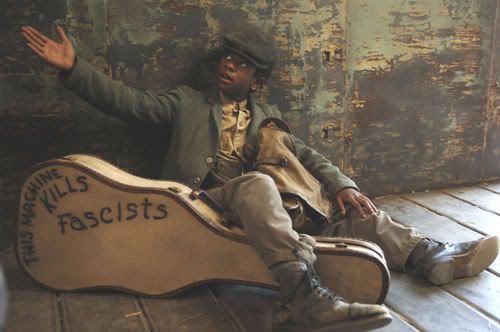
They are: 1) Woody Guthrie--an 11 year old black kid (Marcus Carl Franklin) who rides the rails escaping from a bad situation with just his guitar and his wits to keep him going. He eventually ends up making a pilgrimage to the New Jersey Hospital where the real Woodie Guthrie is dying of TB (Guthrie died in 1967).

2) Jack Rollins--Christian Bale plays the young activist folk singer who ardently sings "finger-pointing songs" and when he finds himself used by political groups, rebels, turns away from them and towards Christian Evangelicism.
3) Robert Clark--Heath Ledger plays an actor who played Jack Rollins in a film, and must deal with the effects of fame, notoriety and their demands on his ideals, private life, and marriage.

4) Arthur Rimbaud--Ben Whishaw plays Dylan the poet, answering straightforward questions at a police booking with wistful asides that aren't really answers (but will do in a pinch). Whishaw has the least to do, and like the next aspect of Dylan gets the lion's share of the best lines.*
5) Jude Quinn--the most hyped stunt-casting of the movie has Cate Blanchett playing Dylan on tour in London, where he is famously heckled by audiences for abandoning folk music for electric rock and challenged by the press trying to understand or categorize this strange creature from the States. This segment is shot in black and white (looking remarkably like the Dylan documentary "Don't Look Back") and heavily influenced by the style of Fellini. Quinn is perpetually bedeviled by esoteric questions that he either dismisses or vaguely answers and rails against the needling inquisition of one reporter (Bruce Greenwood) for whom Quinn writes "Ballad of a Thin Man" in one of the few instances where Dylan's music is used as fore-ground comment.

6) Billy the Kid--Richard Gere plays a Dylan aspect, alone and hiding out in isolation in a freak-filled town called Riddle, Missouri, where he lives under different identities and speaks up for the town when it is threatened by domineering Commissioner Pat Garrett (Bruce Greenwood, again). It's done in the style of Sam Peckinpah in a fever dream with a slow-tracking camera and a wandering editing style, and a narration by Kris Kristofferson (who played Billy in Peckinpah's Pat Garrett and Billy the Kid, of which Bob Dylan was an integral part.*
And the bizarre thing is, the bloody thing works. It helps to be hip on Dylan or you'll miss some of the in-jokes.** But it's enough Dylan and just enough kinda Dylan that one can't be too anal-retentive about getting the facts right. The film is more about the myth, and the persona and mystique (and expectations) of the artist than the real thing, and the use of Dylan songs edge along and suggest deeper meanings than, say, a cultural mis-fire like Across the Universe (which used its Beatles covers to tell you that A = A). Dylan's songs—some the traditional recordings, some enthusiastic "live" versions, some covers (there's a wonderful segment of Richie Havens and Franklin doing his "Tombstone Blues") form a suggestive background soundtrack, as his music did for us, that merely suggest, but doesn't hit us over the head, with the exception of that "Ballad of a Thin Man" segment.

Does it succeed in explaining Dylan? Nah. Some aspects of him are presented, and the acknowledgement that there ARE aspects puts this head and shoulders above the standard Hollywood "CliffsNotes" bio-pic (Ali, anyone?). And the film is filled with references and reverberations enough to fill several movies and a few lives, and that is an artistic victory in itself. And the tackling of the splintering of the artist for changing his art and himself—the holding of the mirror up to the flightiness and provinciality of audiences is a brave act, indeed. I came away not knowing Dylan any more than I did, but glad for the journey and reflected on three quotations on the way out.

"I don't think any one word can sum up a man's life" (Citizen Kane)

"He was a man. What does it matter what you say about people?" (Touch of Evil)

"No decent career was ever founded on a public." F. Scott Fitzgerald


-------------------------------------------------------------------------
* Including these seven Dylan Rules of Thumb:"Seven simple rules of going into hiding: one, never trust a cop in a raincoat. Two, beware of enthusiasm and of love, both are temporary and quick to sway. Three, if asked if you care about the world's problems, look deep into the eyes of he who asks, he will never ask you again. Four, never give your real name. Five, if ever asked to look at yourself, don't. Six, never do anything the person standing in front of you cannot understand. And finally, seven, never create anything--it will be misinterpreted, it will chain you and follow you for the rest of your life."

And, of course, he doesn't follow any of them.

** Dylan played "Alias," a member of Billy's gang, and also created the film's blue-grass score, which included his song "Knockin' on Heaven's Door."

*** My favorites--at a party Quinn is assaulted by the Tommy Boyce-Bobby Hart "I'm Not Your Steppin' Stone" a faux-Dylan piece of silliness performed by the Monkees, and Brian Jones is introduced as belonging to "a really good cover band."

Sunday, March 18, 2018

Don't Make a Scene: Wings of Desire

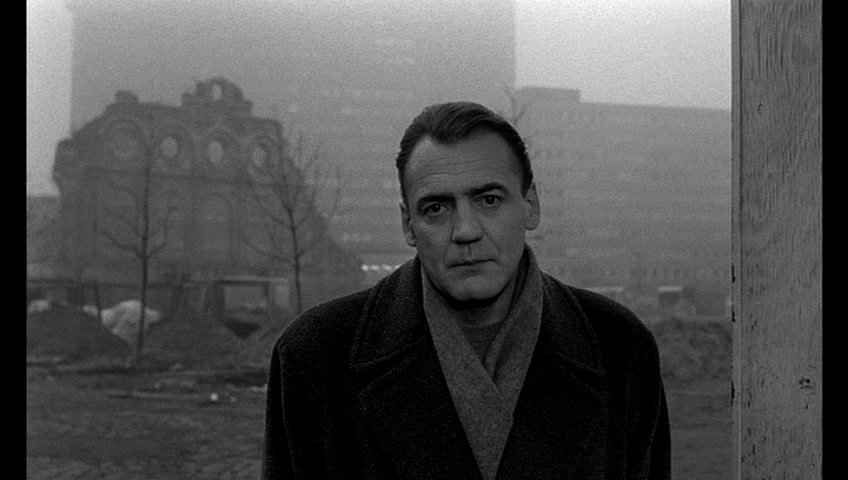
The Story: Wim Wenders' original title for Wings of Desire (his preferred English title) translates to "The Sky Over Berlin."  Far be it from me to second-guess Wenders, but the original belies the Nature of the film. The skies over Berlin are an unbroken line, literally, an open air expanse through which the angels of the tale glide. But the film is one of transitions; everything is bisected and we cross over from one side to the other, breaking barriers as we move along, as easily as the angels walk through walls. We move from the angels' point-of-view to that of the street, while at the same time changing from black-and-white (angel perspective) to color (our reality). Even the city is in a state of flux, divided between West and East Berlin—it was filmed before the Berlin Wall fell—the architectures of the buildings changing, green-space being planted, slums falling, new buildings rising. Everything is changing, and the only way to survive the transition unscathed is to have the grace to fly above it all.

Which is why this story of an angel who chooses this moment to make his own transition, from the spiritual to the tangible, is so special and fascinating.

Along the way, "there are so many good things," moments of poetry, both visual and aural, and everybody has their favorites: the library sequence—the angels hovering over the readers absorbing new thoughts, like it was an exquisite dish; the encounters with poor souls making the path of crossing-over; the dreams; the circus.

And then, there's Peter Falk. If there is a pivot-point for reality and fantasy, it is his performance in this film. Playing Peter Falk (he's called that on-set of the movie he's making, and he's recognized by citizens as "Lt. Columbo"), he is a real actor, playing a movie actor—himself—who also has a special connection to the angels of the film (as do children, who can see them, while the actor cannot). When Wenders offered this part—him—to Falk, I can imagine the actor hesitating for only a second, grasping it. Then, since he was pals and collaborator with John Cassavetes, well-known for on-set improvisation, Falk probably just said, "Yah, what da hell..." and did it.

It's my favorite scene in the film* (so far—I'm still studying this multi-layered gem), when we transition from an empty bus-compartment moving forward (semi-occupied by the angel Cassiel), to a scene of a humble food-stand, as the angel Damiel follows the perspective-lines of the bus on his path to tangible reality. There he encounters Falk, in town performing in a movie, taking a smoke break, getting a warm-up. Falk senses the unseen angel's presence, and engages him in conversation about the joys of life (much to the alarmed curiosity of the cook, who probably thinks this guy talking to himself, is crazy).  It is this encounter that will convince Damiel to "take the plunge" in the very next scene and pursue his desires, that have wings, angels' or no.

Just another in a series of angels, spiritual beings of miracles, who choose, instead to hope, to hope, to hope.

The Set-Up:  The angel Damiel (Bruno Ganz) on his rounds in Berlin, checks on some of his favorite haunts, the flying trapeze artist (Solveig Dommartin) and the actor, Peter Falk (Peter Falk). Just when he thinks Life can hold no more surprises, he discovers one more, which sets him on a solid path.

Action!

Peter Falk walks through war ruins, which is intercut with Cassiel in an empty bus. 
Falk stops at hot dog stand, Damiel walks by. He - and the hot dog stand-owner - stare in amazement as Falk begins to speak:
FALK: I can't see you, but I know you're here!
FALK: I feel it.
FALK: You been hangin' around since I got here.
FALK: I wish I could see your face...
FALK: ...just look into your eyes and tell you how good it is to be.
FALK: Just to touch something!
FALK: See, that's cold. That feels good!
FALK: Or, here, to smoke, have coffee. And if you do it together it's fantastic.
FALK: Or to draw:
FALK: ...ya know, you take a pencil and you make a dark line, then you make a light line...
FALK: ...and together it's a good line. Or when your hands are cold...
FALK: ...you rub them together...
FALK: See, that's good, that feels good!
FALK: There's so many good things!
FALK: But you're not here - I'm here.
FALK: I wish you were here.
FALK: I wish you could talk to me...
FALK: ...'cause I'm a friend.

Falk stretches out his hand, Damiel grabs it. 
FALK: "Compañero."
Damiel leaves hastily...

Wings of Desire (Der Himmel über Berlin)

Words by Peter Handke, Richard Reitinger, and Wim Wenders

Pictures by Henri Alekan and Wim Wenders

Wings of Desire is available on DVD from The Criterion Collection


* It is echoed later in the film with Cassiel, and again, in the sequel Faraway, So Close!