Doing the Limbo Dance with Godzilla (Faith and Ghidorah)
or Dr. Serizawa's Magic Bullet
I was anticipating the new Godzilla movie,Godzilla: King of Monsters, when I saw the trailer start to hit theaters. I enjoyed Gareth Edwards' 2014 take on the series, and was suitably impressed with what Legendary Entertainment was doing with their second "Monsterverse" film,Kong: Skull Island. But, to see the trailer for G:KOM, with appearances by other Toho Studio monsters, like Rodan, Ghidorah, and Mothra (especially Mothra) gave me a sense of giddy joy, as in "My God, they're really going to try and do these cheesy monsters with a sense of "real" CGI verisimilitude, instead of the puppeteered, rubber-suited versions we're used to?" And then, to bring a respectable cast of characters actors like David Strathairn, Ken Watanabe, and Sally Hawkins (all returning from the 2014 film), as well as Bradley Whitford, Kyle Chandler, Charles Dance, Vera Farmiga (!) and Ziyi Zhang (!!!), I was somewhat delirious, as in "Oh My God-zilla, are they actually going to make a decent movie out of this juvenile material? That would be so awesome!" The answer is "No, they didn't." One wonders if they ever could, but the hope was there, and although the film is semi-successful in some aspects, the conclusion from what I saw was a disappointing result from an over-the-top concept. But, to get any enjoyment from the experience, a little perspective is required. To illustrate, here is a scene featuring a "pitched" battle between those same four antagonists from the 1964 feature Ghidorah, the Three-Headed Monster*
There, now you should be prepared to see Godzilla: King of Monsters and come out somewhat impressed. Extreme, I know. But, you have to set the bar pretty low to raise expectations. It's been four years since the appearance of Godzilla—"the day the world discovered that monsters are real"—the film starts with a flashback to the events in San Francisco where two new characters, Mark and Dr. Emma Russell (Chandler and Farmiga), two Monarch**specialists are caught in the fray...with their family for some reason...resulting in the death of one of their kids, their son, Andrew (definitely a downside to "Take Your Child to Work Day" when working for Monarch). This fractures the family (you think?). Mark, embittered and wanting to kill the Titans, and GZ in particular, goes off to study wolves, while Dr. Emma continues her husband's work of creating a communication system, designed to keep whales from beaching themselves. Only she's using it to see if she can communicate with the MUTO's. It's a good way to set up all sorts of "Geez, I hope this works..." scenes.
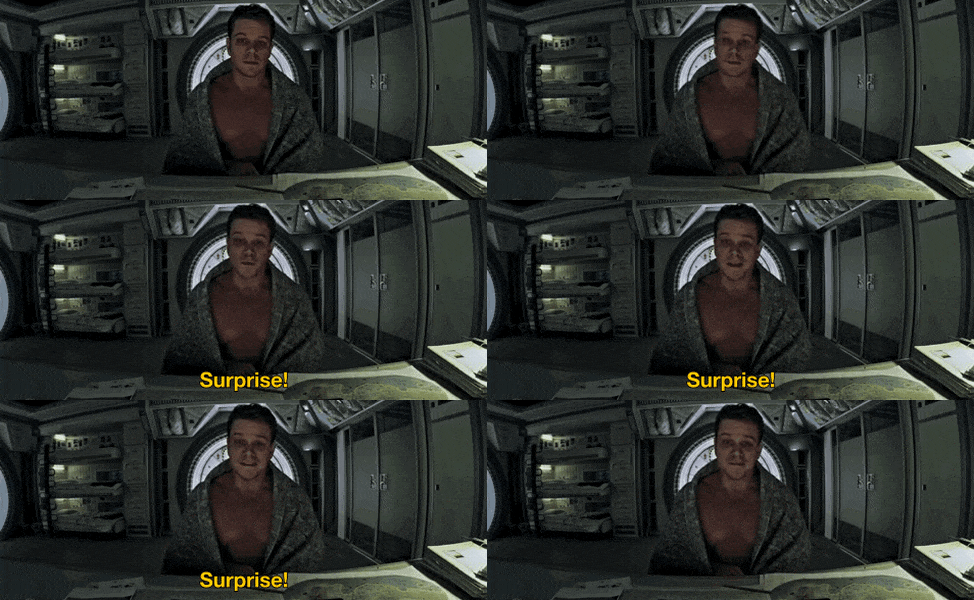
Their daughter Madison (played by Millie Bobby Brown from "Stranger Things") is keeping up contact with Dad and worrying about Mom's frequent moodiness and is one of those irritating "Wesley Crusher" kids, who can take some wires, a USB cable, and a Brillo-pad and hack into a pay-telephone so it can communicate with the Mars rover Endeavor to save Matt Damon (although she has trouble making breakfast...fake-out!). It's no wonder Dr. Emma takes her to the Monarch project where they're trying to awaken Mothra (Hey, remember "Take Your Child to Work Day?" Worked out real well last time, didn't it?). But, not to worry. Even though Mothra freaks out and kills some techs, Dr. Emma is able to take her "Orca" device, push a button, and translate Louis Armstrong's "What a Wonderful World" into Mothra-song to calm it down. This inspires Madison to confuse the multi-million dollar facility with a petting zoo to reach out and touch the creature bare-handed without a care about communicable disease or some sort of tactile osmosis that would put a Mothra-larvae into her body that will burst out at a later time (possible sequel?).
Dr. Emma worries about how she's going to explain this to CPS
They don't have to think about that, anyway, as, once they have Mothra under control, former MI6 agent and prominent eco-terrorist Alan Jonah (Dance) bursts in with some merc's, seize the Orca device, and take Dr. Emma and Madison hostage for his nefarious plans to do something evil and inspire a rescue operation. Mission accomplished on that last one; Monarch, in the form of Dr. Ishiro Serizawa (Watanabe) and Dr. Vivienne Graham (Hawkins) finds Mark dancing with wolves and tells him what's happened. They set out to track Jonah and his whale-sized ambitions to try and get little Maddy back.
Monarch gets lectured by Dr. Emma (while her ex glowers about "hearing this before"
That, as it is, is the plot. The rest involves globe-trotting to many Monarch outposts, tracking the movements of GZ, and the intentional setting free of the three-headed monster Ghidorah, who has been trapped in Antarctic ice for eons. Once he's—or they, I've have pronoun troubles with three-headed things—thawed, it goes about the world freeing other Titans in its official title as apex predator, which is what Jonah has intended all along. His justification being that the Titans have been here longer, and that we relatively newbie humans are screwing up the planet, so the Titans will fix it all up by getting rid of us. This, then, makes Jonah the ultimate anti-immigration activist (hurts when it's you, doesn't it?).
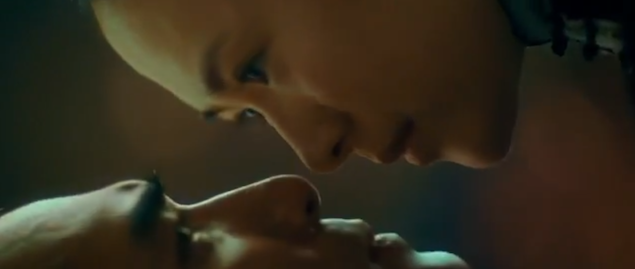
Foreshadowing that Godzilla and Mark might some day see eye to eye.
There's more match-up fights than an episode of the WWF—Mothra versus Rodan, Godzilla versus Rodan, Godzilla versus Ghidorah (SPOILER ALERT-he gets his scaly tail handed to him, regroups then comes back and wins, with a little help from his monster friends, and ultimately wins the gold belt-buckle that says "King of the Monsters") and the puny little humans help as best they can, but, basically, they're farm-league, only good at running away and, failing that, becoming kaiju toe-jam .
Ghidorah bug-zaps Mothra
That's what we all go to see—monsters fighting, even if it's in murky darkness, so they don't have to have the CGI be perfect (or it was the low-projection level of the 3-D version, which is the format I saw it in), and despite the creators' earnest intentions, it's the same format that the other films have usually had. Some pretext in the human world sets everything up—in this case, it's the problems with the Russell's, whom we've never heard of before and have the most basic issues on which to hang a monsters-fighting scenario on. At least, it's not manipulation by space-aliens, or venusians, or some other clap-trap that would cause your eyes to roll sop far back in your head that you'd miss the fights at the end.
Rodan goes in for the kill
You have to suspend belief so high that it's achieved orbit, while at the same time lowering expectations so low that your back will be killing you the next day. Either that, or you have to be such a True Believer Fan, that you just don't care, because you get a thrill every time you hear Godzilla amp up like an old diesel generator before he unleashes a force-beam of some completely unfathomable energy that will somehow shred whatever big-thingy he's up against. When you're that deep in the fantasy, there are no rules of engagement, you're just glad for the engagement—like your desperate Aunt Sophie.
Ghidorah provides free WI-FI to everybody.
The human actors do a fine job of spouting techno-babble and mumbo-jumbo as if it makes sense—Whitford seems to be having a good relaxed time (he's had to negotiateAaron Sorkin dialogue) and Strathairn looks like he's really having to double-down on the glower to prevent himself from cracking up over what he's saying (there are quite a few Oscar and Emmy nominees in this cast, by the way...although this probably won't inspire "For Your Consideration" ads come the next awards season). And they're very good at the Spielberg-trope of looking up with a faraway look as if their lives depended on it.
"For Your Consideration"
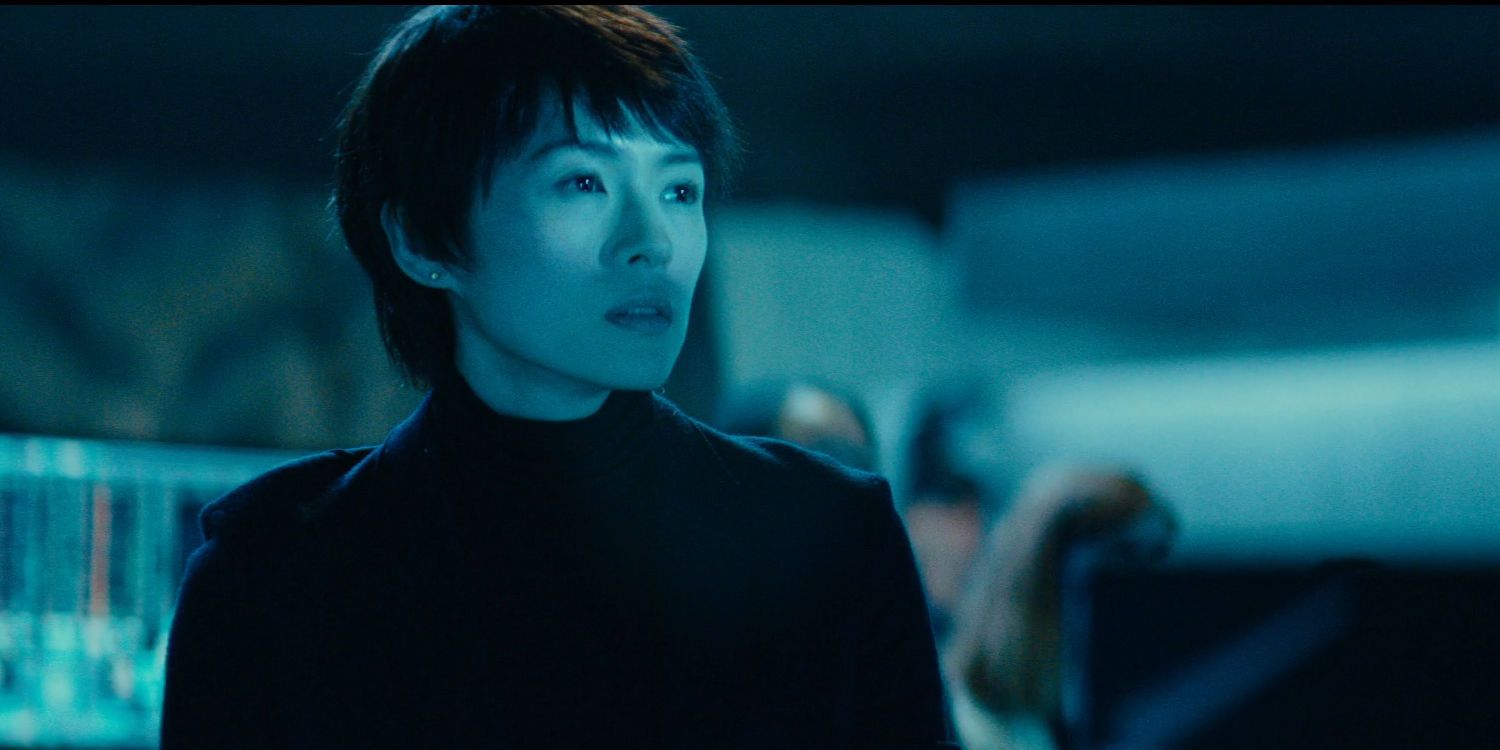
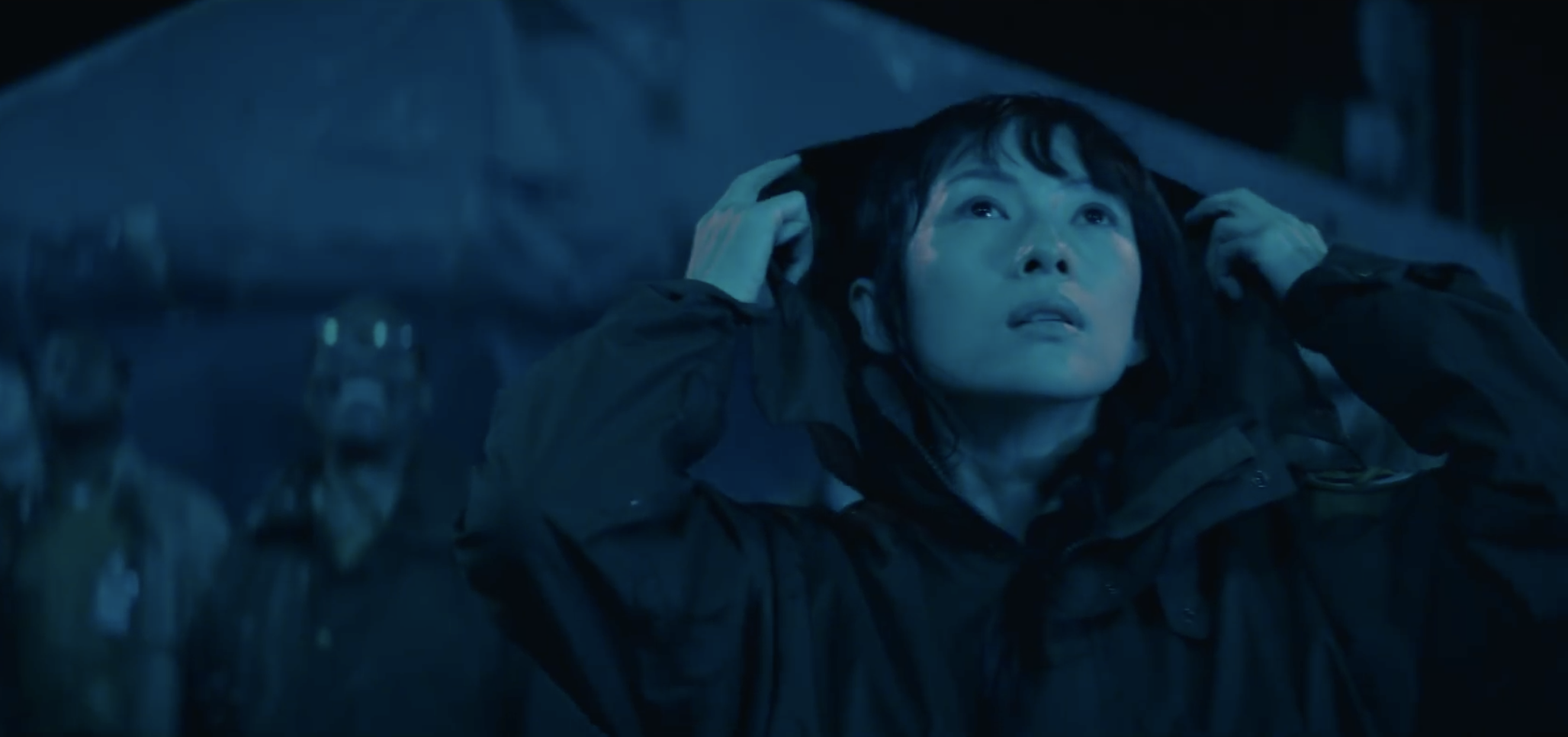
There are, despite some of the hammer-hitting lack of subtlety in the film, some nice touches: the constant calling-upon of hieroglyphic evidence of kaiju presence during man's early development (however unlikely that may seem); the sense of glowing myth as the creatures never seem to be present in anything other than strange weather phenomenon, as if they were tied to the very natural forces that soak, electrify, and shake the planet—like some manifestation of Kurosawa's emotional weather conditions; there's even a moment that might be confusing for most audience members—Ziyi Zhang plays two characters in the film, twinsisters, who hearken back to similar twins, the twin fairies, the diminutive shobijin, who summon forth Mothra with their song. It's a tiny little detail, but it set my "mothra-sense" to tingling when I saw the actress appear in a continuity-defying two places at once.
"Please notice that the 'Fasten Your Seat-Belt' sign is on..."
But Godzilla, King of the Monsters is not that great a movie. A pretty darned good giant monster movie and a bit of an improvement over its source material (remember: no venusians...). If it has any luck, it'll become a Saturday afternoon staple on television—which is where I saw most of these things in my youth (and I was cynical about them then). It pays homage to its source by not being too reverential about it or trying to make it more "significant" than it is (despite my comic intentions to politicize it). It was, and still is, a cheese-fest. It's just that the price of cheese has gone up—significantly—over the years.
"Let's get ready to rummmmmblllllle..."
Oh. And one passing thought: despite the dangers displayed by galumphing behemoths of various genera and type, spitting sparks of a source not found in Nature's spectrum, one gets the impression that they are not considered the biggest concern or threat to the filmmakers. Given the evidence of the film and what they choose to show and how they show it, the real danger is...bad mothers. Hope that doesn't spoil anything.
"King me, baby!"
Prepare for the inevitable cage-match (2020, they're saying)
* Or as it's known in the States, Ghidrah, the Three Headed Monster (with only two syllables). ** Monarch is the secretive Japanese-American organization that studies M.U.T.O.'s (Massive Unidentified Terrestrial Organisms—or the more PC, "Titans") that have emerged from the Earth's hollow interior due to man's atomic experiments and other destructive activities—like building Monarch's massive underground outposts. Monarch seems to have an unlimited budget and unlimited resources, and 61 outposts around the globe to hunt 17 of these things. It's no wonder there is a Senate investigation of the thing in this movie. Next thing you know, Trump will want one of these organizations if he can't get his Space-Rangers.
Oh. One more thing-they always have to fight by power-lines. Always.
Two Words. Vertical. Horizontal. or Once Upon a Time in Forshan Let's get one thing out of the way first. The version I saw of Wong Kar-wai'sThe Grandmaster (aka "Yi Dai Zong Shi" aka 一代宗師) is the Weinstein Company release, which runs 108 minutes. The original Chinese version runs 130. That's about 20 minutes of footage missing. So, I don't know whether I'm reviewing Wong Kar-wai's latest film, or a long, long trailer for it. Normally, I wouldn't be doing much kvetching about this, but I've seen enough of the man's movies to know that The Grandmaster is something very, very different from what he's done in the past (In the Mood for Love, Chungking Express, 2046): more formal, less dialog-driven, more image-conscious and more experimental (and Wong has pushed all sorts of boundaries already in his career). Usually, when a distribution company does this much hatchet-work on a film (Ironically, this film is "presented by Martin Scorsese," who's also had a couple films filleted by the Weinstein's), the most interesting character-driven parts get left behind as "fat," leaving the parts with the most action. Well, in this case Wong might have already done that for us, for in telling the life-story of Ip Man—one that's been in the process for ten years—he's hit the highlights and the high fights and other than some discussions of philosophy and technique, that's it. It's simultaneously illuminating and frustrating: frustrating because the movie plays like a bio along the lines of DeVito's (and Mamet's) Hoffa or Mann's Ali, all life-highlights and nothing to connect the dots; illuminating because it appears to be a dramatic choice, making Ip Man's life segmented between life and work and philosophy and not much else—there is no historical context other than the scripted titles telling you what is going on in the rest of the world.*
It begins with a fight in the rain between Ip (Tony Leung Chiu Wai) and several combatants, staged as a brutal ballet in various speeds, escalates through the number and various tactics of the opponents, and ends with the defeat of the strongest combatant. Ip then flashes back on his life starting with his marriage to Cheung Wing-sing (the incredibly beautiful Hye-Kyo Song), and the news that the master of Northern China, Gong Yutian (Wang Quixiang) has retired and bequeaths the role of master to Ma San (Jin Zhang), with the caveat that the South should have their own master. It is decided that Ip should challenge Gong for the right, and he is put to the test by three Southern masters before the match with Gong. That match is anything but typical, has nothing to do with the training of the Southern masters, and Gong declares Ip his heir in Southern China. That does not sit well with Gong's daughterGong Er(Ziyi Zhang),who challenges Ip for the sake of family honor. Their meeting and subsequent fight is an amusing affair of restraint and dexterity, and the fight concludes to Gong's satisfaction. Ip can only smile and say "I want a rematch."
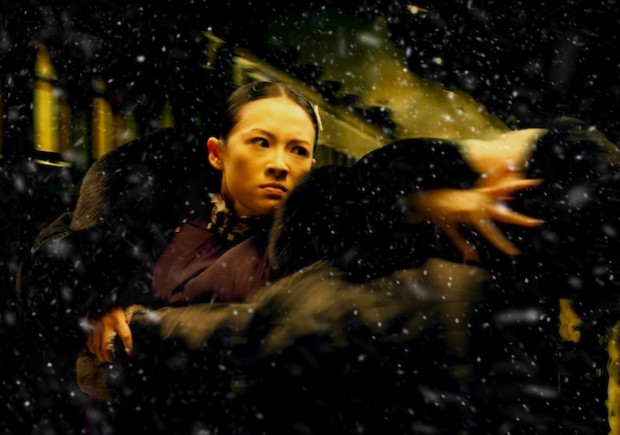
Gong Er's moment of triumph. You can see it in her face.
Now, despite this country-wide grudge match, and the Sino-Japanese War, which plunges the country into a depression and, as a result, sends Ip to Hong Kong to provide for his family, the film could not be more personal, keeping its eye on Ip, while, in the meantime, Gong, who has been only secretly trained in kung fu by her father, seeks revenge against Ma San, in a totally focused, life-sacrificing mission to the death. The two are poles apart in purpose and drive and yet they are drawn together, players on opposite sides. The film is a series of fights, the important ones, punctuated by a series of beautifully photographed scenes of domesticity and meditation, broken up into chapters of title cards, as from the silent film days.
Wong's approach to this is very formal, the photography sumptuously lit, golden light betraying dark spaces and staged sometimes as formal portraits of a time and place, emotions run high, but not betrayed by the faces of the principals, the most expressive being Ip Man's wife, who disappears from the film very early on. I'd be hard-pressed to find a more beautiful film to see this year, even if the beauty comes with a certain static quality that pushes the audience away, albeit gently. And the fights are balletic brawls, filmed with depth and in tight close-ups, but at a pace that allows for position and space to be registered without sacrificing speed. In fact, it's quite invigorating to see a slow-motion concentration edited quickly as the fights are done here, as it is during the first fight in the rain. But, befitting the styles and other situations—the Gong Er/Ma Sanfight hasits own bizarre energy-force—Wong gives each confrontation a different presentation that makes each one different, and mesmerizing.
There is one odd, touching thing that brings up the ghosts of the past just as the title cards harken back to the silents, Wong brings to bear Sergio Leone as a touchstone by making sure that he gives Gong Er a borrowed theme from Once Upon a Time in America to communicate the regret she cannot express herself. It produces goose-bumps, and not just from recognizing the source of the haunting cue, but for being so solidly apt and instantly evocative (composer Ennio Morricone can do that). It's a beautiful, odd, off-kilter film. I only wish to see more of it.
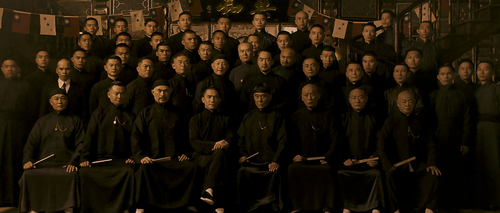
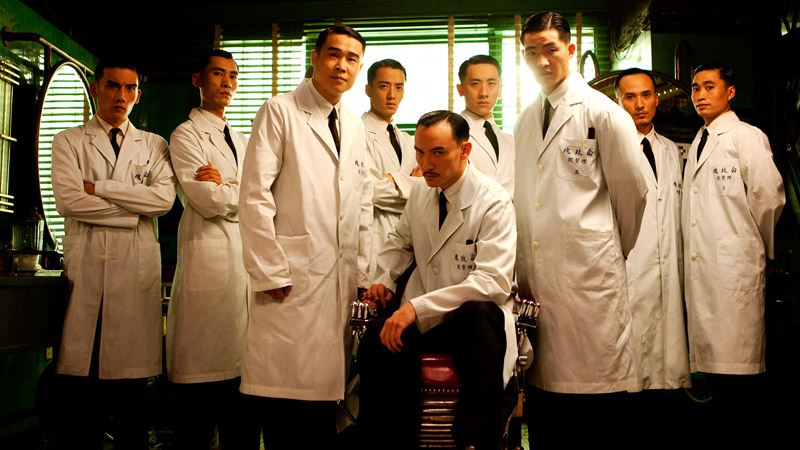
Portrait of the Artist as a Portrait-Artist: Wong Kar Wai book-ends chapters in Ip Man's story with staged sittings
* There have been three other films, heavily fictionalized, on the same subject in the time that Wong was working on this film, as well as a couple television films about him.

 Their daughter Madison (played by Millie Bobby Brown from "Stranger Things") is keeping up contact with Dad and worrying about Mom's frequent moodiness and is one of those irritating "Wesley Crusher" kids, who can take some wires, a USB cable, and a Brillo-pad and hack into a pay-telephone so it can communicate with the Mars rover Endeavor to save Matt Damon (although she has trouble making breakfast...fake-out!). It's no wonder Dr. Emma takes her to the Monarch project where they're trying to awaken Mothra (Hey, remember "Take Your Child to Work Day?" Worked out real well last time, didn't it?). But, not to worry. Even though Mothra freaks out and kills some techs, Dr. Emma is able to take her "Orca" device, push a button, and translate Louis Armstrong's "What a Wonderful World" into Mothra-song to calm it down. This inspires Madison to confuse the multi-million dollar facility with a petting zoo to reach out and touch the creature bare-handed without a care about communicable disease or some sort of tactile osmosis that would put a Mothra-larvae into her body that will burst out at a later time (possible sequel?).


.jpg)