Showing posts with label Wes Studi. Show all posts

Friday, April 2, 2021

Soul

Pixar When It's Jazzing
or
"I am the coming together of all quantized fields of the universe. Appearing in a form your feeble human brain can comprehend. You can call me Jerry."

I freely admit that I should have seen Soul in a theater—I've seen every other Pixar movie on the big screen and I freely admit that the presentation-medium usually informs the reviews of those films. There's something about the detail work of Pixar's movies that pop more on a big screen. I had to watch this at home, though. Disney took the choice away from me, and I will admit it made me a little bitter. I say this because not seeing it all big-and-large, a couple millimeters to a pixel, might prejudice my review a bit.

But just a bit.

Soul did not move me to tears as other Pixar films have in the past. Its suppositions on the inner life of humans skews a bit in the same territory as Inside Out. Its designs seem to spend a great deal of time in the easily-rendered nebulous, and its points of view on "purpose" and "spark" may be too subtle for some who have not reached a certain age—you know, actually lived a life of varying degrees of success and/or satisfaction. All of this is in comparison of Soul to the rich history of Pixar and its output, which is without a doubt the most artistically and financially successful production studio out there. Most souls would shrivel up and die held against such a standard.
But, seen on its own, without (or even because of) that rich legacy, Soul is still a remarkable film of humorous dexterity and sophisticated conceptualization. And humor...plenty of that. And their continuing forays into multi-culturalism (necessitated once they run out of subjects that hid the limitations of digital animation in its early days-and they decided to combat the "uncanny valley" by leaping over it in artistic bounds) has not only made their films richer—well, naturally—but also counter-intuitively more universal.

It's also left it open to sniping from critics of certain sensitivities (and prejudices) who can't see the forest for the trees—attacking some aspect while ignoring the bigger themes of the picture. It's a bit like attacking Finding Nemo because "fish don't act like that" when the story is about "letting go." How did they survive watching Ratatouille when rats were cooking in a restaurant? 
It is the best day in the life of Joe Gardner (voiced by Jamie Foxx), a band-teacher suffering through a class with limitless room for advancement.* There's one promising saxophonist, but that's it. The next quarter is going to be an endless stream of clams and sharps and lagging. So, it seems like too much of a good thing when he's told he's been hired to teach band full-time, complete with insurance package. But, it's clear that his heart is in playing jazz professionally. That's why he jumps at the chance (provided by a former student) to audition for the Dorothea Williams Quartet (she's voiced by Angela Bassett). He sails through the audition and is told to get a "good" suit and be back at the club at 6:30.
Joe's heart is soaring. Which is probably why he falls through an open man-hole and dies. Well, not quite. But, when his awareness kicks in he's on the fabled staircase, if not to Heaven then to "The Light." This is one escalator he wants to jump off, and in so doing, finds himself somewhere not-so-fabled. It's not "the Great Beyond" he's informed, but "The Great Before," where souls go to be indoctrinated into their apparent personalities, and become mentored so they can achieve the little merit badges needed to go to Earth.
Joe, however, is not where he's supposed to be. He's not on his way to the After-life, he's in the Before-Life, which makes the After-Life hell for a counter named Terry (Rachel House, deliriously idiosyncratic, as always), who finds the count is off. Rather than write it off as "shrinkage" Terry begins an investigation, while "Before" counselors (all named "Jerry" and voiced by Alice Braga, Richard Ayoada, Fortune Feimster, Zenobia Shroff, and Wes Studi) cover his tracks by giving him a job as a "last-ditch" mentor to a troublesome soul.
How many souls have there been? Trillions? Well, this one's a problem and has been a long time. This soul's name is "22" (voiced by Tina Fey—"How come you sound like a middle-aged white lady?" Joe asks it. "I just use this voice because it annoys people," it replies) and she has had the Best and the Brightest of mentors throughout history.** All failed—even Mother Theresa ("I have compassion for every soul...Except you. I don't like you.") and 22 just does not want to take the next step to live, despite Joe's best efforts. That next step—it's more like a prat-fall—is when the two souls accidentally fall to Earth, while viewing Joe in the hospital, and get into the adventure trope of "switching psyche's"—walking in someone else's shoes.
If the "Great Before" were a TV show, we've already seen that...countless times. But, Soul makes it fresh, fast, funny, and the most entertaining part of the film. There is a lot of "concepting" going on, with talk of "The Great Before" and "The Zone" and "Lost Souls" and philosophical/psychological concepts dealt with in cartoon-graphic terms—"this whole place is a hypothetical..." 22 finally just admits—and sometimes, the grasping at ideas is a little thin. But, once it starts getting down to Earth, the film is much more on solid ground, comedically and spiritually.
And it's beautiful, especially when it's out of the pastel, cotton-candy landscapes of the "hypothetical," and back in Pixar's "Real World" (I've included a bunch of screen caps below ***) that take your breath away. Pixar's renderers always seem to advance the bar with every new film and here, the results are astounding; the film is full of pieces of art that you just want to frame, made even more incredible for the realism in their movement. 

One wants to say that it's a step-back. But it isn't. It's another well of imagination the overflows and inspires. 
Joe "in the zone"

* The very first joke of the movie is a terrible, amateurish version of "When You Wish Upon a Star" over the opening Disney logo. It's hilarious, off-putting (because you don't know what or why), and wonderfully tweaks their corporate overlords. I love Pixar...

** 
22's wall of past mentors--a couple of them are Pixar creators who have passed, and Jack Kirby's in there, too!

***  

Thursday, February 8, 2018

Hostiles (2017)

Outpost Traumatic Stress Disorder
or
"'Deserves' Got Nothing to Do With It"

Donald E. Stewart died in 1999 after a career as a screenwriter (you may remember his scripts for The Hunt for Red October, Patriot Games, A Clear and Present Danger, and Missing). Now, this is curious: he left a "manuscript" for a project for what was to be Hostiles in the 1980's and Scott Cooper (who directed Black Mass, Crazy Heart, and Out of the Furnace) took up the mantle of the film, seeing it through to completion last year.

Hostiles is in theaters now and the promotion of it, the ads on television of it, has led to a lot of questions on my part—it's a Western (a rarity these days) but what type of "Western" is it going to be? Is it going to be myth or truth? Is it going be clean or messy? Tragedy or triumph? Is it Nation-building or genocide? Is it going to hearken back to Westerns of the past or plow new ground? What sort of animal is this "Western" going to be?

It's opening quote by D.H.Lawrence doesn't help much, except in retrospect: "The essential American soul is hard, isolate, stoic, and a killer. It has never yet melted."

Yep.

We're told it's 1892 in New Mexico and in a valley of scrub squats a naked farmhouse. Riders approach. Wesley Quaid (Scott Shepherd) is working when he sees the five horses appear over a ridge, his wife Rosalie (Rosamund Pike) is teaching adverbs to her daughters ("how where and when"), with the baby asleep in the next room, when Wesley busts in and tells her to run to the woods like they'd planned and don't look back. But, she can't. Wesley shoots, but almost immediately he is shot full of arrows and scalped. Running with the baby in her arms, she is horrified that her daughters are picked off with rifle-fire, but she still runs and hides. The Comanche raiders can't find her, but they set fire to the house. The baby is dead in her arms from a bullet that didn't reach her. 

Captain Joseph Blocker (Christian Bale) returns to Fort Berringer, New Mexico, after capturing an Apache family that has escaped. He and Master Sergeant Tommy Metz (Rory Cochrane) share a bottle and reminisce about their long campaigns fighting the South and then the Plains Indians; Metz has been relieved of his guns due to "melancholia" ("There's no such thing" says Blocker) and confesses he's going to retire, but the Army, as it always does, has other plans.

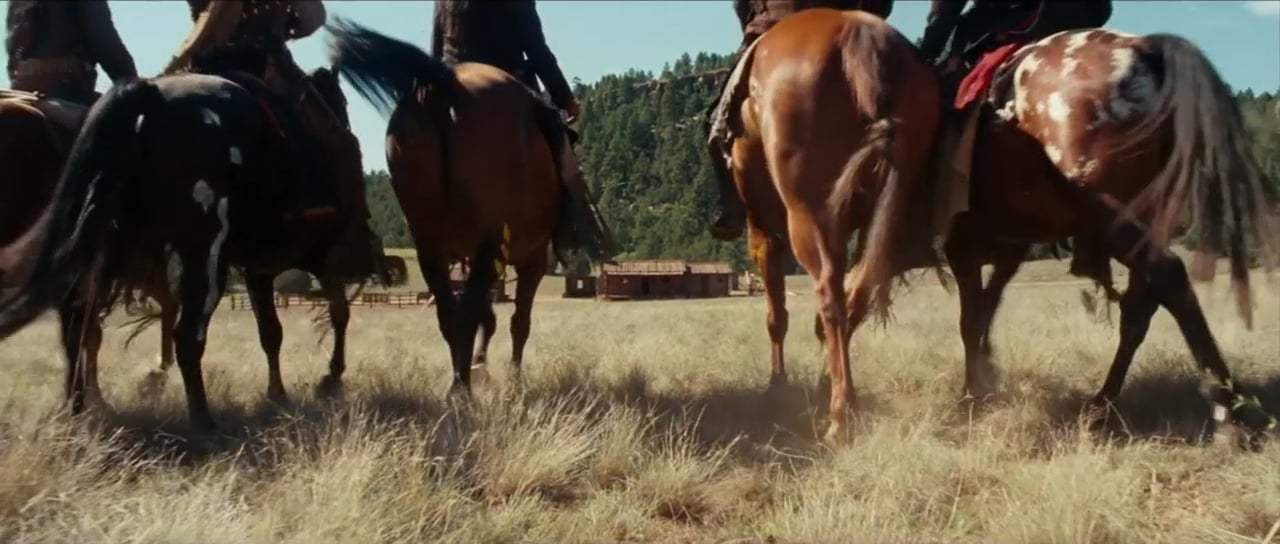
Berringer's commander, Biggs, (Stephen Lang) has orders—"a cause celehbray"—from President Harrison: one of the fort's prisoners, a Cheyenne Chief named Yellow Hawk (Wes Studi), is dying of the cancer and Biggs wants Blocker—and no one else—to escort him and his family back to "The Valley of the Bear" in Montana so he can die in his homeland. Blocker is adamantly opposed to the idea and refuses, to the point of insubordination. As a conveniently expository reporter for Harper's Weekly informs us, Blocker has probably scalped more men than Sitting Bull "himself," and while Blocker acknowledges that it is not his place to disagree, he will not carry out the orders and would just as soon cut the throats of every member of the family. Biggs tells him to sleep on it; he leaves in the morning.

After a night straight out of a Terrence Malick movie where Blocker walks out to the prairie with a thunderstorm in the distance and screams his protests about it, he gears up and takes a squad with him: Metz (of course); buffalo soldier Corp. Henry Woodson (Jonathan Majors); a rookie out of West Point, Lt. Rudy Kidder (Jesse Plemons); and a Pvt. Phillipe Dejardin (Timothee Chalamet), who everybody calls "Frenchie." Once out of sight of the fort, Blocker stops the party saying "the fuckin' parade's over," takes out two Bowie knives and orders Yellow Hawk to dismount, offering him one of the knives. The Chief scrutinizes the Captain "I do not fear death" he says in Cheyenne, and Blocker orders the two Cheyenne males to be chained up for the rest of journey to Montana.
They don't get too far until they find the Quaid farm, still smoking, the dead unburied, and Mrs. Quaid sitting in the burned out husk of her home, still holding her dead infant, with her daughters tucked neatly into bed. She demands that they not be disturbed, and Blocker, with a career of dealing with tragedies like this, places the emphasis on comfort rather than pushing the realities of the tragedy on someone still in shock. Even the offer of burial of the loved ones is dropped...immediately...when the woman, in her grief, demands she do the job herself. She digs and digs why the soldiers stand by, finally pawing in the dirt (much like Blocker raked the ground in the "Malick segment") until assistance is gently offered and she acquiesces, allowing for a service to be performed just after the sun has dropped below sight.
This hasn't gone unnoticed by Yellow Hawk and his party. The old chief goes to Blocker and requests that he and his son be unchained to better assist in any defense against the Comanche renegades. He is entirely practical and sees danger for all parties "They are snake people," he tells Blocker in Cheyenne. "They do not discriminate." The words weigh on the captain but he will not relent. The chief may make sense, but not enough to soften his caution. For him, it comes down to deeds, not words. It is only after an encounter with the Comanche that leaves Woodson wounded and Dejardin dead (and three of the Comanche dead, one by Yellow Hawk running over him with his horse and another by his son, Black Hawk (Adam Beach) strangling him with the very chains that bind him does he relent. The Captain can be practical, too.  
He's also different than most Western heroes. You know the type. Most of them are fierce subscribers to the idea of "Manifest Destiny," (as in "there's a wilderness to be tamed and, by God, I'm the one to do it"*). The wilderness is one thing, but the indigenous peoples living on it before them is quite another. Most of the time, we just get the settlers' view of things, but about 50 years after movies were created (and "the Western" along with it, scarce decades after the real thing happened), we started to get a thread of the viewpoint of the First Peoples' point-of-view which can be summed up as "there goes the neighborhood" or more contemporaneously "who let all these foreigners in here?" The making of the nation was pretty much boiled down to a governmental experiment combined with a continental race war. But, it really wasn't until John Ford made The Searchers in 1955 that we got to see the racial aspects of the Western, and it was write large when its top-billed star—John Wayne—played the character of Ethan Edwards, a complete and total (and unrepentant) racist.**
Your initial impression of Captain Joseph Blocker leads you to think he runs along the same lines—and director Cooper nudges the cine-philes in that direction by opening with a similar family massacre and a shot from the interior of the house that frames Nature in a doorway in the same manner that The Searchers did in its initial images. But, Blocker does not see things as merely black or white, but more of a shade of mordant gray. He's not a strict racist, per se (and his tearful leave-taking of Corporal Woodson is meant to dispel the notion), he just hates Indians—at least his experience as a soldier has taught him that that should be his first line of defense. He's seen too much death, and, in turn, caused too much of it to think that any business with Natives is not a good business. And it comes to him as naturally as putting on his uniform.***
And, as if to prove the point, Cooper takes it a step further; at a Colorado outpost along the way (where Woodson can be doctored) and Mrs. Quaid might take her leave, Blocker and his troop are given another task—escort Sgt. Charles Willis (Ben Foster) to Montana to be hanged for murder. He's given a couple more guards, and, despite the offer of sanctuary, Mrs. Quaid opts to continue to ride with the troop to Montana. And it is this portion where most of the reviews of Hostiles has been a might unfriendly.
Some of the accusations against Hostiles comes to its length at just this point—some folks think you don't need the Willis character, but I see it as a bit of reinforcement to shore up what might be a too-easy character arc for Blocker if it did not exist. Willis provides him a chance to look in a dark mirror, and see what might transpire of a man who goes down a wrong path. Willis—who once served with Blocker, and was at Wounded Knee with him—has taken his military experience and gone off the rails, murdering civilians, crimes for which he has been convicted and is on his way to be punished for. It may pad the movie a bit, but it does allow the alternative side to be heard from; Willis and Blocker are not the same man, but their paths are marked by similar times and occurrences, the accumulation of which have created the men they've become. Blocker could let those instances influence his choices, let the past influence the future, holding the names of the men killed under his command as a shield...or an excuse. His prisoner is the bad angel tempting him from the path he appears to be taking—made manifest (in all senses of the term) with his own destiny hanging in the outcome.
As you might be able to guess, I love Westerns. It's one of the two genres (besides science-fiction) that puts a mirror to our current age, speaking to us from the past (or the future), from the "when" about the present, about us and where we are today—about the "why" and the "how". Somehow, putting us in another frame of time puts us in another frame of mind, as well. The locale is different, but we can still recognize the human condition while it teaches us from a different perspective than the familiar, if we choose to recognize it.
Hostiles is of an age, 'way past the films of John Ford (although it pays homage to The Searchers), which dared to even bring up the matter of race in movies that were considered just "cowboys 'n injuns," to consider the Western as myth—and, as such, makes more than a passing reference to Eastwood's Unforgiven (even cribbing a line from it) and bringing a certain spin on the same director's The Outlaw Josey Wales—in how the battle to build a Nation exposes the best and worst of our natures, and, if we survive it, how, after the last echoes of gunfire fade, we choose to continue the journey—by looking back or looking forward? Do we continue it by building or by retrenching? Do we look to our bloody past or look to an uncertain future? Where is there security in either?  
Hostiles has a preference, obviously, but, in its penultimate sequence it still challenges those assumptions, by putting another challenge—another dark mirror—in the way of civilization...of nation-building. The choices are elemental, the ramifications complex, but it comes down to choosing sides...and what side you're on.
Like I said, I love Westerns, and I like them best when they're challenging. And Hostiles is one of the most challenging of the breed.


* See also: "a man's gotta do what a man's gotta do."

** If you could get past the fact that the character was played by traditional Western hero, John Wayne (which a lot of people couldn't). Some people see him as a hero without noticing that the one GOOD thing he does goes entirely AGAINST his previous intentions and inclinations...and that the movie basically shuns the character and bars him from civilization.

*** Christian Bale has a funny little character "tic" when his character is thinking—he rubs his scalp at the line of his hair...as if he's valuing it and saying good-bye to it for the last time if he thinks wrong. 

Saturday, September 13, 2014

Avatar (2009)

Re-published from 2009.

"I Was a Marine in the Na'vi Reserve"
or 
Dances with Smurfs

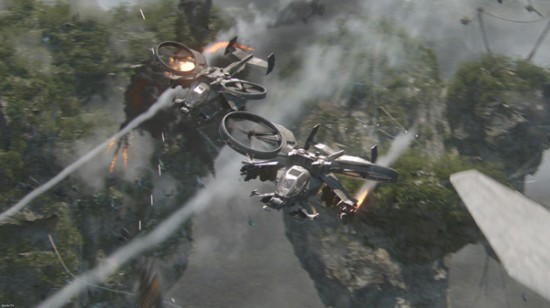
Avatar is this Holiday season's elephant in the room. It is too big a target to not take pot-shots at, and will probably be too successful to avoid the temptation. Not that one needs motivation; there's plenty to be critical of. Like that proverbial elephant, take away the visuals and it will be seen as bits and pieces of other films: a little bit of this, a little bit of that. Something old, nothing new, something borrowed, and mostly something blue. Yes, it's derivative* (all James Cameron's films are). Yes, it's 3-D effects are spotty (Cameron can't resist getting too close to the "lens" frequently, so that the tip of things lose their coherence, and close-up ferns tend to become transparent, and there are early sequences that just move too fast for clear 3-D optics). The right-wing pundits will blast it for being "anti-military" (Can't argue with that—an occupying Army force that is the muscle for a rapacious corporation is the villain**—we've seen that in The Abyss and Aliens—on the other hand, Cameron gives them the coolest toys). Yes, it's too expensive. Yes, it's big and obvious and dumb. I'll grant you all of that. Sure.
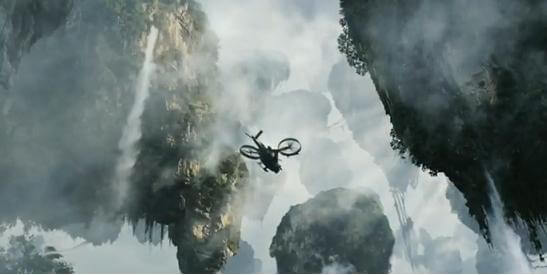
But, damn, if it isn't fun. And thrilling. And at times stunningly beautiful, even breath-taking. There are moments (when Cameron actually feels the need to slow things down so you can appreciate it) when the imagery evokes such awe that you forget that you've seen it before in other films, and sometimes done better.
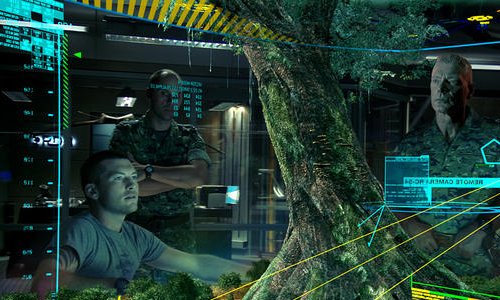
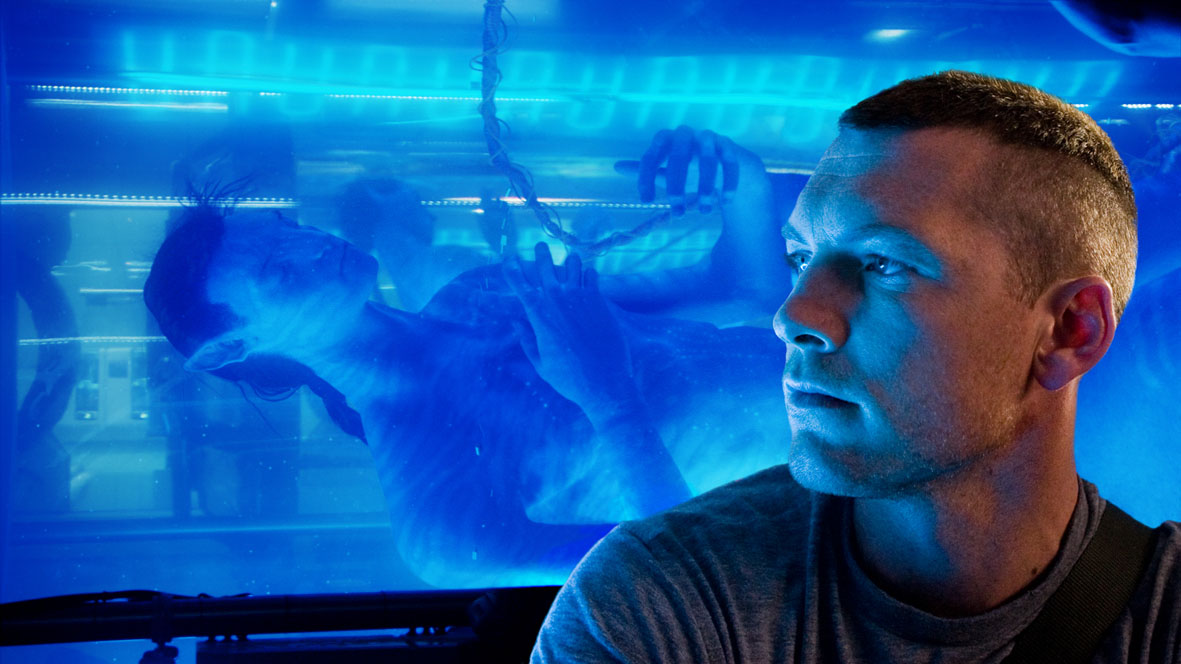
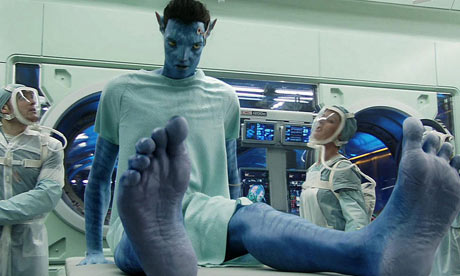
In the year 2175, paraplegic Marine Jake Scully (Sam Worthington—well, his head, anyway, the rest is an actual paraplegic) is offered the chance to replace his late twin brother in a scientific program to blend in with the indigenous tribe of ten foot tall aliens called the Na'vi. Brother Scully had been in training for years for the task, but because Jake's DNA matches his brother's, it's easier to let an untrained rookie with conflicts of interest take his place rather than train a replacement for such an essential mission. That mission is to move the Na'vi off their sacred land that contains a rich source of what the decimated Earth needs to run its machines, a floating mineral called "Unobtainium."***
There were legitimate titters in the audience at that one. It is indicative of Cameron's grab-bag approach to Avatar that he seriously uses a scientific in-joke, as well as exposing how little care he was taking with the story. "Unobtainium" is just lazy writing, like a detective looking for an actual "McGuffin," or a tech explaining that those scanners run using the latest "Vaporware." He couldn't come up with a more clever name like "dilithium," or "adamantium," or "Upsidaisium," or "Wedonthavenuffovum?"****
Apparently not. Because what we have in Avatar is a case of James Cameron becoming George Lucas. The two have been at odds over the years with competing films and competing SFX companies (although Lucasfilm's ILM—not Cameron's acquisition Digital Domain—worked on the FX of Avatarthe majority of which were done by New Zealand's WETA) that now the Tiger-hunter has become the Tiger. Avatar is the equivalent of the sumptuous "Star Wars" prequels, with more care given to how ships look when they land than to how people sound when they talk. We have more of the 22nd century humans using contemporary 20th century idioms and lame wise-cracks. No one's advanced—Earth is infected with a military-industrial simplex whose short-term strategies have decimated the planet (the corporate weasel is played by Giovanni Ribisi, rather than Paul Reiser this time, and the off-his-rocker military honcho is Stephen Lang, rather than Michael Biehn--Michelle Rodriguez plays the Latina soldier in the wife-beater, and Sigourney Weaver...is still Ripley, believe it or not.) Your afterward discussion meal will be peppered with discussions of "Well, if they could do THAT, why couldn't they do THAT?" and so on.
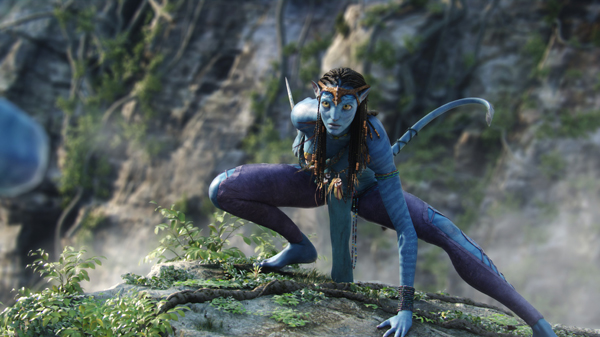
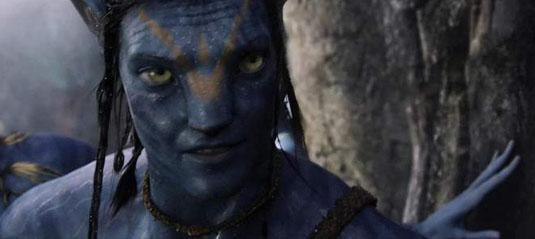
The Na'vi are innocent cat-like savages with golden eyes bigger than those in Keane paintings. They have three fingers and a thumb on their hands and six toes on their feet—if that sounds a little evolutionarily suspect, here's another one for you: the horses on Pandora have six legs, two in the back, four in the front. The people are based on every "noble savage" cliche ever used in the English language—everyone speaks in low, measured pronouncements and the chief is played by Wes Studi (it's always Wes Studi--I love him, but, c'mon!), his obligatorily high priestess of a wife is CCH Pounder, and their daughter, the princess—with whom Sully becomes romantically involved, opening up the floodgates to sources—is played by Zoe Saldana (Uhura of the new Star Trek). Nice cast, but they weren't given much to do to stretch their acting muscles—in fact, the roles are a little regressive. There's more challenges voicing a Disney film.
Get out those 3-D glasses, kids (No, the tinted ones)
One watches with a gob-smacked smile on one's face, but before too long it's apparent how it's going to turn out...and what complications are going to ensue before we get there. One has to conclude that, except for his technological savvy and his rather loopy art design, Cameron just doesn't have any new ideas. If you're looking for revolutionary in your films or film-makers, it is not here.
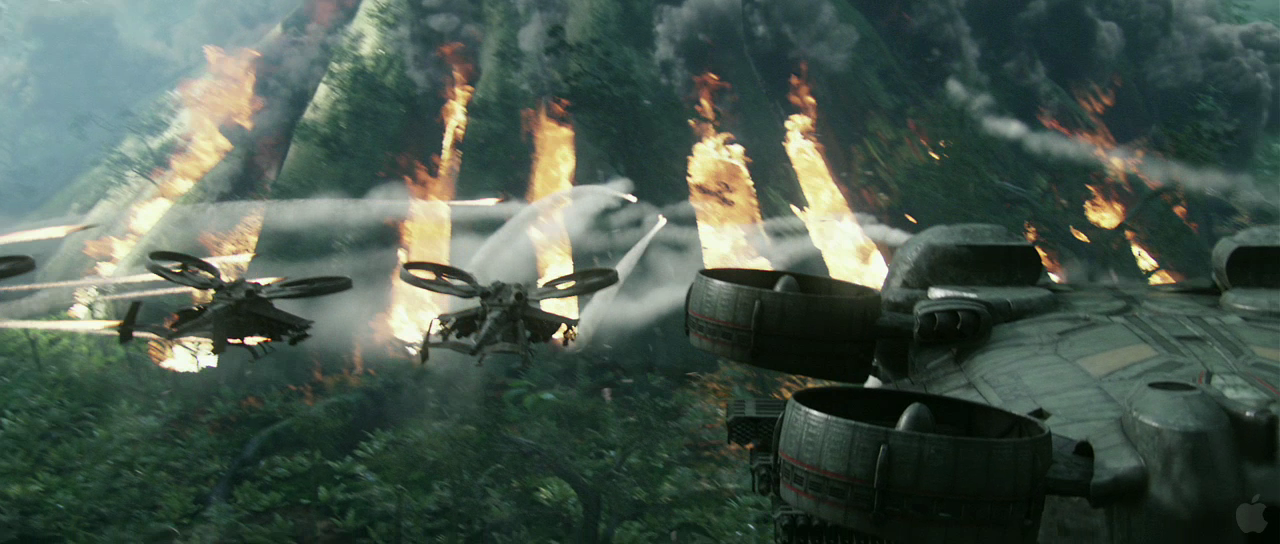
And, as you know it would, it all climaxes with an all-out battle between the Na'vi and the military, which Cameron knows how to direct so it's quite a bit more effective than a "Transformers" battle. It's mighty violent with lots of explosions and death and some nasty punctures by big Na'vi arrows. Parents should be warned—I saw a bunch of kids go into hyper-activity during the battle scenes. You're going to wish you had one of Cameron's heavy-lifting "AMP suits" to get 'em back into the car.

But,
as a sci-fi re-telling of the "Native" tropes written by European writers, it's fun. Just don't be disappointed once the fancy wrappings are taken away, you find it's the same present you got last year.


* Aw, why drag it out? The sources are Run of the Arrow, the "Pocahontas" story, Poul Anderson's "Call Me Joe"(which is about humans using brain-linked native avatars on Jupiter), Dances with Wolves, "Dune," FernGully, heavy doses of Edgar Rice Borroughs' "Tarzan" and "John Carter of Mars," the "Dragonriders of Pern" series, the original storyline of Star Wars (in which a primitive tribe defeats a technologically advanced one—a Lucas favorite theme), allusions to the decimation of the American Indians, the VietNam War and the War in Iraq. And if it's a "'civilized' man learns from indigenous tribe that they are more civilized than him" story, it's in Avatar.


** There wasn't. I'd forgotten—The company releasing Avatar was 20thCentury Fox, part of Rupert Murdoch's News Corp. There were no conservatives grumbling until after the movie had cleared $1 billion dollars in receipts.


*** "Unobtainium" was also used in The Core—it is the metal coating plating the ships to make them resistant to molten temperatures and pressures.

**** "Dilithium cystals" power the U.S.S. Enterprise (rather than what Dr. McCoy prescribes Kirk for...his...ADD), "adamantium" is the metal that coats Wolverine's bones, "upsidaisium" was an anti-grav metal in "Rocky and Bullwinkle
," and "Wedonthavenuffovum" I made up.