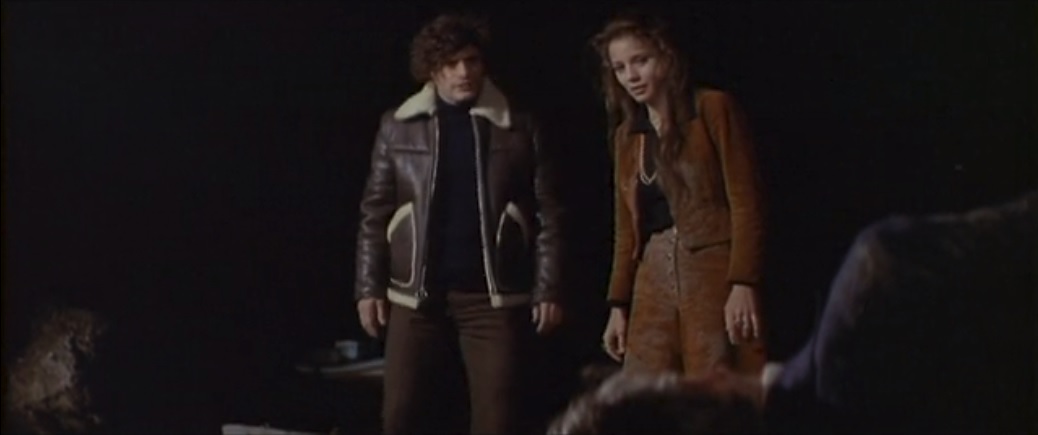
The Last Run (Richard Fleischer—after John Huston, 1971)
"Father, I have sinned. Lately, I haven't done much of anything. I don't believe much. There's this thing I have to do and I want to do it right. It's the only thing I know. It's for money. But, I would like to do it right. That's all."
Harry Garmes (George C. Scott) is a driver. He used to work for the Outfit in the U.S. and for the past nine years has been living low in self-imposed exile in Portugal. His only child is dead. His wife's run off. He has few companions—his friend, Miguel, with whom he started a fishing business and ended up just selling him the boat; and Monique (Colleen Dewhurst), a prostitute with whom he is involved but not romantically. Both are business ventures. That's all.
If he has a passion, it's for a relic of the past—his vintage 1956 BMW 503 Cabriolet convertible, which Harry has customized with a supercharger—and Harry dotes on it, like a family doctor. In the title sequence—accompanied by a stately romantic theme by Jerry Goldsmith, dominated by cimbalon, strings, and harpsichord—Garmes does some final adjusting, listening, fine-tuning. We don't know it yet, but he's making final preparations for a job. It is his first in nine years, and he wants to make sure it is done right. At least, that he does his job right.

He does a test-run of the Beemer, pushing it to its maximum, and, satisfied, he does a final visit to Miguel and Monique. He leaves her with an envelope of money that he may need when he comes back—if he gets back. If, after a time, he has not retrieved it, the money is hers. Then, packing lightly, and securing a gun under the dash, he takes off for the job. On the way, he makes one last stop.
At a provincial church, he enters and takes a look around. Except for a single "vieja", the place is deserted. Seeing a confessional, he crosses over and kneels and slowly stammers out the speech at the top. Then he gets up. As he walks out, a priest comes out of the vestibule and asks if there's anything he can do for him. Harry realizes there was no one in the confessional, he was just speaking to empty air. "No, I've done what I need to do." He walks out.
His instructions are to drive to a certain spot and wait. He's given a photograph, which he memorizes and burns. He cleans his pistol and takes a long, scenic drive through the Spanish mountains to his rendezvous. He doesn't know what he's waiting for; he has the picture, the place and that's it. It's all he needs to know, except that he'll be driving his passenger to France to another rendezvous. Simple enough.
It's never that simple.
When Harry gets to the spot, he witnesses a rather elaborate set-up for a prison-break and his "package" escaping undetected by the guardia or anyone else. It is Paul Rickard (Tony Musante) and Garmes makes quick work of stashing him under the back-seat, throwing him a wig and a change of clothes and then gearing out of there while the authorities are still confused. It is miles before, he lets Rickard see the light of day and peppering him with questions about what he knows (nothing). But, he does find out that Rickard is more of a hired-gun than a safe-cracker, that he has plans beyond just getting to France—like hooking up with his girlfriend, and that he is one irritating, cocky son-of-a-bitch. "The job" just got that much worse.

It just gets "better" and "better." When they get to the hotel that Rickard has specified, they find Claudie Scherrer (Trish Van Devere), who has been waiting for them for two weeks. Garmes is annoyed—she gives the trigger-happy Rickard a gun, while the young tough decides he's in charge constantly needling Garmes by calling him "Uncle" and a "dinosaur." Garmes already feels like a third wheel on this job, and he sees which way it's going. He decides to give the couple his intended double room, taking the single Claudie had been staying in, but on his way out asks to speak to Rickard privately out in the hall.
He slams Rickard into a wall face-first and puts a choke-hold on him, rasping that he's in charge and he won't be anyone's punch-line. Rickard, mollified for now, sulks back to his room, while Garmes goes up to the girl's room, finding the sink filled with her soaking underthings.
He dutifully hangs them to dry and gets some fitful sleep. His run is suddenly more complicated and a lot more dangerous—what do his old mob-cronies want Rickard for? He's a hit-man, not a safe-cracker and hit-men are a dime a dozen. Who is on the other side of the trip to France and why do they go to all the trouble for this punk?
It turns out Garmes fears are warranted. Rickard is in jail for assassination and is to be delivered to France for disposal. That's the job. But, having completed his task, Garmes can't help but go beyond the bounds of the job and do a little over-time, getting involved against his better judgment. Why? Claudie may have the answer: "We're his family." And, as irritating as Rickard is, Garmes can't help but feel protective towards Claudie, even though he suspects Rickard is using her to influence him.
 |
Fleischer is adept at using the film's widescreen format to show the
obvious triangulation between Harry, Paul and Claudie. It might have
been too obvious a visual trick for Huston. |
The three turn into a dysfunctional triangle of fugitives, on the lam from the very people Harry is working for, and the longer that they are in his care, he's in danger. So, he finds an alternate way to get them to a sort of safety, against his older, wiser, better judgment.

The tag-line in the film's promotional material is "In the tradition of Hemingway and Bogart," (although Bogart only did one movie based on a Hemingway story—Howard Hawks' To Have and Have Not) and Scott, in an interview in Time Magazine at the time of filming, said he was making the movie because it reminded him of old Bogart movies. Scottish writer Alan Sharp—who also wrote Arthur Penn's Night Moves—may have had that intention (the Garmes confessional scene certainly has the feel of a disjointed Hemingway monologue) and the film feels a bit like the earlier mentioned Hawks movie as well as a similarly-themed film by John Huston, Key Largo. In both, a principled, if shaded, man must make a decision he wants to avoid, as circumstances are forced on him. The Last Run certainly carries that theme, but with much more of Hemingway's existentialism than with a studio-enforced happy ending.

Interestingly, Richard Fleischer wasn't the first director on the project. John Boorman was but left the project (going on to make Deliverance, instead—good move). John Huston took over the project, having worked with Scott twice before—The List of Adrian Messenger and The Bible: In the Beginning—but the two got into loggerheads about script re-writes and the casting of Tina Aumont (daughter of Maria Montez and Jean-Pierre Aumont) as the female lead. Huston left the production quite soon after the start of filming, taking over quickly and efficiently, and working with Ingmar Bergman's director of photography Sven Nykvist.
The film did not make money, and wasn't considered a success, either at the box office or artistically, despite Scott's post-Patton notoriety. He would bounce back the next year with The Hospital (written by Paddy Chayevsky) for which he was again nominated for the Best Actor Oscar—which he again refused to acknowledge.
I recently participated in an episode of the podcast Forgotten Films where I helped discuss this rarely seen troubled Scott film. Hope you give a listen.
 |
| Scott and Huston in the early days shooting The Last Run |