Showing posts with label Tom Waits. Show all posts

Tuesday, May 3, 2022

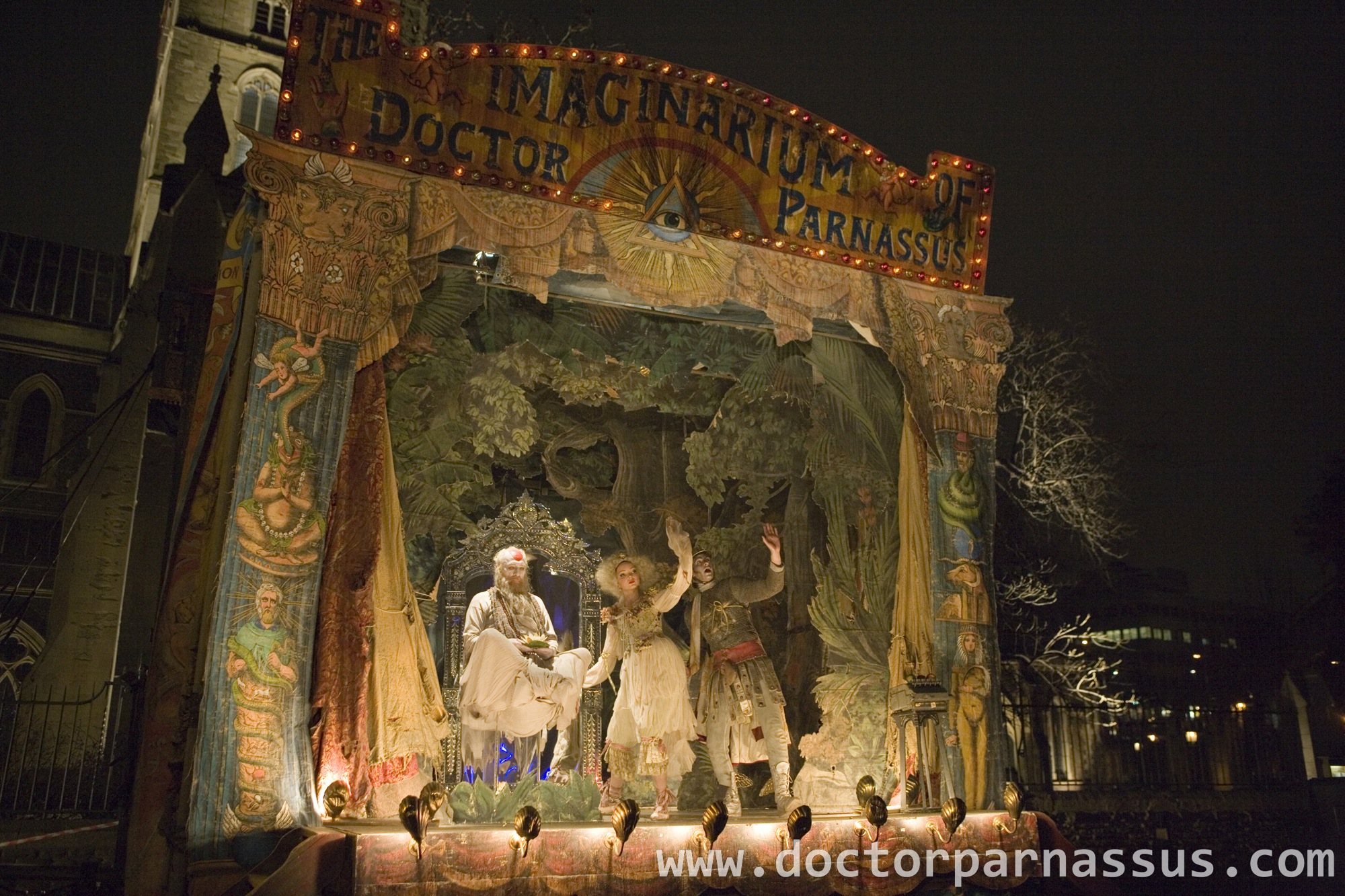
The Imaginarium of Dr. Parnassus

Written at the time of the film's release...
 
And...at the time Avatar had come out and marching towards becoming the "#1 Box Office Champion of All Time." I was underwhelmed by it—there's a link to my review buried down there if you even care. On the other hand, nobody was going to see this film, which, as you can tell if you read it, I found a shame. One can advocate, but people are going to see what they want—it's their money, after all—and it's all a part of the free market (or as some would label it, "cancel culture"—the Supreme Court seems to think what you do with your money is free speech, even if you're paying for it). But, just as I quixotically advocated for The Imaginarium of Dr. Parnassus, I would also urge people to see the wonderful Everything Everywhere All at Once, which, in a multi-plex of less imaginative offerings has far more bright ideas and film-making brio than the rest of the offerings in said multi-plex combined.

"Ladies and Gentlemen, This World is Full of Wonderment for Those with Eyes to See it."
 
 
One must consider the momentum of publicity when one talks about James Cameron's Avatar. The tsunami of NewsCorps force-fed publicity and societal group-think has done its job on the populace and the majority are of one mind. At this point, I've heard too many smart people saying that nobody will ever make movies the same way again, that it's ground-breaking, and (okay) the story isn't much, but the visuals are so spectacular it compensates for the stunning more-of-the-sameness of the blah-blah-blah.
 
You don't know what you're missing. There is more imagination, thought and, gosh, genuine wit going on in the "mirror" sequences of The Imaginarium of Dr. Parnassus than in anything in Avatar. Hell, even the non-CGI "live" sequences are amazing to look at.
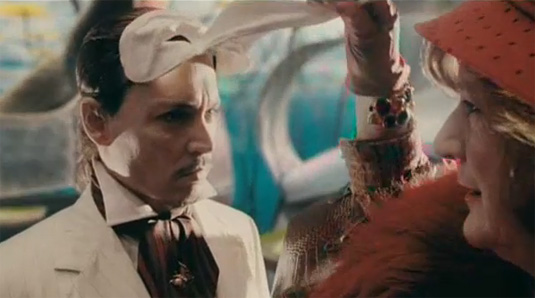
But...nobody's lining up to see Imaginarium. And that's a shame. For, if you want a fantasy film brimming with ideas, some of them quite provocative, it is this one, directed by that most snake-bit of directors, Terry Gilliam. It has been abundantly documented ad nauseum the tragic story of this film: how star Heath Ledger died in the middle of filming, and how a corps of Ledger-Gilliam supporters—Johnny Depp, Jude Law, and Colin Farrell—stepped up to play the visages of Ledger in the "Imaginarium" sequences (actually it seems perfectly natural the way Gilliam does it), but what isn't reported is that Gilliam was hit by a bus and broke his back during the filming.* Despite these alarming developments that would halt anyone other than a crazy "Monty Python" alum, the film is rich in detail, bursting with context, and doesn't have that "scrimping" footage-stretching feel that so many films-in-trouble give off.
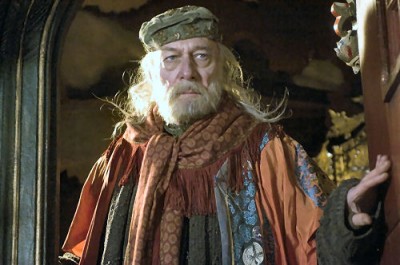
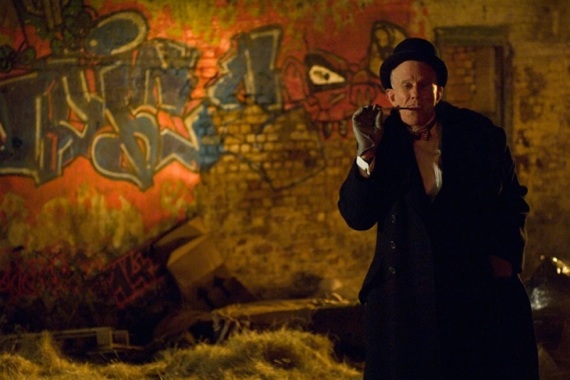
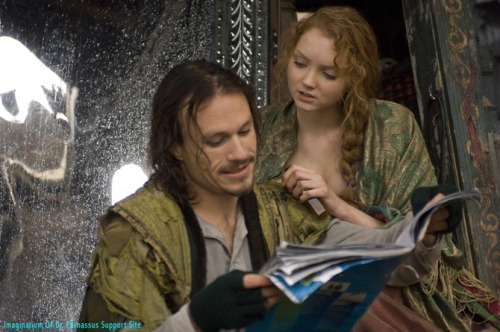
It's basically a fairy-story set in our world (or a delirium dream, not sure) where Dr. Parnassus (Christopher Plummer) is an immortal, who, with his rag-tag theater troupe—assistant Percey (Verne Troyer), barker Anton (Andrew Garfield) and daughter Valentina (model Lily Cole, whose alarming face is that of an alabaster porcelain doll)—travels in an out-sized Bergman-crossed-with-Joad horse-drawn wagon/convertible stage, enticing marks to enter his "Imaginarium," a mirror that sucks the hapless into Parnassus' bizarre mind-scapes, where they either live...or die. Parnassus, you see, has made a deal with the Devil. Inhabiting the old man's mind, as he does most of ours, is Mr. Nick (Tom Waits...of course), who has his own lures to the impure of heart. Enter one of Nick's speak-easy's or one-night-stand motels that stick out like sore toad-stools in the landscape and BOOM! the Devil takes your soul. And the bottom line of the Devil's deal is a certain number of souls before Valentina's sweet 16th birthday ("The age of consent" she trills) or her day of freedom becomes her day of imprisonment, as the Devil claims her for her own. A situation as Grimm...and familiar...as can be.
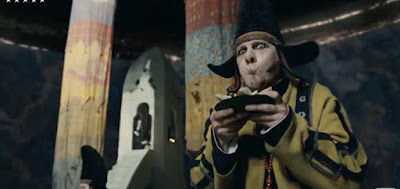
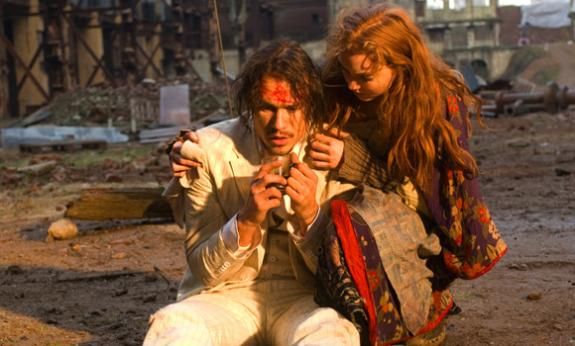
But Gilliam's Devil is in the details. The little band are aided in their quest by an amnesiac named Tony (Heath Ledger) whom they save and who, in turn, tries to save them, but whose past comes back to haunt and threaten them. Ledger is at his quick-silver best here, his accent wavering through several dialects, his eyes darting (all qualities picked up by his capable alter-ego's), for Tony is a chameleon, a huckster, the trickster of Myth—which Gilliam uses to savage satiric effect—and is a devil of his own, capable of destroying what he seeks to save. The battle between Good and Evil, Duty and Temptation turns complicated, and Parnassus must bargain again, at great sacrifice, to save that which he loves most, whether it's wished for or no.
The Devil's in the details for the look of the film, too. The "real-world" that the "Imaginarium" wagon trundles through is our world, but it's a world of extremes: back-alley garbage-lands with trash-fires that litter the scene (where the rag-tag group seems to fit most) and vast temples of commerce-malls, where Tony, with a marketer's zeal attempts to bring new customers. Each of these victims have their own "Imaginarium" realms: a wealthy dowager emerges into a vision of giant fashion-shoes, another a 2-D pop-up book forest. At one point, a falling "Imaginarium" customer takes an incredible fall, and Gilliam cuts to an improbable "Python" joke—a giant thumb-tack—sitting in the middle of nothingness (Gilliam mercifully, for the moment, has the hapless mark miss the point). And even outside the mirror, there are wonders of movie-making brio. In a scene where Percey walks away from Parnassus with his usual bluster, Gilliam shoots the diminutive Troyer at a heroic looking-up angle—the camera had to be scraping the street.
Now, a confession. It may sound like I'm gushing about Gilliam here, but I've always had a problem with his films: I fall asleep through them. It's not that I'm bored, but there's something about the richness of detail, the constant flow of new things to look at, and the murky lighting that induces narcolepsy in me. Before seeing a Gilliam film, I try to load up on coffee and sugar to get through it. I have no idea why this occurs (maybe it's
Rapid Eye Movement caused from the orbs darting about the screen), but it is inevitable—it occurred here through the Jude Law sequences
—but I managed to keep my eyes open throughout the whole thing this time.
If the film is flawed, it is that it tries to do too much. Even with a simple story, derived from old fairy-tale tropes, Gilliam again attempts to fit 10 pounds of story into a 5 pound film. Complications begin to pile up, revelations are delayed, little troubling details are revealed—there's a convenient pitch-pipe here—and everything becomes resolved in an ambiguous and hasty manner. Like most Gilliam films, a second viewing may make murky matters clearer. 
Plus, the overall story has a premise open to interpretation...
is it a "God versus Devil" story, or merely a fairy tale? The Christian Science Monitor's Peter Rainer thinks it may even be autobiographical with Parnassus a mask for Gilliam, "a mad dreamer forever riven between his imagination and the necessity to sell it."** And like his "Python" fraternity, there's a streak of dark running through this, as with all Gilliam films (remember how Kevin's parents are killed at the end of Time Bandits?), that may be off-putting for some viewers. Fans of Gilliam's films should expect it, but those who prefer their fantasy milkier may not like the taste of the dark stuff. Avatar is far less subtle, more a punch "on the nose," and although dark, gives the impression of a happy-ish ending.
So, it is doubly appropriate that Imaginarium brings me back to Avatar. For what is Gilliam's film but a re-working of the caution "You can fool some of the people all the time, and all the people some of the time," and that includes the Devil, but the Devil gets his own.
What's Gilliam's next movie? Well, he's determined to go back and film his
Don Quixote movie, come hell or high water.*** It is only appropriate for this most quixotic of film-makers, forever charging against the impossible odds at realizing the incredible visions wind-milling in his head.

* Here, the endlessly inventive Gilliam made lemonade—convincing the bus company to provide transport rather than face a law-suit, thus saving lots of production money. And, if all of this wasn't enough, producer William Vince died right after filming. The film is dedicated to Ledger and Vince, and credited as "A Film by Heath Ledger & Friends." 
 
** Nice observation, that. But Rainer also thinks Ledger looks "dispirited" in the film--well, yeah, the character's just gone through a painful transition, but Ledger's performance of it is never less than audacious and energetic. I'm guilty of it, too, but critics shouldn't try to read actor's minds--they're chameleons, after all, when they're doing it right, and we should speculate cautiously when ascribing motivations to surface appearances on film.
 
*** He did. The Man Who Killed Don Quixote was released in 2018.

Tuesday, January 4, 2022

Licorice Pizza

What Makes Gary and Alana Run?
or 
Once Upon a Time in Paul Thomas Anderson's Encino
 
"I'm never gonna forget you. And you're never gonna forget me."
 
At some point, the current crop of filmmakers go back home. Lucas did American Graffiti, Linklatter did Dazed and Cofused, Tarantino made Once Upon a Time in Hollywood. They take stories and attitudes and landmarks and build a movie out of it. Nostalgia, certainly. But, also an homage to a better time of life (certainly for them), not dealing with critics and unions and divas, when the dreams were simpler and just within grasp. Aspirations went with ideas and not with box office, and the chance to tell stories the way you want to tell them is the biggest aspiration of all.
 
And so, makes Licorice Pizza about a time that can't be recaptured, merely recreated and certainly not eulogized. These things are supposed to be celebrations. The film takes place in 1973 (Anderson was born in 1970, but started making films when he was eight), so there is more than a hint of idealizing the period, as its young protagonists bumble through the California Dreaming and Ambition that typified the era in the post-Summer of Love/Manson-Psychosis.
Meet Gary Valentine (
Cooper Hoffman); he certainly wants to meet you. Gary is a child actor who's aging out of the industry, but has found a new outlet for his precociousness. At 15, he has a public relations firm in partnership with his mother, and he is always on the eye for "the next big thing" that will make his future. At his high school's picture-taking day, he is struck by a lightning bolt in the form of photographer's assistant Alana (Alana Haim), 25 years old, and both stand-offish and alluring. Gary loves a challenge and he asks her out for a date. As if! He's a high school student and a pimply one at that. But, Alana is still trying to find herself, and so, to her surprise, she takes him up on it, at a darkly upholstered watering-hole that Gary's company has done work for.
There's an agenda for the rendezvous; Gary has to fly to New York to do a promotional gig on "The Ed Sullivan Show" for this movie he did with Lucy Doolittle* (
Christine Ebersole). His mother has to stay behind to watch the business, and Gary, being underage, can't fly across country unsupervised. So, he asks Alana if she'll be his "chaperone". For him, it's a mere complication that needs to be dealt with, like re-scheduling a meeting; for her, it's just weird, she's an adult and she has to supervise this horny kid. But...it's a chance to fly across country. It's a chance to go to new York. It's a chance to be behind-the-scenes of show business.
It's a chance to be an adult.

Alana is from a strict Jewish family straight out of "Fiddler"—three daughters who are expected to "shelter in place." For her to be in charge on this trip, it's a thrill, no matter how odd it is to be with Gary, and it starts a series of adventures and misadventures that up-ends the traditional trope of "girls mature faster than boys." It's true to a point, Gary is incredibly immature emotionally, but has enough chutzpah and charm and manner that he's comfortable in any room he walks into. Alana is the more mature—to a point—but she's hindered by self-doubt and limited life-experience. Together, they're a power-house combination: where one is deficient, the other is strong (he can't drive; she can).

It's just the emotions get in the way. They're both smitten, but not in love. They're more partners, co-conspirators. So, Gary gets Alana an agent. Gary discovers there's this new thing called a "water-bed" and determines to be the most successful retailer in the L.A. area. When Alana starts working on the mayoral campaign of councilman Joel Wachs, she hires Gary to shoot some promotional pieces and Gary uses insider information overheard in the campaign headquarters to start a pinball arcade business.

But, with those adventures come friction. Alana's agent gets her a meeting with producer-star Jack Holden** (Sean Penn), who has dinner and drinks with the aging star, which is witnessed by Gary in a simmering jealousy. That's pay-back from Alana, who Gary hired to promote water-beds at his brick-and-mortar store only to ignore her for a class-mate at the opening. Alana is miffed that Gary has used the insider information to build his arcade business and goes for drinks with the attractive Wachs, only to discover that he's just using her as a "beard" to cover his break-up with a lover.
But, the most extended sequence (and the best) is Gary and Alana dealing with a water-bed delivery for one of their customers, Jon Peters*** (
Bradley Cooper going over the top because you can't under-play Jon Peters), which involves Peters' own "irrepressible" personality, the energy crisis, and driving a delivery truck through the Hollywood Hills all mixed into an "incredible mess" scenario that skirts the edges of the "comedy/panic" matrix.
For Anderson, who cast friends, relatives, sons and daughters of friends, and family in the film—and photographed it himself—it must have seemed like making a home movie when he was eight years old. That everyone is so good in it just shows that he's as good at making friends as he is at casting. The script, based on tall tales told by producer/child-star Gary Goetzman is rather shaggy at times (and a couple of times, downright cringey, as the scenes involving
John Michael Higgins' non-Japanese speaking restauraunteur), careening like a teenager's mood-swings, but ultimately, it's momentum leaves you with a smile on your face for one of the loosest movies Anderson has ever made, celebrating the sparking of adulthood's pilot-light before it becomes the smudged simmering of middle-age.
 
It's good to have fun making movies every once in awhile.

* The character is based on Lucille Ball. If you griped about Nicole Kidman's portrayal of her in Being the Ricardos, you will NOT be happy with what Anderson and Ebersole do with her.
 
** "Jack Holden" is based, it seems from dialogue spoken in the film, on William Holden, a movie star somewhat past his prime, but still considering roles where the leading lady is in her 20's ala Breezy.
 
*** Jon Peters is based on the real Jon Peters, who agreed to be portrayed in the movie only if they used his favorite pick-up line ("Hey, do you like peanut butter?") in the script because, after all, he is "from the streets."


Tuesday, November 27, 2018

The Ballad of Buster Scruggs (And Other Tales of the Western Frontier)

One Step Forward, Two Steps Back—That's a Western Waltz
or
"Uncertainty. That is appropriate for matters of this world. Only regarding the next are vouchsafed certainty."
or
"Misanthrope? I don't hate my fellow man, even when he's tiresome and surly and tries to cheat at poker. I figure that's just a human material, and him that finds in it cause for anger and dismay is just a fool for expecting better."

There is a sense of nostalgia that prepares you for The Coen Brothers' new Western anthology film The Ballad of Buster Scruggs (which makes its premier on Netflix and is playing a very few theaters in the U.S., presumably for Oscar award consideration). It starts with a nicely-composed shot of a dog-eared book bearing the same title as the film, familiar for the plain dust-jacket (from a time before marketing became the thing to sell the book) that will be recognized to anyone who's had to clear out the bookshelf of a recently-passed relative, or from a Sunday afternoon perambulation through a used book store. You can practically smell the dust and age of the pages, as a hand crawls into frame and gingerly opens the book to the artistically rendered end-papers and then to the "meat" of the book, where the page-turning pauses on the dedication page, which has these words:
To Gaylord Gilpin
Who shared with us these stories,
And many more alike, one night
in camp above the roaring fork
'til approach of morn stained the sky
and our esteem for him stained our trousers.
This Book is Dedicated
There are six stories in the book, the titles giving no clue as to what they might be about. Turn the page and we see a list of the color illustration plates included in the volume. A tissue protects the illustration and we see the first burst of material showing us the contents, a single image and an arbitrary line of prose that only hints at what's inside, creating a mystery and a void to be filled, a goal to move on to. And we begin...with "The Ballad of Buster Scruggs."

1. The Ballad of Buster Scruggs
Buster Scruggs (Tim Blake Nelson) is a singing cowboy riding out of Monument Valley into what passes for civilization in the day and age, his legs wrapped around his horse, his arms wrapped around his guitar and his throat wrapped around the traditional ballad "Cool Water." Buster is a white-hat cowboy, loquacious of song and speech (by which he is constantly addressing the audience as in "Don't let my white duds and pleasant demeanor fool ya. I, too, have been known to violate the statutes of man... and not a few of the laws of the Almighty!"). His story demonstrates his "downright Archimedean" skills with a gun, and his reputation as the "San Saba songbird" as he creates a quick comic elegy for one of miscreants of poor nature who have the fool-hardiness to draw on him.*
One can see why the Coens were tempted to start with this one, as it is the funniest and most arch of the six stories, recalling to mind the Looney-Tunes nature of Raising Arizona, and with a lovely, goony performance by Nelson that endears you to him, even if, occasionally, it creeps one out. It sets up the tone for the entire film, where The West challenges the expert and the novice alike and Death comes in unexpected and inconvenient ways and should also prepare viewers that, as such, they can be surprising and grisly, as well. 
"The Ballad of Buster Scruggs" is a comic primer for the anthology, showing the film's approach to dusty death and the film's larger message of the nature of wilderness, and the efficacy of trying to rise above it.
"You seen 'em, you play 'em" sneered the hard man.

2. Near Algodones
An outlaw (James Franco) decides he's going to knock over the only game in town (except there's no town)—a bank that looks like it fell right out of the sky to land in the middle of the plains. But, it's just not his day. He has to contend with the institution's sole teller (Stephen Root), who's been through the procedure before, and who, in the opinion of the would-be robber, "doesn't fight fair." 

The outlaw will have very good luck today, but not so's you'd notice.
After waking up, he finds his neck in a noose, with a hanging party all ready to carry out its sentence. Fate steps in to get him out of the jam, but also put him deep into another one. He will ultimately learn that there's a good side to everything as long as he has the time to appreciate it.
"Pan-shot!" cried the old man.

3. Meal Ticket
A humble wagon makes its way through the scarce pockets of civilization that mark a mountain landscape. It is a traveling show, featuring a cultured orator, Harrison (Harry Melling), who has the added fascination that he is a quadriplegic. The show is fairly simple—the curtain of a small stage parts to reveal the orator, and after a dramatic pause that allows for gawking, he gives dramatic recitations of the story of Cain and Abel, and other sources as diverse as Shakespeare, Shelley, and Abraham Lincoln, to the spare audiences looking for diversion from the night and the cold. 
Harrison is under the care of his manager (Liam Neeson), who drives the wagon, posts the bills, prepares the stage, does Harrison's make-up, and provides sound effects for the parts in which God appears and needs accompaniment. He also collects the spare change that the audience provides for their night's entertainment, enough to provide a hot meal cooked over a campfire. The manager does that, too, and feeds Harrison by hand. Lodgings would be too expensive and the audiences are noticeably dwindling the farther they head through the mountains.
The two are tied together in partnership, but the days are long and the rewards are meager. 

"Meal Ticket" is a story of entrepreneurship, reduced in all its hard-scrabble desperation, and the eye toward improving business at all costs with little regard to anything but the sound of coins in pockets, and it resonates as timely as the day's financial headlines that emphasize the bottom line at the cost of human dignity...and life.
"The quality of mercy is not strained, it droppeth as the gentle rain from heaven."


All Gold Canyon
Based on a Jack London story, "All Golden Canyon" tells the story of a grizzled prospector (Tom Waits), who enters a pristine valley with the intention of culling the riches hidden within it, without regard to the wonders that surround him.
He sets up an elaborate system, digging through the dirt, and noting the glittering specks of gold that he is able to pan out of it, to find the vein of gold that he knows must be there, the source of which he calls "Mr. Pocket," that will allow him to leave the valley a very rich man—if he can survive long enough to hit pay dirt.
And in all that mighty sweep of earth, he did not see a sign of man nor the handiwork of man.

The Gal Who Got Rattled
A mail-order bride, Alice Longabaugh (Zoe Kazan) travels with her brother by wagon train to meet her intended husband. But the journey is long and accompanied by cholera, natives, and her brother's dog, named Benjamin Pierce, whose instinct, owing to its city nature, is to bark at anything wild, upsetting the prickly members of the wagon train, already impatient by the deprivations of the long journey.
When her brother dies, Alice is left alone, on her own, with no experience, few prospects, and a singular disposition towards fretting, which endears her to the ramrod of the train, Billy Knapp (Bill Heck), who takes it upon himself to solve her cares and problems, much to the mute consternation of the train boss, Mr. Arthur (Grainger Hines), who has other considerations than those of a worrisome girl, out of her depth, and out in the wilderness.
The longest and most intricate of the stories, "The Gal Who Got Rattled" is based on a story by Stewart Edward White, and one could comment, here, on the top-tier performances and the exquisite photography (shot digitally, a Coen first) by Bruno Delbonnel, who's been doing a lot of work with the Coens, Jean-Pierre Jeunet, Tim Burton and Joe Wright, but that praise can be said for the entire anthology, no matter the conditions or weather they were recorded in. The film is beautiful to look at, frequently threatening to overwhelm the stories, but never quite doing that, becoming an intricate part of the story-telling fabric, the wide expanses of prairie and horizon looming and often overpowering the melancholy insignificances of the tiny figures making their ways through them.
Mr. Arthur had no idea what he would say to Billy Knapp.

The Mortal Remains
Five passengers (played by Saul Rubinek, Tyne Daly, Chelcie Ross and Jonjo O'Neill and Brendan Gleeson) on board a stage-coach as they make their way from a sunset prairie to the enfolding night on their way to Fort Morgan. 
The five could not be less compatible as they hold conversations as to the nature of man and the nature of love on the one side of the stage, while on the other the two partners, Thigpen and Clarence reveal themselves to be "reapers"—bounty hunters, who on this very ride are carrying their latest victim (on the roof of the cabin) to be dispatched at Fort Morgan...but is that the only one designated by the gentlemen who clearly revel in their work? 
Unlike the other segments, "The Mortal Remains" is shot entirely on a sound-stage, even the fronts of the fort's houses are decidedly two-dimensional, but it ends the film on a decidedly creepy, if  ambivalent note, the kind of campfire story best saved for when the last embers glow out and leave only wraiths of smoke.
Whether or not he heard, the coachman did not slow.

And there you have it: the cowboy, the outlaw, the entrepreneur, the prospector, the wagon train, the stagecoach—tropes and aspects of the Olde West, but given a determined melancholy twist that has become synonymous with the works of the Coen Brothers. The Ballad of Buster Scruggs is another genre-busting masterpiece that plants a flag in their careers, as they never do less than interesting work, but there are some that clearly stand out more than others.

The Ballad of Buster Scruggs is one of those. Not a "return to form," so much as one of those where everything works and their experimentation reveals the strengths of the inspiration they've decided to sardonically play around with—in this case, the Western's ability to show us that whatever we may gain, we lose something in the transition, making the genre both the perfect home of triumph entangled with tragedy, sometimes inseparably.

It is, indisputably, one of the best films of the year. Ironically, good luck finding it in a theater.

*


Surly Joe, the gambler, he will gamble nevermore,
his days of stud and hold'em they are done.
It was long about last April, he stepped into this saloon,
but he never really took to anyone!
Surly Joe, Surly Joe!
Oh, wherever he's gamblin' now, I don't know!
He was slick but I was slicker,
he was quick, but I was quicker,
and the table stopped his ticker, Surly Joe!
Surly Joe, Surly Joe!
Won't be missed by anyone, will Surly Joe!
Humankind he frowned upon,
but not now, his face is gone!
Guess your frowning days are done, oh Surly Joe!
Surly Joe, Surly Joe!
A cedilla on the "c" of Curly Joe!
He was mean in days of yore,
now they're moppin' up the floor
One more sight to make him sore, oh Surly Joe!
Surly Joe, Surly Joe!
Where the rest his face has got to, we don't know!
He was never any fun, now his grumpy race has run,
kisser blown to kingdom come oh Surly Joe!

Tuesday, November 6, 2018

The Old Man and the Gun

The Last Ride of the Sundance Kid
or
"Brother, I'm Not Talkin' 'Bout Making a Living"

It's the smile you notice. Forrest Tucker (Robert Redford) walks into a bank and if there's no women behind the teller-stations, he'll ask to see the manager. Then, invited to the manager's office, he'll sit down, smile, and open his coat showing the manager that he has a gun, and (very reasonably) ask for an emergency withdrawal of some weight to keep him from using that seen gun in a way injurious to that manager. He never says that the gun is loaded—psychologically, that is irrelevant—it achieves its purpose without getting into details. And he never has to demonstrate. It rarely doesn't work, and he'll leave the banking institution several thousand dollars richer.

Detective John Hunt (Casey Affleck) interviews employees post-robbery and when he gets to motivation, he strives to keep incredulity out of his voice when he re-states what he's been told: "So, you did what you did because he said he had a gun..." "Yes. And also, he was sort of a gentleman."
Robert Redford doesn't direct The Old Man and the Gun, but he does some producing chores on it, and it is David Lowery (who worked with Redford on his miraculous un-tuned version of Disney's worst musical, Pete's Dragon) who is calling the shots, making a breezy film based on David Grann's* New Yorker article on Tucker**, who became known as "The Gentleman Bandit" cutting a swath through Southern banks in the 1980's. Tucker usually worked alone, and on tougher jobs that needed more co-ordination and a fast getaway, with two long-in-the-tooth associates Teddy (Danny Glover) and Waller (Tom Waits), who became known in law-enforcement circles as "The Over-the-Hill Gang."
When we first meet Tucker, he does a job ("Belmont Texas, July 26, 1991" we're told to give the film some authenticity by place/time-stamps as well as a first title that states "The story, also, is mostly true."***), a hearing aid in his ear (which is tuned to police frequencies), and as he makes his escape, he passes a motorist, Jewel (Sissy Spacek), who has broken down on the highway. He stops to help, and as, after police cruisers have raced by, he pulls his head out from under the hood. "Do you know anything about cars?" Jewel asks. "No," he replies. "Not really."
A tow truck is called, as he knows nothing about cars. They're a means to an end, just like lunch at a diner with Jewel while the police are running around outside, looking for this "gentleman bandit." She's trying to figure him out. He introduces himself as "Bob...Bob Kelly." "I like that truck of yours," she mentions. "Yeah," he says casually. "I stole it." But his eyes twinkle when he says it. "Hey, I'm just pullin' your leg." When he's a little vague about what he does, she presses, and he asks for her phone number. She writes it down and slides it across the table. He writes down what he does and slides it back. She looks at him in shock. "What's worse—if I'm lyin' or telling you the truth?" More talk, and he talks about his list of "things I want to do, but haven't done yet."

"Better hurry up," she smirks.
It's probably as good as time as any to talk about Robert Redford's face. There's no longer a hint of the smooth, angelic planes that made his initial days of acting so problematic—finding roles that would play against type than as "the nice boy"—that he finally roughed it up with various facial hair until folks could look past...his looks. His face, now, is a complicated map of wrinkles that crinkle with every expression, going beyond the weathered look he's had in the last couple decades and becoming more expressive and more open in conveying what his character is feeling. It's like Redford's movie-star mask has dropped. And we're starting to see him in his own skin. More on that at the end.
Hunt actually has contact with Tucker, when he's inside a bank that gets robbed by him right under the detective's nose. The bank goes into lock-down and all he can think of is his kids in the car, who are probably wondering that's going on with daddy in the bank; they'll be panicking when they see the police cars showing up. Try as he might, he can't convince the bank officials that he IS a police officer and he doesn't NEED to wait for the police to show up. Somewhere in there, he must be frustrated that he's less convincing to the bank officials than the robber.
Hunt had been frustrated with police work, maybe even quitting, but Tucker's spree energizes him (despite the ribbing his fellow officers give him for chasing a senior citizen bank robber). He WANTS to catch this guy, even goes on television saying that he WILL catch him—a broadcast that Tucker sees, and when the next job happens, the Gentleman Bandit leaves a present of a $100 bill saying "Detective John Hunt: Good Luck! 'The Over-the-Hill Gang'."

Oh. It's on.
Meanwhile, Jewel and "Bob" start seeing more of each other. She invites him out to her farm, introduces him to her horses, tells him she's keeping the place, despite her kid's protestations that she should get herself a condo with little up-keep. "Now's the time to be a little selfish." "Bob" likes the idea of her keeping the place, being independent, but he's not smiling when he looks out at the place. At a mall, they look at a bracelet Jewel likes, and Bob grabs her by the arm and they walk out without paying for it. He's all smiles. She looks at him...and stops in her tracks. She turns to go back to the store, and he, sheepishly, follows her.."sorry, we totally forgot..he's paying for it."
The FBI steps in when the Gang pull a job across state lines, leaving Hunt to merely look on in frustration, while somebody else handles the leads. Then, he gets a letter: a young woman named Dorothy (Elizabeth Moss) writes him a letter, saying that the robber, from his description and from stories her mother told her about her absent father makes her suspect that the two might be one and the same. Her father's name: Forrest Tucker. Background work on Tucker shows a lifelong criminal history, with a penchant for escaping whatever prison thought might hold him. A chance encounter between the two men in the bathroom of the local diner just confirms what Hunt has begun to suspect—and the two men now know each other—by sight.
"Lookin' sharp makes you look like you know what you're doin'
...even if you don't."
Lowery's direction is low-key and efficient, less concerned for the striking image (as he has in the past), but keeping an eye for the magic that his cast can deliver at the drop of a smile, and the energy transference between a scene between an old pro like Redford and a "bury-it-deep" performer like Affleck manages to bring out sparks in both actors. Working with Redford seems to invigorate Affleck with just that much more wattage, as Spacek does the same for Redford. The story lends itself to making one wonder what makes a character like Tucker tick, and the answer lies in the very longevity that belies a high-risk occupation. This is some of Redford's more subtle work in his career and it's helped by the etching carved into his face that allows the slightest of smiles shine through with satisfaction. It is a melancholy acknowledgment of damage along the way, which might be apparent to those around Tucker, but he wouldn't be aware at all.

One can't help but smile, albeit sadly, in return.

If this is Redford's last film performance (I'm highly skeptical of that), it's a great one to go out on.


* Grann also wrote the book The Lost City of Z.

** January 23, 2003, if you're checking or looking for it at the old magazine store.

*** One should remember that Butch Cassidy and the Sundance Kid started with the title "Most of what follows is true." The "also" of The Old Man and the Gun hearkens back to it. The film is a sly little tribute to Redford in places; at one point there's a clip of the young Redford from The Chase (1966), and there's a sweet little nod to The Sting, that I won't spoil by pointing it out.