Showing posts with label Ronald Colman. Show all posts

Saturday, September 23, 2023

The Story of Mankind

Saturday is typically "Take Out the Trash" Day. And while this is not the worst movie I've ever seen, it certainly comes wretchedly close....

The Story of Mankind
(Irwin Allen
, 1956) Before becoming "The Master of Disaster" of 1970's cinema, and even before his tenure of TV sci-fi schlock-meister in the 1960's, Irwin Allen was making movies of indeterminate quality and low budgets, first with RKO, where he produced movies as package deals teaming actors, writers and directors. We talked about one of them, Double Dynamite, here. That one starred studio boss Howard Hughes' favorite, Jane Russell, a down-on-his-luck Frank Sinatra...and Groucho Marx. He produced another film—also starring Groucho—before making his directorial debut with a documentary version of Rachel Carson's The Sea Around Us, a film that Carson loathed—she never again let Hollywood touch one of her books—but it managed to win the Oscar for Best Documentary Feature. And because it relied largely of stock footage, it also managed to turn a tidy profit.

After moving from RKO to Warner Brothers, Allen made another documentary and then turned his attention to The Story of Mankind. Based on a Newbury Award-winning children's book,* published in 1921, Allen did a very (very!) loose adaptation**, again relying mostly on stock footage, and a large cast that were paid day-rates and shuffled through production as quickly as possible.
The film centers around "The High Tribunal of Outer Space"—basically a three-tiered court-bench, a couple of desks and a floor of fog, with a circle of extras and as cheap a set as has been used in Hollywood—where the High Judge (
Cedric Hardwicke) is holding court. It seems that mankind has created a new weapon, a "Super-H-bomb" and the survival of the species is in the balance. So, a case is being made—not that it would apparently do any good—of whether mankind (or species-kind) should survive. Nothing is said of how the outcome will be dispensed or if any interference is going to be made to influence the outcome. 
At least, with a fantasy like A Matter of Life and Death, the stakes were small enough that events could be altered to accommodate the judgment, but here there is no apparent action—there evidently was no stock-footage available to make the point.
So, we're left with an impotent court-proceeding in judgment of mankind. It was a hoary concept then, and it was a hoary concept when Gene Roddenberry purloined it for the pilot of "Star Trek: The Next Generation". The prosecuting attorney arguing against the mass-plaintiff is Mr. Scratch, aka "The Devil" (played by 
Vincent Price, who seems to be the only player having a good time making the movie and who, therefore, seems to attract audience sympathy). For the defense is a singular non-entity called "The Spirit of Mankind" played by Ronald Colman (his last role) with the resigned air of a beleaguered "straight-man" going through the motions.
The Devil brings up all sorts of examples of humanity at its worst. Then, Allen illustrates it with set-design at its worst and trots out one of his day-players—
John Carradine as Khufu, Peter Lorre as Nero, Virginia Mayo as Cleopatra (the script actually says "Yes, Cleopatra was quite a girl..."), Marie Wilson as Marie Antoinette (the way she squeaks "Let them eat cake!" will set your teeth on edge), and...wait for it...Dennis Hopper as Napoleon.
Peter Lorre's Nero is extremely illustrative of the whole exercise.
"The Spirit of Man" counters with Moses (Francis X. Bushman), Hippocrates (Charles Coburn), Hedy Lamarr as Joan of Arc—with one really unfortunate transition between scenes***—Queen Elizabeth I (Agnes Moorehead) and William Shakespeare (Reginald Gardiner), Sir Isaac Newton (Harpo Marx...Harpo Marx?!!), Christopher Columbus (Anthony Dexter explains his theory of a round Earth to a monk played by Chico Marx!!), Alexander Graham Bell (not Don Ameche, but Jim Ameche), then wraps things up with a plug for The Bible and a kid representing the potential of mankind. Judge Judy would have cleared the room in seconds...with her boots. 
As he did with his earlier documentaries, Allen bridges scenes that he shot with stock footage from other Warner films to make it appear that some money was spent on the thing and it wouldn't surprise if he cherry-picked figures from the History that he had available images for.
You could make an argument that it all was an attempt at "camp" if the serious parts weren't taken so seriously and the comedy bits didn't fall flatter than the American accents used by all these international figures. No, it's all "1950's-sincere," which is merely hilarious in retrospect for all the silly import imbued in the thing. "Camp" implies you know what you're doing.
But, I will confess to enjoying a couple of things. Price's performance is enjoyably arch, and played with his typical game commitment to bad material. If he betrayed on ounce of condescension, it wouldn't work or be as entertaining as it is and one has to admit, he's a Hell of a trooper.
And then there's a Groucho Marx moment in his embarrassing segment of Peter Minuit robbing the island of Manhattan from the Natives, who declare the proposition "robbery!" ("That's quite true, but is it a deal or isn't it?"). It's just one line, but it made me laugh out loud. When Groucho/Minuit meets with the all-too Anglo-depicted Indians, he is greeted with the stereotypical "How..." to which Groucho replies "Three minutes and leave them in the shell!"—a Marxian non sequitur of such head-spinning irrelevance that for a moment I thought the movie might actually be turning clever.

Needless worrying. The segment was racist, sexist, inaccurate, and (worst of all) unfunny, showing how off the Marx The Story of Mankind is.

It should be preceded with a warning:

* You can read "The Story of Mankind" at the Project Gutenberg site.

** Star Ronald Colman cracked the movie was "based on the notes on the dust-jacket."
 
*** 
"But...but...I'll be inventing cell-phones and 'Fizzies'!"

Thursday, March 3, 2016

The Talk of the Town

The Talk of the Town (George Stevens, 1942) One could almost look at The Talk of the Town as being a sequel of sorts to Mr. Smith Goes to Washington, focusing on the judicial branch, rather than the legislative, and with more of a divided heart as to what kind of movie it should be.  

Part of that may be the number of screenwriters involved. Not only is Mr. Smith's scripter Sidney Buchman present, but also Irwin Shaw (both men would feel the lash of the blacklist in the 1950's) and Dale Van Every for story adaptation.  That many cooks typing away may explain the sometimes lurching tone from comedy to romance to high-mindedness to, uh, the underlying plot-line that once-in-awhile gets attended to.


The "main" interest is: who will Nora Shelley (Jean Arthur) end up with, romantically?  Stevens shot two endings and let preview audiences decide. Case closed.

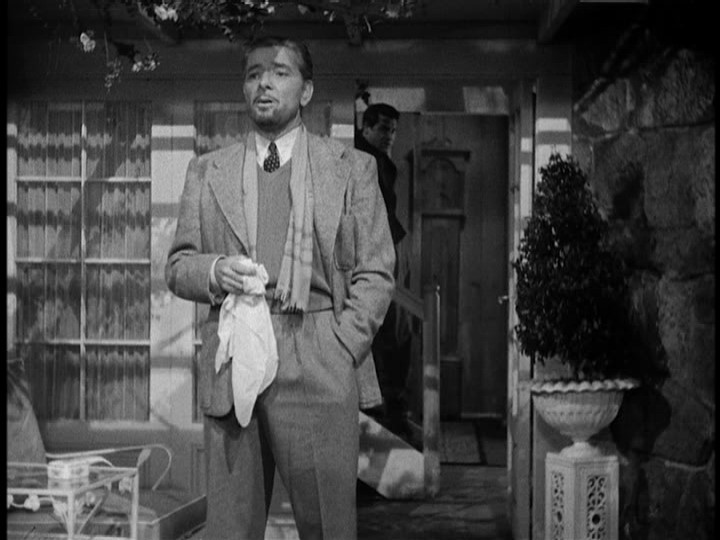
It's the least material aspect to the film in the first place. The plot involves the burning of a local mill and the framing of mill worker and "activist" (one assumes a unionist) Leopold Dilg (Cary Grant) for arson and the murder of the plant foreman.  Everything is stacked against Dilg from the mill owner calling for his blood in the sympathetic press, to the trial judge being in Holmes' hip-pocket. Dilg escapes from prison (in a dramatic opening sequence that's a bit out of sync with the rest of the movie) and hides out in "Sweetbrook," the rental house run by his high-school acquaintance Nora, who's trying to get the place in shape for the impending arrival of a temporary lodger, law dean Michael Lightcap (Ronald Colman) who's taking the Summer off to write a book.  This being a comedy, Lightcap arrives early—the night Dilg has stumbled his way in—and Nora has to hide the runaway in the attic, while the police comb the area looking for him.
"Hilarity ensues"
After a restless first night for all—nervous Nora has spent the night in another room and Dilg snores in his attic roost leading Lightcap to advise Nora she needs to do something about her adenoids—the complications begin: Dilg is too restless a spirit and cranky an agitator to to stay cooped in the attic; Lightcap needs a secretary and to keep Dilg under wraps and separated from Lightcap, Nora takes the job; and then, to raise the stakes, a local Senator stops by to tell Lightcap he's being nominated for the Supreme Court. So, politics being what they are (the same as always), if there's any hint of scandal, oh, like, say, harboring a wanted fugitive in your house, it could hurt the professor's chances of being one of the Supremes (depending on who's in The White House, of course).

Dilg being Dilg, he can't stay under wraps for long, and he's soon hiding in plain sight as "the gardener," and his views of the law leads to some sparring over the letter of the law and how it can conflict with the intent, especially when those intentions are not honorable to the spirit of the law, and Lightcap finds himself embroiled in a conflict of interest, where his cloistered view from his ivory tower looks pretty good in theory, but bares only a conversational similarity to its practical applications in the world of dog-eat-dog.
That's the meat of The Talk of the Town, but the screenwriters and Stevens must gild it with a "who gets the girl" story-line that will satisfy the jury of the audience. Stevens let the answer to the question be decided by a preview audience of peers—with nothing decided until the very last second. With Colman as a sophisticated book-smart professional with a lot of learning to do, and Grant as am earnest dreamer, it's hard to choose, but Arthur is, as always, a delight, finding ways to make the quick-witted Nora flustered, but with the best of intentions and the most charming of choices.  Like the movie, she's a bit of a mess, but an enjoyable one.