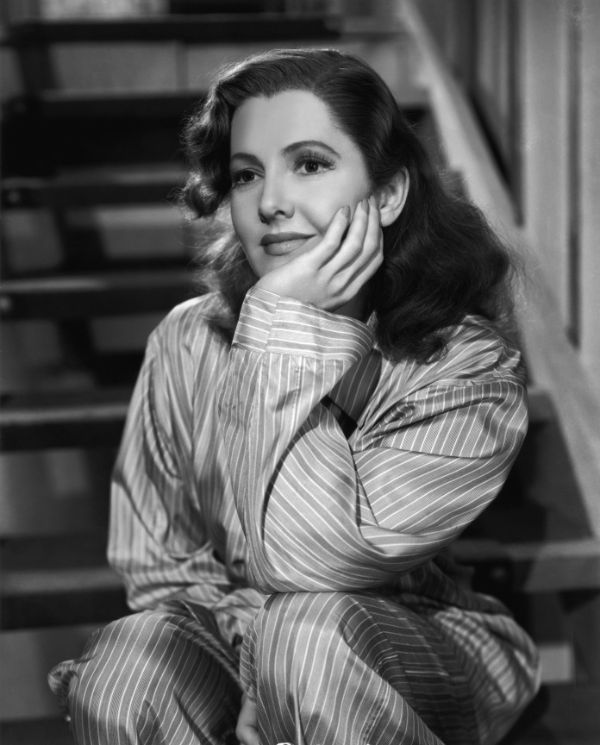
Coming back from the war, he co-founded Liberty Films with fellow Army Signal Corpsmen Frank Capra and William Wyler, but made no films for the fledgling production house and the company folded. He would not make another film until I Remember Mama (1948), a film that bore some resemblance to his own upbringing in America. Then, 1951's A Place in the Sun, a dark tale of a man's duplicity and fall from grace, won him an Academy Award for Best Director.
His follow-up film was far-afield from the subject matter that was associated with Stevens both pre-war and post-war—a Western that sharply demarcated right and wrong, almost naively making a world where good wins out over bad, without the complications and hollow justifications of an adult sensibility, Shane.


At which point, the stranger re-enters the scene and introduces himself as "a friend of Starrett's" and seeing how he's armed, too, Ryker backs off with a final warning to clear out or the Rykers will clear them out themselves. The stranger's intervention casts him in a different light to Starrett, and introductions are made.
The stranger's name is "Shane." Just "Shane." No indication if that's christian or surname. And, for his stance on behalf of Starrett's family he's invited to stay the night and have a meal, which he compliments as "an elegant dinner." Then, without any prompting, he goes out and works on cutting out that stump as a thanks. Starrett goes out to help and between the two of them, they're able to clear the stump at night-fall, a task that the homesteader had been working on weeks. Starrett asks if Shane wants to work there, as he most certainly seems to want to help.
 So, who is Shane? He doesn't say where he came from, and as to where he's going? "Heading North—one place or 'nother. Some place I haven't been." Some place he isn't known is what he means. That would seem to be a contradiction as he's quiet. Polite. Keeps his counsel. Knows his place even if he doesn't have a place. He's rootless...in a community trying to establish them. He feels comfortable there, despite that, but never so comfortable that he can't be snapped out of it at the first sign of trouble. He doesn't make trouble, but he's seen enough to know trouble will almost certainly come to him as it seems to have come to him in the past.
 He's twitchy. When little Joey pumps his unloaded rifle, Shane whips around, ready to draw down on him. He's haunted, probably because of his skill with a gun and having had to use it. And he's ridden into a situation where trouble could come from across the fence, ready to tear that fence down if it's in the way. Ryker is one of those breed of men who fought hard to establish his stake and will fight just as hard to keep things the way they were when there was no one else but him. He's not interested in community—he's all the community he needs—and he resents seeing what he thinks is his from being parceled out to newcomers. To "others."


For a Western of that era, Stevens ramped up the level of violence than what audiences were used to. His fights were messy affairs that were tightly edited to maximize the cuts and scrapes one associated with the usual dust-ups. And anyone seeing Shane remembers the shoot-outs where a bullet could propel a person backwards like they were yanked off their feet (which they were, due to some discrete cabling).In such a world it's no wonder that Marian Starrett tells her young son "Joey, don't get to liking Shane too much." There's always the possibility that a man such as Shane won't be sticking around for too long, whether riding out of town or being buried in the cemetery that overlooks the slip of a town. But, the kid can't really help himself. Shane is something of a mystery, not saying much, but giving the child the same level of attention as he does the father and the mother. That makes an impression on a kid. And his proficiency with his fists and his guns—all fascinating to little Joey—endears the man to the boy.* Stevens is playing with Myth in Shane, and nowhere so boldly as in little Joey's hero-worship of the competent stranger, his version of a White Knight, who gives him a lesson in strength in restraint (something Joey doesn't quite comprehend) as well as the cold competency in "doing what has to be done." To standing up in the face of wickedness, not backing down, no matter the consequences, and fighting the good fight. At times, it's almost too much, with Stevens cutting back and forth between fights and Joey's wide-eyed reactions to the fireworks.
 And it all comes to a head when, once the killing is done, Shane takes his leave, having brought resolution—but hardly peace—to Jackson Hole. The dirty work is done, and just as there was no place for a killer like Wilson, there isn't for Shane, either. And despite the child's entreaties, there is no going back...not from what you've done. And not from what you've seen. It's a weird scene, simultaneously a bit over the top, but also punches the gut on an emotional level. Even more so when you take in George Stevens' history in the war.
 That ending resonates...and haunts. Not so much as a small child's plaintive pleas, but of the echoes embedded in them of a director who had seen the worst atrocities perpetrated by man, and, through that boy, implores the darkening wilderness for a world of forbearance and a return of the merely and simply decent.


In context, Shane is so much more than "a Western", and is heart-breaking. Fundamentally.

* And to the point, author Raymond Chandler (who'd written a couple of Ladd's noirish movies) had said this about Ladd some years earlier: "Ladd is hard, bitter and occasionally charming, but he is after all a small boy's idea of a tough guy."


_01.jpg)