Written at the time of the film's release..."Karma is the Ultimate Bitch in this One"
or,
If You Can't Stand the Hot-Flash, Get Out of the Kitchen.It's refreshing to see a movie about a mature couple of advanced age—mine—dealing with post break-up issues. I just wish they weren't being so immature while doing it.
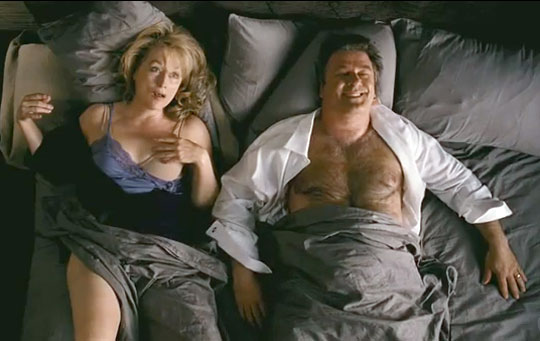
Jane Adler (Meryl Streep) is reaching a transition point in her life—approaching "empty nester" age: her oldest daughter Lauren (Caitlin Fitzgerald) is engaged to Harley (John Krasinski), middle daughter Gabby (Zoe Kazan) is moving out of the house, and youngest, Luke (Hunter Parrish) is graduating from college. Her ex-husband Jake (Alec Baldwin) is now married to young "Ms. Thang" Agness (Lake Bell), with an inherited son (from her last affair), Pedro (Emjay Anthony). She has decided that she's going to expand her nest...er, house so she can have "the kitchen she's always dreamed of;" she runs a salonish bakery, and she can cook (second movie this year—Julie & Julia from Nora Ephron, this one from Nancy Meyers, both of whom seem to be trying to keep Streep in the kitchen).
Youngest son's graduation pulls the whole family together in New York, with Jake "flying solo" due to family illness. Once there, the two old marrieds hook up, and once Jane is tanked, there occurs a "once more for old times' sake" canoodling that leaves him satisfied and her vomiting.
Most guys would take that as a sign, but not Jake. Soon, he's spending too much time at Jane's, telling his ex-wife that his current wife doesn't understand him, and while it may seem like sweet revenge for Jane, she's also creeped out by it, so much so that she won't tell the kids, and allows it to interfere with a budding romance with her architect (Steve Martin). Now, maybe I've been watching too many "Nature" shows on elephants lately, but I could have used David Attenborough to explain this mating ritual to me.
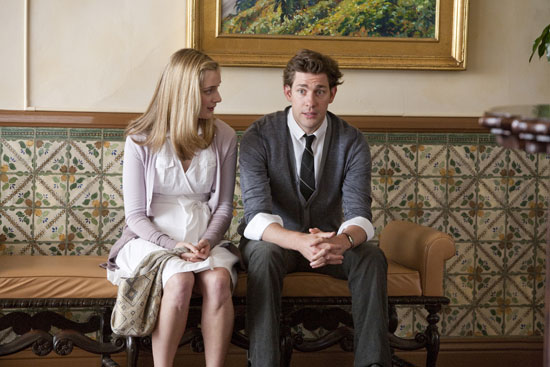
Maybe it's that Martin and Baldwin are playing the roles the other should have taken: Martin's love interest is a deferential, shell-shocked divorcee with a manner that reminded me of Charlie Ruggles, and Baldwin's in full pursed lips obnoxious priss mode (without the "30 Rock" irony) that makes his character not so much funny as alarming. And Streep, consummate pro that she is, works the material for all its worth, fluttering and kvelling and kvetching, making Jane seem two pastries shy of a brunch. There are times when there seems to be some acknowledgment of time—Jane is constantly fanning herself, as if caught in a hot-flash, but the next instant she's giggling like Juno.The one guy who seems to be doing something interesting is John Krasinski, as the not-yet husband who finds he's baby-sitting his future in-laws, and is the only one who seems to rise above the material to be doing something interesting—interesting and funny. As the only fully-informed character in the cast, he manages to convey the screwball nature of the situation, acting as the surrogate audience, eyes widening with each embarrassing compromise. He makes Meyers the director—with her sledge-hammer reaction shots and uneven pacing seem far more successful than she is.
 "Whatever..."
or
"What's Next, Basquiat? (Whoa-Whoa-Whoa-Who-o)"
"Whatever..."
or
"What's Next, Basquiat? (Whoa-Whoa-Whoa-Who-o)"
George (Freddie Highmore, the excellent kid from Finding Neverland and Charlie and the Chocolate Factory, practically grown up) is a senior at a tony prep school in New York, in danger of getting kicked out. He's depressed. Not because he's going to get suspended, but because he's coming to grips with the fact that life is short and nobody gets out alive. So, he doesn't pay attention in class, doesn't do any work and uses his books as doodle-canvas, some of which is very not bad. His teachers (Jarlath Conroy, Ann Harada, Alicia Silverstone) know he's smart but are frustrated that he couldn't begin to apply himself. His principal (Blair Underwood) cuts him every break, but he just doesn't apply himself. "Life is meaningless," he tells a teacher when picking up assignments. "And that includes the homework, unfortunately."He tells his mother (Rita Wilson) and step-father (Sam Robards) "I've got it under control," but it's just a delaying tactic. He's too smart for his own good, but like most students, he doesn't know what he doesn't know. That's where life comes in. But he won't get there, by being so insular, cut off from everybody.After another stale-mate with the principal, he goes up to the roof to smoke, where Sally Howe (Emma Roberts) is smoking. A teacher comes up and George becomes Sally's knight-in-shining armor by pretending to be the one dragging. Later, she confronts him about why he did it. "I'm the teflon slacker," he says. "I'm more used to getting into trouble and I'm better at talking my way out of it." He and Sally become friends...then things get complicated.
They do, but they don't.
His habitual failure to commit extends to their friendship, as well, and it's a little hard to determine why—maybe he's just not willing to apply himself, or maybe he has such a fear of failure (or a fear of success, where he could lose everything). But it's pretty clear that he'll take a "wait and see" attitude with everyone...and everything. He enjoys spending time with Sally, who's popular and a knock-out and seems to find him intriguing in that way that geek-writers think women are attracted to geeks. And she seems to want to "go there," but he's all "we're just friends" despite the time he spends with her when he'd normally be in his self-imposed solitary confinement. No wonder she sees other guys...which he thinks of as some kind of betrayal.
What does he think would happen?That question, and so much of the film, is intriguing and keeps your interest (like a train-wreck does), as long as there are no consequences to his actions. But, once they all start piling up, The Art of Getting By stops getting away with it. Then, it becomes frustrating (in about the same capacity as that "me stupid" feeling you get for delaying writing that term-paper for so long). Then, writer-director Gavin Wiesen swerves in his little game of "chicken," in a wish-fulfillment fantasy that even Woody Allen, schlub-fantasist that he is, would mock if he saw it.
Wiesen casts his film well, and his direction of the actors shows he's not afraid to take risks.* And the screenplay shows promise. But, that ending is a big "Fail." Maybe it was imposed to get distribution, but, man.... Like the protagonist, there is so much potential there, that just gets wasted. * Roberts is a heart-breaker, the teachers (even Alicia Silverstone) play tough with their characters, and props to anyone who hires Elizabeth Reaser and doesn't squander her talent (as the "Twilight" films do).