or
Taking Inside Out 2 Twice a Day Will Take the Place of Xanax
It's nice to see that Disney* is permitting Pixar out of its streaming jail-cell and letting its movies open in theaters again. It seems to have paid off as Inside Out 2 has out-performed expectations—certainly Disney's—and has generated Barbie-land box office. One took the hopeful sign that allowing the only-streaming releases to have a theatrical run made them re-think what they were doing with its best—and longest-held—assets. Pixar product is just too good to be restricted to home theaters, and Inside Out 2 is a good example of why.
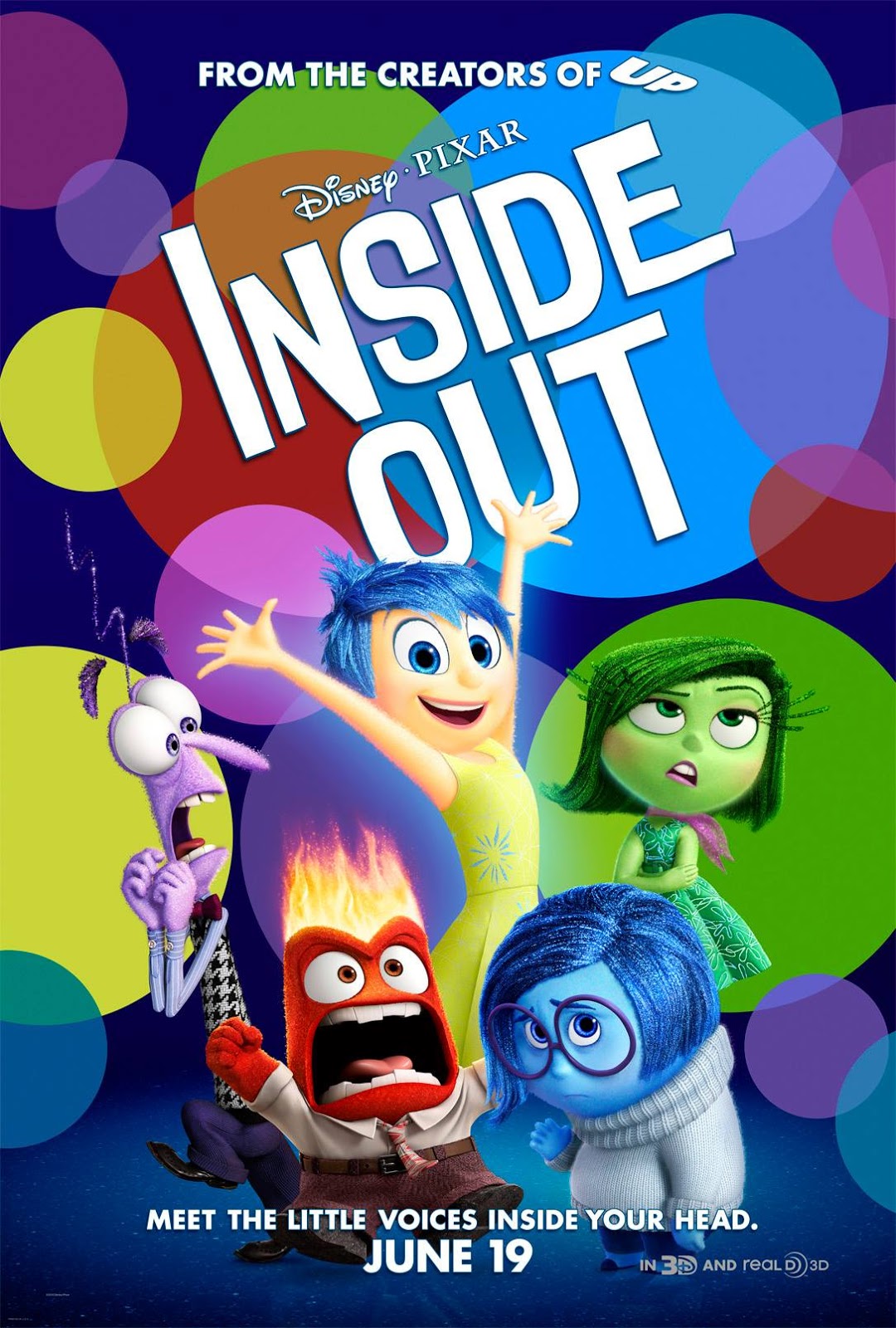
Sure, a couple of the sequels have been less than spectacular—Monsters University, Cars 2, and Lightyear (although not technically a sequel) had a creative lethargy backing the stunning visuals, but this sequel to 2015's Inside Out takes advantage of the inevitable march of time to expand and deepen its particular cartooniverse. That it is all contained in the mind of our gal-pal Riley (now voiced by Kensington Tallman), who survived her move to San Francisco and flourished, retaining her passion for ice-hockey (a big story-point in this one) and keeping it together with some help from her humors in Head-quarters. They are Joy (Amy Poehler), Sadness (Phyllis Smith), Anger (Lewis Black), Fear (Tony Hale taking over for Bill Hader), and Disgust (Liza Lapira taking over for Mindy Kaling), who have negotiated Riley's emotional life in the intervening years and managed to make a go of it, despite outgrowing clothes, getting braces, and the near-occasion of pimples. Of course, she's had help from her supportive gal-pals on the hockey team, Grace (Grace Lu) and Bree (Sumayyah Nuriddin-Green). Her school has just won State and grabbed the attention of Coach Roberts (Yvette Nicole Brown) of a local high school who has invited the three to a weekend hockey camp.
 Pretty easy for five emotions to handle, one would think. Especially as Joy has worked out a new doohickey that allows her to take bad memories and vacuum-tube them to the back of Riley's mind, where they won't do any harm to her burgeoning "Sense of Self." All very neat and orderly...just like kids are (he said with a wink).
 But, remember how I dropped the mention of a "pimple"—well-rendered subtly by Pixar pixelators)? The night before she goes off with her friends to the camp, Riley's "Puberty Alarm" goes off, sending everyone into a panic, and requiring a crew to come in and do a "mitigation" on Riley's head-space, leaving the old crew with a new console that—shall we say?—is a bit..."sensitive". Plus, there are all sorts of new gizmo's and buttons no one's ever seen before.
.webp) Those "upgrades" are for a quartet of new emotions generated for Riley by her hormones and they are Anxiety (Maya Hawke), Envy (Ayo Edebiri), Embarrassment (Paul Walter Hauser) and Ennui (Adèle Exarchopoulos), who show up and decide they're going to run the place...that is, Riley...during her hockey weekend. This, of course, complicates matters, and one notices that having these guys around makes describing what happens in the story sounds a little too "on-the-nose." It's far more subtle—and entertaining!—in the Pixar presentation than the summation, which reads like symptoms in a psychological post-mortem.
Those "upgrades" are for a quartet of new emotions generated for Riley by her hormones and they are Anxiety (Maya Hawke), Envy (Ayo Edebiri), Embarrassment (Paul Walter Hauser) and Ennui (Adèle Exarchopoulos), who show up and decide they're going to run the place...that is, Riley...during her hockey weekend. This, of course, complicates matters, and one notices that having these guys around makes describing what happens in the story sounds a little too "on-the-nose." It's far more subtle—and entertaining!—in the Pixar presentation than the summation, which reads like symptoms in a psychological post-mortem.


.webp)

To wit: Anxiety manages to rip away Riley's Sense of Self and locks away Joy (and her comrades) in an effort to push Riley to achieve her ambitions on the ice. Sounds a bit clinical, doesn't it? It's not, but shows how cleverly director Kelsey Mann and his co-scenarists Meg LeFauve and Dave Holstein manage to integrate human turmoil into an adventure story that's enjoyable for kids and relatable for adults (who'll be answering questions with a smirking "just you wait..."). The kids watching this movie will grow up into the answers that had previously sailed over their heads.


Inside Out 2 will get you right in "the feels."

* Although one notices that the House of Mouse has put on an ultra-long company logo (that might actually qualify as a short subject) onto the beginning and the end of this one as if to emphasize who's in charge. The Pixar logo is same as it ever was. Don't let that discourage you from missing the tag-line at the very end of the movie, though.