"Juan is the Loneliest Number That You'll Ever Do"
Thursday, May 30, 2024
Vicky Christina Barcelona
"Juan is the Loneliest Number That You'll Ever Do"
Wednesday, March 27, 2024
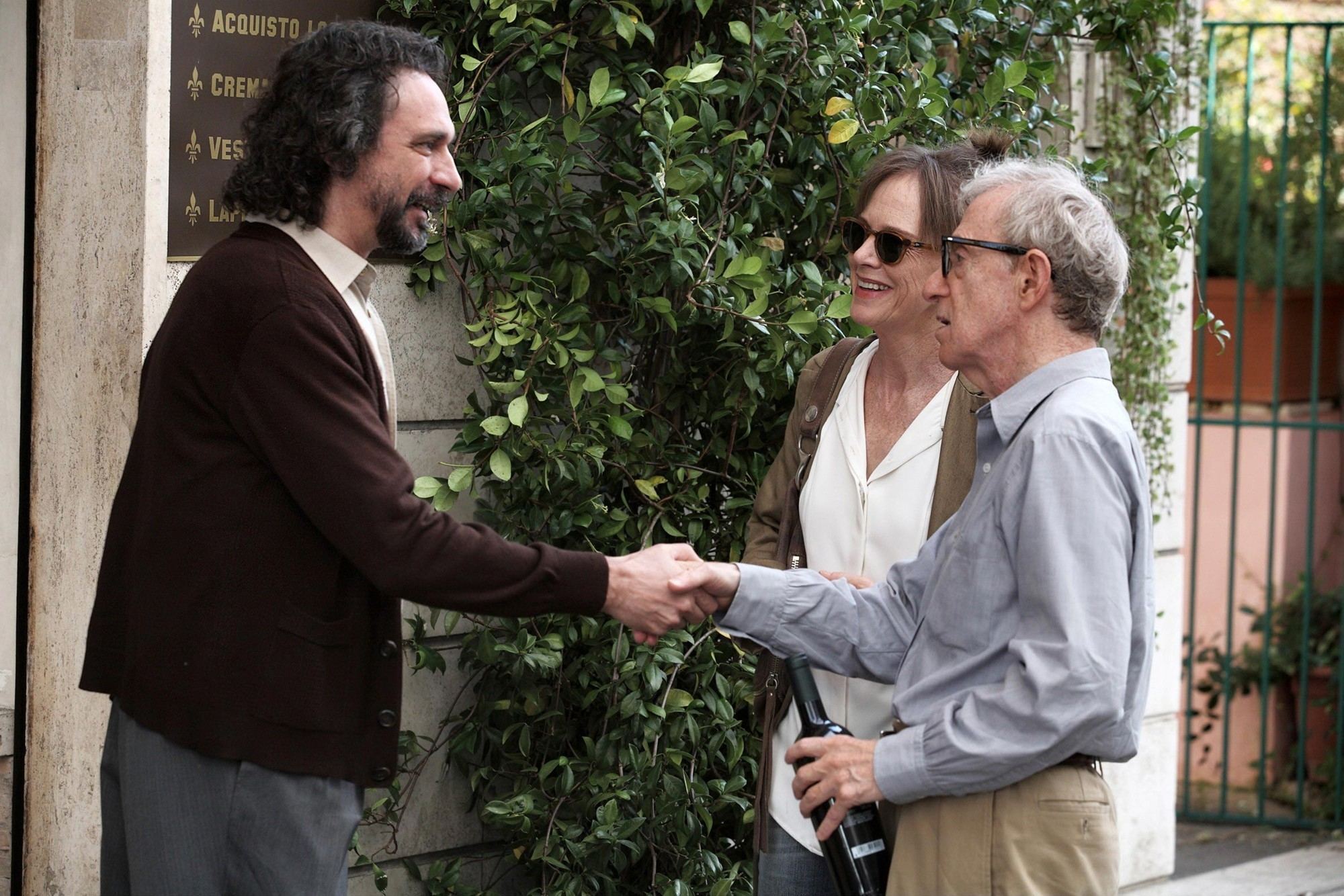
To Rome With Love
The Ozymandius Melancholia Gambit ("Turbulence! My Favorite!")
Far be it for me to suggest that Woody Allen might actually be comfortable in his own skin as a storyteller. but when it has come time for him to do his own "Roman Holiday" film, To Rome With Love, there's not a hint of Fellini in it (Been there, done that—specifically, way back in 1980, when he made his Stardust Memories in tribute to the great Italian film-maker).
Truth to tell, his latest has more in common with the Italian "anthology" films of the 1960's, where directors would tackle similar themes in short personal films.
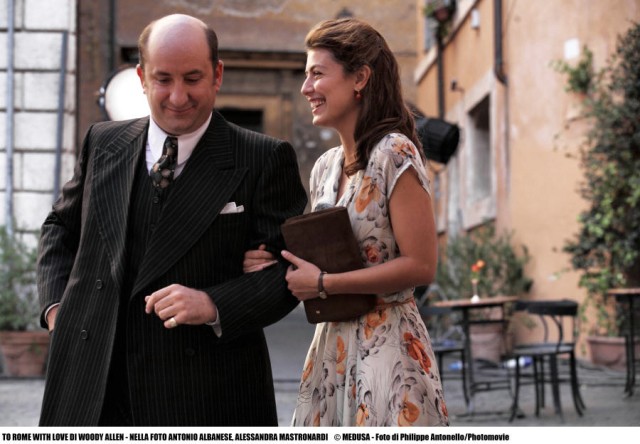
To Rome With Love has four interlocking fantasias about love and personal dissatisfaction: in the first, a young married couple (Alessandro Tiberi and Alessandra Mastronardi) come to Rome, where he is to be introduced to his new work situation—eager to make a good impression, the wife goes shopping and ends up getting lost and involved with an Italian film-star, and hubby, thanks to a case of mistaken identity, must go to his functions in the company of a pre-arranged hooker (Penelope Cruz); the second involves two architects, one seasoned (Alec Baldwin), the other just starting out (Jesse Eisenberg) who become each other's fantasy figures (of a sorts) when the young architect, already attached to Sally (Greta Gerwig), falls for her best friend Monica (Ellen Page), a self-involved, if fascinating, actress. The third involves a "normal member of the middle class" in Rome (Roberto Benigni) who suddenly becomes "famous for being famous," and is pursued and interviewed by an indiscriminate paparazzi; the fourth involves a former classical music executive (Allen), who discovers a great opera singer (Fabio Armiliato) in the family of his potential son-in-law..with conditions.
The setting is Italian, but the themes are pure "Allen-town." Each of the characters get a brief glimpse of "life on the other side," gingerly placing their toes where the grass is greener, and find it wanting, but themselves enriched from the experience, survived without harm or consequences paid. Baldwin's architect gets to play devil's advocate (much the same way as Bogart did in Play It Again, Sam) with a realist's wisdom, as opposed to a romantic's fool-hardiness—a good cure for his nostalgia. The Italian couple experience romantic fantasies before settling down to domestic bliss, not older but wiser.
Thursday, January 13, 2022
The 355
Saturday, January 5, 2019
Nine
"How Do You Solve a Problem Like Fellini?"
or
"There Ought To Be Clowns (Don't Bother, They're Here)"
There is a great movie, I'm sure, to be made of the Tony Award winning musical Nine. But this isn't "it." Nor, I think, was "it" an intention for the production company to do so.
In fact, it is hard to determine what "it" is, and what "it" intends to do. Is it a musical adaptation of Fellini's 8 1/2, or of Fellini's life? Is it even an adaptation of the original musical, as there are far more songs left out of it than are in it?* Locations are changed, circumstances and motivations are sliced and diced. One wonders what was so wrong about a hailed musical confection that the late Anthony Minghella and Michael Tolkin (who wrote the script), current director Rob Marshall, and the producers seem to be running away from it.
They aren't the only ones, merely they slowest of the pack. Daniel Day-Lewis was a last minute first tier replacement for the more suitable Javier Bardem when Bardem walked off the project pleading "exhaustion"—but not exhausted enough to flee, evidently. Bardem makes very wise career choices. Nicole Kidman replaced Catherine Zeta-Jones after the producers wouldn't acomodate her demands to expand her part. One wonders why they'd balk about making any more changes for their Chicago Oscar-winner after making so many of their own.
But, truth be told, the thing is a sorry, sorry mess. Not true to its source, its inspiration, or even to itself, one reads the description of the original musical and wonders why it is not the movie. But one gets an inkling. Fellini's film, made about a creator's inability to create a harmonious chorus of the voices in his head, his muses, his collaborators and backers all clamoring for attention had a structure, a purpose and an approach. But it did not have a lift, a creative inspiration until Fellini made it about a director rather than a writer. Fellini had no trouble making it, letting his conscience and unconscious be his guide (or Guido, if you will). On the contrary, he was energized by it. His "film that got away" would not occur until a bit later in his career.
The creators of Nine saw it as about themselves, and the difficulty of achieving a vision. One sees the disconnect with the Fellini inspiration as soon as the musical Guido's obsession with the Folies Bergiere is brought to song. Folies Bergiere? Mama Mia! Where's the Circus? Fellini equals circus! Comprende? But, "Nine" the musical—not the film, that gets even worse—is glitz and spangles and presentation with a smattering of psychological insight embroidered in a mash-up (one can't call it a mixture) of half-inspired and un-inspired songs.
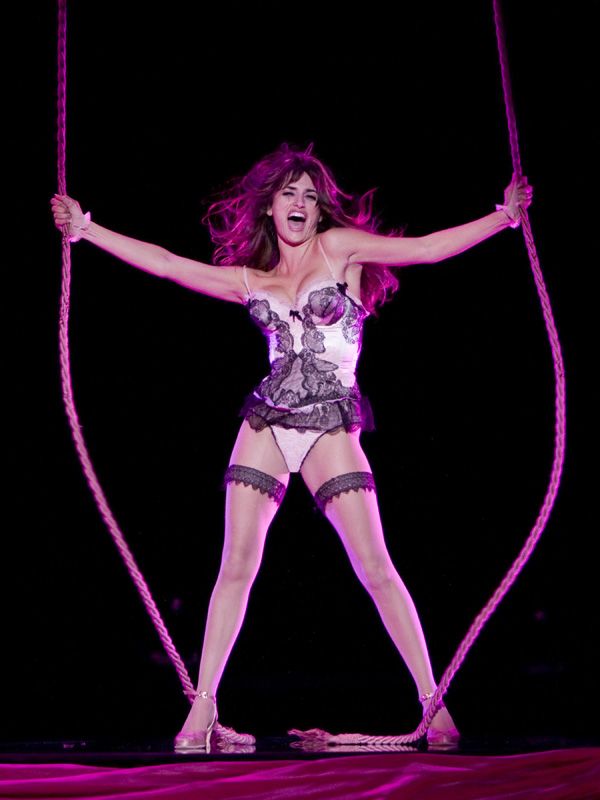
"Nine," the movie, is a whoring down of that concept. Big stars. Small ideas. A polyglot of a tribute to a movie it doesn't understand, and the Broadway production that the money-men didn't feel had enough pizzazz** to put keisters in the seats (Because nothing makes you want to "Fosse, Fosse, Fosse" and booty-shake like ennui and creative stagnation!***). So, we've got Day-Lewis (he's fine—not too believable, but at least he's not doing a John Huston imitation this time).**** We've got Nicole Kidman and Penélope Cruz (wonder what they had to talk about on-set?), Kate...Kate Hudson (??), and....Fergie?(!!). Then, to give it some ethnic legitimacy they throw in Sophia Loren***** and Miramax staples Judi Dench and Marion Cotillard. Cotillard is heart-breaking as the Giulietta Massina look-alike wife—played by Anouk Aimée in Fellini's film (she's even got Massina's brave smile down). Dench does fine by her number, silly and irrelevant as it is, but as if to gin up any excitement, they work over-time trying to make it entertaining. Cruz gets a sizzling number as director Guido Contini's mistress-played by Sandra Milo in the original film. Kidman plays Contini's past star Claudia (based on the Claudia Cardinale character in 8 1/2—which would have tied in with Zeta-Jones' participation, but goes back to the original inspiration, "ice queen" Anita Ekberg for Kidman's participation). Loren plays Contini's domineering Mamma, usually a grotesque in Fellini's films. Director Rob Marshall undercuts the material by over-cutting, editing all the momentum out of the music, which veers from worthwhile ("Be Italian" given a rip-roaring rendition by...give her credit, she's the best thing here...Fergie of "The Black Eyed Peas") to the filler ("Cinema Italiano" given sass by Kate Hudson, but shot and edited like an MTV version of the old '60's "Shindig!" program).
I was looking forward to this one, but very high expectations leave the biggest craters when they fall. Not a fan of musicals, Nine only confirmed why I've rarely enjoyed them, as they can be false and irrelevant to anything resembling life or the impulse to song that it might evoke.
This adaptation of an adaptation of a somewhat autobiographical work by the artist, even though titularly and musically adjusted for inflation, just isn't worth as much as the original. Artistically, it is bankrupt.
* Three new songs were written for it, all of them unmemorable—in a bid to score more Oscar nominations for The Weinstein Company which oversaw this sorry mess.
** Imagined conversation: "Y'know? Everybody's singing about their feelin's an' everything! There's not enough dancing with women with big bazooms, and Alfa Romeo's and Fiat's!! Know what I'm sayin'?"
*** Although Fosse did make a musical based around a heart attack.
****...which reminds me, the last movie I've seen that ended (like Nine) with the director-figure saying "Action" was Clint Eastwood's White Hunter, Black Heart—where Eastwood was playing (and imitating) John Huston!
***** Did it occur to the makers that the only Italian in their film celebrating Italian cinema is Loren? And that she didn't work with Fellini?
Tuesday, November 21, 2017
Murder on the Orient Express (2017)
or
"Not No Much a WhoDunnit as a WhyDoIt?"
Agatha Christie was loathe (and that is the precise word) to have her books adapted by Hollywood. She wasn't crazy about the "Ten Little Indian" versions, and absolutely despised the Margaret Rutherford-starring Miss Marple films (especially when Tony Randall cameoed as Hercule Poirot in one of them). She reconsidered towards the end of her life after a personal appeal by Lord Mounbatten (father-in-law of one of the producers) that resulted in Sidney Lumet's 1974 all-star version of "Murder on the Orient Express", starting a series of fims and a flood of adaptations for British television, featuring Marple and Poirot. CBS broadcast a modern-dress version starring Alfred Molina (which was clueless and terrible and would have produced a train-like shriek from Miss Christie from beyond the grave).
When the "Poirot" series (with the dedicated David Suchet) did its adaptation a few years ago (with Barbara Hershey, Eileen Atkins, Hugh Bonneville, and Jessica Chastain among the suspects), it was head-and-shoulders more satisfying than the multi-million dollar film version. But, on the heels of that was announced a new film version to be directed by (and starring) Kenneth Branagh and one could only wonder what the possible reason might be.
![]() |
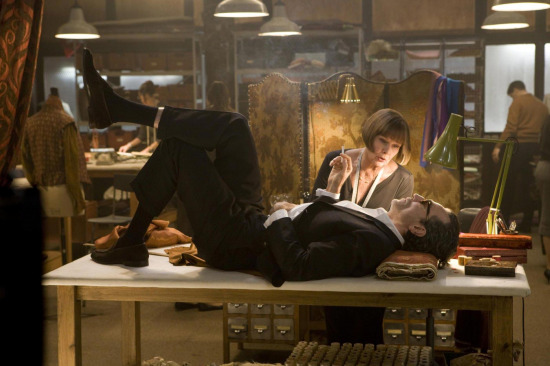
| The Detective |
![]() |
| The Victim |
Poirot is in Jerusalem investigating a theft involving a priest, a rabbi, and an imam (like "the joke" he comments). Exposing his dramatic side by doing his presentation of evidence in front of a crowd at The Wailing Wall—seems a bit extreme—Poirot solves the crime. Given the ecumenical divisions of the suspects that's at least all-inclusive, but it's a fairly risky procedure to do this so publicly. Why would he do this in front of strangers who have no clue (literally) of the particulars of the case.
There are clues aplenty and the reasonable assumption that the murderer is still on-board, as a couple of random attacks, none fatal, make it suspicious that one of the others could be next. But, who could be the perpetrator of such a vicious murder? As Poirot interviews everybody on the train, he finds threads and suspicions, but most of them seem to be distractions rather than real clues.
At least, Branagh's is not as perversely celebratory as the 1974 Sidney Lumet version—a murder is committed, after all—but it is not as brave and resolutely moral as the Suchet television version, which has the detective shaken and fighting tears by his own actions (or lack of them) in the service of what might be justice. The detective is trapped by his own catholic history (far beyond the aspirations of Christie) and feels complicit in the whole affair. Now, that is something of some import. "The Murder on the Orient Express" has one more victim; it kills something in Poirot.
I guess that is the answer to the ultimate mystery—why do it? I just wish the answer was something more than "why shouldn't they?"
* ...for instance, in a couple of scenes, Branagh is seen clutching a locket with a portrait of his lost love, Catherine. Who? No such person existed in all of Christie. The closest Poirot came to "the woman" (how Sherlock Holmes referred to the woman he most admired, Irene Adler) was the Countess Vera Rossakoff. Setting something up for another movie. Well, to do that the first one has to be good.
Saturday, March 19, 2016
The Counselor
or
How to Get a Head in Business
The Counselor is not "The Worst Movie Ever Made" (as some would have it) nor should such a withering condemnation (from a critic? *pfft*) warrant it any sort of pity-praise to escalate it above what it deserves. Pity is the last thing on the mind of The Counselor.
What it is is the first original screenplay by Cormac McCarthy—he also exec-produced—and directed, with a lavish budget for just about everything, including dirt, by Ridley Scott, who one should now probably call a "stylist," rather than a director. Everything looks great. But, again, one wonders if Scott read the script beyond descriptions.
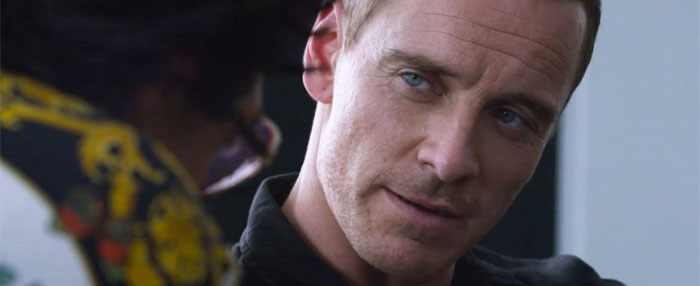
Like so much of McCarthy's work, it is dark and gritty and nihilistic—in a hopeful, moral kind of way; in other words, it's a story or very bad people doing very bad things from the point of view of a person who is tsk-ing in the background. Perfect director for this would have been Martin Scorsese. But, it's Ridley Scott who, given his past, seems to have a lot of sympathy for the devil (Blade Runner, Legend, Hannibal, Matchstick Men, American Gangster, Prometheus), indeed, in his last movie, the hero was, once again, a synthetic human being with its own sense of ethics. That synth was played, rather brilliantly, by Michael Fassbender, which is why he's the titular lead.
The thing about novelists doing screenplays and writing for the movies is they're slumming, unless they see themselves as legitimate film-makers (see the Coen Brothers or John Sayles). Maybe McCarthy couldn't flesh out his characters for the novel form. Maybe he wanted to see what a film-maker wanted to do with a work he wasn't happy with and see what the collaborative process would produce. Maybe he wanted to make some money. But, for whatever reason, McCarthy chose to do this as a film, and not a fully thought out novel.
![]() |
| "...red in tooth and claw" |
I suspect that we are ill-formed for the path we have chosen. Ill-formed and ill-prepared. We would like to draw a veil over all the blood and terror that have brought us to this place. It is our faintness of heart that would close our eyes to all of that, but in so doing it makes of it our destiny... But nothing is crueler than a coward, and the slaughter to come is probably beyond our imagining.I remember a scene from the Elia Kazan film of The Last Tycoon where movie mogul Monroe Stahr in a fit of pique exits a screening saying "'And I, you...' nobody TALKS like that." Everybody talks like that in The Counselor, everybody's vocabulary is up to snuff, and everybody has the time to ponder and philosophize. But what their philosophy centers around is Nature, "red in tooth and claw." But Nature doesn't have the time to think about what it is doing, except strategically. If there is a slaughter to come for the human race, the meek won't inherit the Earth, but evidently the pretentious will.
Everybody talks a good game in The Counselor, but it makes a bad movie.