Showing posts with label Jessica Chastain. Show all posts

Thursday, January 13, 2022

The 355

It's a Man's World—God Help Us (If She's Listening)
or
"We're Spies, Asshole!"
 
The reviews have not been kind to The 355, and the critics have teamed up around it like a circular firing squad. "Generic" says The Guardian. The L.A. Times says it "feels familiar and is a bit tired." The (London) Times calls it "lazy" and "box-ticking." Christy Lemire of Ebert.com criticized it for the clothes.*
 
Because it stars nice looking women and they should have been dressed more fashionably.
 
The Wikipedia article on it says Rotten Tomatoes reports it has an aggregate score of 4.4/10 (so it's the squishy green emoji). Cinemascore says audiences give it a B+ (which is better than average). I use that to illustrate the summary judgment despite the fact I hate aggregate web-sites, believing that metrics is the down-fall of Society, and that such sites do not promote critical thinking, and individuality. I think they work against people seeing movies, rather than promoting it. I give aggregate sites an "F" and don't visit them so their ads will get one less "little tingle." And one less reason for being.**
 
Add to that, I live on the west coast of the United States, but not in Los Angeles and certainly not in New York (it being on the east coast), so I don't entirely subscribe to the trope that "January is where movies go to die," seeing as I see a lot of good movies released outside of the Academy nominating window here. And I've seen my share of spy movies, action movies, and thrillers. The tendency for them to go over the the top now has only increased with the superhero genre—my eyes still hurt from the rolling they did watching Black Widow running up some scaffolding falling in space. It's tough to find a tough spy thriller anyone, or a smart one, or even a believable one, so many have come before spoiling the barrel.
 
But, the spy genre does teach one lesson: trust no one. The 355 extends that to movie critics.
Not that the film is without flaws. When an important member of a operative team is reported killed and the guy in charge says "I identified the body myself," I muttered "Well, I haven't seen the body..." and the exact nature of the computer drive—the McGuffin of the story—isn't made sufficiently clear other than it can hack into anything and "start World War III" and "set the world on fire" and people ooh and ahh over its elegance and sophistication. Until you drop it in the sink, that is. And just when I was thinking of calling this piece Everything Bond Does But in Heels" someone has to use 007's name in vain: "James Bond always ends up alone." (No, he doesn't—more times than not, he ends up in a boat!).
But, what sets this one apart is an attitude of viciousness, physical and psychological. Most spy-action movies are exercises for (what Gustav Hasford in "The Short-Timers" called) "the phony tough and the crazy brave"—fan-boys who've never had their noses broken. It looks good with all the kick-boxing moves and quick editing, but it's all ballet, essentially, designed that the feints look close, but couldn't knock a cigar out of a mouth. This one has plenty of that, although the fights are kept to a lesser amount. The women of The 355 just shoot people. And then shoot them again.
The story involves five women from different countries' intelligence services: American CIA agent "Mace" Brown (Jessica Chastain), German GND agent Marie Schmitt (Diane Kruger), Briton Khadijah Adiyeme (Lupita Nyong'o) former MI6 agent, Colombian DNI psychologist Graciela Rivera (Penélope Cruz), and (eventually) Chinese MSS agent Lin Mi Sheng (Bingbing Fan). They're all after this super-drive that is being ponied about by a former drug cartel, now re-branding to concentrate on raw, naked power. Brown and Schmitt are the lone wolves, driven agents with prominent chips—the non-computer kind—on their shoulder holsters. Adiyeme got out of the game and is a tech security consultant with a stable home-life, and Rivera is the civilian, a PTSD specialist—brought in to bring in an operative from the field (physician, heal thyself)—who has a normal family life with a husband and two kids. It's her job to ask "What are you talking about?" when the strategizing starts to get technical.
These five women are operating in a world of men—both bad guys and purported good guys. It was The King's Man—a not-great movie with some "moments"—that pointed out that the best undercover agents are staff, usually made up of women and minorities, so these five are negotiating through the "man's world" by virtue of being overlooked...or being dismissed by allies and enemies alike ("Are you under control?" one of them asks. "No." is the reply. "Are you?" "No!" Of course, they're not) They all have "issues" which might seem less important if they were traits exhibited in "the boys," but these five are all trying to prove something. The result is they have little patience for negotiating, and they're brutal.
Take, for instance, when Brown and Schmitt—who have been seeking the same target from different sides—draw down on each other. Stalemate. Then, Schmitt gives the command to drop the weapon and starts a countdown. "5!" She starts. Then Brown takes it over before that second is up—"4!" Schmitt is even quicker in response with "3!" and you just know something bad is going to happen. 
Or when they've got a courier tied up and want information and give him the old cliche "You can do this the easy way or the hard way" and he refuses. One of them just shoots him in the leg, tells him she's deliberately hit his femoral artery and he's only got two minutes before he bleeds out. There's a tourniquet waiting if he agrees.
That's matched when the bad guys have the five at gun-point and, when they get stone-walled, bring up screens of the people closest to them, and then summarily shoot one after the other in the effort to get one of them—any of them—to crack. The film is tougher, 
more mean-spirited, and less contrived in setting up complications than just about any spy or action film that I've seen in a long time. You know the complaint about most spy movies—why don't they just shoot 'em—this is one that does that. But none of the participants in the critical "kill-box" for this film have mentioned it or given it any credit for it.

No. It's all about "the fashion."


* In the comments section of Lemire's review, nobody pointed this out. They were too concerned that women couldn't take out men in a fight because they weigh less. They hadn't seen the movie. Most of the fights dispense with "the manly art" because the women just shoot people in the head. Twice. For good measure. Jessica Chastain's character does have a fight...with one man...and it goes on and on and she's very bruised and bleeding after it. Bingbing Fan has a fight with four guys using the broken base of a free-standing lamp—she dispatches one while putting it through his neck.
 
** Please notice my lack of links for those sites. You can find them on your own without my help.

Thursday, March 18, 2021

Take Shelter

Written at the time of the film's release

Riders on the Storm
or
"Take Care of Your Family.  Handle Your Business."

The Laforches, Curtis (Michael Shannon) and Sam (Jessica Chastain) are re-united in the evening—he from his construction job, she from her consignment cottage-business and taking care of their daughter Hanna. They hold each other in the doorway of their daughter's room, as the child sleeps soundly. And even though their daughter is deaf, they still speak in hushed tones. "I still take my boots off before I come in the house," he says, wondering at the extra precaution.

"I still whisper," she murmurs, smilingly, in reply.

It's a lovely little scene in a resolutely controlled horror film.* But, it's emblematic of the themes of Take Shelter as a whole.  Curtis and Sam are made for each other, protecting their family, even unnecessarily. They just approach it from different ways. "You've got a good life, Curtis," says his friend and co-worker, Dewart (Shea Whigham). "That's the best compliment. Look at a man's life and say that he's doing everything right."
Yep.  But that good life is about to be tested.  And woe to the prophet who sees things no one else can, be they Moses, Jor-El, Melanie Daniels, Roy Neary, or Dr. Miles J. Bennell. Despite their special knowledge, they are, at best, ignored, and, at worst, (well, aside from their planet blowing up), shunned and reviled...from those who do not see and are deaf to his warnings. Nobody likes a party-pooper, however good their intentions.  And that "special knowledge" will test the best of marriages and relationships.** Especially when it comes to family.  He's doing crazy stuff to protect them, and she's wondering if he's crazy and should get out of the situation...to also protect them.  The goals are the same, but coming from opposite points of view. The potential for a train-wreck is dire.
But "dire" is exactly what Curtis is worried about. His region of Ohio is being pelted by severe thunderstorms and even when the rains cease, the cloud don't part
but roil in the background heaving shafts of lightning to the fields below.
Then, there are the dreams that involve those closest to him attacking him,
leaving him gasping in panic attacks, costing him sleep...and perspective. The dreamscapes become more and more...uh, nightmarish as torrential rains obscure vision, townies become zombie-like predators and the laws of Nature are supplanted by cheap courtroom theatrics, birds, reflecting the odd flying patterns seen in his real life, rush in a fevered frenzy and begin dropping out of the sky, dead. The rain becomes oily, then God knows what will happen.

But only God. Curtis' visions doesn't extend that far.
Of course, he could merely be going crazy,
like his wife and neighbors think, especially when he spends a lot of money and risks his job to expand the storm shelter out back. And, then, there's his family history—his mother (Kathy Baker) was diagnosed with paranoid schizophrenia when she was Curtis' age. Maybe pills will stop the oncoming onslaught if it is only in his mind.
But what if it doesn't? 
Take Shelter
is discomfiting, just as Hitchcock's The Birds is. No explanation is made and one is kept guessing throughout. And writer-director
Jeff Nichols (Shotgun Stories) manages to, again, take a simple idea, and expand it to feature length, keeping the film centered on human drama rather than ignoring the potential of the story with empty spectacle.
Shannon delivers a dangerously controlled performance that only snaps into a rant at one particularly inappropriate moment.  And Jessica Chastain continues her roll of extraordinary movie-choices and making her parts uniquely her own, not unlike her co-star from The Help, Sissy Spacek.  All in all, an interesting exercise in dread.


>* I use the term advisedly, as Take Shelter is an "Environmental Horror" film, in the same genus as Hitchcock's The Birds, or M. Night Shyamalan's The Happening.  There are no slashings, and hardly any blood is spilled, but it does mess with your head and keep you guessing.  Oh, yes it does.

** Think of the Nativity, and the conversation that ensued when Mary told Joseph "I'm pregnant and God did it.  Oh...and Merry Christmas."

Friday, September 11, 2020

Zero Dark Thirty

Written at the time of the film's release.

"You Know That Thing We Talked About"
or
How Are Things in Tora Bora?

Writer Mark Boal and director Katheryn Bigelow have made the two most important dramatic films about The War on Terror: the 2009 Best Picture Oscar Winner The Hurt Locker and now, Zero Dark Thirty, which covers the behind the scenes investigations to track down Usama bin Laden and the subsequent Operation Neptune Spear in Abottabad, Pakistan.

The film originally started as a feature about the carpet bombing of Tora Bora, and the field work leading to the decision and was scheduled to begin filming when the raid occurred. Immediately, the other film was shelved, and Boal began writing this, incorporating his research from the previous work which dovetailed with the earlier effort. It's a fascinating, troubling story of human beings waging war on an intimate level, trying to secure threads of information on a specific target, while also trying to keep track of new terror acts that might occur any time, any where.

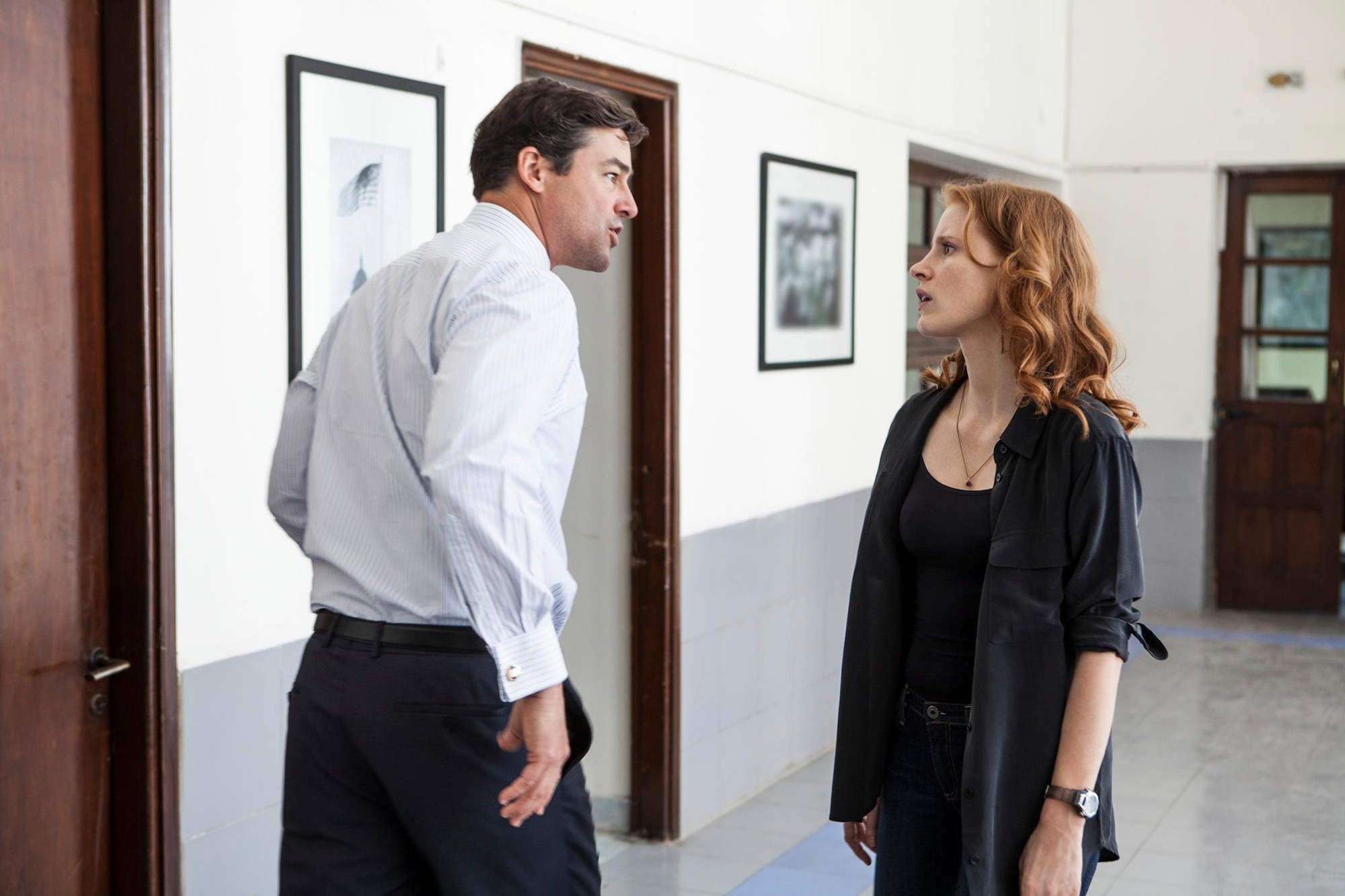
It focuses on one woman, a CIA analyst named Maya (played by Jessica Chastain)—her IM handle is "Maya173", but "Mark Owen," the nom de plume of one of the Navy Seals participating in the raid, refers to her in his book "No Easy Day," as "Jen." Maya is book-smart, street-savvy, but must learn "the ropes," literally, of interrogation by any means necessary. She is trained in the way of torture by Dan (Jason Clarke), who has been at this for awhile and has it down to a science—the speech "If you lie to me, I will hurt you," the loss of control, the humiliation, the physical and mental stresses, the releases from which information may come. Dan offers to keep Maya out of it, but she demurs. She will participate. She will actively sweat information out of the "detainees" in the euphemisms for prisons like "CIA Black Sites." "You are not being fulsome in your replies" she yells as she slams her hand in the interrogation table.  And when she's not participating, she's poring over other interrogations, reams of intelligence, and being a general pain in the rear to her superiors and colleagues. For station chief Joseph Bradley (Kyle Chandler), the job is to walk the razor's edge of politics and prevent more terrorism—he doesn't even care about bin Laden anymore, as there are too many attacks he's trying to prevent—every attempt that gets by is a failure.
But, for Maya, bin Laden is an obsession, her white Muslim whale, and it takes a zealot to find another zealot. She'll veer off into other investigations, particularly when some of her own are killed in an attack, but time only intensifies her resolve, almost becoming a mania, and her patient investigation is off-set by a gloves-off approach to her superiors (when asked her role in the briefing by the C.I.A. director—at the time, Leon Panetta—played by James Gandolfini, she replies "I'm the m#####-f##### who found this place, sir"), almost as if her persistent pressure torture techniques are being applied up the chain.* The Obama White House dithers over action until absolute proof is obtained that bin Laden is held up at the Abottabad compound, but Maya is resolute. When more cautionary analysts give the odds at 60%, she defiantly ups the odds to 100%—"Okay, 95%, because I know certainty freaks you guys out." But, it's that certainty that fuels Seal Team 6 in their mission—in the videos below, she's specifically mentioned and lauded in Mark Owen's account.
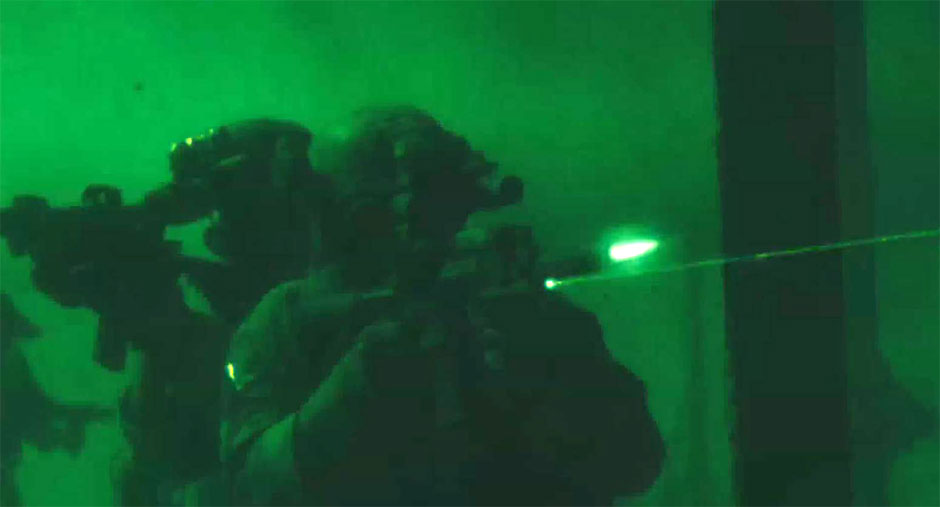
It is a fascinating movie, but a draining one, starting with torture scenes and ending with a recreation of the raid as it went down, shot mostly in tense disorienting night-vision. The character of Maya, or "Jen" or whoever she is, is a fascinating one, a portrait of obsession and the toll it bears—she's repeatedly told that she looks "terrible" throughout the movie—and when she lashes out at her superiors for their lassitude, or just plain pusillanimousness, there is a definite sense of someone unhinged—controlled, but pushed to the breaking point. A fury waiting to unleash, she is our version of a Holy Terror, a match for her enemies, and one can't help but wish her peace...suspecting that it will never happen.
2020 Addendum: Zero Dark Thirty came under some attack at the time of the release for its presentation of torture and its techniques and the implication that information obtained by it led to the critical information that led to the Abottabad raid. The movie is vague enough and the information so voluminous that one comes away with the impression that it wasn't critical to the intel (indeed, the location was confirmed by other means). As for the portrayals being an endorsement of torture, that's a little hysterical—to not portray it would have been 1) a whitewash of what was going on and 2) leaving out a specific chunk of the shaping experience of Chastain's "Maya"—one might just have well kept out the car-bomb attack that killed her colleagues. The character is driven by her experiences, hardened by them...and by her personal need for revenge. Her torture training is part and parcel of it. 

I came away from the film seeing a revenge drama that ended up, not in triumph, but in hollowness. The dead are still dead and the threat is just as real. There's no "Mission Accomplished." Just an "X" placed in a ledger that never empties.

I'll repeat what I said in the asterisked point. Zero Dark Thirty walks such a fine line that one can see whatever they want to in it.

The FBI's notice of bin Laden's death and the Situation Room during the raid.
Bear in mind, one helicopter went down during the raid.

* There are torture scenes, but they're not commented on, and any politicizing of it is so much hot-air—one can see in the film any position they want.  It walks a very fine line, merely presenting, and if someone tries to see their point of view in it, they're merely counter-projecting.  

Tuesday, May 19, 2020

The Debt (2011)

In these days of communicable diseases and precautionary measures for the greater good, folks on both sides of the aisle and of every color-stripe are being a little flippant with the "N"-word—"Nazi." 

So, just for a refresher course, we are going to sub-set the "Spies" series we're doing with movies where there are Nazi's (you know, "the bad guys"—Indiana Jones fought them in Raiders of the Lost Ark!) 

And we're going to call it "Nazi's...Nazi's everywhere."


The Debt (John Madden, 2011) Remake of the Assaf Bernstein 2007 original out of Israel.

A team of three Israeli agents are tasked with bringing a concentration camp doctor, Dieter Vogel (Jesper Christensen) to justice. The team, two men and a woman (Marton Csokas, Sam Worthington—his best film performance, one should say—, and Jessica Chastain) must find the man, who's now an OB/GYN in Berlin, kidnap him, and hold him him until they can transport him out of the country.

Things do not go well. 

They manage to grab the butcher, but end up hold up in their apartment with the man, while delays keep the four antagonists in close proximity. The cops are stepping up the investigation looking for him, rather than having things cool down. Everyone is trapped like rats, all the better for everyone to get to know each other better. Then the fun begins.

It's thirty years later and the three (played by Tom Wilkinson, Ciaràn Hinds and Helen Mirren, respectively) are being feted at an event celebrating the publication of a book in which the incident figures, written by the female agent's daughter. The three are praised, glad-handed and lionized, despite the fact that one of the three is missing.

And the story isn't really true.

John Madden is not the best fit for the film, despite his previous television work. But he gets the milieu down, and the layered performances of the principles benefit from his attention to detail (although one doesn't feel that the performances between older and younger selves merge too successfully).  Ultimately, the film feels unsatisfying, and not just in the sense of the downbeat subject matter.  
One is left feeling next to nothing, except in the uselessness of the exercise—where the mission is to fulfill commitments rather than doing any real good—to exact revenge, rather than justice.
Some lip-service is paid to duty, to country, but one gets the impression that's merely a card to be played in a battle of wills. In the end, its a case of diminishing returns: if justice can't be achieved, revenge will do; if that doesn't happen, the best to do is keep up appearances for morale and PR. If one can accept that such a conspiracy of silence can be maintained for 30 years without corroborating evidence—a not-small consideration (especially given these agents)—the movie still feels empty and unsatisfying.

Saturday, September 14, 2019

It: Chapter Two

(Insert Witty Verb) It
or
Pennywise and Poundfoolish

Well, you can tell Halloween season is approaching because the movie-theaters are starting to get an infusion of horror movies in anticipation. I'm not a fan of the genre (although I do my time in the dungeon during the month of October), but lately, things have been mighty thin in the "Coming Soon" department, so there's no way I can avoid it. It's Horror or Nothing.

It: Chapter Two would have been seen, anyway, although I hadn't seen the "First Chapter" in the theaters. Frankly, I wasn't interested. I'd been a devotee of Stephen King's writing in his first couple decades, then around about the time of "Needful Things" and "It", I stopped reading him, mostly because I would have had to do daily bicep curls in order to read them—"It" clocks in at some 1400 pages, and if I wanted to read something encyclopedic, I'd've read the encyclopedia.*

There'd been a TV mini-series here in the States, and I turned it off after 30 minutes. Because..."clowns." My favorite books of his are still "The Dead Zone" and his novella collection "Different Seasons."
But, I did catch Andy Muschietti's Chapter One the other night on cable, and was pleasantly surprised by what I saw. Screenwriters Chase Palmer, Cary Fukunaga (he's directing the new Bond film even as we write this) and Gary Dauberman scraped away some of the fat and sillier gristle from the book and hacked away at King's flashback structure to present the "kid version" of the "Derry Disappearances" story and made it a tough little diamond. Then Muschetti, who's Argentinian, did some remarkable casting for the kids (with an eye to who would play them as adults) and had the truly inspirational idea of putting Bill SkarsgÃ¥rd in the make-up as "Pennywise" the clown, in a performance that isn't camp but devious and manic and truly creepy. 
Chapter One is a good, scary movie because it concentrates on the worrisome fears that takes the innocence out of childhood and starts us on the straight path to neurosis rather than adulthood. The best part of the movie isn't the horror bits, it's the kid-bits, and the way that like-minded "Losers" can bond over the little tragedies that may mean nothing to adults (and more often than not be caused by them), but can make a kid question whether the sun should come up in the morning. SkarsgÃ¥rd is great and all, but one wanted to spend more time with the "Losers" because they were funny, squabbley, human...and loyal. Led by Jaeden Martell of Midnight Special and The Book of Henry, Jack Dylan Grazer from Shazam!, Finn Wolfhard, Jeremy Ray Taylor, Chosen Jacobs, Wyatt Oleff, and the remarkable Sophia Lillis.
"Here we are again in our old familiar places..."
It: Chapter One ended with serial child-kidnapper Pennywise the Clown dispatched, but with the suspicion that he would return again in 27 years, and "The Losers" promising that if he should appear again that they would have each other's back to take the "thing" down again. 
Now, in Chapter Two, it is 27 years later and the only one left in town is the one kid who couldn't fit in anywhere except for the Losers, Mike Hanlon (now played by Isaiah Mustafa, the guy who's hilarious in those "Old Spice" commercials). He lives in the library loft, working with dusty books in a town with internet, cell-phones, kindles and no library patronage. But, when he hears over the police scanner that another kid has gone missing after an already mysterious disappearance following a vicious homophobic attack at the town carnival, Mike puts out an APB for the Losers to "Come Home."
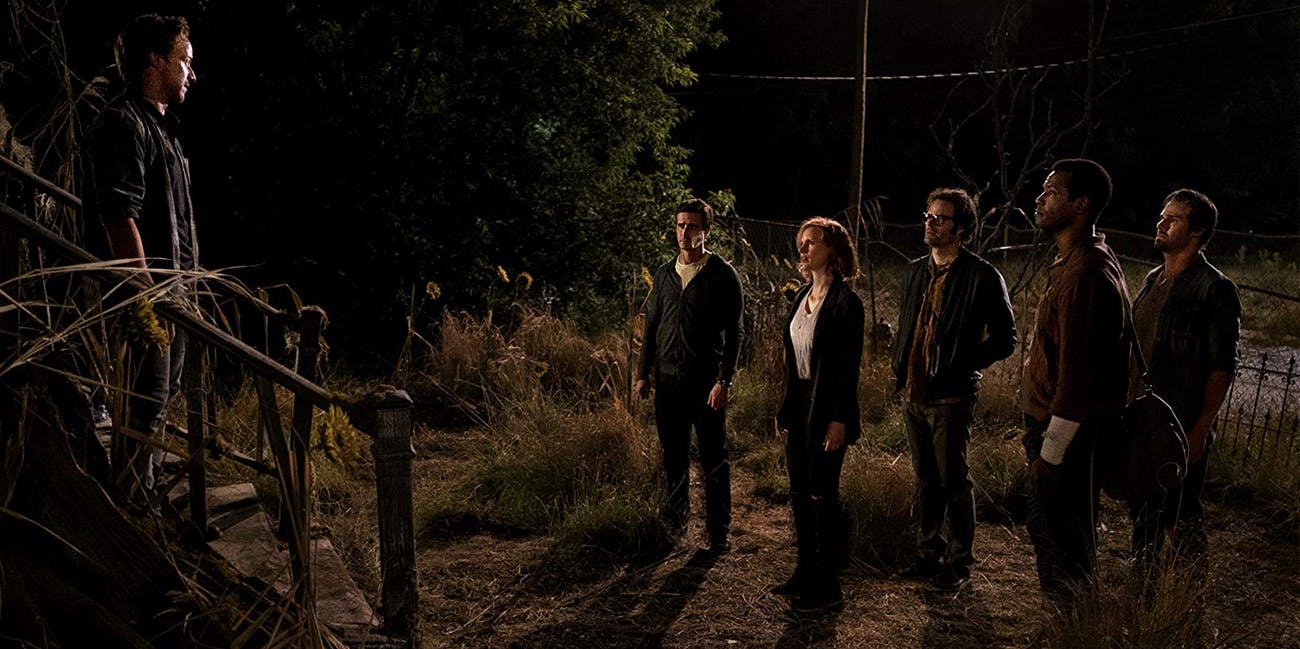
This is met with a universal reluctance by all the grown-up Losers: "Stuttering Bill" Denbrough (James McAvoy) is a horror writer (meta alert) who has a problem writing endings (real-life irony alert)—and he is told this by just about everybody including the cameoing Stephen King (HUGE real-life irony alert) and the director of his latest movie project, Peter Bogdanovich ("You said you loved the ending" "I lied."); Eddie Kaspbrack (James Ransome) has turned his hypochondriacal tendencies into a career in risk-management; irritatingly vocal Richie Tozier (Bill Hader, bless him) has become a stand-up comic; Beverly Marsh (Jessica Chastain) is a fashion designer who escaped her abusive father to marry an abusive husband—you can grow up but not grow out; and Ben Hascomb (Jay Ryan), the chubby "New Kid" with a crush on Bev has become a hunky architect ("shipper" alert). 

The one member of "The Losers" who opts out is Stanley Uris (Andy Bean) , who chooses suicide rather than confront the potentially deadly threat. Everybody else goes back to Derry at Mike's call and meet at a Chinese restaurant. Most of them have put those days out of their minds, but the memories—good and bad—come flooding back, challenging their wills to turn back and run away.
But, Pennywise starts to clown around and go on a psychological attacks against the Losers, they start to harden their resolve and decide to follow Mike's plan to employ a Native American ceremony to weaken and take out Pennywise, whose origins (in King's tortured explanation—I won't bother to relate it, as it's tough to type when you're rolling your eyes) have more to do with the stars than with themselves.
I prefer Chapter One to Chapter Two, probably because the first movie does the better job of avoiding the dumbest aspects of King's novel, which tries to provide a rational—relatively—explanation for what Pennywise is and why he does what he does. Frankly, King was just working too hard to bring some validity to his concept, when his readers are just happy to know there's a killer clown feeding on fear. We don't need an in-depth rationalization for why the car in "Christine" is haunted, when the audience already buys into the conceit of the supernatural and things that giggle in the night.
So, the movie follows each Loser as they track down the talismans from the days of the Derry disappearances 27 years ago: the paper boat from Billy's little brother Georgie, the postcard given to Bev by Ben (although she thinks it's from Bill), Ben's yearbook page that Bev signed when he was still "the New Kid" in Derry, the asthma inhaler from Eddie, a video game token from Richie—why these things are important to Pennywise's demise is a mystery, although, dramatically, they represent a Bonfire of Childhood Vanities. Certainly it's better than the rite of passage that King wrote of, first, in his book (and the filmmakers—wisely—left out, maybe because it's just too creepy and also potentially gut-busting). They may be important to the development of the kids turned adults, but what has that to do with Pennywise?
Was it really necessary to draw it out like this? The movie clocks in at 2 hours 45 minutes and feels bloated because of it. There are lots and lots of good "bits" scattered throughout it (or It: Chapter Two) and the performances by the cast—young and old—keep the movie interesting (Bill Hader is particularly effective both comedically and dramatically). But once the battle is taken underground to Pennywise, the movie starts to get frustratingly fussy and pretentiously woo-woo. It's not even very good action—I refrained from effecting a Monty Python accent and yelling at the screen: "Run away! Run away!" as I have less of a fear of clowns and red balloons than I do of flying buttered popcorn.
But, up until that time Muschietti does deliver on the shocks, usually by doing a standard "sting-in-the-tail" fake-out: as the person on-screen is confronted by a barrier to another room, ominous music begins to ramp up and climaxes just before the door is opened/the curtain is torn aside and they are confronted by...nothing. A moment of doubt. A moment of confusion. A moment of searching. A moment of relief. Then, they turn around and are confronted by something horrible that has been behind them the whole time. It happens enough that you learn to delay getting a firm grip on your soda by about 4 to 5 seconds. And that, friends, is a cardinal sin in a horror movie.
Still, for fans of the first movie and for fans of Stephen King, the second chapter won't disappoint—as so many King adaptations seem to do. The secret seems to be to take the main ideas of his books and burn them down to the core elements and concepts and leave his details out, because what works in his word-processor (and sent into our fearful little alligator brains) doesn't always work when projected to the screen. It takes a clever manipulator and story-teller to translate the story visually and provide the same thrills the written word does. (isn't that what all adaptations should do?). If not, then the time and money and effort are just wasted.
Muschietti, is less at fault if his Chapter Two doesn't live up to his Chapter One—he does a good job of creeping you out and clowning around, and one looks forward to what he does in the future in whatever genre he decides to pursue next.


* I haven't completely sworn him off, though: I did read his time travel novel "11/22/63," which, although a slog, was a worthwhile slog. But, I just returned his sequel to "The Shining," "Dr. Sleep," to the library (there's a movie coming out) after trying several time to "crack" it, (and developing some bursitis in my elbow) but finally giving up on it.

Thursday, June 27, 2019

Dark PhoeniX

Jean Therapy
or
Screwing up "The Dark Phoenix Saga", Part DeuX

"The Dark Phoenix Saga" (done in two parts—"The Uncanny X-Men" Issues 101-108 and "The Uncanny X-Men" Issues 129-138) is considered to be THE great story of the Chris Claremont/John Byrne run of the "X-Men" comics, when the series was at its apex, not only in terms of sales but also creativity. It seems inevitable that if you're going to do something with "The X-Men" (in whatever media), you're going to get around to do a version of that particular story, so dominant is it in the canon. How could one resist? It's simple, it's tragic, and it involves that gut-buster of the comics field—killing off a principal character, in this case, the character of Jean Grey, considered the heart and soul of the X-men (as well as the love of the group's leader, Scott Summers, aka Cyclops).*

Well, (as they say in Monty Python) she "got better."

But, the run was controversial and revered. Just that—point of fact—despite its high regard in fan circles, the story is not that great. Claremont was playing with issues of god-like powers and how such abilities can corrupt the weak**—not a big revelation there (although, truth to tell, i get the sneaking suspicion that not many voters are familiar with it). What made the story interesting came from editorial interference. At one point ("The Uncanny X-Men #135), Grey, in deep space in her Phoenix state, decides to recharge her depleted powers by snuffing out a distant sun, thus wiping out billions of beingsthe D'bari (remember it, it'll show up later)—in another solar system. She suffered no consequences. Claremont seemed okay with that. But, then Marvel Editor-in-Chief Jim Shooter found the idea abhorrent—comparing it to Hitler going unpunished for the Holocaust. It was Shooter's insistence that Jean Grey die, which was dramatized as an act of self-sacrifice. It terminally limited what Claremont could do with such a conflicted character (you gotta keep your creative options open), but it allowed for some rough justice and a kind of penance, balancing the moral scales just a smidge'. But, it tinkered with the mythological (which, really, all superhero stories do, to a point) in an extremely obvious and melodramatic fashion. Fan-boys love that stuff.
The first X-Men movie series—the one with Hugh Jackman's Wolverine—rushed into the story, making it cross between X-Men 2: X-Men United and X-Men 3: The Last Stand. But, it did so in a clumsy and quite heretical way; in The Last Stand, Grey's Phoenix (played by Famke Janssen) atomizes her lover Scott Summers—aka Cyclops (James Marsden)—in one of her first acts, giving one of the comic's major characters extremely short-shrift,*** then compounding it by having her disintegrate Professor X (Patrick Stewart) as well. This allowed series star Jackman to be the one X-Person who could defeat her (as he had regenerative healing powers, which was fine as long as she disintegrated him REAL SLOW—if she just "blowed him up real good" that would have been less of a conceit, and one HELL of a writer's conundrum to solve). But, then, The Last Stand chose the easy way out in all matters. It was a huge letdown for both fans of the comic and the film series and the response was quite vocal. Also—as The Last Stand was extraordinarily expensive for its time (even by super-budget standards) it was deemed a financial failure, as well as artistic failure to the point where Singer's "return" X-Men movie, X-Men: Days of Future Past "x'd" it out of existence.

I wish I could say that Dark Phoenix does a better job of it with the "First Class" X-Men, but it does not, although its path is not as radical. There were issues during filming—most of the cast and crew admit that the third act, involving an elaborate trains sequence, replaced an earlier more cosmic resolution (supposedly because preview audiences found it too similar to Captain Marvel's ending, although this is a guess as Marvel is being mum about it). Who knows if it would have been better? But, it doesn't solve the main problem—timing.
The character of Jean Grey (as portrayed by Sophie Turner, who does great work with what she can) was introduced in X-Men: Apocalypse and she had barely enough screen-time for the character to generate any emotional stakes with the audience. This film tries—putting a young Jean Grey into a life-shattering traumatic event (interestingly, the same one as turned Dr. Sivana to the "Dark Side" in Shazam! (I guess Marvel doesn't watch too many DCU movies—they should, if only to see what not to do).
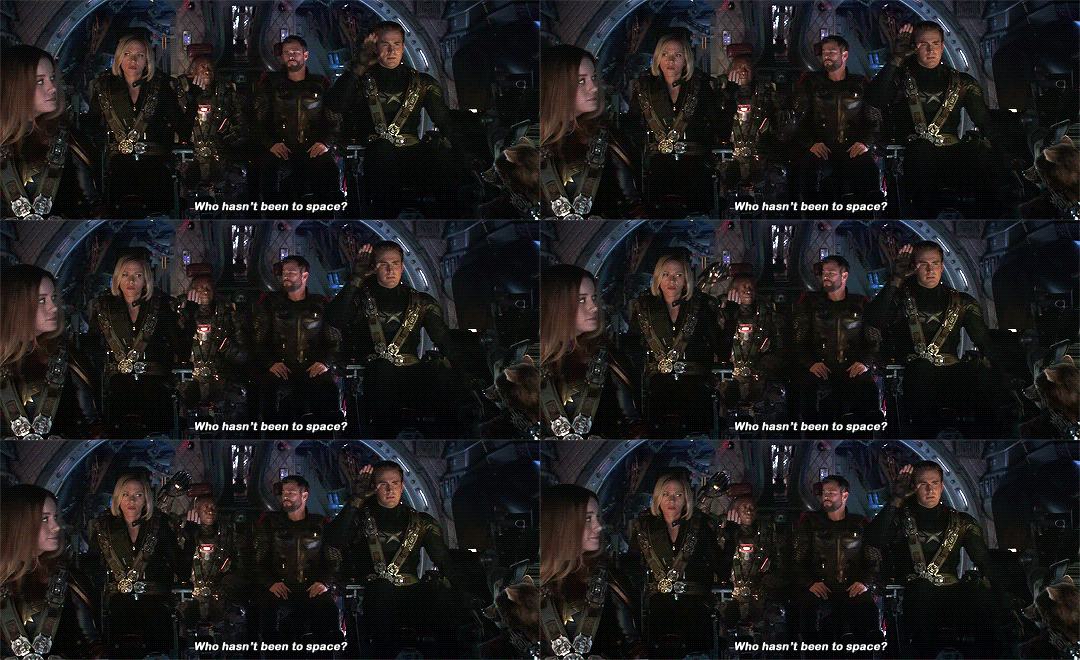
Cut to the efforts of Professor Xavier (James McAvoy) to take on guardianship—and care-taking—of the young Jean at the Xavier School for Gifted Children, where he provides a mental block band-aid to keep Jean from going down a dark path. Unfortunately, he's the one who induces the event that pushes her over the edge. At the notification of the President—the government trusts the X-Men now?—the core team—Beast (Nicholas Hoult), Mystique (Jennifer Lawrence), Nightcrawler (Kodi Smit-McPhee), Quicksilver (Evan Peters), Cyclops (Tye Sheridan) and Jean are sent to space ("raise your hands if...") to rescue the crew of the space shuttle Endeavour from a virulent energy source (fulfilling the classic Marvel trope—"I dunno what it is, but it sure is big"). Nightcrawler *BAMFS* over to rescue the crew, but manages to leave Jean on the shuttle where her efforts to keep the vehicle together exposes her to the energy's attack, which she absorbs. It dramatically increases her psycho-kinesis, but puts the emphasis on the "psycho" part by breaking the mental block Prof. X had established.
Pretty soon, she's having to deal with the awesome powers she possesses, the inhibitions it dispels and the fact that she enjoys it to a destructive degree. There is a lot of room to snark that the plot is a cautionary tale about giving a woman to much power, which is quite the opposite of the line Marvel should take especially given its Captain Marvel film and the too-brief tip of the cowl to super-women in Avengers: Endgame.
The results are damaging to the X-Men—one prominent A-lister is killed—and it results in all the mutants taking sides—Xavier's group on one side trying to get Jean back to school to try to mute her instincts, and the group headed by Magneto (Michael Fassbender) and Beast to try to eliminate her. Both groups are challenged by the shape-shifting D'bari (ah, reader, you made it this far!) led by the power-hungry Vuk (Jessica Chastain, who shoves portraying intelligence aside for a serene lizardish entitlement), who have been tracking the Phoenix Energy and want to suck it out of Jean for themselves...
Attack in New York. Attack on the mutant-train (which is quite dynamic and well-realized, actually). But, again, we've spent more time with Evil Jean than with the sympathetic one. The consequences of the actions don't resonate and seem less than a tragedy than a sensible outcome to avert disaster. Timing. 
Another X-Men movie with Turner's Grey might have helped, but 20th Century Fox (which has the movie rights to the characters) wanted to wrap up this version of X-men (2.0?) so that it could be "re-imagined" under the auspices of their new Masters, Disney-Marvel. And so the potential for a good film is once again sacrificed for corporate interests. As they used to say on "The Bullwinkle Show," "That trick never works."
You can bet they'll try it again for a third time (unless the "re-boot" tanks) because it's not like there are a lot of other X-Men stories to tell. How many times have we seen Krypton explode and Bruce Wayne's parents get shot? Maybe "re-boot" and "re-imagining" shouldn't be the terms used but "recycling," instead. Send the old stuff to the burn-bin and start anew?

Seems appropriate. Phoenix's may rise. But, first there have to be a lot of ashes.


* No one dies in comics. Not really. And especially in the Marvel Universe ("The House of Ideas"). In 1986, writer Kurt Busiek and Bob Layton revived the character as part of their team in "X-Factor" with the first issue.

** File under: "Power corrupts; Absolute power corrupts absolutely." You can file it, but it'll probably take you a year to find it again, because a lot of people do that one. I find it...thought-provoking that the director so dominant in bringing most of the X-Men movies to the screen, director Bryan Singerwho could learn a thing or two about the abuse of power—did not direct the two "Phoenix" films.

*** Lord knows why, probably to shock the expectations of those familiar with the original, in much the same way that Stanley Kubrick in The Shining had Jack Nicholson's Jack Torrence kill the guy who, in Stephen King's book, ultimately saves the Torrence family, giving more power to the wife and son to triumph and save themselves, but also to shock the hell out of the complacent fans. Worked great. With Cyclops, not so much, although one could make an argument that she had to kill her former lover to "detach" herself from her Jean Grey past. Pfft.
Rockin' roller-blades, it's Dazzler! (Marvel's dumbest superhero)