Showing posts with label Nicole Holofcener. Show all posts
Tuesday, October 19, 2021
The Last Duel
or
"Deny...Deny...Deny"
Ridley Scott's new film, The Last Duel (written by Nicole Holofcener—she wrote and directed Enough Said—and the Good Will Hunters Matt Damon and Ben Affleck) is, as they say, "based on a true story"—one of significance—that of the last judicial duel—a trial by combat to the death—held in France.
Now, that's a big deal—we're all familiar with duels and jousting from the movies and their romantic notions of such brutalities—but this particular episode resonates now, for very deliberate reasons, and the 2004 book by Eric Jager, from which the film is based, predates that resonance, but it has been taken, and been transformed by recent cultural and sociological events (at least the acknowledgment of such), with a new, more informed and ironic eye. More towards that after the brief synopsis.
The players are real people and their stories are intertwined with the politics and fealty of 14th century France:
—Jean de Carrouges (IV) (played by Damon), a French Knight and governor of Normandy, of "rash and temperamental" manner, who after several campaigns and the death of his first wife and son, married Marguerite de Thibouville receiving as dowry several parcels of her disgraced father's land, which would lead to acrimony with Count Pierre d'Alençon.
—Jacques Le Gris (played by Adam Driver), friend and neighbor of Carrouges, and favored member of the court of Count Pierre d'Alençon (over Carrouges). The Count gave a parcel of land to Le Gris that Carrouges assumed was part of his wife's dowry, and the subsequent suit over that land infuriated the Count and caused animosity between the two French knights. It should be noted that Le Gris had a reputation as a womaniser.
—Count Pierre d'Aleçon (played by Affleck), Count of Allençon and Perche.
—Marguerite de Carrouges (played by Jodie Comer) Second wife of Jean de Carrouges, and who accompanied her husband to a fete celebrating the birth of a friend's son. At this festivity, Carrouges and Le Gris publicly put aside their differences and Le Gris first met his friend's wife. Although the friendship was strained, it is here where things started to seriously deteriorate.
The events that led to the duel are based on an accusation by Carrouges against Le Gris—that while the former was away fighting in Scotland, Le Gris forced his way into the Carrouges castle while his wife was alone and raped her. Knowing that when the crime is presented at the court of Count Pierre it would be dismissed, Carrouges pressed his charges to the Court of France, demanding a judicial duel. Le Gris denied the charges, and his lawyers called witnesses for Le Gris' account and against Marguerite's charges—she was six months pregnant at the time of the trial. Calling on her to testify, she swore the truth of the accusations, but the lawyers argued that, as she was pregnant, and she swore she didn't "enjoy" the encounter, that she was lying, as "science said" that rape could not produce a pregnancy, but a satisfying sexual experience could. The implication being that she had an affair with Le Gris and sullied his good name rather than invite the wrath of her husband.
The duel was allowed to determine the truth of the matter, as the winner of the contest—the last man standing—was obviously, by God's hand, telling the truth. If Le Gris won the duel, then not only would Carrouges be dead, but the charges would—God says—be proved false and Marguerite would be burned at the stake for committing perjury while testifying. There's a reason the period is called "medieval."
Now, notice that the gentlemen involved all have Wikipedia pages devoted to them, but Marguerite does not. The writers have decided to rectify that by giving Marguerite her due. The film is structured in three chapters (book-ended by the events of the duel): "The Truth According to Jean de Carrouges," "The Truth According to Jacques Le Gris," and, finally, "The Truth According to Marguerite de Carrouges"—"The Truth" hanging for a just a moment longer as the rest fades. The film goes the "Rashoman" route of telling the same story from three perspectives, each one colored by the prejudices, assumptions, and—finally—the experiences of those involved. They differ wildly with the individual—in Carrouges' "Truth", he is steadfast and always in the right and in the others, he's a diffident, strident buffoon. Le Gris' sees himself doing his duty and his rape a moment of passion for a love burdened to an unhappy marriage. Marguerite sees her husband as more concerned with property than her and Le Gris as a man full of himself and not to be trusted—a "ladies' man" we'd say although the term couldn't be more opposite.
But, there is one truth hanging over it all: it's a man's world. As a cleric says at one point "rape is not a crime against a woman. It is a property matter." Women are a means to an end—the acquisition of property and brood-mares for progeny. It is no comfort at all that The Last Duel is set in the past as the arguments and attitudes have a familiar ring to them—I've heard the "rape could not produce a pregnancy" garbage come out of a U.S. representative recently discussing the abortion issue and a cleric's advice to "deny, deny, deny" the accusations against Le Gris are an all-too-familiar tactic in The Attorney's Handbook. Even the idea of burning a woman at the stake for perjury has the same base core-values of roasting her in the press. If the stakes weren't so high, one could take satisfaction in the spectacle of men chopping at each other with battle-axes just to keep them occupied and from doing more damage.That the story is told three times must have cut down on costs a bit—just do another version of the same scene with alternate dialogue or attitude and it has the audience the ring of familiarity while giving another version of events. And one notices the differences and takes note as the narrative changes. It's a good strong effort by Scott, whose period pieces can be quite good or quite indifferent. His 14th Century France is perpetually overcast, punctuated by the traditional Scott "fluff" of chaff flying through the air, be it smoke, snow, or back-lighting shafts of light. His battle scenes seem to have settled on the quick-cutting shutter manipulation he's become fond of giving the action a jittery, desperate feel.
It's a story about men maneuvering through a man's world, but the importance of the story boils down to women and the damage done to them in the process. One may be tempted to say that this is a post MeToo movement "penance" movie (and some critics have), but the observations that women are caught up in the machinations of men no matter how petty can be observed just in reading about the six wives of Henry VIII. This is not news even if it becomes fresh in the zeitgeist, any more than racial bias started to be "noticed" by greater numbers of whites after the death of George Floyd. It's just that it was buried in the understood infrastructure rather than being discussed around the water-cooler in broad daylight. It's not "woke" (as much as some—mostly men—are wont to comment) to merely point out something that is consistently ignored just as it is consistently present. Scott's cut-away's to various women's reactions in the movie are more significant in how pervasive the problem is, than just the show-casing of this one historical incident.
"A man's home is his castle" goes the old saying (you can tell that it's old in that it ignores the existence of women). And we've gotten used to period dramas in which those fortifications are "stormed." The Last Duel is just another deliberate forward assault on the impregnable stature of male dominance and the patriarchy—as backward a notion as royal ascendancy and as heretical as the divine right of kings—and we're just as slow to topple those structures even if we rushed to disprove those latter two. But, walls are vulnerable to time, and they eventually crumble with or without human intervention.
Thursday, March 17, 2016
Enough Said
Yadda, Yadda, Yadda....
or
Ex-Men and Women: Daze of Futures Past
It's refreshing to see a rom-com where the entangled are not "zygotes in love," young puppy-lovers with their whole lives in front of them as they go walking off into the sunset, or walking along the sandy-beach, or kissing in front of fireworks while the music swells and we head for the exits. That's about the time where the "They Lived happily Ever After" credit of "The End," sometimes with the cutesy "(?)," burns itself into the acetate, and I give a guttural chuckle while the thought of there being a sequel where everything goes to shit burns itself into my grey matter.
Most rom-coms, even the most cynical ones, are first acts, where the lessons learned and the hurdles tripped over only get us to the threshold of commitment and then leave us with the unasked question: "So, how's THAT working out for you?"
But, when you're dealing with adult rom-com's there's always that bittersweet quality where flirtations are recognized to be temporary sparks, and that work is involved and sometimes relationships need to be as tailored like clothes, as people change and grow either too comfortable or not comfortable enough. If nothing fits, then it's time to do some spring cleaning and donate stuff to somebody else. That's the situation with people in Enough Said, the latest film by Nicole Holofcener, who's doing her best to off-set the male-centric movie landscape in the States. This one centers around Eva (Julia Louis-Dreyfuss) a single mother, once divorced, working as an in-home masseuse, who's dreading the departure of her daughter (Tracey Fairaway) for college, and feeling needy, probably because it's one thing to be a married "empty nester," but a single one? Misery loves company.
That's why her meeting Albert (James Gandolfini) at a party is such a lucky break. Divorced, nebbish-y, his daughter (Eve Hewson) is also going away to college. There's no real attraction at the beginning, and there's really nothing there, but a casual date is fun, and she finds herself relaxing with him. Her therapist-friend (Toni Collette) is supportive, as is her daughter, such as she can be. Even one of her clients she's bonded with, Marianne (Catherine Keener), thinks it's a great idea.
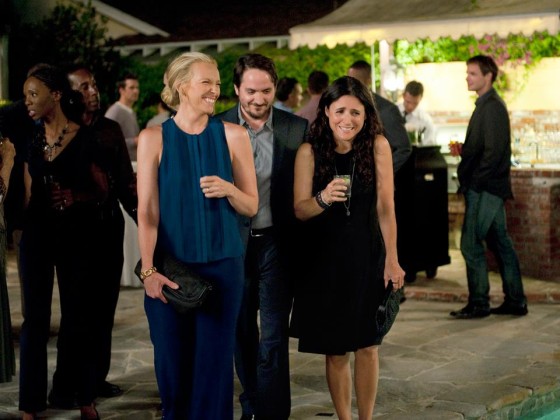
It's going great...just great...great. Yeah. Then, she starts to notice that the things that irritated Marianne about her ex, are things that Albert does all the time. It's not that they are particularly irritating, but...she never noticed them before, and now that she's noticing them...yeah, they are pretty irritating things. And, considering that those "things" broke up Marianne's marriage to him, Eva decides that maybe she'd better fire a couple of shots across Albert's considerable bow to see if she can change him before things get any more serious. For Albert, it starts to sour their relationship because when Eva brings them up (as he says) "it's like I'm with my ex-wife..."
This is kinda sit-commie. A little too convenient (story-wise) that everybody should be in such proximity that they get caught up in each other's orbits (minor quibble), and you want to apply some malicious reiki to Eva's neck—if it weren't for the fact that this is a kinder, gentler version of Louis-Dreyfuss' Elaine Benes from "Seinfeld," so wrapped up in herself that she's quite unaware that she's an emotional black hole, starting to suck the energy out of people to fulfill her needs, so in pursuit of "the new" that she tends to shaft the familiar (a not uncommon trait). The wonderful thing about Louis-Dreyfuss (besides being able to channel her dark side in her sleep) is how she is still able to make Eva engaging. She has to be, for the attraction to work. And Gandolfini is superb in this, vacillating between shy comfort and wariness, constantly looking at people out of the corner of his eye as if looking at them directly will reveal too much or put his vulnerability out there to be skewered. Good cast all around and they do make the most of the material, of adults who are still in need of love and finding that available hugging arms are in increasingly short supply.
or
Ex-Men and Women: Daze of Futures Past
It's refreshing to see a rom-com where the entangled are not "zygotes in love," young puppy-lovers with their whole lives in front of them as they go walking off into the sunset, or walking along the sandy-beach, or kissing in front of fireworks while the music swells and we head for the exits. That's about the time where the "They Lived happily Ever After" credit of "The End," sometimes with the cutesy "(?)," burns itself into the acetate, and I give a guttural chuckle while the thought of there being a sequel where everything goes to shit burns itself into my grey matter.
Most rom-coms, even the most cynical ones, are first acts, where the lessons learned and the hurdles tripped over only get us to the threshold of commitment and then leave us with the unasked question: "So, how's THAT working out for you?"
But, when you're dealing with adult rom-com's there's always that bittersweet quality where flirtations are recognized to be temporary sparks, and that work is involved and sometimes relationships need to be as tailored like clothes, as people change and grow either too comfortable or not comfortable enough. If nothing fits, then it's time to do some spring cleaning and donate stuff to somebody else. That's the situation with people in Enough Said, the latest film by Nicole Holofcener, who's doing her best to off-set the male-centric movie landscape in the States. This one centers around Eva (Julia Louis-Dreyfuss) a single mother, once divorced, working as an in-home masseuse, who's dreading the departure of her daughter (Tracey Fairaway) for college, and feeling needy, probably because it's one thing to be a married "empty nester," but a single one? Misery loves company.
That's why her meeting Albert (James Gandolfini) at a party is such a lucky break. Divorced, nebbish-y, his daughter (Eve Hewson) is also going away to college. There's no real attraction at the beginning, and there's really nothing there, but a casual date is fun, and she finds herself relaxing with him. Her therapist-friend (Toni Collette) is supportive, as is her daughter, such as she can be. Even one of her clients she's bonded with, Marianne (Catherine Keener), thinks it's a great idea.
It's going great...just great...great. Yeah. Then, she starts to notice that the things that irritated Marianne about her ex, are things that Albert does all the time. It's not that they are particularly irritating, but...she never noticed them before, and now that she's noticing them...yeah, they are pretty irritating things. And, considering that those "things" broke up Marianne's marriage to him, Eva decides that maybe she'd better fire a couple of shots across Albert's considerable bow to see if she can change him before things get any more serious. For Albert, it starts to sour their relationship because when Eva brings them up (as he says) "it's like I'm with my ex-wife..."
This is kinda sit-commie. A little too convenient (story-wise) that everybody should be in such proximity that they get caught up in each other's orbits (minor quibble), and you want to apply some malicious reiki to Eva's neck—if it weren't for the fact that this is a kinder, gentler version of Louis-Dreyfuss' Elaine Benes from "Seinfeld," so wrapped up in herself that she's quite unaware that she's an emotional black hole, starting to suck the energy out of people to fulfill her needs, so in pursuit of "the new" that she tends to shaft the familiar (a not uncommon trait). The wonderful thing about Louis-Dreyfuss (besides being able to channel her dark side in her sleep) is how she is still able to make Eva engaging. She has to be, for the attraction to work. And Gandolfini is superb in this, vacillating between shy comfort and wariness, constantly looking at people out of the corner of his eye as if looking at them directly will reveal too much or put his vulnerability out there to be skewered. Good cast all around and they do make the most of the material, of adults who are still in need of love and finding that available hugging arms are in increasingly short supply.
![]() |
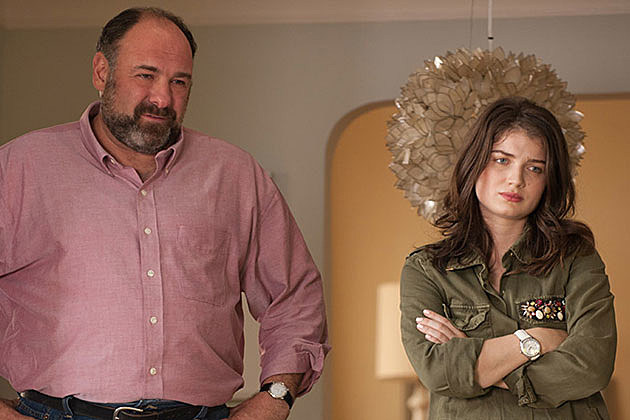
| He talks during movies and rattles his popcorn, so I couldn't date him. Louis-Dreyfuss and Gandofini in Enough Said. |
Subscribe to:
Comments (Atom)


