Showing posts with label Nancy Davis. Show all posts

Wednesday, June 30, 2021

Donovan's Brain

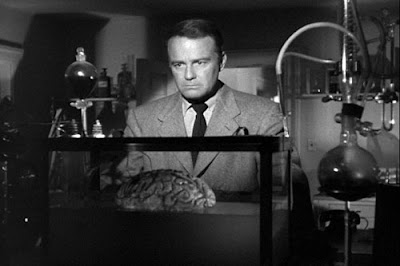
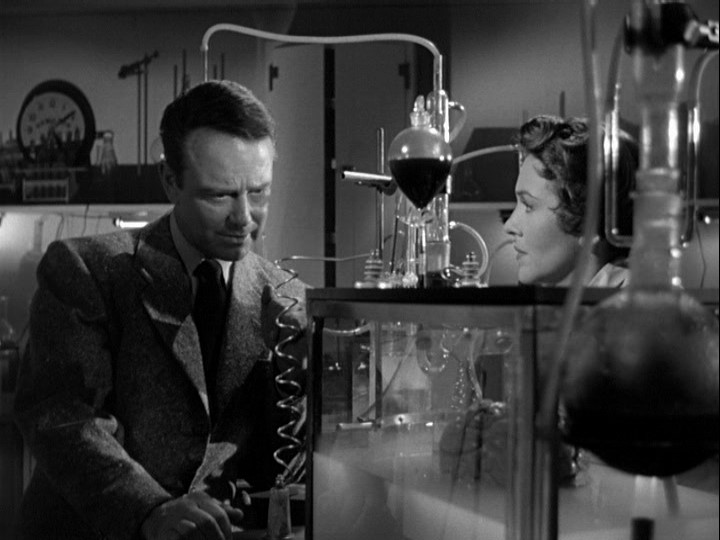
Donovan's Brain (Felix E. Feist, 1953) Turgid and over-the-top '50's sci-fi pot-boiler (based on Curt Siodmak's 1942 sci-fi thriller) about a scientist, Dr. Patrick Cory (Lew Ayres) experimenting with trying to keep alive what Woody Allen called his "second favorite organ:" the human brain.
 
Volunteers are, naturally, hard to find.
 
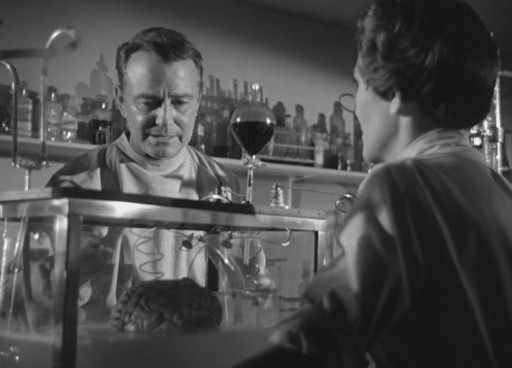
After limited success with monkey-brains, opportunity falls from the sky with the conveniently nearby plane-crash that kills millionaire-industrialist H. W. Donovan--but leaves his brain undamaged (these millionaire industrialists have pretty thick skulls). And before you can say, "The ganglia's all here!" Donovan's brain squats in one of those big aquariums that can hold all sorts of veiltails and comets (there must have been one in the waiting room!) 

Now, this film was made in the "Ameri-CAN" era of the 1950's, so there is no thought given to defeatist talk like "Just because we CAN, doesn't mean we SHOULD" Not when Cory's wife is played by Nancy Davis, the-soon-to-be Mrs. Ronald Reagan! "You get in there, Daddy, and pickle that brain!"* 

Now, now. I'm letting my leftist agenda get in the way. The future First Lady is the best thing in the movie (Mr. Ayres being a little bit...restrained for the material, as maybe he thought he was still playing Dr. Kildare or something) and her palm-outward-looks of horror at the intractability of her favorite brainiac's single-minded purpose rise above the studio-prescribed requirements of the science-plagued ingenue. 

Now, because a brain in an aquarium is a lonely thing (despite being surrounded by bubbling water, flashing lights and the instrument that goes *ping!*), Cory devises a system for the brain to communicate (Davis could have told him that as it was a man's brain, he shouldn't make it a priority, but there's no stopping Cory). There being no cadavers lying around (but, boy, just you wait) and because Universal Pictures has the film-rights to "Frankenstein," he sets up a system so Donovan can electrically communicate via brain-waves, telepathically sending messages to the team. Sort of like using lawyers while he was alive. But requests to have his water changed just isn't enough for the industrialist. Suffering from unrequited lobe, once he gets Cory's ear, he soon wants the whole body, and Cory is helpless to resist Those Big Business Brain-Waves. 

Usually when you combine an entrepreneurial spirit with a scientist, you get a snow-storm of government-grant proposals. But Cory...goes to the lawyers, instructing them to turn over Donovan's fortune to him, so he can...Mwah-hah-hah...expand his empire. Living in an aquarium does that to you. 
Not very good, really. But, a bit ahead of its time when dealing with the possibility of altering brain-chemistry for purposes of rehabilitation. And Dr. Cory goes in with the best of intentions—to find a cure for alcoholism. 

But the story screams like a B-actress for a re-make that can touch political, social and pharmacological fronts. What if Donovan was on Xanax before the crash, and afterwards, the brain becomes stronger, but more hostile? What would an entrepreneur do given the power to control others? Well, control more, I'd think. He'd want to corner the market. What if the brain could be used as a power-source—a self-regulating power-source? And what might it do with that power? In an age of wireless gadgets and computers, and artificial limbs controlled by brain-impulses, what couldn't the brain do (besides the dishes—it's a man's brain, after all)? Think of the movie you could make now...if you had a mind to. 

Low-angle indicates dominance...
* Actually, I can hear Nancy Reagan saying that...

Tuesday, March 8, 2016

The Next Voice Your Hear...

The Next Voice You Hear... (William A. Wellman, 1950) Leo, the M-G-M lion doesn't roar in The Next Voice You Hear... probably so as not to offend any Christians with Roman Coliseum associations that might produce a "thumbs down." But, that's not the oddest thing in a picture steeple full with them. The wildest thing is to see William "Wild Bill" Wellman's name as director—maybe he's atoning for all those gangster pictures he did in the '30's—associated with its theme. On a Tuesday, at 8:30 in the evening when Mary Smith ("American," as she's identified in the credits, and as well she should be as she's played by Nancy Davis, soon to be Nancy Reagan) is helping son Johnny (Gary Gray) with his long division, and Dad Joe ("American," played by James Whitmore) having finished doing the dishes for his pregnant wife after a typical pot-roast dinner, and settled down with a beer and his paper, that something peculiar happens on the radio.

Not that we get to hear it. God speaks on the radio. "This is the voice of God. I'll be with you for the next five days." Joe, a bit stumped, walks in to tell his family, and the first thing out of mother Mary's mouth is "Was it one of those Orson Welles things?"

Funny. Joe thinks a local kid is pulling a stunt with a ham-radio kit, but a phone call reveals that another neighbor heard the same voice interrupting another program on another station. "Did it sound like Lionel Barrymore?" asks Mary, out of the blue. After the first night, Joe's pals at the Ajax Aeronautics factory have their own speculations "It's mass-psycho-orology. Only fat-heads are gonna fall for a gag like that!"
But, the next night, God shows up again. The stations try to record it, but nothing shows up on the electrical transcriptions. More people are hearing it, and it's determined that it's a global phenomenon. And people are starting to seriously freak out. Before the week is over, Joe "American" is going to go on a major bender, when all he wanted to do is buy a pack of smokes, and the resulting loss of stability splinters his family.
Not that he was any too stable to begin with.  What keeps The Next Voice You Hear from sinking into a sermon swamp is the casting of Whitmore and, yes, even Davis as the American couple. Whitmore is no leading man material, but is a facile actor who pulls off charming even when he's a bit of a louse. Here, he's impatient to a fault, perpetually late for work, flinty with co-workers, disparaging of supervisors, and even he and the wife do a little sniping back and forth at each other. There's one sequence where son Johnny, so used to Dad's frustrating ritual of resuscitating a faltering car engine, mimes it for Mom split-seconds before the sound effects of the effort come clanking through the door. It's not dysfunctional to any degree, but it is refreshingly a couple notches below "Father Knows Best."
Credit screenwriter Charles Schnee and Wellman for daring to throw a little real conflict (and a healthy dose of irony) into the thing to keep audiences out of a diabetic coma, and to make it as palatably earnest as one of Norman Corwin's inspirational radio-plays.  
And should one get all-blustery and righteous and harumph about the overt religious message, one should bear in mind that the next year The Day the Earth Stood Still would cloak the homilies in the shiny jump-suits of science-fiction.