Showing posts with label James Whitmore. Show all posts

Thursday, October 10, 2019

Them!

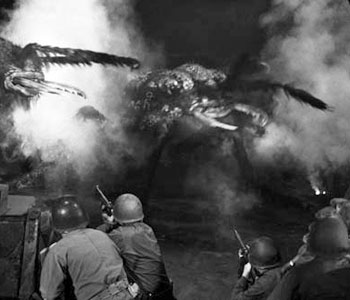
Them! (Gordon Douglas, 1954) "When Man entered the atomic age, he opened a door into a new world. What we'll eventually find in that new world, nobody can predict." What no one could predict is that giant atomic-mutated ants would spoil The Big Picnic. Somehow, one expected the splitting of the atom to have more profound effects.

But nature abhors a vacuum or tampering with things on the atomic level, and, apparently, so did the world-wide movie industry, because, by 1953, two films that displayed horrific effects from atomic testing exploded on (appropriately, I guess) American and Japanese theater screens: The Beast from 20,000 Fathoms (Eugène Lourié) and Gojira (Ishirô Honda). Neither film exactly bombed.

And as The Bomb (and a popular 1952 re-release of King Kong) begat The Beast..., so did that Warners film beget Them! (which became Warner Brothers' box-office champ in 1954)*, inspiring a subsequent fallout of atomic themed films featuring Incredible Shrinking and 50 ft. metamorphoses that have had a half-life of (going on) 60 years. Them! may not be the glowingly cheesiest of them all—some of the writing's not bad, and despite the subject matter, some of the performances are surprisingly good—but, then, what can you expect with such an early entry in the genre, everybody was trying hard, and the writers managed to throw in some scientific fact mixed in with the hokum. But, it does have an exclamation mark in the title, which immediately makes it suspect.
And it has a good intro: a little girl (Sandy Descher) is found by police wandering in the desert, mute, in shock. Tracing her back to the family trailer (!), they find it split open—but from the inside. Hmmm. Mystery abounds, and at one point Sherlock Holmes is invoked (appropriately, as he once had to do battle with The Giant Rat of Sumatra, "a story for which the world is not yet prepared").  
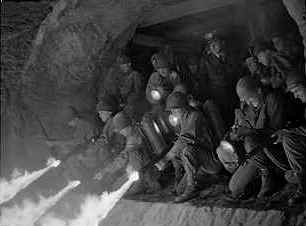
But, you can't hide a gargantuan ant for very long, not even in the desert, and soon the local constabulary and the army (with the help of a couple of myrmecologists (you know, "ant-thropologists") take on the formidable formicidae with all manner of WWII surplusflame-throwers, bazookas (that look really cool!), cyanide gas cannisters, and rocket-propelled grenades—one wishes for the huge Monty Python foot to appear, or a monstrous can of Raid...better yet, turn New Mexico into a giant ant-farm

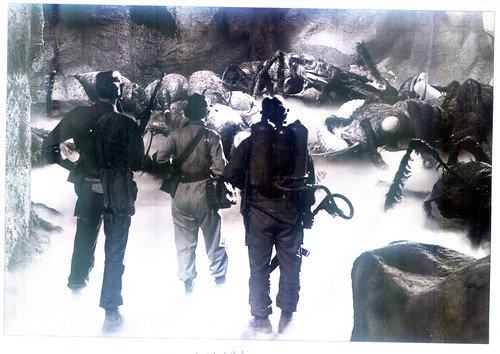
There is no trying to "negotiate" with the ants (it was the 1950's, after all, at least they weren't hauled up before the House Un-American Activities Committee), and even one of the scientists—the cute female one (Joan Weldon), after making her observations, documenting them, and taking her corroborative pictures,** turns to her companions with the flame-throwers and says, "Burn it. Burn EVERYTHING!" O-kay...
This one was directed by Gordon Douglas,*** who worked his way up from "Our Gang" comedies to Laurel and Hardy and became to go-to director for 20th Century Fox when they needed a fast turn-around on a sequel or a Frank Sinatra movie, and sports all sorts of good actors trying to take it all seriously: Edmund Gwenn, James Whitmore, James Arness, Fess Parker (in an odd role as a man driven lunatic by the sight of giant ants), and look for glimpses of Richard Deacon (reporter), William Schallert (doctor) and Leonard Nimoy**** (fleetingly) as a soldier with some interesting information, and with no less than four employments of the giddily hysterical "Wilhelm" scream (performed by Sheb Wooley) shrieking throughout.  "The Wilhelm" was recorded for the 1952 film Distant Drums and became part of the Warner Brothers stock sound effects library under the title "man being eaten by alligator." 
And giant ants. Lots of giant ants. Zillions of them. Although, for budgetary reasons, we only see three at a time.
"The Wilhelm," however, probably wouldn't be classified as one of those "profound effects" previously mentioned.
"Look...it was a paycheck, okay?"

* Interestingly, though, no Academy Award nominations....

** Dialogue that came to mind: "I need to get one of you officers close to one, so I can get some perspective. Would you...?" "Lady!  You nuts??!!

*** And, you can tell that it was SUPPOSED to be shot in 3-D, with some shots hurtling at you...and evidently in color (only the title is), but someone in Warners accounting wisely decided not to "splurge" on a giant ant movie.

****

Thursday, August 3, 2017

Above and Beyond

Above and Beyond (Melvin Frank and Norman Panama, 1952) The story of Lt. Col. Paul Tibbets who, during World War II, was charged with the task of training crews for the most secret bombing mission of the war—the dropping of the experimental atomic weapon that was concurrently being developed at Los Alamos. The story is different in a couple different ways: one, made in 1952, it dares to tell the story of the mental strain that such a highly secretive mission can have on the psyche, especially considering the destructive consequences the new bombs would bring; two, probably to draw a female audience, it tells the story from Tibbets' wife's point-of-view, of the hardships that a war-time marriage must go through, especially in a situation where the details of the operation cannot be disclosed to anyone, even if the secrets and responsibilities threaten to tear the marriage apart.  The choices come down to nuclear war or nuclear family. And both are extremely fissionable.

It's frustrating: Tibbets (Robert Taylor, far more nuanced than he usually is) working around the clock, must perfect the strategies for a potential suicide mission, while also consciously recognizing the horror his direct action will take—when offered an assignment, after readying the B-29 ("a flying death-trap," great commercial for Boeing) for high altitude combat missions, he's given a buzzer and told, "Now think—what would you do if that buzzer could end the war, but cause hundreds of thousands of Japanese lives." The idea rocks Tibbets back on his heels, considers all the options for forty seconds, then deliberately presses the buzzer.
Meanwhile, his wife (Eleanor Parker) must deal with long absences, no explanations, and the obvious stresses, the mission, which she knows nothing about, throws at them. To make matters worse, she billeted, along with the other airmen's wives (who are only too quick to blame her and her husband for their own living situation), at Wendover air base in Utah, a hell-hole with sub-standard housing, raising two kids (with their own short fuses), virtually fatherless. At first, it's suggested that she not come to Wendover, until the base's security officer (a tamped-down James Whitmore) opines that she being the only wife not on-base might arouse suspicions—the movie is full of such "damned is you do..." crossroads.
The scriptwriter-directors Frank and Panama, who were usually involved in lighter fare than this, do the character of Tibbets' wife no favors—she has difficulties, but domestically, not militarily, while a war rages on. She's given some egregiously selfish moments, like telling her bomber-pilot husband how she feels bad for all the kids on the ground caught in the situation—absolutely, and an extremely valid sentiment, but are you really going to tell your bomber-pilot husband that, when he's got his own guilt he's dealing with? At one point, remembering Tibbets' mother's name (which would eventually emblazon the Hiroshima bomber) she mopes "Enola—even the word backwards means 'alone.'" Yeah, honey, the world's a powder-keg and it's all about you. If you want something to worry about, how about your family turning to ash at ground zero? And, not that she'd know it, her husband might get caught in the flash-point or his bomber might get buffeted by a shock-wave, the result of a man-made conflagration no atomic engineer could predict, and the world had never seen. Tibbets as going through his own issues, but I'll bet his wife was faring better than her on-screen portrayal by Frank and Panama.
Still pretty interesting to see a 1950's film sanctioned by the Air Force (and especially General Curtis LeMay—played in the film by Jim Backus) that contemplates the use of atomic weapons and—despite pressing the buzzer—takes that long pause to consider the options and the terrible weight such a decision might impose.

Tuesday, March 8, 2016

The Next Voice Your Hear...

The Next Voice You Hear... (William A. Wellman, 1950) Leo, the M-G-M lion doesn't roar in The Next Voice You Hear... probably so as not to offend any Christians with Roman Coliseum associations that might produce a "thumbs down." But, that's not the oddest thing in a picture steeple full with them. The wildest thing is to see William "Wild Bill" Wellman's name as director—maybe he's atoning for all those gangster pictures he did in the '30's—associated with its theme. On a Tuesday, at 8:30 in the evening when Mary Smith ("American," as she's identified in the credits, and as well she should be as she's played by Nancy Davis, soon to be Nancy Reagan) is helping son Johnny (Gary Gray) with his long division, and Dad Joe ("American," played by James Whitmore) having finished doing the dishes for his pregnant wife after a typical pot-roast dinner, and settled down with a beer and his paper, that something peculiar happens on the radio.

Not that we get to hear it. God speaks on the radio. "This is the voice of God. I'll be with you for the next five days." Joe, a bit stumped, walks in to tell his family, and the first thing out of mother Mary's mouth is "Was it one of those Orson Welles things?"

Funny. Joe thinks a local kid is pulling a stunt with a ham-radio kit, but a phone call reveals that another neighbor heard the same voice interrupting another program on another station. "Did it sound like Lionel Barrymore?" asks Mary, out of the blue. After the first night, Joe's pals at the Ajax Aeronautics factory have their own speculations "It's mass-psycho-orology. Only fat-heads are gonna fall for a gag like that!"
But, the next night, God shows up again. The stations try to record it, but nothing shows up on the electrical transcriptions. More people are hearing it, and it's determined that it's a global phenomenon. And people are starting to seriously freak out. Before the week is over, Joe "American" is going to go on a major bender, when all he wanted to do is buy a pack of smokes, and the resulting loss of stability splinters his family.
Not that he was any too stable to begin with.  What keeps The Next Voice You Hear from sinking into a sermon swamp is the casting of Whitmore and, yes, even Davis as the American couple. Whitmore is no leading man material, but is a facile actor who pulls off charming even when he's a bit of a louse. Here, he's impatient to a fault, perpetually late for work, flinty with co-workers, disparaging of supervisors, and even he and the wife do a little sniping back and forth at each other. There's one sequence where son Johnny, so used to Dad's frustrating ritual of resuscitating a faltering car engine, mimes it for Mom split-seconds before the sound effects of the effort come clanking through the door. It's not dysfunctional to any degree, but it is refreshingly a couple notches below "Father Knows Best."
Credit screenwriter Charles Schnee and Wellman for daring to throw a little real conflict (and a healthy dose of irony) into the thing to keep audiences out of a diabetic coma, and to make it as palatably earnest as one of Norman Corwin's inspirational radio-plays.  
And should one get all-blustery and righteous and harumph about the overt religious message, one should bear in mind that the next year The Day the Earth Stood Still would cloak the homilies in the shiny jump-suits of science-fiction.