Showing posts with label L. Show all posts

Thursday, March 13, 2025

Local Hero

Local Hero (Bill Forsyth, 1983) The head of Knox Oil and Gas Company, Felix Happer (Burt Lancaster) decides that the site for the new Knox oil refinery must be in the Scottish town of Ferness, and so he sends "Mac" MacIntyre (Peter Riegert)—because his name sounds Scottish ("they're your people" even though his family is Hungarian)—to impress on the locals the need to sell the town to Knox Oil, which already has a team in Aberdeen doing research on what it'll take to get the facility up and running.

What it will take is the entire town of Ferness to approve of the venture. But, will they go for it? MacIntyre would rather do the whole operation at Knox Oil in Houston ("I'm more of a telex man"), but Happer insists "Mac" travel to Ferness and scout the location for himself and to "watch the sky" for anything interesting as (as he tells him) "The constellation of Virgo is very prominent in the sky right now, in Scotland. I want you to keep an eye on Virgo for me. Will you do that?" Happer happens to be an amateur, but very enthusiastic, astronomer.
So, Mac flies to Scotland, specifically Aberdeen where Knox has a research facility and hooks up with a rep, Danny Oldsen (Peter Capaldi in his first movie) and discuss the refinery plans before heading to Ferness, where he plans to woo the locals. Everything's a little bit primitive in that "living-off-the-land" kind of way and Mac makes the rounds of the residents, who, once they find out there's American money involved, are all-too-eager to hear what the pay-out will be. While negotiations are going on, Mac becomes less the "go-getter" and adjusts to "island-time" and the quirky life-styles of the locals. At night, he goes to the town's one phone-booth to keep Happer apprised of the situation. "Watch the skies," he keeps exhorting.
His one hitch of the locals is old-timer Ben Knox (Fulton Mackay) who lives in a shack on the beach, but he owns the land and has no intention of selling, no matter the price, a human sea-wall to the development. Although the Fernessians might be "quirky" it's a mercenary kind of quirky and Knox's recalcitrance takes a bit of "twee" out of their quaintness. And a row looks to be a-brewing in the small town.
In the meantime, people get known and Mac becomes more and more like an islander. His closest contact is Gordon Urquhart (Denis Lawson), the innkeeper and town accountant, whose way of doing business is singular, as well as one of his clients, the captain of a Russian fishing boat, who regularly stops in Ferness to check his stock portfolio. Danny becomes infatuated with a dedicated marine biologist, Marina (Jenny Seagrove), who is convinced that Happer's company is going to be building a marine research facility and who has the distinction of being so dedicated that she has webbed feet.
Meanwhile, Mac keeps watching the skies and starts to become fascinated with the meteor showers and the northern lights, phenomenon that he breathlessly relates to Happer on his phone calls, prompting the boss to come see things for himself.
The film has all the charm of a fish-out-of-water story—director Bill Forsyth both wrote and directed—while maintaining sympathy for its hapless lead character falling under the island's spell while also making the case that small-town life has its advantages, despite (and maybe even because of) its remoteness. Forsyth was adept at bringing out character details that charmed even if they could also risk an audience's sympathies, and Local Hero manages to walk the tightrope of dry humor and odd-duckness.
If it had been made three or four decades before, one would swear it was a product of The Archers, and, in fact, it bears a lot of tonal resemblance to I Know Where I'm Going! without leaning so much into Scottish culture. But, it has a way of making you yearn for community and towny closeness. And it's beautiful as all get-out.
In the next few weeks, I'm going to be doing more reviews of Forsyth's work, as in my obsessive movie days, he was always a particular favorite of mine to watch.

Tuesday, January 14, 2025

Last Chance Harvey

Most of this was written at the time of the film's release. I saw this in a theater because the cast was so good, how could I not?

 
Last Chance Harvey (Joel Hopkins, 2008) Consigned to forgotten corners of the internet amid the dark alleys of the streaming services, this amiable and genial little semi-romantic semi-comedy boasts a fine casting of plucky players trying to make more of it than it is. Maybe it's only on the lists of those completists who want to see every single movie that Dustin Hoffman or Emma Thompson starred in (and certainly those are good goals), but I would be surprised if anybody had ever heard of this movie, which seems a shame. You read the reviews and practically everyone says is that Hoffman and Thompson are magical together, and if it was just them...the movie would be amazing.

The titular Harvey Shine (Dustin Hoffman) is a musician working for ad agencies writing commercial jingles, but he's always wanted to be a jazz pianist. He's been hired to write yet another innocuous ear-worm, but he's on his way to London for his estranged daughter's wedding (he at least feels the absolute need to be there). He's told, rather cruelly by his boss (Richard Schiff) to take his time, enjoy himself...because he won't have a job when he gets back.

Hey...Mazel tov!
Add to that, his estrangement from his family (his ex-wife, played by
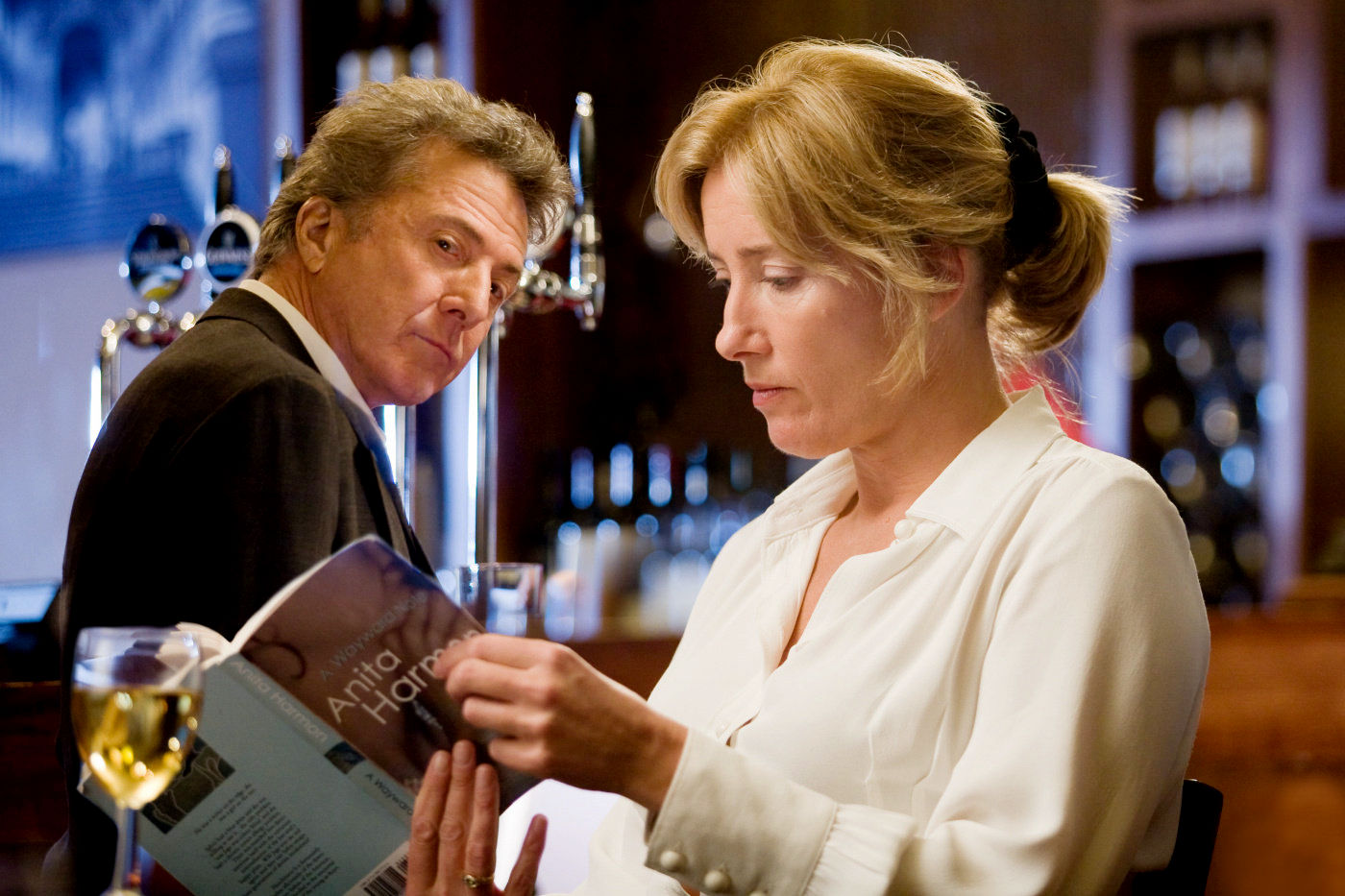
Kathy Baker, is now married to James Brolin's character) his awkwardness with social situations in general, and that dear daughter wants her step-dad to give her away, Shine is having a very bad time of it. He spends the wedding at the back of the church (at least he's there), but he's determined to skip the reception and just slink home, until he finds his flight delayed with a long layover. Only thing to do is hit the bar, and once there, he has a strained conversation with Kate Walker (Emma Thompson, always exactly right), an airline worker he previously had blown off while she was just doing her job.
She wouldn't be there if a connection didn't happen
...not merely back to the U.S., but between the two characters...and as I said it's amiable and genial and you probably already know where it is heading. Hoffman is such an adept spur-of-the-moment actor and Thompson is such a quick wit and sharp writer that it's like seeing your two best friends spark off each other and say what you will about the rest of it, but that is a joy.
There is a complication or two of the An Affair to Remember variety—don't worry, no one gets hit by a bus—and we get to witness what may be
the longest wedding reception in history. The slight story-line is fleshed out with Kate's eccentric mother (the wonderful Eileen Atkins) who thinks that there's a Rear Window-style murderer living next door. Hilarity ensues.


Still, you could do worse than this one to kill a little time, especially with such a good cast.

Wednesday, September 11, 2024

The Lucky Ones (2008)

A review of one of the films from the post 9-11 environment, written at the time of the film's release.
 
The Lucky Ones (Neil Burger, 2008) Every war, every "police action," seems to have its "re-patriation" film. World War 1 had The Razor's Edge, 2—The Best Years of Our Lives, Vietnam—Coming Home. The Lucky Ones involves returning troops in the ongoing Iraq War, different from their cinematic (and real) fellow troops in that they're not coming home. They're on a 30 day leave before going back as part of the "stop-loss" program. So, this takes place as more of an interruption to their service. What happens when the environment is not so regimented, or as dangerous. The three come back from the war altered, and all have specific goals in mind, all of which change when they actually touch boots to ground in the States.

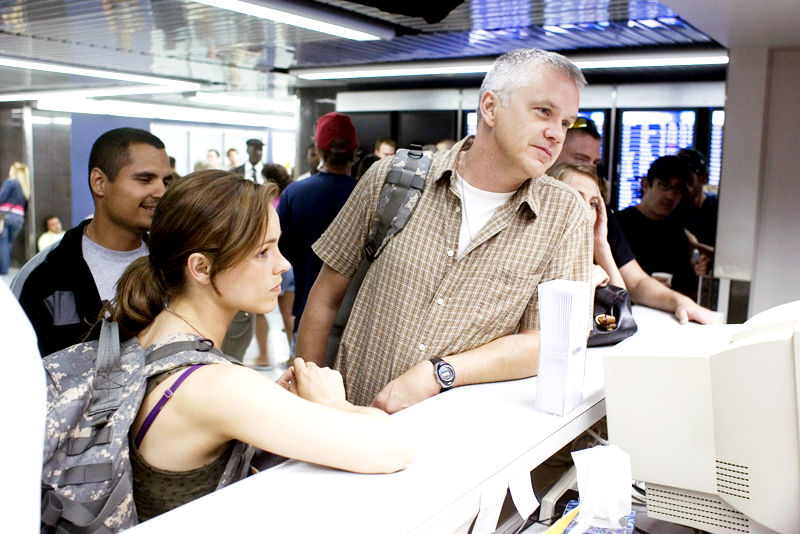
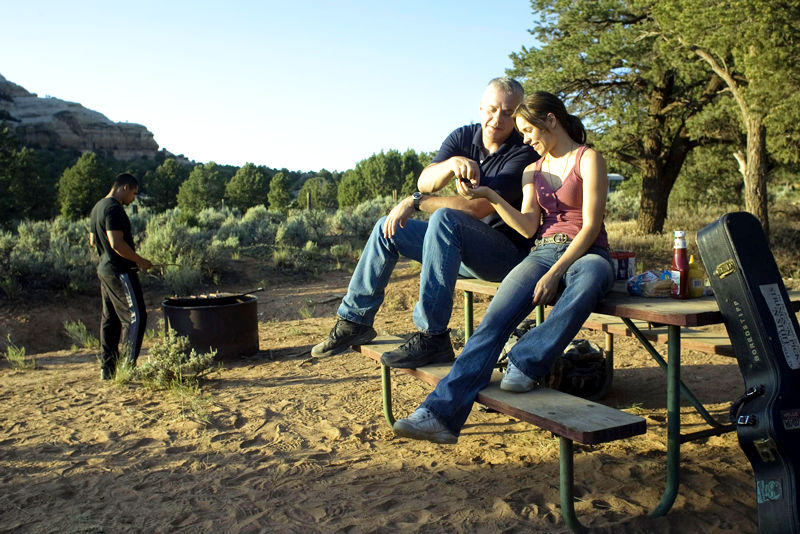
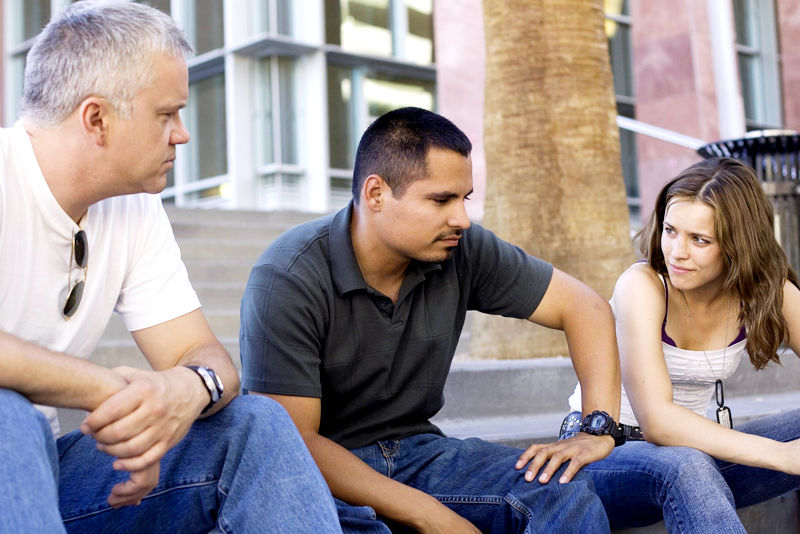
It follows three vets—Cheaver (Tim Robbins), an older sergeant just off his third and last tour, T.K. (Michael Peña), wounded, but gung-ho about going back, and Colee (Rachel McAdams), a neophyte coming back with a mission and a hole in her leg. They're all damaged: Cheaver is psychologically out-of-whack; T.K.'s purpose is to get back to his fiancee to see if "his equipment" still works after being wounded; Colee wants to find the family of the guy she hooked up with there and return his guitar to them. Meeting on the flight state-side, they decide to pool resources to get where they're heading. But, like any road-trip, there are detours, changes of plan, and the occasional loss of bearings. Stability is not to be found at home for any of them, and the trip only reinforces the perception that their fellow soldiers are the only ones who've "got their back."
Some of the episodes reach a bit, while some feel natural, and mostly the film avoids easy answers—less than it avoids mention of the war, except for a brief opening scene. The Lucky Ones is less concerned with Iraq, than it is with the soldier's plight, caught in the demilitarized zone of not fitting in either here or there.
Putting them on the road—in transit—reflects that sense of rootlessness (as most road-movies do) that these perpetual soldiers must have that is unique to this era's soldiers. The film never really tackles that subject head-on, as it almost has a duty to do, instead relying on the various "missions" and destinations to define the characters. Ultimately, the film has nowhere to go once those stories are used up, and the film ends on a logical melancholy note.

Where it shines is in the performances. As with the war, Burger and his co-writer
Dirk Wittenborn are quiet about the soldiers, presenting them as rather independent pawns in a much bigger game, their choices on the road sometimes unconventional, and not S.O.P.  But McAdams, Pena, and especially Robbins (this is some of his subtlest work in the past decade and nice to see), breathe a likable humanity into their characters, buffering the moments of manipulation and contrivance. You like these guys and want them to succeed, even if they are a bit unreadable—enough so that some of their choices surprise, even deep into the movie. That The Lucky Ones manages to do that is no small accomplishment.

Thursday, June 6, 2024

Little Children

Written around the time of the film's release. Field's most recent film—after an extended hiatus—was Tár, which received lots and lots of attention.

Little Children (Todd Field, 2006) One I've been wanting to see but avoiding. Again, bad decision. 
 
Todd Field has the spirit of Kubrick in him. Field, as an actor, worked on Eyes Wide Shut and Kubrick subjected him to "the drill" about his first film, In the Bedroom—"Why do you want to make that? What can you bring to it? How can you tell your story more compellingly? Is it worth doing, though?" 
 
But Field is a far looser director, and with a much more sure sense of humor, though that was missing in Bedroom. That razor-like humor helps in this story of a neighborhood not coping well with a convicted sex offender in their midst (he's a flasher). Everyone in the Boston suburb is on the critical edge of everyday panic and with an aversion to complacency combined with a complacent lethargy—sure, everyone is a hypocrite about something—so everyone seems determined to see how far they can push the envelope before things come crashing around their ears. 
But the film focuses on a quartet in the neighborhood: retired cop Larry (
Noah Emmerich) is a retired cop on disability, who misses the job and finds some solace in harrassing the sex offender Ronnie (Jackie Earle Haley), who wants to live a normal life—like his Mother (Phyllis Somerville) whom he lives with wants for him—but his past is a constant deterrence.
Larry is friends with Brad (
Patrick Wilson), who is studying for the Massachusetts bar (at least he should be), but has chosen to be a househusband and raise his son Aaron (Ty Simpkins) while his wife Kathy (Jennifer Connelly) is consumed with her PBS documentary career.
Brad spends many a lazy afternoon taking Aaron to the park, giving the gaggle of stay-at-home Moms there a chance to observe appreciatively and speculate about him. One of those gaggle is Sarah Pierce (Kate Winslet), who was working on her doctorate, but gave up on it when she married her now-estranged husband. All of this talk of Brad makes Sarah curious, and—as her husband is more interested in internet porn than her—they gradually "it's-only-platonic" themselves into having an affair. An affair that ultimately leads them to want to leave their respective spouses and run away together.
Every film is a bit of a "bubble-world," limited in scope to the characters featured prominently in the story. And it's the chief complaint by people who don't like particular films that they depend too much on the limited cast-members to sell the coincidences that make up a story. Little Children is one of those films. Pull out any of the plot-threads and it'll tumble like a Jenga tower.
But, that argument is so much blinkerdly cherry-picking. One of my favorite episodes of the podcast "This American Life" the author Lisa See tells of the Chinese proverb "No coincidence, no story" and the entire show curates stories from listeners with the most amazing coincidences. One is hard-pressed to think of a film...or a book where the confluence of incidences didn't create some narrative thrust. No coincidence, No story...even if it's only that these people are locked under some circumstance...if only by coincidence. 

So it is with Little Children. There is an air of clinical observation to the film that is cruel and humorous, though, for the characters portrayed, everything is of deadly earnest and has complex consequences. And its use of
Will Lyman (the voice of "Frontline" as well as "Last Week Tonight") as narrator is brilliant. 
Uniformly the cast is excellent with
Kate Winslet, Patrick Wilson (he had the least showy role in HBO's "Angels in America" as the closeted conservative), Jennifer Connelly (restrained and never better), and particularly Jackie Earle Haley as the flasher. Absent from movies for years, Haley now has a cadaverous look like he's being consumed from the inside, and his beady-eyed pressurized work keeps you on pins and needles. He and Winslet received the lion's share of accolades at awards-time last year, but the film itself should have received more attention...certainly more than The Departed did. 
 
Todd Field is a guy to watch.

Tuesday, February 13, 2024

Love in the Afternoon (1957)

Love in the Afternoon (Billy Wilder, 1957) Light Billy Wilder film from the effervescent days when he was directing Audrey Hepburn at the start of her career.

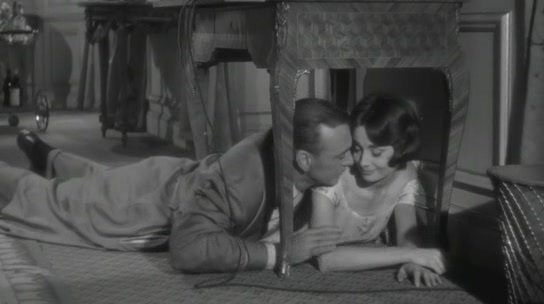
This one had me smiling immediately with Maurice Chevalier's opening narration—"Zis is the city, Paris France"—echoing Jack Webb's "Dragnet" opening. Chevalier plays a private detective, Claude Chavasse, specializing in "matrimonial work," and lately the case-work has been dominated by one subject, American millionaire Frank Flannagan (Gary Cooper), who is cutting a wide swath through the world's female population, both married and unmarried divisions. The work has turned Chavasse into a cynic about the paths of love—he's gumshoed too many of them—in marked contrast to his daughter, Ariane (Hepburn), a cello player (hold that image in your head for a moment), still wide-eyed at the prospect of romance, and fascinated with her father's work, something he does his utmost to discourage.
When she gets wind that a cuckolded husband (John McGiver, hyperventilating amusingly in fine comic fashion) plans on breaking in on his wife's tryst to ventilate Flannagan, she steps in from the balcony to insert herself into the situation. This leads inevitably (in the movies, at least) to an affair between the elder lothario and the young ingenue, one that she manipulates by trying to talk a competitive game in conquests. The situation is ripe with comic possibilities, which Wilder exploits every chance he gets, even using Flannagan's moving musical accompaniment (the final assault is preceded by a four piece rendition of "Fascination").

Much has been made of Cooper's age in the film, and it is an issue. Cary Grant was supposed to be Flannagan (Wilder had been trying to entice Grant into one of his films for years) but when a deal wasn't reached,
* Cooper, who at 56 was Grant's senior by three years, was hired. Cooper is an odd fit, as opposed to younger men like, say, Gregory Peck (as in Roman Holiday) or William Holden (in Sabrina), but Wilder works around it, initially, keeping Coop' in shadow to emphasize his "mystery man" status, and Cooper's early performance is, interestingly, boyish and somewhat immature.

And that's the point. Flannagan is a man-child, used to getting everything he wants. And Ariane has her choice between younger men—immature and unsophisticated—and Flannagan—sophisticated but immature. All it takes for him to grow up is a level of commitment, something he's avoided his whole life by having a train to catch. Both character arcs feel complete and satisfying, even though it is the "7-10 split" of May-December romances, and one feels a little creepy watching them make out.
And a little guilty, in the same way that it was tough to watch the denouement of Wilder's Sabrina. Okay, it's charming that she likes the old guy, but if he really was thinking this through, with all this new-found maturity, wouldn't he be thinking about her, and what she has to look forward to in a life with him (which can be summed up in one word..."short")?
And then, one considers Wilder, and the blithe, darkly cavalier sensibility that he brought to the movies, moral though his stand-point might be. One can imagine Wilder, the guy who ended Some Like It Hot with "Nobody's perfect," with a similar tag for this movie: "Aren't you concerned about the age difference?"  "If she dies, she dies..."
 At this point, Grant was getting concerned about his age and being paired with young actresses ("robbing the cradle, again" is how James Stewart summarized the situation late in his career), but his misgivings must have subsided enough to co-star with Hepburn in Charade for Stanley Donen six years later.

Thursday, February 1, 2024

The Lost Weekend

We're getting down to the bitter dregs of reviews I wrote for the "old" web-site, so, appropriately, here's another one directed by Billy Wilder, that—cautionary tale that it is—still manages to hold up through force of writing and some astringent direction.

The Lost Weekend (Billy Wilder, 1945) Don Birnam (Ray Milland) is an aspiring writer, drunk and sober, caught in a self-defeating loop of dependence and neurosis. His dependence on, and devotion to, alcohol has put him into a tail-spin of false confidence and self-loathing where his dreams are only out of reach because he can't pick himself off the floor. His "rye" attitude drowns his dreams and feeds his nightmares and without it, he's brittle, paranoid and living in the future, waiting for the shot-glass aimed at his destruction.

Sounds like so much fun. Sounds like a "speech" or a lecture coming on. Sounds like one of those movies "for your own good." Sounds like I'd rather have a drink. Fortunately, Billy Wilder's in charge, and yes, it's preachy at times, but most of the time, it's tough as nails and doesn't hold back on what a louse Birnam is without alcohol, and how pathetic he is with it.
But, it's not "Pity-Party: The Movie." Wilder makes it clear that Birnam is his own worst enemy and the alcoholism is just a symptom. At the movie's start with Birnam barely through a week of sobriety and packing for a trip in the clean country upstate New York with his brother (Phillip Terry), it's all he can do to keep from eyeing the bottle he has hanging out his apartment window. Milland's performance is brittle, officious—like Cary Grant without the stick pulled out. But, once his brother and girlfriend (Jane Wyman, pathetically co-dependent) are out of the way, Milland's eyes go snaky looking for alcohol in his apartment's old familiar places. Then, once he's got a burn going on, Milland is in full glory as an actor—an amazing performance, eerily reminiscent of Gloria Swanson's Norma Desmond four years in the future (and also directed by Wilder).
There are joys aplenty in this film, not just from some cracker-jack writing, but also Wilder's direction—putting Milland in front of a subtly discombobulating projection-screen for his long "wild turkey" chase to find a liquor store open on a Jewish holiday, the nightmare sequence of the alky ward and the subsequent "screamin' meemie" sequence in his apartment. There are also great performances by
Howard Da Silva as a particularly wary bartender, and a wonderfully creepy performance by Frank Faylen, who is eerily complacent telling Birnam about the tortures of DT's.
Part tract, part horror film, but without the absurd homilies of Reefer Madness hysteria, The Lost Weekend lets you off with a warning this time.The Lost Weekend was a co-winner of the Grand Prix at the very first Cannes Film Festival (Ray Milland won Best Actor), and it went on to win Oscars for Best Picture, Best Director, Best Screenplay and Best Actor. Only two films in history have won both the Palme and the Best Picture Oscar.*

Premiere Magazine voted it one of it's "25 Most Dangerous Movies."
**
* This was written many years ago—see the addition below—but since that time, it's only happened one other time since, with the Korean film Parasite in 2019. It's still a pretty damn rare happenstance.

* Paramount was pressured by both the alcohol industry AND temperance societies not to release the film. It did so on a very limited basis to critical acclaim, encouraging the tee-totaling studio to take a chance and open it in more theaters. I originally ended the piece by saying  "All that, and it has yet to be chosen for the National Film Registry.(What are they? Drunk?)" . It was voted into the National Film Registry in 2011

Thursday, December 14, 2023

Leave the World Behind (2023)

Everything is Disconnected ("Siri, What's This Movie About?....Siri?.........Siri?.....Do I Hear Chuckling?") 
 or
"Ain't That a Shaymalan?"
 
I just got a new cell-phone. A smart-phone. I'd had a "dumb-phone" before...for like 15 years—can't be that dumb if it's lasted for 15 years, can it? Very dependable. Always worked. Made phone calls. Text. The occasional picture. But, now a year in to smart-phone land, I find myself depending on it more...more time spent on this one than the last one. Too much time, really. I'm at that stage of life where I really shouldn't be wasting the amount of time I have left.

And I do it anyway ("idiot").

And I've been quite amazed on how much I depend on this phone for features that I quite happily lived without for so many years. And how much everything is now so tied up together with the phone, my car, my bank, my messaging...everything. And it scares the crap out of me. What happens when they don't work? Will I be able to go back to "analog mode" in order to get things done? Probably...it will just take more time (hopefully).
So, along comes Leave the World Behind
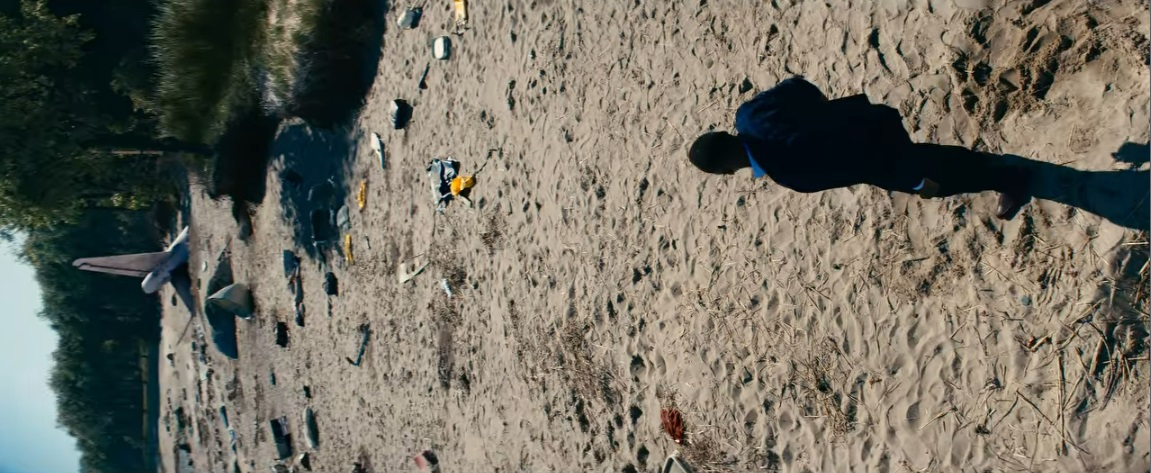
this year's end-of-year doom-and-gloom Netflix release (last year's was White Noise and the previous year Don't Look Up)--based on the 2020 best-seller by Rumaan Alam, and written and directed by Sam Esmail (creator of the cult series "Mr. Robot"). In it, a New York couple, the Sandfords, Amanda (Julia Roberts) and Clay (Ethan Hawke)--they have two kids, Archie (Charlie Evans) and Rose (Farrah Mackenzie)--rent an Airbnb for a short vacation out of the city...to Long Island. Amanda's a bit "prickly" from her work (advertising, natch) and Clay's work as a media studies professor is stressing him out, so the "vacay" is spontaneous and short, much like Amanda. 
And it's fine...a very neat well-designed house...with a pool...close to a beach. Then things get weird. An oil tanker heads right for the shore without slowing and runs aground. Then, everybody's cell phone goes out. Radio stations stop broadcasting. Computers work but can't connect to the internet, so they're a bit isolated for news. The place is still nice, and they're provisioned if they have to stay longer. Sit and wait. That's the best thing to do given any lack of evidence.
Until there's a knock on the door late at night. It's the house's owner, G.H. Scott (
Mahershala Ali) and his daughter Ruth (Myha'la), dressed to the 10's after an evening at the symphony in New York. They've shown up at the doorstep because New York is in the middle of a blackout and they've come to their Long Island retreat for safe haven from the craziness the blackout has created. Amanda is suspicious—they could be anybody—but Scott has keys to the liquor cabinet and knows the email address Amanda contacted to get the place, and he even offers a bit of a refund for the inconvenience of sharing the place overnight. Some haggling and repercussions are interrupted by a notice that comes over the TV announcing that all stations have ceased functioning due to a national emergency. Reluctantly, Amanda agrees with Clay to let them stay...but there are questions. And nobody has any answers.
Some come through in the morning—Amanda awakes to some brief alerts on her phone's news-feed. The U.S. is paralyzed by a massive nationwide hacking attack on U.S. systems that have darkened New York and interfered with broadcast and navigation systems. But, more things have happened and continue to happen—there are distant explosions and a crippling sonic attack that shatters windows and deafen inhabitants. Wildlife is acting strangely—deer appear out of nowhere and the house pool is invaded by flamingos. Visiting a neighbor's home to commandeer a satellite phone, Scott finds that it doesn't work, indicating that U.S. satellite systems have been compromised. Drones drop leaflets that translate to "Death to America" and airplanes start to drop from the sky.
The Sandfords attempt to leave the island, but find the routes snarled by miles of Teslas drawn to the same spot by self-driving systems (interesting that this week Tesla has recalled models with that system
; the publicity from the movie must not be good). Complications ensue and the Sandfords and Scotts must join forces to seek shelter as advised by Scott's contractor, a suvivalist (Kevin Bacon), who has prepared for the end-times.

It's a clever little conceit that plays on all sorts of modern fears of weak power grids, infrastructure lapses, "Havana syndrome," and hacker gangs and provides all the doom-scrolling you need for the modern world in one neat 2 hour package. That is if one can ignore the temptation of complacency and is paying attention. Snatches of "Special Reports" and recognition of this week's hole of fallibility go off in one's head as one keeps watching things for these people get worse and worse (the flamingos I've never seen covered on "60 Minutes", though) and it's all done for straight tension, not for any satiric purpose as in Don't Look Up.
It's aided and abetted by strong performers who are very good at playing "I have no idea what's going on but I'm not comfortable with it" and with a particular nod to Roberts for daring to risk her reputation as "America's sweetheart" with a performance that is flat-out vexing for its negativity and pure harridanism. One wonders how her character could function in the world of advertising with her ability to say exactly the wrong thing at the wrong time. Her results must vary.
One must also admire the direction of Esmail, who, as if the events in the teleplay weren't off-putting enough, manages to present them in such a disorienting fashion while still keeping you aware of who's where and what their relationship to their surroundings are. One should always be aware of directors calling attention to themselves with camera tricks, but Esmail does them in such a clever way that one follows fascinated to see what he's going to do with it, rather than merely dismissing his tricks with a dismissive "show-off" remark. He also employs a nifty editing scheme: like author Dan Brown's way of ending chapters just as things are getting interesting, Esmail will cut away to another sequence when there's a slight escalation in tension, then cut back once that situation starts getting busy, and continues to see-saw with ever-building tension until a viewer is ready to snap. I've been seeing a lot of dismissive comments saying that Leave the World Behind is boring; there is no way it could be with this editing scheme—maybe those commenters upped their daily medication.
I found it to be a compelling little slow-burn thriller of the M. Night Shyamalan school—every-day situations are up-ended by some weird phenomenon that then goes to great pains to try to explain it all away, however tortured that explanation may be. Here, the speculations seem a bit more plausible, even if they are horrific in scope. Toss in some
Fincher-style transition tricks, and one is slowly pushed to the end of one's seat...with the occasional check to make sure your devices are still online.
Even moreso, it reminds one of one of the better "Twilight Zone" episodes from that series' first incarnation. Leave the World Behind is the "The Monsters Are Due on Marple Street" for the 21st Century, and the coming Trumpocalypse.
 
And it still works.