Showing posts with label Keifer Sutherland. Show all posts

Thursday, November 7, 2024

Juror #2

A Rainy Night in Georgia
or
Juris-Imprudence (So, Help Us, God)
 
If I recall (having seen every episode) Clint Eastwood never appeared on the old "Perry Mason" TV show—one of the few elder statesmen-actors still working not to do so (and he was working for that show's network at the time). He seems to be making up for that with Juror #2, a courtroom drama with enough twists and turns to make Perry trip while hulking out of his chair at the defense table (come to think of it they rarely had juries on the "Mason" show—budget, you know).
 
James Michael Sythe (Gabriel Basso) is being tried for the brutal murder of his girlfriend, Kendall (Francesca Eastwood). They'd been seen fighting at a local watering-hole on a dark-and-stormy night and the politically-inclined District Attorney (Toni Collette) makes the case that Sythe was seen following after the victim as she was walking home in the torrential down-pour. Her body was found the next morning in a culvert under a bridge dead from blunt-force trauma. His attorney (Chris Messina) argues nobody saw the murder (even if a lot of people saw the fight at the bar). No murder weapon was found and Sythe maintains his innocence. One of the jurors, a retired copy (J.K. Simmons), says "He shoulda took the plea deal." 
But, one guy on the jury, Justin Kemp (
Nicholas Hoult), expectant father and reluctant jurist, isn't so sure. Once on the jury and hearing the details of the case, he starts having flash-backs of a night a year ago, when he was at the same bar the night that argument happened, but his wife had just lost twins, and he was thinking of having a drink, despite being in AA for four years sober. He remembers driving down the same road where the girl was killed and, distracted by his phone, took his eyes off the road and he hit something. Hit something hard. But, getting out of his car and looking around, he saw nothing, and, supposing he'd hit a deer and it ran off, he got back in his car and drove home.
Now, sitting in court, hearing the particulars, he's not so sure. Maybe it was this girl, Kendall, that he hit with his car. Day after day he sits in the courtroom hearing testimony from investigators and expert witnesses all leading to the suspicion that it was Sythe who did it deliberately. The trouble is: nobody saw him do it. It's all circumstantial and speculation. And the more Kemp hears, the more he thinks he might be the guilty party and the guy he's going to sit in judgment of is innocent.
What would you do, dear reader? I'd like to think that you'd do the right thing and turn yourself in and let an innocent man go free. But, my reading of "the times" (and the lack of civics classes in public education) tells me that nobody admits to doing anything wrong if nobody knows about it. Let sleeping dogs lie. Nobody's getting hurt. It wasn't my fault. I needed the money. I had a rotten childhood. In today's environment, George Washington would have hid the axe. Honesty's for suckers and losers. Kemp's excuse is he has a family with a baby due any minute, he can't do that to them.
But, what about Kendall? Her aggrieved family? What about the schlub who's being railroaded by the cops and the judicial system and may go to prison for life for something he didn't do? Is that justice? Kemp goes to his AA sponsor—a lawyer (Kiefer Sutherland)—who tells him vehicular man-slaugher will get him 30 years to life if he admits what he did, but maybe, just maybe, the jury will find the guy innocent and the problem will just...go away. And when closing arguments are over and the case goes to the jury, it is near-unanimous that Sythe should go to prison—except for one juror, Kemp. And he begins a methodical, near desperate process to convince the fellow jurists that Sythe is not guilty...within a reasonable doubt. And he's the perfect man for the job...as he may be the guilty party.
It sounds like an upside-down version of 12 Angry Men—the television-play and movie where one jury-member tries to convince his determined fellow jurists that the person they're supposed to judge is not guilty (and for a while it goes down that path)—but, there are complications and points of jurisprudence that threaten to up-end the entire trial. But, what none of the members of the court see is that they've got the wrong guy (sure, they've got the most likely guy), but what they don't see is the responsible party is right under their noses, and he is completely irresponsible to do what is expected of him—to do the right thing. Justice really is blind here, as Eastwood keeps visually reinforcing again and again and again.
It's a different movie, one that Eastwood's fans might not cotton to as it features nobody to root for, and the protagonist is dishonest, vulnerable, self-interested and...the worst sin of all, has self-doubts. Usually in Eastwood's film of choice, they're stalwart in the face of implacable enemies and chart a straight course towards what is a resolution or usually revenge. Sure, there have been vulnerable Eastwood protagonists, flawed Eastwood protagonists, even Clint veered off the straight and narrow in things like Bronco Billy and Tightrope. But, to have self-doubt come into play, I think you'd have to go all the way back to...Breezy. And not only self-doubt. In another age, at another time, one could see Kemp as a villain, a slightly sociopathic one with a narcissistic tunnel-vision that prevents him from seeing anything beyond his own situation. He's at least a coward, and a selfish one at that. Let another man rot in jail for something he did? What a lying skank.
But, that, the movie is saying is the point. At one point, the judge in the case tells the jurors "this process, as flawed as it is, is still the best way of finding justice." But, is it? In a world of people of good faith and strength of character, it very well may be. But, it is dependent on honesty and the penalty of the law. If everybody is lying on the stand, without the fear of perjuring themselves, the system ("flawed as it is") is worthless. Anybody not doing their job rightly, be they police, lawyers, judges, or witnesses threatens to derail any pretense of achieving "justice." And in a worthless system, where justice may actually be derailed, everybody is at risk. You only have to look at the work of the Innocence Project to see the results of a process that doesn't care about truth or innocence but only in the "feeling" that it's good enough or to make things seem done (hence the dependency on plea-deals). People fall through the cracks in such a system and then become lost in it. And some die in it. You can't seek to rid Society of corruption with a means that, in itself, is corrupt.
 
Eastwood hasn't done anything like this before—although Mystic River comes close—basing his movie around "the bad guy" (if we want to be simplistic about it), however self-serving the character's rationalizations for doing so. And he's aided immeasurable by the one thing Eastwood has always excelled at: casting. Everybody in this is playing top of their game, but none so much as the seemingly ubiquitous Nicholas Hoult. Hoult has an open face like a young Tom Cruise (back when he could play vulnerable) but the eyes are haunted and tentative like they're already seeing what's about to happen...and dreading it. And there's just enough doughy softness to him that you might end up caring about what happens to the guy, even though the moral quagmire the movie negotiates makes you want to see him get his "just desserts."
 
I was going to end this review with a rant about the Warner Brothers studio only releasing this one to 50 theaters (the reason being that Eastwood's last feature Cry Macho under-performed at the box office which rankled the WB CEO and made him wished he'd never financed it, despite Eastwood earning Warner a couple billion dollars easily from his output). Eastwood made this movie at the age of 93 (which is astonishing) and there is "talk" about his retiring—I doubt he will—so it seemed a churlish way to put one of your big earners out to pasture. But, evidently, the film is making enough money in the U.S. (and Eastwood's films always do well in Europe) that the studio is increasing the number of venues and extending its limited run in existing theaters by a week.
 
So, no rant. Merely a grumbling acknowledgment through my teeth that the theater situation is "not as bad as it could've been." And a grim smile while saying you should try to find a theater nearby that's showing it and see for yourself. This is a good one. And it might be the last chance you get.
"Courtesy Warner Brothers" Yeah, I suppose...

Thursday, October 14, 2021

Monsters vs. Aliens

Okay, I know this isn't a horror film. It's an animated comedy for kids...but it has monsters and aliens and the monsters are based on actual horror movie monsters, so.... 

Written at the time of the film's release...
 
"The Ginormica Monologues"
 

It's the perfect wedding day for Susan Murphy (voice of Reese Witherspoon, cracked on the boil): she has the perfect dress, the perfect church, and the perfect groom in fat-headed weatherman Derek Dietl (Paul Rudd). But it's all in the timing.  

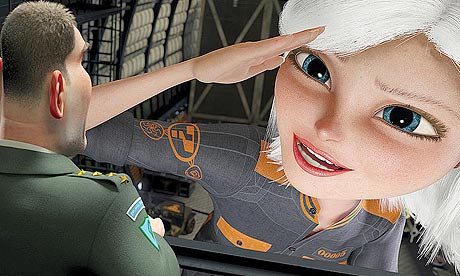
Just after a little pre-nuptial spat about honeymooning in Paris or Fresno, the bride-to-be gets squashed by a meteorite. At the altar, everyone comments that she's positively glowing...but...glowing green! Then, she goes from meteoric to all metaphoric, by growing enormously, dwarfing her puny groom and scientifically smashing the church to splinters. I kept waiting for the parents to say "our little girl's grown up!" but no such luck.*
Pretty soon, the Army led by General W.R. Monger (a gruff Kiefer Sutherland, having fun) fires hypodermics in her butt and Gulliver her to the ground, where she awakens in one of those cavernous U.S. installations we only wish we had, with a bunch of other monsters Monger's captured since the atomic testing days of the 50's. There's the Missing Link (Will Arnett), a Blob named B.O.B. (Seth Rogen in a bit of typecasting), and the insane Dr. Cockroach (Hugh Laurie), as well as a giant Japanese moth creature called Insectizoid. Kept prisoners by the government, they are finally called out as a last resort when Aliens, led by the evil Galaxhar (Rainn Wilson, like you've never heard him) attack the U.S. ("...they only seem to ever attack here,"** intones a Brokawed-paletted news anchor) after humiliating the President (Stephen Colbert...typecasting again).
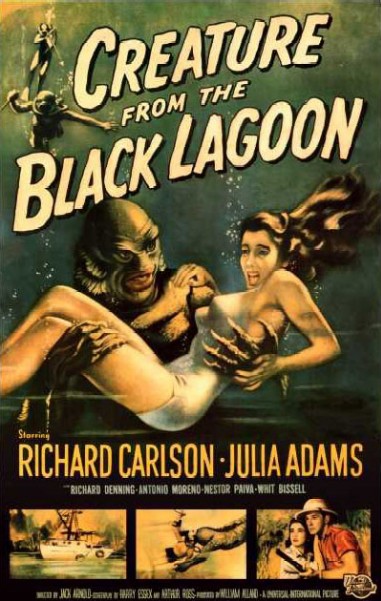
Dreamworks and the directors (Conrad Vernon and Rob Letterman of Shrek 2 and Shark Tale, respectively) do a nice job of plumbing the envelope of the monster-crowd giving us versions of Mothra, the Fly, the Blob, The Creature from the Black Lagoon and the 50 ft. Woman, and instilling the politically correct message that these aren't monsters but "special" people...er, things...entities (whatever). Indeed, the entire movie plays like a therapy session for Susan to embrace her empowerment and not to see her change as an accident of Nature, so much as...a happy accident of Nature. Hey, empowerment is empowerment even if you do go up 30 dress-sizes
The animation? Extraordinarily simplistic in a weird way. Susan looks like one of those big-eyed Keane children, and most of the men seem to be variations of Nixon (except for Derek, who looks uncannily like Conan O'Brien). The monsters are varying body-types and primary colors, so you can tell who's who when they're flitting across the screen (which they do a lot). 
Still, there is good planning going on, so one is never at a loss for where one is, and where the danger lies. In a totally made-up universe that can be a problem. And the 3-D effects are impressive, starting with a Dreamworks logo gag (heh), and a gratuitous paddle-ball sequence, although the 3-D-ness, sometimes comes off as having the dimensions of a pop-up book. But, the process has come a long way, and is frequently, deliberately eye-popping. It's not enough to recommend seeing it in theaters, though, so hopefully when it comes to DVD, they'll include the 3-D version, with glasses.
* ...and I'll bet the attendess threw puffed rice, (badum-bump!)

** Personally, I think it has to do with our Immigration Policy. "Okay, you can destroy the Golden Gate Bridge...once, but promise you'll never do it again and we'll consider granting you amnesty."\

Tuesday, June 2, 2020

A Few Good Men

A Few Good Men (Rob Reiner, 1992) This a time before "The West Wing." It was before "JAG." It was before anybody knew about Aaron Sorkin and the tropes of his writing. It was the third play that Sorkin wrote and his first big success, sold to producer David Brown for an amount "well into six figures" and a tenure as a writer-for-hire at Castle Rock Entertainment—he would work on the screenplay for A Few Good Men, Malice, and The American President.

But, A Few Good Men was the first one that launched the Sorkin brand. Based on a true incident (told to him by his JAG-sister Deborah) about a near-fatal hazing incident at Guantanamo Bay, the script is both a detective story and a story of personalities under pressure. It was turned down by Tri-Star Pictures for lack of star interest, but that all changed when Reiner, one of Castle Rock's founders, expressed interest in directing it.
Lieutenant Commander Joanne Galloway (Demi Moore), a lawyer of the NIS has been following up a complaint by PFC William Santiago about an incident at Guantano Bay, Cuba, but Santiago has turned up dead—supposedly at the hands of the subject of the complaint, Lance Corporal Harold Dawson (Wolfgang Bodison) and PFC Louden Downey (James Marshall). But, Galloway looks into the two's records, and finds them spotless and begins to suspect some foul-play. 
Dawson and Downey are transferred to a Washington D.C. prison for subsequent trial and Galloway requests the case, but it is assigned to Lieutenant JG Daniel Kaffee (Tom Cruise) a Navy JAG lawyer who has never litigated a case, preferring to plea deal, instead—that may be because he's a bit of a flake, but also because his father was considered a great trial lawyer and that reputation sets a very high bar. Galloway, despite reservations signs on as Dawson's lawyer and Kaffee picks Lt. Sam Weinberg (Kevin Pollak) as legal advisor.  
Galloway is convinced that Santiago died as a result of a "Code Red," an internal disciplinary action not sanctioned by the military, a "hazing" of sorts to put peer pressure on a soldier not meeting expectations. The team begin investigations: Kaffee meets with the defendants and finds them good soldiers, but Dawson's attitude towards Kaffee holds a slight contempt for Kaffee being a less than spit-and-polish officer; the defense team gets the go-ahead to fly to Guantanamo where they meet with base commander Colonel Jessup (Jack Nicholson), executive officer Lt. Col. Markinson (J. T. Walsh) and Lt. Kendrick (Keifer Sutherland), Santiago's commanding officer. In the interview. Jessup denies ordering a "Code Red" (even though he does see it as a means of strengthening the ranks), but did approve Santiago's leaving the base "for his own safety" once the report to the NIS was made. The meeting is cordial by flinty.
The matter is complicated by Jessup's regard in the military—he is in line to take an important position with the National Security Council, and there's more than a whiff of evidence to suggest that Kaffee was picked to head the team for his proclivity for plea deals, thus ensuring that the matter never makes it to trial. Indeed, Kaffee brings up the matter with Dawson as prosecutor Jack Ross (Kevin Bacon), knowing Kaffee's inclinations, has made an offer of six months in prison for the pair along with dishonorable discharges. Dawson refuses the offer as cowardly—he was following orders—refusing to salute Kaffee when their meeting concludes.
Knowing he is not playing his strengths, Kaffee tries to resign from the case, but is convinced to go through with the case. At the grand jury hearing, Kaffee offers a plea of nor guilty, setting up a formal trial for which he is ill-prepared while the minutiae of details pile up and Markinson—Jessup's executive officer—goes missing. It becomes clear that—as Kaffee sums up—"We're going to get creamed, aren't we?" and he's going to have to do battle with well-ordered, disciplined—and colluding—witnesses. The participants and the atmosphere are hostile.
A Few Good Men—and Reiner—benefit from a cracker-jack cast, many working outside of their comfort zone. Reiner, with a solid script and a solid cast, seems to up his game and, benefiting the military formalism, demonstrates a disciplined directing style, more than displayed in the restrictive courtroom scenes where the drama intensifies into shouting matches and acting fireworks, particularly between Nicholson and Cruise—Jessup's testimony, which is the fulcrum and climax of the story; the only false note is the series of shots that suggests Kaffee doesn't know what he's doing and doesn't have the evidence needed to goad Jessup into a confession (of course he does and it's false drama to suggest he doesn't). 
Nicholson is 100% on point—even sitting in a witness chair and shot from his chest-medals up. Cruise, on the other hand, was going through his "awkward phase"; he quickly became a star in Risky Business, but his next few years he spent trying to prove himself as an actor, frequently overdoing the histrionics, like a high jumper trying not just to clear the bar, but set records.* 
And it's funny:  A Few Good Men is famous for that "You Can't Handle the Truth" scene with its fiery speeches and dagger-projecting looks. It's good stuff. So good that Jessup's speech defending his actions frequently turns up as inspirational memes. The words may inspire. But, Jessup is a flawed human being and a flawed commander, because simmering under the speeches is an overriding arrogance. 

It's actions, not words that define character. Military leaders lead by example, lest their orders be seen as empty directives. While thinking of this film, John Ford's Cavalry Trilogy burbled up in me memory—particularly his 1948 film, Fort Apache and 1950's Rio Grande—and the character of Captain Kirby York (played by John Wayne in both films), who, in the first film is passed over for the command of a frontier fort by an arrogant commander (played by Henry Fonda), who is subsequently killed in a massacre by his own foolhardiness and rigidity. For the good of the Cavalry and "the Corps," York defends the man whom he had disagreements with, and in the second film, York—now in the position of leadership—is in danger of becoming the very same type of martinet commander played by Fonda in the earlier film. That conflict forms the emotional spine, and the qualities of character and leadership were very much a consideration of Ford, who struggled with those same issues in his own life as a commanding director on-set.

What makes A Few Good Men an interesting exercise is that Cruise's Kaffee can be accused of the exact same flaw of arrogance. That the two should lock horns makes for compelling drama and makes the film just a bit more mature than a cursory look would reveal.


* When I did a "Don't Make a Scene" of the Jessup—"You can't handle the truth!"—testimony, it was rough going: I could always find a frame where Nicholson looked great, but Cruise—trying to act up a storm—frequently was caught looking a bit silly. I poured over his shots frame by frame trying to present him at his best—I think I accomplished it—but, the asides and mugging (which might be effective on the screen) was, when frozen, looked like he was preparing to get to his good part without actually getting there. He's calmed down quite a bit—even if he's now constantly in motion hanging onto the sides of airplanes and being batted around on wires—but his tendency to over-do was a real issue for years. The thing is that star-making turn in Risky Business showed just how good an actor—and charismatic a star—he is.