Showing posts with label John Geilgud. Show all posts

Thursday, July 4, 2024

Becket (1964)

 
"In the year 1066, William the Conqueror crossed from France with his Norman army and conquered the Saxons of Britain at the Battle of Hastings. Henry II, his great grandson, continued to rule over the oppressed Saxon peasants, backed by the swords of his Barons and by the power of his imported Norman clergy."

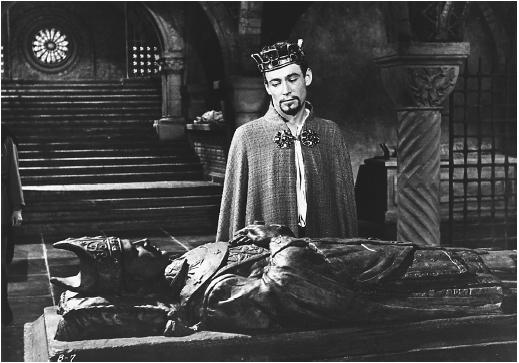
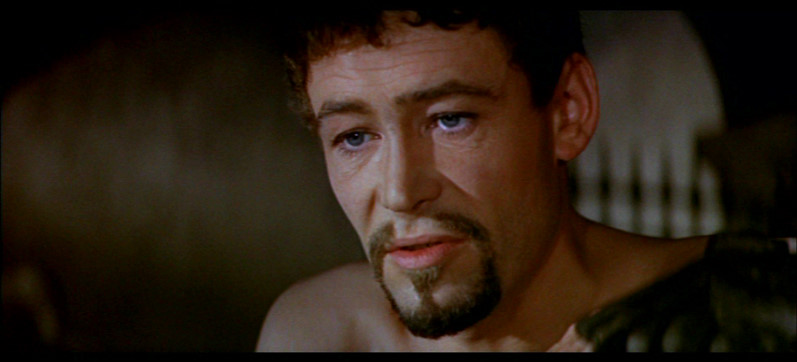
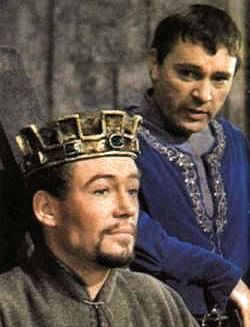
Why bother about religion when there's so much wenching to be done? Wenching and bellowing at the TOP of your lungs while you're at it! King Henry II (Peter O'Toole, who would play the role again a few years later in The Lion In Winter) is having a bit of trouble with his Archbishop of Canterbury—who objects to his lands being taxed. So when the elderly Archbishop dies ("He'll be much more use to God than he ever was to me"), Henry appoints as his replacement his old friend, fellow debaucher, and new chancellor Thomas Becket (Richard Burton)—"He's read books, you know, it's amazing. He's drunk and wenched his way through London but he's thinking all the time." A cozy and advantageous arrangement for both parties. What could possibly go wrong with that?

Well, Becket, actually. And it's a matter of going right. Thomas, being a Saxon—actually, he was Norman, the original playwright Jean Anoulih got it wrong—causes some grief to Henry's Court, when he should be winning his people over to the King's side. And then Becket finds religion as archbishop and gets all self-righteous on Henry, taking the Church's stance on conflicts with the King.
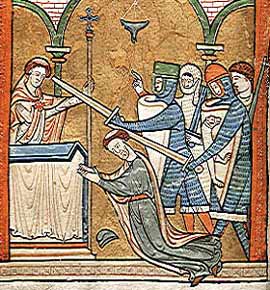
This turn of events—and character—does not sit well with the "perennially adolescent" first Plantagenet King, and in a drunken rage shouts, "Can no one rid me of this meddlesome priest?" and he has
barons who are perfectly willing to take on the job. Becket, in death, becomes a folk-hero to the Saxons, and Henry, in his remorse, and for political expediency, has himself flogged and petitions for Becket's sainthood. 
Am I giving anything away? The story's only 800 years old
! O'Toole and Burton have a fine time playing "Can you top this?" with each other in scene after scene, Burton controlled and stentorian and O'Toole indulgent and capering. Add John Gielgud as the King of France and you have some of the best British actors doing top-notch work rolling around some very rich dialogue abetted by some glorious cinematography by Geoffrey Unsworth. Yes, it's talky (in the best way), but with this cast, it sure is entertaining conversation.
These days, one can't help but be reminded of the stark contrast between the story of Becket and the far-in-the-future States in that Kings have the prerogative of "offing" their opponents and it is only Henry's largese and his own self-loathing that makes him accept a punishment for his actions, narcissist though he may be. Oh, those were the good old days.


Thursday, April 25, 2024

The Formula

Written at the time of the film's release.

The Formula (John G. Avildsen, 1980) Fairly lousy movie, done in the clunky Avildsen style, of a police detective (George C. Scott) following a series of murders that involves the MacGuffin of a synthetic substitute for petroleum. Avildsen is the perfect director for thudding cartoons like the "Rocky" series and The Karate Kid. But when having to provide any subtlety or style, as he attempted to do with Slow Dancing in the Big City, it's a miserable failure. And one has to say that he didn't add anything to the thriller or detective genres (or even the "paranoid thrillers" established in the 70's) with The Formula.

There is one joy, however, and that is to see the meeting of two of the better actors of the American stage square off, and really, it's probably the only reason the film got made (except for a tenuous tie-in to the then-dissolving energy crisis). They have one scene together of any consequence. Both men are a bit over-weight—
Marlon Brando playing the fattest of oil-cats—and the two meet for a semi-perfunctory sizing up of each other.
* One anticipates sparks flying between two acting titans.

And they don't. It's a genial little walk in the sun and the two banter back and forth—Scott's Lt. Barney Caine probing gently and Brando's Adam Steiffel waxing folksy and feigning detachment. But it's fun to watch. Brando's off in his "method" world—if he seems distracted it's because an assistant is feeding his lines through a hearing aid, and Scott observes the performance with an odd amusement, completely out of character.** What you're seeing is a fellow thespian (and fellow Oscar refuser) do his thing and barely suppressing his amusement...and bemusement.
It happens sometimes in movies, when very talented people with nothing to prove collide in a scene. As when
Meryl Streep and Vanessa Redgrave play old friends in Evening, or Al Pacino just sits back and revels in Jack Lemmon's shop-talking in Glengarry Glen Ross. It doesn't help a bad movie. It can't help Evening or The Formula. But it's one of those magical moments when artifice is usurped by genuineness and the joy of creation is reflected off the screen to the audience.

* Come to think of it, Brando's character would have been more effective if he were an insular baron.

** Apparently, the rueful shakes of Scott's head during the scene are his reaction to Brando doing a completely different "read" of his lines than previous takes.