White Heat (Raoul Walsh, 1949) Did a podcast for the Large Association of Movie Blogs the other night with MovieRob—he's in charge of the "Acting School 101" segment, where they focus on a particular actor for the month (there's also a "Directing School 101") and the contributors post links to relevant posts they've made. This month's Acting 101 subject if James Francis Cagney (which is why you've seen seemingly irrelevant Cagney posts lately—I'm cleaning out the attic of the old blog I wrote and bringing them over here) and we had a rollicking discussion—I could've gone another couple hours on the subject, it was so much fun. But, my No. 1 pick of Cagney performances (Rob's was Yankee Doodle Dandy, a great choice) was White Heat, which Rob had never seen. "Ro-o-o-b," I bleated in my best Mary Tyler Moore imitation. "You've GOT to see White Heat!"
Everybody should. It's a late-forties return to form with Cagney in gangster mode...but with a big difference. Cagney's early gangsters were opportunists, falling through the cracks of bad economics and bad situations to eke out a living by the easiest way possible—crime.

But not White Heat's Cody Jarrett. When Cagney returned to Warner Brothers Studio to do it, he read the script, recognized the form but found it a little formulaic and, thus, dull. Cagney had a suggestion: "Let's make him nuts," and the script was altered and Cagney's criminal thus had no justifying excuses—Jarrett is psychologically damaged ("like his old man" says a gang-member)—all id, with no ego or conscience to curtail it. He's mother-fixated, greedy, jealous, and subject to debilitating headaches ("like a buzz-saw in my skull," he describes it). Whether it's caused by blood pressure, stress, PTSD, or just bad humours, he's due for a stroke if he doesn't curtail it. But, before he does, he's going to take out as much as he can, monetarily or in collateral damage. "Top of the world, ma" he toasts his mother in a perverse version of The American Dream. "Top of the world."

Jarrett's gang goes in for The Big Scores, robbing trains, pilfering payrolls, stuff that involves high risk with high rewards (except for those who succumb to the high risks). When the job's done, the gang splits up, finds a hide-out to lay low, with Mom Jarrett (Margaret Wycherly) in tow to monitor police efforts and plan the next heist. But, not for too long, as Jarrett gets antsy and the headaches start. Plus, there's Cody's wife Verna (Virginia Mayo) who loves the spoils, but not having Ma breathing down her neck and nagging. Jarrett keeps her under a watchful eye and a short leash, because he's just as suspicious of her as he is of weasels in his gang like "Big Ed" (Steve Cochran), who Jarrett knows would love to take over the Jarrett game and serve divorce papers to him from the barrel of a gun.

All that time keeping his enemies close also makes him a little myopic. After a train-heist that scalds one of the gang-members, Jarrett orders the mug shot rather than have to carry around a guy wrapped like a mummy everywhere. But, the chosen executioner has a soft heart, he leaves the stricken thief alive, but only for so long. Police find the man, finally dead of his injuries, and do some forensics. It leads to a stake-out that traps Jarrett, Ma, and Verna, but Jarrett shoots chief investigator Philip Evans (John Archer) and starts a reckless police chase that ends, when Cody pulls into a drive-in.

But, Jarrett has an idea; at the same time he was pulling the train job out West, he knows a hotel job that was going down in Illinois by an acquaintance in crime, who has gone to ground. Jarrett is going to go to Chicago and turn himself in for the hotel robbery. He'll go to prison for two years, but not to the gas chamber for the deadly train robbery, and, when he gets out, he's got a lot of loot stashed. He leaves Ma in charge, and Verna stewing.
But, the Treasury Agents have a plan. They agree to Jarrett's light sentence—they don't kick at all—and they bring in "undercover specialist" Hank Fallon (Edmond O'Brien), who's just finished another long stretch in prison...posing as a con to get information, you understand. His job is to get close to Jarrett, find out what he can, what he did with the train job loot, and find the name of the mysterious planner who's been giving Jarrett his big ideas. Oh, and stay alive in a federal pen with a bunch of cut-throats.
That's the movie's set-up, and things, as they should, get complicated, but except for big issues like Life and Death, the details don't amount to much. What matters is Jarrett's reaction to them and Cagney's performance is the entire key to it. One hesitates to call it a "one-man" show (O'Brien is properly stalwart and Mayo and Wycherly do wonderful, vaguely comic work), but Cagney so dominates an audience's attention and challenges it, that the details seem to disappear.
Cagney's advice to actors was to "plant your feet and tell the truth," even though he was the most theatrical of performers. You believe him and what the character is going through. White Heat proved one thing—there's no over-the-top with Cagney; even the scenes where his crazy behavior scares the crap out of you, what he does feel genuine and, for all the hyper-emoting, and occasional jibbering, authentic. One also cannot argue with the visceral way he throws a punch.

The extremes of behavior of the Jarrett character would make any death scene a little disappointing, and so, director Walsh stages the most hysterically dramatic death for a character in the movies (short of Godzilla, anyway). It's almost supernatural in its implications, and as much as supporting characters are given lines to tone it down and bring it down to Earth a bit, it doesn't douse the ecstasy that comes out of Cagney as he shrieks his send-off line. It is spectacular, but more than that, it feels apt and right, because of the bigness of the portrayal. Cagney makes you realize that you just can't kill a creature like Cody Jarrett. You have to atomize him. And in a post-Hiroshima era, that takes a lot of will to not have qualms about it.
And the scary thing is; Jarrett wants it, relishes it, and even helps it along. He feels he's earned it.
But, it's Cagney's performance that justifies so grand and volcanic an exit. And it's too intense and good to leave you wanting more.

 Bear in mind that Destination Moon was made seven years before Sputnik put the fear of dumbness into Americans** and kicked our fledgling rocket program into "trust" mode. In the movie's opening minutes, researchers and private corporations are on the cusp of launching the first man-made satellite into orbit only to have the rocket launch off the pad and then slam itself into the desert, disastrously. And just a couple of months later, they're talking about sending a manned rocket to the Moon. Baby...steps, guys....
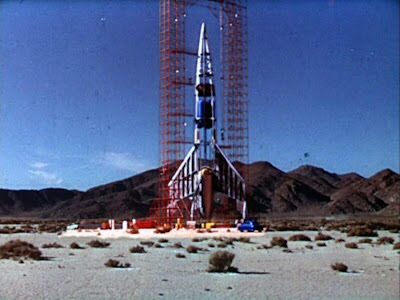 The Woody Woodpecker cartoon attracts investors (it's called "science fiction" for a reason...) and pretty soon construction begins on a Moon rocket using atomic energy to create enough steam thrusters to power it out of Earth's gravity and to the Moon. The entrepreneurial heads of the program are going to be the ones on-board for the flight, not test pilots, and they are Jim Barnes (John Archer) the aerospace magnate whose company built it, famed rocket scientist Dr. Charles Hargraves (Warner Anderson) who designed it, retired General Thayer (Tom Powers) who wants America's presence in space to be used for deterrence and technician Browne (Ted Warde) who supervised the technical aspects of the good ship, Luna.