Showing posts with label George Raft. Show all posts

Saturday, November 27, 2021

Skidoo

Saturday is traditionally "Take Out the Trash" Day...and they don't get much more trashy than this one...

Skidoo
(Otto Preminger, 1968) Legendarily off-kilter comedy by that "master" of comedy, Otto Preminger, who, in his effort to make a movie that was "with it" perpetrated a film so far without "it," that one wonders why nobody told him it might be a bad idea...for any director. 
 
It might have been because there wasn't anybody at Paramount Pictures who had the power or the industry knowledge to be credible to a movie veteran like Preminger. Paramount had been "acquired" by Gulf and Western in 1966 and its chairman Charles Bluhdorn had made his mark in auto parts, zinc mines and manufacturing and was furthering his mint-making by buying up properties and tinkering or selling them off. Preminger was making films for Paramount and was a "studio property" who'd had a history of making edgy films that would challenge taboo's, but whose recent films were considered both artistic and financial failures.
This did nothing for the fortunes of Paramount, which, if you look at the films being released in that period (before bringing on Robert Evans as head of production) betrays of a long line of losers with the odd hit—usually a foreign acquisition, like Alfie and films that might be interesting (Seconds) but didn't attract an audience. The industry itself was seeing a downturn in receipts with more color TV's in homes and a calcified audience that wasn't getting any younger. Preminger thought he had a solution—make a movie that would appeal to "the kids."
Retired hitman Tony Banks (Jackie Gleason) has his evening of television interrupted by a pair of mobsters, Hechy (Caesar Romero) and son Angie (Frankie Avalon), who have orders from their boss "God" (this will be revealed as Groucho Marx, his first film appearance in eleven years) to knock off "Blue Chips" Packard (Mickey Rooney) who is due to testify before a Senate committee on organized crime. Banks begs retirement, but when a buddy (Arnold Stang) is found dead, he goes along with the plot for the safety of his wife Flo (Carol Channing) and his daughter Darlene (Alexandra Hay).
The idea is to have Banks smuggled into the same prison as Packard and then whack him—or "kiss him" in the mob parlance used in the film. He is incarcerated with Leech (Michael Constantine) a psychopath and "The Professor" (Austin Pendleton) a technical wizard arrested for draft-dodging. Meanwhile, Darlene's new boyfriend Stash (John Phillip Law) and his gang of "hippies" are being hassled by the police for their anti-establishment ways and Flo, being a bit of a free spirit herself, helps them from being arrested for living in the streets and invites them into her home.
Tony already has guilt feelings about whacking "Blue Chips" but when he mistakenly takes a tab of acid provided by The Professor, he gives up on the idea and instead tries to find a way of breaking out—involving lacing all of the food in the prison with LSD and escaping by makeshift balloon when everybody is high as kites.
The movie's heart might be in the right place, but it's mind is utterly lost. Maybe they were thinking they were making an all-out all-star comedy like It's a Mad Mad Mad Mad World—a favorite of writer Mark Evanier, and who takes the opportunity to trash Skidoo every time it comes out of hiding. Sure, there are grudging pleasures: it features performances by the Big Three Batman TV villains with Romero, Frank Gorshin and Burgess Meredith, all acting, as does everyone in the film,in a manner that would charitably called "broad." Small parts with Richard Kiel and Slim Pickens. The notion that they filmed part of it on John Wayne's yacht. The score by Nilsson is harmless—he sings the End Credits—but it's not exactly good, either.
Nor is the film by any stretch of the imagination, even stretched pharmaceutically. There are sequences—a musical number with dancing garbage cans for instance—that are so badly thought out and executed that it is doppler-shifted into inscrutability in post. There is a cold-sweat chill of desperation over the whole enterprise. Sometimes even that can be cruelly funny. But not here. Even the casting of grizzled—if professional—veterans can't remove the stink of mercenary pandering and witless and dull-edged stabs at satire.
It's a mess. And not a funny one. Not even the knowledge of incompetence—as with the films of Ed Wood—can save it. One can only look at it with the hope that the bottom of the barrel has been reached. But even that hope gives no comfort. 
 
Bad trip, dude. 

Wednesday, September 23, 2020

They Drive By Night

They Drive By Night
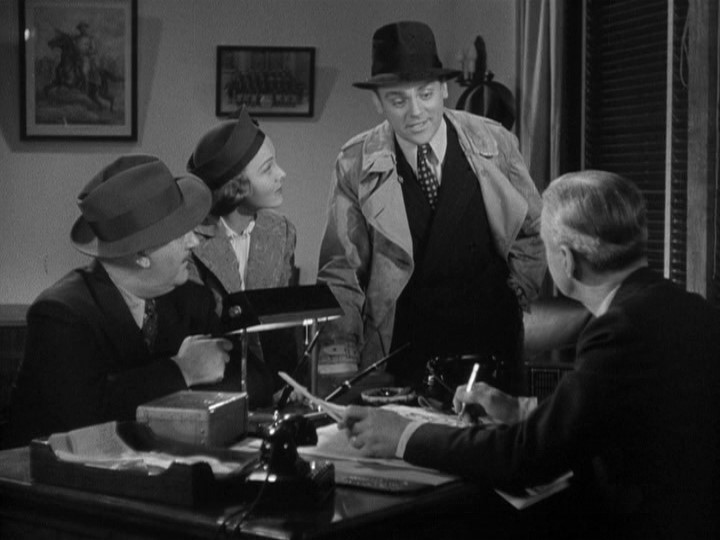
 (Raoul Walsh, 1940) Warner Brothers-style action-and-intrigue pot-boiler about...wild-cat truckers. Well, that shouldn't be much of a surprise. In lieu of gangsterism, the trucking world could serve as a substitute for rough-and-tumble world of trying to make a fast buck on the legitimate side of the ledger in the world of capitalism The subject hit something of a zenith combining trucking and film-noir in Jules Dassin's Thieves' Highway. This tough little film from Raoul Walsh—who made definitive films on both crooked and straight paths to success concerns the brothers Fabrini (George Raft and Humphrey Bogart) are partners in a truck who decide to stop working for other shipping companies and do the deals themselves. This pushes their murderous schedules to the edge and consequences determine a change of focus. An interesting little movie where two Warner's tough-guys—Raft and his understudy at the time, Bogart*—do "everyman" jobs and mine real drama out of it. Of course, it couldn't be a Warner's picture without action and the film boasts two nail-biters where truck-drivers fall asleep at the wheel, filmed with the snap that one can expect from Raoul Walsh.
Where the movie excels is the smart patter that spins drama in the economic realities of this corps of transport specialists. The movie manages to slip in lessons in Unionization and Modernization amid the wise-cracks and the trumped murder-plot that dominates the film's second half. You begin to feel like you're learning something without being preached to.
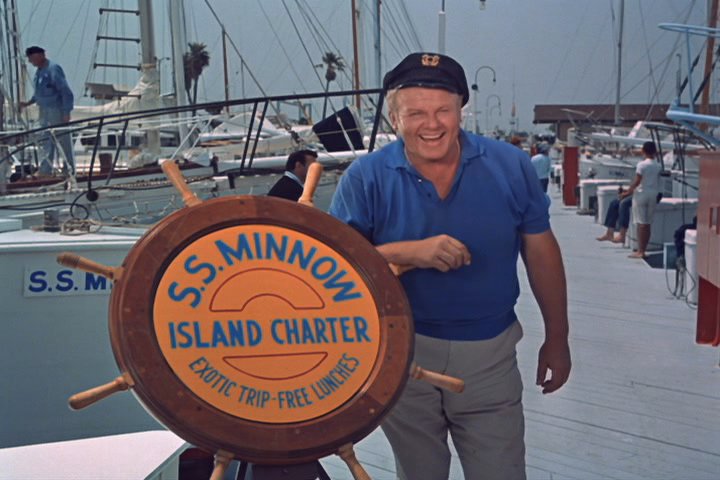
And there's enough good acting going on that raises it above "B" level. Raft is a bit looser than usual in the starring role, but Bogart has the most dramatic...and fun part. Ann Sheridan does well with her wise-acre dialog and Ida Lupino manages a mine-filed of femme fatale neuroses with dexterity and quick-silver reactions. But the stand-out is Alan Hale—"The Skipper''s" dad—who takes the part of a trucker-who-owns-a-company and can't believe his good fortune. Hale's "Ed Carlsen" never has a "down" moment, and is carried out with wolfish good spirits and the sense that he's making it up as he goes along. His performance is the diamond in the rough in this rough little film about trucking. 

*At this time in his career, Bogie was still upset at the way his career was going, he was still doing the occasional western, and just the previous year he starred in the worst movie of his career--The Return of Doctor X! But in his next movie would be a part that Raft tosses aside--"Mad Dog" Roy Earle in High Sierra. And the next part meant for Raft but inherited by Bogart would be detective Sam Spade in The Maltese Falcon.

Saturday, June 15, 2019

Each Dawn I Die

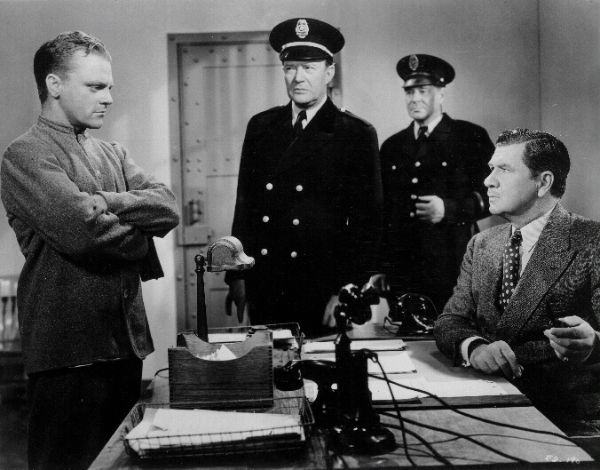
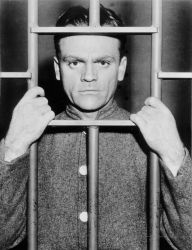
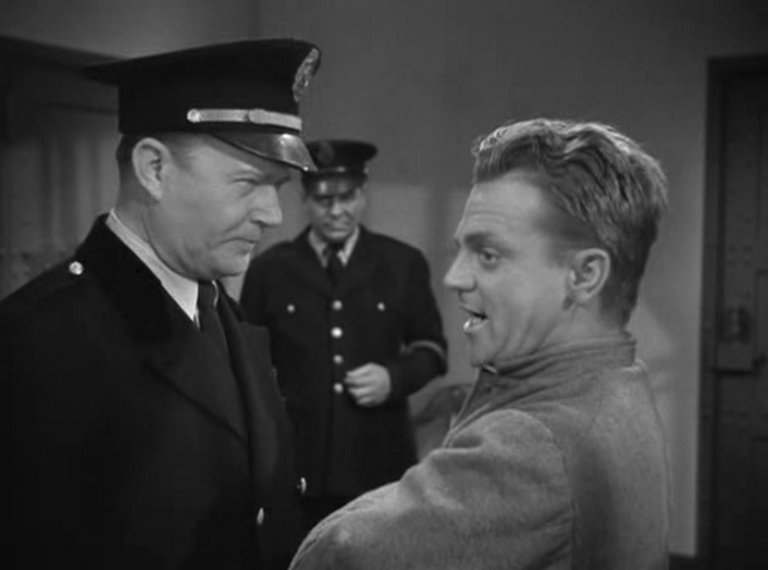
Each Dawn I Die (William Keighley, 1939) Edgy newspaper reporter Frank Ross (James Cagney) has a hot news lead, but it gets buried when the crooked assistant D.A. he's trying to get the goods on, knocks him cold, douses him in whiskey, and puts him behind the wheel of a car and sends it caroming down a city street, ultimately killing three innocents. Ross is convicted of vehicular manslaughter and thrown in jail, his campaign against the crooked DA (who is trying to run for governor) quashed.  

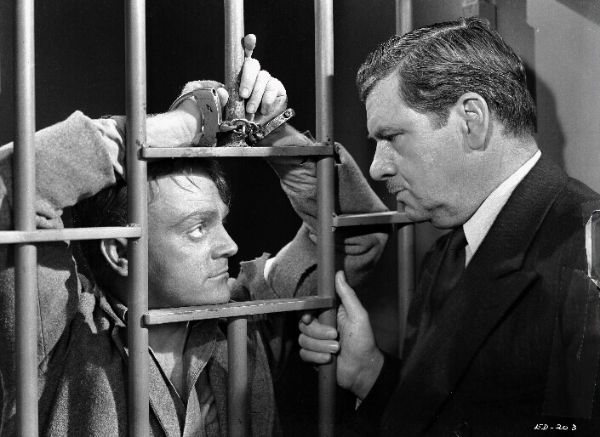
On the outside the folks in the newsroom his reporting partner (Jane Bryan) and his editor are trying to dig deep to find out how to get around the lawyers, and inside Frank tries to stay alive, getting information from fellow prisoners in the sweat-shops, and even saving the life of "Hood" Stacey (George Raft), who, to repay the debt, cooks up a hair-brain scheme to find  who framed Ross. When another inmate is killed, Ross names Stacey, in order for the gangster to be tried, and make it easier for him to escape.

Not very likely. Stacey does escape, however, but reneges on his plan, making one more set-back for Ross, who is slowly going crazy with his prison-term, and the impossibility of finding out who's responsible while stuck behind bars.
No, it's not very credible, but the points of interest in the story are Cagney, who pushes the boundaries of what "good guy" behavior can entail and Raft, who's smooth, wry, likable, and utterly corrupt. This makes him completely different from the crooked DA who isn't witty, isn't smooth, and is dully cruel, but is also utterly corrupt. So, the difference between good and evil (in its shades of gray) in the audience's affection is that "bad" must also be personally bad, and incapable of entertaining us. If you can entertain us, obviously you can't be that bad a guy, even capable of reforming. But, what separates this from other Warner Bros. efforts of the period is that the authorities, although personifications of fear and threat, are also completely fallible and downright evil. The "good guys" are the "bad guys" and that's something a little different in a post-"Code" gangster movie.