The Wrong Box*(Bryan Forbes, 1966) Bryan Forbes is a British director not known for a light touch, nor as a writer (and—in the few instances I saw him, not as an actor, either!). So to see him in charge of a comedy leaves one a bit nonplussed as opposed to amused (which should be the bloody intention!). The same can be said for this film, which tries very, very...veddy... hard to be funny, but ends up evoking feelings of something akin to pity (which just won't "do" for a comedy, much as Chaplin liked to use it in his bag of tricks). The story of a tontine—a trust created for a clutch of privileged school-boys that will go to the last man standing (and the controversies that ensue—The Wrong Box should have the same breakaway, mean-spirited greediness of, say, It's a Mad, Mad, Mad, Mad World(And one should say that with Stanley Kramer, you wouldn't think of being able to do a comedy, either, but look at that result!), Those Magnificent Men in Their Flying Machines, or The Great Race, but instead has a leaden lethargy sometimes punctuated by awkward transitions, ill-timed (and rather unnecessary) close-ups, and the frequent appearance of title cards (to explain something the direction does not adequately provide) in a black-out format that recalls silent movie transitions. However, they come in at souch odd times, they're more interruptions that transitons (Odd that one can even mis-time interstitials!)
It's Bryan Forbes imitating Richard Lester making an Ealing Comedy, but without Alec Guiness, and as slap-dash as the Lester's direction could be at times, he at least could tell a story, and give it the momentum so it would never flag or falter.As it is it's one of those 95 minute movies that seem to last forever.
The screenplay is by Larry Gelbart and Burt Shevelove, who wrote the book for the Broadway musical "A Funny Thing Happened on the Way to the Forum" (Lester's film of which was released the same year—coincidence?) John Barry's galumphing score works overtime to make it frothy, but this is one granite souffle. What is missing is whimsy, rather than desperate manicness, and it fortunately is found in Sellers' work, and in the odd performance of Wilfrid Lawson as the harried (not that you'd know) butler, Peacock.
John Barry's ultra-light waltz is lovely but at odds with the material.
* The asterisk is used so that it isn't confused with the silent version of Robert Louis Stevenson's novel (with Lloyd Osbordone i913—not that a lot of people have seen it.
Seance on a Wet Afternoon(Bryan Forbes, 1964) Psychological thriller about a mad British couple, who decide to kidnap a child for nefarious purposes, and they might get away with it if both of the perpetrators weren't both mad as hatters!
Myra Savage (Kim Stanley) has a cottage industry as a medium in London, that is only moderately successful. This puts a financial strain on the couple as her husband Billy (Richard Attenborough) cannot hold down a job, due to his asthma. Billy's guilt for that and his general lack of spine accounts for his being totally under Myra's sway, probably initiated when the couple lost their child, Michael, in childbirth and he accommodated her every whim during her break-down afterwards. Whether this encouragement contributed to Myra's living in a fantasy where she speaks to the soul of Michael in her seances is up for debate. But, what's not debatable is who has the power in the family dynamic.
It's Myra...and Michael.
Then, Myra comes up with a plan to make more money and it's indicative of her madness...but there is some method to it. As her powers as a psychic are medium to none, she decides that she will scare up some business. She proposes to Billy that he kidnap the daughter of some well-off neighbors. They will keep the child in their home—and, of course, demand a ransom—and Myra will offer her services—as a psychic, mind you—to help the police find the missing girl. Her "reputation" as a spiritualist will then For Myra, it's a slam-dunk. For Billy, it's a potential charge of kidnapping if they get caught. Billy cannot say "no" to Myra. But, neither can Bill depend on Myra to keep herself together and not have something catastrophic happen.
If only he had someone around who could...I don't know..."see the future".
Forbes' direction is, to put it charitably, lethargic. The film does pick up a bit of pace as Billy is in London attempting to retrieve the ransom money knowing full well that the drop is being watched. Suddenly, Forbes camera becomes less claustrophobic and takes on the look of a security cam as Billy furtively tries to "blend in" with the pedestrian traffic. The sequence is helped by John Barry's underscore—which prior to this time has been dominated by ethereally echoing vibraphones—kicks in to the type of inexorably escalating music that he'd used for long sequences in the James Bond films. Barry was Forbes' secret weapon, shoring up his films like a masterful frosting hides a less-than-successful cake.
And then, there's Kim Stanley. Seance is notable, if only for Stanley's presence in it, as she preferred stage work to film and her film roles are few and far between...but memorable in the exquisite detail she brought to her work. Her Myra is a fascinatingly manipulative character, never a harpy, but quietly insistent and almost seeming to float in another dimension from reality. It's superb work, and almost makes sitting through this Seance a worthwhile experience.
Deadfall (Bryan Forbes, 1968) Middling Bryan Forbes drama starring Michael Caine as a cat burglar hired by a safe-cracker (Eric Portman) for a nearly impossible job. Actually, the burglar, Henry Clarke had been casing this job for awhile and has checked into a sanitorium to get close to his target, but he's lured into working with the much older safe-cracker by the man's much-younger wife (Giovanna Ralli). Consulting with the couple, the Moreaus, it is decided that they will do a trial run robbing the strong-box of another socialite, with Henry scaling the walls, gaining entrance and then letting the husband, Richard, into the house to break into the safe. The socialite couple will be attending a concert on the prospective night and while they're safely enjoying the performance, the two men will do their night-time prowling, which will involve drugging guard dogs, and Clarke scaling the outside of the mansion, having to perform a maneuver, called a "deadfall", where he must drop from a rooftop to a lower ledge without benefit of a supporting rope.
Now, just the fact that I mention that should alert anyone that Clarke is taking more risks than he should. He does, after all, use a rope to scale the outside of the estate—couldn't he, then, move the rope (or take a second one) to avoid having to perform that risky maneuver? But, no, it doesn't happen that way for the sake of ginning up the suspense, the task of a night robbery being risky enough.
But, then, the whole movie is like that. There are so many lost opportunities and so many unnecessary risks in this less-than-perfect crime that you wonder why nobody questions the job, the partnership, anything for what looks, on the face of it, to be a hopeless enterprise.
Most of the blame must fall on Forbes, who wrote and directed, and had the interesting idea to stage that first robbery to a concert performance. His favored composer, John Barry, wrote an original piece for the film—"Romance for Guitar and Orchestra"—which would serve as the background for the robbery sequence, cutting back and forth between the concert, the robbery, and the villa's staff listening to the concert over the radio. It's the same strategy Alfred Hitchcock used for the meeting of the conspirators and victims at the Royal Albert Hall in his second version of The Man Who Knew Too Much, and as Hitchcock used his composer for that picture, Bernard Herrmann, to conduct on-screen, Forbes had Barry appear as conductor. Interesting little trivia item, and Barry wouldn't appear on-screen again until serving as an orchestra conductor in The Living Daylights, his last film as composer for the James Bond series.
It's a great idea—except that Forbes can't even do that right. Barry does his job—he'd been writing romance and action cues throughout the 60's, and he'd learned that he didn't need to ramp up the pace for action sequences. But, Forbes' penchant for unusual angles and POV makes the performance footage less than interesting. The interest is far more on the robbery, which is shot well, but is rather ruinous in what happens—at one point it becomes apparent to Clarke that Moreau can't open the safe and he begins yelling (Shhhh!) and comes up with a plan B to take the safe by hammering it out of the wall.
Okay, the shouting rather kills the mood of the music, a slight offense, but then, Forbes has Caine hammering the wall...in total silence. Wouldn't the noise—and vibration—alert the staff sitting, a couple hundred feet away, enjoying their dinner to something going on—even if they weren't depending on an alarm system that Clarke had already cut? Does the music playing over the radio—and the soundtrack—mask what is some very concussive noise? One cannot have it both ways and it's stylistically patting one's head while rubbing their belly. It's a very bizarre sequence And baldly contrived.
One wonders why he did it this way; there's a long history of film-heists done in silence and stealth, and this one has neither. Forbes was very much a part of the "Swinging 60's" period of British film-making, but his films were not revolutionary, despite his stagings and sometimes pointlessly arty framing. His films are curiosities, not classics, and every so often they seem to lose the point and get distracted by some half-hearted flippancy. Watching them, they seem to exist in a world that doesn't make much sense and half little to do with the real world.
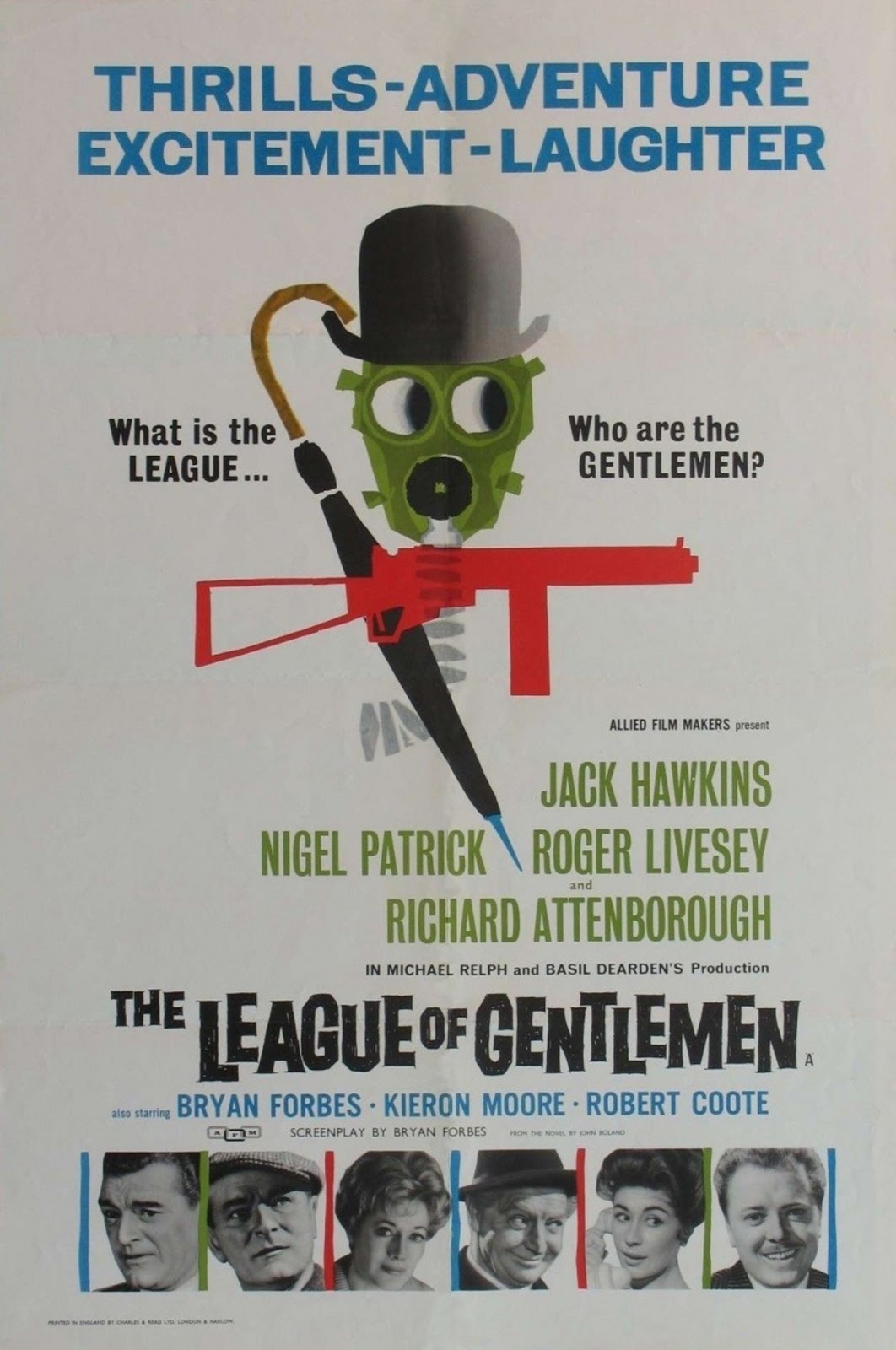
The League of Gentlemen(Basil Dearden, 1960) Basil Dearden's semi-whimsical heist film begins with a sequence that is quite out of whack with the rest of the film but gives a sense of the mind-set behind it. It is late at night on a dark noirish street, and the camera creeps up on a man-hole cover. It pops open to reveal Lt. Col. Norman Hyde (Jack Hawkins) surreptitiously looking about to see if his exit might be seen. Then he climbs out of the sewer dressed in a dinner suit. He then makes his way to a Rolls-Royce and and leaves the area. It's a visual joke, one that would be expected—and was done—in a James Bond film. The juxtaposition of grime and well-heeled attire is a clever little summation of themes, especially in a society built on class, but except for the visual juxtaposition, it will have nothing to do with the rest of the film. In fact, the little episode is never mentioned again. The film proper begins with the next sequence.
Hyde returns to his home and cuts several £5 notes in half and inserts them, with an invitation from "Co-operative Removals, Ltd." to a lunch at the Cafe Royale, into copies of a paperback book of a crime novel entitled "The Golden Fleece."*He puts each into their separate envelopes and sends them out, seven in all. Their destinations are to seven particular men.
Their intended recipients—"all crooks of one kind of another," "all men of the world"—are disgraced military men, "trained at the public's great expense to do things with the utmost efficiency...which, frowned upon in peace-time are acclaimed in times of war." They are—in the photograph above, left to right: Captain Frank Weaver (Norman Bird), former leader of a bomb-disposal unit, drummed out for trying to defuse a bomb while drunk, which ended up killing four of his men—he now fixes time-pieces in his flat; Major Rupert Rutland-Smith (Terence Alexander), discharged "after some embarrassing mess of yours," resolved by hush-money from his rich wife which has left him hen-pecked and reluctantly accepting of her own many indiscretions; Captain Stevens (Kieron Moore), former fascist, forced out for his homosexual activities, which have made him a victim of blackmail, threatening his gymnasium; the high-toned Major Peter Race (Nigel Patrick), whose black-market activities led to his resignation, and now subsists on gambling and a room at the YMCA; Captain Martin Porthill (League screenwriter and future director Bryan Forbes) was kicked out for killing suspected Cypress terrorists and now makes his living playing the piano in dives and as a gigolo; Captain Padre Mycroft (Roger Livesey, of so many films by "The Archers"), formerly a quartermaster was convicted of "public gross indecency" and now, paradoxically, is a con-man using a contrivance of religious ordinations; finally, there's Lt. Lexy (Richard Attenborough), who sold secrets to the Russians and now runs an electronics repair shop for the lowliest of customers.
Hyde, for his part, "served my country well for 25 years and was suitably rewarded by being made redundant" and the experience has left him bitter and useless—all those skills and nothing to show for it. "The Golden Fleece" proved an inspiration on which he could hoist his revenge; he has researched and planned a bank robbery, and to accomplish he has gathered together a troop of morally compromised men with military discipline and specific skill sets to help plan and carry it out. He gives them a limited time to think things over, and, to a man, they agree ("Your presence here restores my basic disbelief in the goodness of human nature," he remarks); Hyde treats them as a military unit, barracking them in his own stately home for drills, research and to serve as a base of operations. Under the ruse of a food inspection for cover, they split off and while part distract the brass, the others steal guns, ammo, and other supplies making it look like an IRA action...when the loss is found.
Once all is arranged, they move their operations to a warehouse where the details are finalized. The goal is to rob a bank of enough resources that the men can split the money each receiving at least£100,000. Can British ingenuity and a proper military training pull off the raid despite improper motives (and the inevitable complications that pop up in these things?) All's fair in love and war...but war exercises?
Dearden, given the military nature of the heist is efficient and a bit ruthless in his direction—nothing fancy and nothing too rococo in how he plans his shots— Forbes' screenplay is witty and dry, and the actors all fill their niche-roles with Hawkins providing a commanding presence in both senses of the word, as both leader and star. The League of Gentlemen could be seen as a more austere version of such playful British heist films as The Lavender Hill Mob or The Ladykillers, but without their sense of twee or whimsy. Additionally, with such a collection of dedicated rotters, given their falls from grace in the eyes of Society, the film-makers evoke enough "sympathy-for-the-underdog" attitude that allows one to think that they just might pull the job off.
It gives the film that added sense of suspense right up to the last minute.
* In the novel, the book is not "The Golden Fleece," but a real novel called "Clean Break' (written by Lionel White), which was filmed as The Killing by Stanley Kubrick in 1956.