Showing posts with label Bette Davis. Show all posts

Tuesday, June 13, 2023

The Bride Came C.O.D.

The Bride Came C.O.D.
(
William Keighley, 1941) Supposedly, the idea was that Cagney wanted to do something lighter than his typical tough-guy gangster act, brought in his brother to produce, hired the sharp twins-writing team of Julius and Philip Epstein and started casting about for the romantic lead to play opposite him. Ann Sheridan, Ginger Rogers, Rosalind Russell, and Olivia de Havilland were all in the mix at some point. But, somehow, Bette Davis got the part. Evidently, she wanted a change of pace from her dramatic roles and she and Cagney got on famously making Jimmy the Gent seven years earlier, so...why not?
 
But, did anybody consider the trouble that might come from putting the two biggest rabble-rousers on the Warner lot starring together in the same movie? One or two of the studio brothers might have been asleep at the switch, but the film did get made with neither of the stars being "suspended" but up-staged by some of the wiliest character actors ever in supporting roles.
The story is alarmingly close to Capra's It Happened One Night: A socialite, Joan Winfield (Davis) is sand-bagged with a marriage proposal in front of a night-club audience by her bandleader boyfriend, Allan Brice (
Jack Carson), who is prodded into making the announcement by gossip columnist (Stuart Erwin) under deadline. Under pressure, she agrees, but California having a 72 hour waiting period before they can get hitched creates a problem. It's decided—by the scandal-monger—that they can fly to Vegas to tie the knot sooner. When her father (the booming Eugene Pallette) finds out he's apoplectic; he doesn't want the wedding to go through at all!
That's where cash-strapped pilot Steve Collins (Cagney) makes a landing in this mess. He's about to have his plane repo'd, but makes a deal with "Pater" Lucius K. Winfield to make a unscheduled stop from Las Vegas to Amarillo, Texas (where the father will pick her up), but with Joan only and it's been negotiated for his standard freight rate—$10 a pound. When the wedding party shows up at the local air-strip, the bridegroom-to-be and the mouth-piece are coaxed off the plane by Collins' mechanic Pee Wee
(George Tobias, remembered best as neighbor Mr. Kravitz on the "Bewitched" TV series) and the pilot takes off with the prospective bride much to her protest. Technically, it's kidnapping, even if it's for hire.
But, Joan is a fierce fighter and once she gets ahold of a parachute, she'd determined to jump out of the plane en route, foiled by Collins banking the plane and throwing her—repeatedly—back into the cabin. But, all that maneuvering causes the plane to stall, and they end up crashing in the desert, close to the ghost-town of Bonanza that had sprung up around the old Enterprise mine. Hilarity ensues. The comedy is broad, bordering on slapstick, what with prat-falls and Joan constantly falling into cactus plants ("Oh, there must be something magnetic to a cactus that attracts me right to it...or vice versa!"). And Davis plays it broadly, trying to eke out the last drop of humor from any given situation...while Cagney just reacts to what she's doing, with either exaggerated laughter or venom.
In Bonanza, things get more complicated, what with search-parties looking for the pair under the command of William Frawley, and the town's only existing citizen (Harry Davenport) a mass of eccentricities and a way of changing sides at the drop of a plot-point. Soon, Collins is in jail, Joan goes on a wild desert ride in a flivver, and both end up lost in that abandoned mine, all the while waiting for either the fiancee or the father or both to show up before anything can get resolved. Cagney's character remains a bit stalwart, but Davis' changes her mind every ten minutes of movie-time. Things are further confounded with the minutiae of state law, matrimonial provisions, and some dubious reverse psychology. If everything was under federal law things would be a lot simpler, but the plot wouldn't go anywhere. State laws are funnier and more suited for comedy.
The movie was popular when it came out, and, as something changes every few minutes, one can see why audiences found it entertaining. And while Davis is out of her element, she is amusing, and Cagney doesn't fall easy victim to caricature until his laughing scenes. The only one who really disliked the film, in fact, was Davis, who didn't like the script, hated the desert heat of Death Valley, and was no fan of cactus, as she evidently did fall into one while filming. It's a light-weight vehicle pushed by two powerful steam-engines, so it's a bit of a mismatch. But, seeing the two play off each other rather seamlessly is the film's greatest strengths.

Tuesday, December 21, 2021

Death on the Nile (1978)

Death on the Nile (John Guillermin, 1978) The success of the 1974 adaptation of Murder on the Orient Express—and author Agatha Christie's favorable view of it—almost guaranteed another all-star production by producers Brabourne and Goodwin and their choice for story was Christie's "Death on the Nile" to be scripted by Anthony Shaffer, who had done re-writes on the film version of Murder..., plus had written The Wicker Man, Sleuth, Alfred Hitchcock's Frenzy, so he knew his way around murder and had a wicked sense of humor.
 
But, plans called for extensive location shooting in Egypt where noon temperatures would soar to 130°F. Albert Finney, who barely tolerated the make-up process that turned him into Christie's Belgian detective Hercule Poirot under studio conditions, balked at having to go through the same thing in the African desert. Producers turned to the versatile double-Oscar winner Peter Ustinov to take over the sleuthing duties, and surrounded him with fading Hollywood glamor and some noteworthy youngsters.
Heiress Linnett Ridgeway (Lois Chiles) has everything she wants in the world and is a loyal and magnanimous companion. When her friend Jacqueline de Bellefort (Mia Farrow) asks Linnett if she could take her fiancĂ© Simon Doyle (Simon McCorkindale) on as an assistant until he can get on his feet, Linnett takes one look at him and is only too happy to oblige. This she does by starting an affair with him—that's quite a benefits package she offers—then the two get married and take off for an Egyptian honeymoon.
But, they're not alone. Wherever they go, no matter how remote, they encounter Simon's jilted
fiancĂ© Jacqueline, who vows never to let them forget and who is determined to ruin their their married life. Two's a honeymoon, but three's a scandal—and possible enemy action, so the two lovers plot to ditch her by pretending to take a train at the Aswan station, but, instead, book a Nile cruise on the paddle steamer, the S.S. Karnak. Coincidentally, also sailing on the cruise is the master detective Hercule Poirot. And if you believe that, you've never read Agatha Christie. 
The honeymoon couple seem to be surrounded by acquaintances on the trip: there's Andrew Pennington (George Kennedy), who is keeping an eye on her because he doesn't want to know he's stealing from her legacy; author Salome Otterbourne (Angela Lansbury) is being sued by Linnett for basing a character on her—she's accompanied by her daughter (Olivia Hussey); Dr. Ludwig Bessner (Jack Warden) is a psychiatrist who had treated some of Linnett's friends in the past and she'd threatened to expose him. 
Then, there's the Communist (Jon Finch), who considers the Doyle couple parasites; the socialite Mrs. van Schuyler (Bette Davis), who merely covets Linnett's jewels (as she's a kleptomaniac)—her nurse Miss Bowers (Maggie Smith) blames Linnett's father for bankrupting her father. Then there's Colonel Race (David Niven), Poirot's old friend and confidante. He's the only one who doesn't have some sort of animosity towards Linnett—and they're all on the same boat.
Then, Jacqueline joins the cruise, carrying a derringer and a marksman's ability with it. As if by clockwork, Jacqueline gets drunk the first night, confronts Simon and shoots him in the leg, and is immediately taken to her cabin and put under heavy sedation. With Jacqueline out of the way, maybe the passengers—and especially the honeymooners—can expect some peace and quiet.
Fat chance of that! The next morning, Linnett is found dead with a bullet-hole in her head, and the letter "J" written in blood within her reach. It's murder alright. And SOMEONE's responsible! But, who? And with so many ties to the dead woman among the passengers, it could be anyone, and the most likely suspect was in a morphine stupor and looked after all night by Nurse Bowers. It's up to Race and Poirot to untangle the connections and sort out the clues to determine who did what. One things for certain—no one's getting off the boat without a splash.
If only the movie were a little splashier. Oh, it has its amusements—the location work, shot by the estimable Jack Cardiff, full-on scenery-chewing by Lansbury and Davis, as well as an amusing turn by Smith. Everybody else hits their marks and don't bump into the masonry. And then there's Mia Farrow...with a performance so over-the-top that you know she's got to be the murderer even though everything points away from her. Hysterical and manic, you just know she's got to be involved somehow. Just because of a person is scheming and jilted doesn't mean the character-actor has to double-down to get the point across. 
 
And ultimately, that's the film's biggest flaw. Because if the actress is so concerned that she appear crazy, it must be pertinent, or else they'd try to appear normal.  It's as if Farrow saw the limelight falling off her and onto Lansbury and Davis and decided to overcompensate. It throws the story and the movie out of whack.
 
It will be interesting, then, to see what happens when a new version of Death on the Nile is released in February of 2022, directed by Kenneth Branagh (again, after Murder on the Orient Express) and starring himself, Gal Gadot, Emma Mackey, Armie Hammer, Jennifer Saunders, Letitia Wright, Annette Bening, and Russell Brand. We shall see.

Wednesday, July 22, 2020

All About Cooking Beans with All About Eve

A slight side-road today.

NPR (the U.S.'s public radio network) had a story about a slight discrepancy during the pandemic. During the initial crush of panic-consumerism, there was a lot of buying (besides toilet paper, providing an education in supply chain deficiencies), there was also a run on flour, yeast and beans. One would expect a lot of kitchen activity going on.

Evidence suggests that everybody is baking. Just how much sourdough bread can a nation make? A cursory glance of Instagram and Facebook will tell you.

But, not a lot of people are cooking beans. Perhaps it's the quantity of them when you buy in bulk and people can't anticipate planning a few days in advance anymore (what day is it?). Maybe sourdough bread is less daunting, a short term solution and not a multi-day commitment.

Anyway, NPR noticed this and did a report and included a handy tip: when cooking a pot of beans, boil them for 15 minutes, turn the heat down and start watching All About Eve.

At the point when Margo Channing utters her immortal line—
MARGO Fasten your seat belts. It's going to be a bumpy night.

—you should add salt (appropriately).

At the point when she's in the car (getting cheaply sentimental) and says "Funny business, a woman's career" then it's best to get up and check to see if the beans are done—you don't want to hear that schlocky "a woman needs a man" speech, anyway.

After all, ya got a pot of beans so the world is yours.

Thursday, October 31, 2019

Whatever Happened to Baby Jane? (1962)

Whatever Happened to Baby Jane? (Robert Aldrich, 1962) As if Sunset Blvd wasn't perverse enough, Robert Aldrich took the 1960 novel by Harry Farrell and turned it into the Grandest of Guignol's about the passing of Hollywood glamour with two of the greatest stars of the past pitted against each other in a battle for screen supremacy. Reportedly, the filming was contentious as both Bette Davis and Joan Crawford despised each other and didn't care who knew it. That vehemence inspired two very overheated performances that reached deep into both ladies' bags of tricks—Davis' over the top Jane, and Crawford's long-suffering Blanche. Whatever one may think of the picture, no one can't resist looking at a train-wreck...in the middle of a cage-match. And director Aldrich, who could be counted on to make his own fireworks when he needed to, merely had to turn on the camera and watch the material boil over.

And, on occasion, keep it from exploding.

Cautionary placard for ticket-buyers of Whatever Happened to Baby Jane?
The Hudson family is riding a financial success in 1917, as their daughter "Baby Jane" is a beloved silent film star and doing stage appearances to promote her marketable likeness in the "Baby Jane" doll. America's little sweetheart, however, is, away from the spotlight, a spoiled-rotten brat who dominates the family who give in to her every whim and tantrum to keep the money coming in. Her sister Blanche can only look on and seethe in jealousy.
Cut to 1935. Both Blanche and Jane are appearing in films now, although Blanche's fortunes have eclipsed Jane's and the older film star is drinking to drown her sorrows. But a deliberate auto accident by one against the other reverses all fortunes.
It's modern times (1962) and both sisters live in a Los Angeles mansion in Los Angeles, Blanche (Crawford), confined to a wheelchair from the car accident, watching her old movies on television and reliving her past. Jane (Davis), meanwhile, is still drinking heavily, bitter, and delusional enough that she's teetering on the edge of a psychotic split. Jane is Blanche's "caretaker," with as opposite a definition of "care" as possible. It being 1962, movies didn't show everything involved in caring for a paraplegic, so it's limited to Jane's preparing and bringing of meals. But, in Jane's resentful state, what she uses for protein becomes more than questionable.
What she doesn't make for Blanche is pancakes, presumably because that is what she seems to be using for make-up.
Jane dresses up in woman-sized girly dresses and cakes on the foundation in an attempt to look younger* and acts like a coquettish child while interacting with strangers, but, once you get to know her, she turns into a harridan, dropping the act. Her viciousness is no act, however, and it's escalating, the further she gets away from her fabled childhood and her own dreams of Hollywood success. But Jane is used to getting her way, combined with a twisted guilt for her sister's paralysis, as she was black-out drunk when the crippling accident occurred. 
While Blanche is basically confined to the upstairs, Jane has the run of the house and takes delight in taking any joy she can from Blanche's existence. It is merely the presence of a housekeeper (Maidie Norman) that keeps Jane's more extreme activities in check, and she is beginning to resent it.

It's a battle for control between the two sisters, with Blanche seemingly at the disadvantage. But, she has control of the house, and when she announces to Jane that she intends to sell it, Jane ramps up the abuse, locking Blanche in her room, tossing out her mail and restricting access to the outside world by means of disabling their telephone. Particularly venomous are Jane's manipulation of her sister's meals, at one point using her pet parakeet as an entree, while at the same time living under the illusion that she can revive her career with personal appearances.

But, the public has long forgotten Baby Jane.

Blanche, on the other hand, defends her sister, no matter what cruelty is inflicted on her. Her long-suffering victim-hood has its own deep origins in that accident in ways that are not obvious on the outside.
It is an extraordinary, squirm-inducing example of bat-shit-crazy film-making, with an extra level of cruelty than the usual hard edge Aldrich put on his films as the two sisters have a battle of wills that almost guarantees mutually assure destruction. It has a sardonic nastiness reminiscent of Edward Albee's "Who's Afraid of Virginia Woolf?"

It would almost be unwatchable if it weren't for the two actors involved in the struggle (which spilled over to their antics against each other on-set). The casting is key with Davis and Crawford in opposite corners, diametrically opposed in both technique and performance goals, with Crawford falling back on her woman-martyr characterizations and Davis careening in the opposite direction going for manic intensity. Given how the film plays out, it shouldn't work, but both actresses can't help give it their all for screen-domination. It is one of the miracles of casting that couldn't be more ideal.

"We're getting along. Really, we are."
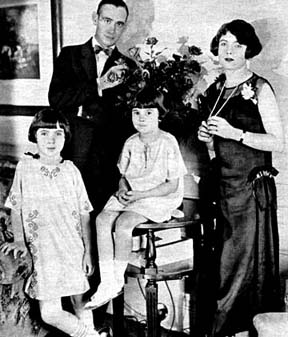
Although she seemed far more stable, there are rumors than "Baby Jane Hudson" was based on 
Diana Serra Carey, who starred in silent pictures as "Baby Peggy"

* When Davis' daughter saw her "Baby Jane" make-up, she reportedly said: "Oh, Mother, you've gone too far this time!"

Wednesday, April 12, 2017

Satan Met a Lady (1937)

Satan Met a Lady (William Dieterle, 1937) Warners' second adaptation of Dashiell Hammett's "The Maltese Falcoln" done with a much freer hand and less devotion to the source novel.

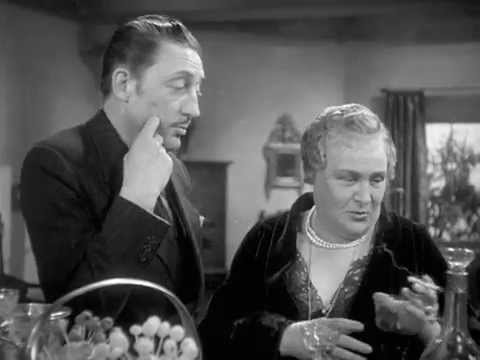
When confronted with the Hays Office crackdown on lascivious content in movies, Warner Bros. found a lot of their catalog unreleasable for re-issues. In the short term, they solved the problem by judicious cuts in audience favorites and by creating revamped versions of past product. A new "Maltese Falcon" was put in production a scant five years after the first's release. In the interim, another Hammett property had scored big at the box office; The Thin Man with William Powell and Myrna Loy had proved a sensation, and since nothings exceeds like success, "The Maltese Falcon" was freely adapted to be more in line with what worked with The Thin Man, more comedy and an emphasis on glamour and the high life. So, Sam Spade became detective Ted Shane, as played by Warren William, a stetson-wearing rake, seen at the start of the film as being run out of town by some city-fathers and returning to his old haunts and old job at a detective agency in San Francisco. Among his first clients is Valerie Purvis (Bette Davis) who warns of being tracked by a dangerous man, and before long, Shane's detective-partner (Porter Hall) is killed and the story begins anew.

Same story but, like Hammett's detective, the characters are significantly altered, if the track of story-line still stays basically the same. Take, for example, Joel Cairo who is transformed into a stuffy Brit played by Arthur Treacher (rather than fisticuffs, Shane and the character do some jolly breakage in Shane's apartment); Kaspar Gutman is Madame—note that—Madame Barabbas (Alison Skipworth), and Wilmer is a thick gunman named Kenneth (Maynard Holmes), whom she dotes on, and Effie Perrine, the Spade and Archer receptionist is Miss Murgatroyd (Marie Wilson), the epitome of a dumb blonde. And the falcon? It's now the legendary horn of Roland. The whole debacle is treated as farce, with more interest in having a good time than actually acquiring the MacGuffin.
The film is directed by William Dieterle, one of Warners' prestige directors, having already directed their all-star version of A Midsummer's Night's Dream in 1935, and who would go on to direct the multi-Oscar winner The Life of Emile Zola, The Devil and Daniel Webster, and projects for David O. Selznick. He keeps everything moving breezily for awhile, but the movie stops dead at the end with an exposition scene that makes up for lost dialogue and movie-time (the Huston version, four years later—the only one where the male lead is top-billed—has the same issue, but it's part and parcel of the drama). Davis was so dismissive of the script that she stayed away from filming for three days, hoping to be taken off the job, in favor of the more serious, prestigious roles which she favored.
Satan Met a Lady probably did not need a falcon, as, by itself, it is one strange bird. With its detective that is anything but private and sticks out like a sore thumb, its eccentric cross-gendering to appease the Catholics, and its game of "Who's got the horn," it does no justice to the source novel or the other Hammett adaptation its trying to ape. Five years later, John Huston, hot from his scripting duties for Warners (including Dieterle's Dr. Ehrlich's Magic Bullet) would take the property with another Warners B-player in the lead, and stay true to the novel by scratching away at the layers of lacquer demanded by the studio, to find the gold underneath. 
William and Davis not seeing eye to eye
Lorre, Greenstreet, Bogart, and Astor:
The cast of the next Maltese Falcon waiting in the wings.

Saturday, June 6, 2015

Olde Reviews: All About Eve

This was part of a series of reviews of the ASUW Film series back in the '70's. Except for some punctuation, I haven't changed anything from the way it was presented, giving the snarky, clueless kid I was back in the '70's a break. Any stray thoughts and updates I've included with the inevitable asterisked post-scripts.

This is a companion piece to Sunset Boulevard.

All About Eve (Joseph L. Mankiewicz 1950) All About Eve is not unlike Sunset Boulevard. It deals with the lust for glamour in show business—in this case, the theater in New York, not the neighborhoods of studios in Hollywood. It, too, was made in 1950, its female characters, for the most part, actresses, are...uh, abnormal. And it, too, is biting, but places its knives-in-the-back in a ci-vi-lized manner, and twists it...delicately...not with Wilder's carving techniques.

What we have is
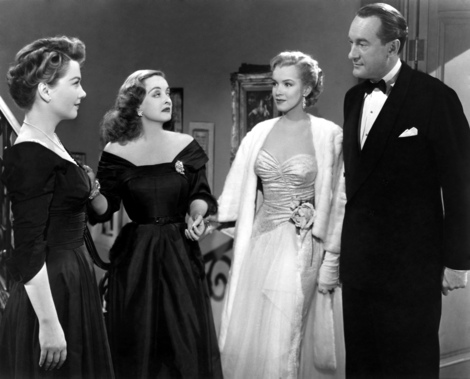
Bette Davis as Margot Channing, a spoiled child-actress, now on the shady side of 40, but still playing ingenue roles. What we have is Anne Baxter as Eve Harrington, a young ingenue who gazes adoringly at her idol, Margo Channing. What we have is Addison DeWitt (played by George Sanders as drily as a total-vermouth martini), the chief stiletto of the critical press, but you've also got Gary Merrill, Celeste Holm, Thelma Ritter, (and, in a very brief role, Marilyn Monroe) in a highly literate script which gives almost everyone some role they can sink, or cut, their acting teeth on, in a story that has "everything but the blood-hounds snapping at their rear end" (and, in a way, that happens, too.)

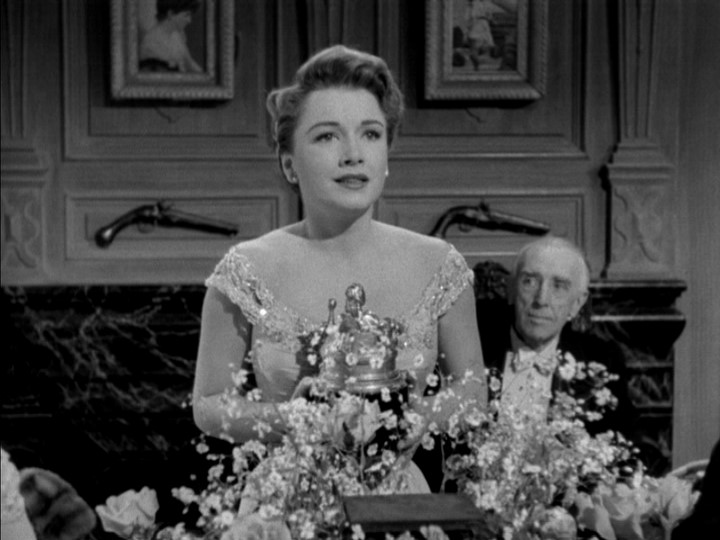
You see, we meet all these people as Eve is receiving the Sarah Siddon Award for Best Stage Performance of the Year. A joyous occasion for everyone, right? The very young actress gets a big break—everyone's happy, right?
No, the principal characters are either looking embarrassed, wonderingly perplexed, mad, or just cold to the event. It's flashback time to see why such a double-reaction to the prestigious theater event. And in a "Citizen Kane-switch," one flashback is narrated in turn by several people. And we are through this told All About Eve...but also Margo, Addison, everybody. Everybody's soul is laid bare through the dialogue and the quirks and pops of the performances of the cast. It's a thoroughly entertaining two and a half hours, and its light cynicism will take of the staleness of Sunset Boulevard out of your mouth. It will do that, but will hardly make hopeful young starlets complacent.
Broadcast on KCMU-FM on February 3-4th, 1976 

I still love this movie and I find it invaluable as a source for great lines. Go ahead. Go to the IMDB listing for All About Eve (all you have to do is click on the name at the head of the review*) and go to "Memorable Quotes." There's at least a couple pages of them. All smart, literate and bitchy. I used one in January 2009, as a sub-head for the blog-title (Addison DeWitt's non-self-deprecating "While you're waiting you can read my column. It'll make the minutes fly like hours." Only he could say that about himself--everybody else would be cut down for a remark like that, sort of like only Nixon being able to go to China.) Another favorite of mine is in this olde review: "Wow. Everything but the blood-hounds snappin' at her rear-end" as expressed by the inimitable Thelma Ritter. There's one involving Marilyn Monroe's hungry starlet, Miss Casswell, as she enters a theater-party. She scans the room looking at the producers: "Why do they all look like unhappy rabbits?" DeWitt leans in and confides: "...because they are." Smart. Literate. Bitchy.

And curiously old-fashioned. One doesn't get too far in that list before it comes to the Margo Channing monologue about the value of her life—a speech that always made me uncomfortable: "Funny business, a woman's career - the things you drop on your way up the ladder so you can move faster. You forget you'll need them again when you get back to being a woman. That's one career all females have in common, whether we like it or not: being a woman. Sooner or later, we've got to work at it, no matter how many other careers we've had or wanted. And in the last analysis, nothing's any good unless you can look up just before dinner or turn around in bed, and there he is. Without that, you're not a woman. You're something with a French provincial office or a book full of clippings, but you're not a woman. Slow curtain, the end."
Oh, really! Pretty prosaic for a smart script. Even though this was written in the late 1940's, it still rankles a bit unless you're, say, Anita Bryant. There's also the way Addison DeWitt and Eve Harrington come across as asexual monsters for whom career is everything and a "normal" lifestyle is to be shunned and mocked.** Being a careerist is a bad thing in All About Eve. Chasing after love, whether you're good at it or not is the holiest of holies. As I said, this was written in the 40's. One of my favorite quotes from 2008 is Richard Dreyfuss' one about being directed by Oliver Stone in W.: "You can be a liberal and still be a fascist." Just as you can be smart, literate, and bitchy, and still come across like a schoolma'rm.

All About Eve was one of the first films to be made part of The National Film Registry.

It has a "100% Rating" on the Rotten Tomatoes site. Can't do better than that.

* That would be the start. It's an old habit of mine to think in terms of "reels." The "head" is the start, and the "tail" is the finish, or the part that tucked into the reel's hub.

** The wikipedia article on All About Eve suggests that Addison and Eve are gay, thus making their aberrant behavior a result of their sexuality. Sure.  Or maybe they're just driven amoral people.  "Okay, but whatever you do, don't tell Chuck."