Showing posts with label Warren William. Show all posts

Thursday, June 3, 2021

The Man in the Iron Mask (1939)

The Man in the Iron Mask (James Whale, 1939) "The Man in the Iron Mask" is a genuine part of French history, and the identity of the man (who probably wore a mask of black velvet cloth, rather than iron—blame Voltaire) is still one of speculation.

But, most people know "The Man in the Iron Mask" from his fictionalized appearance in Alexandre Dumas' last volume of his "D'Artagnan Romances" series, "The Vicomte de Bragellone: Ten Years Later" where the story is the last section, comprised of Chapters 181 to 269. In it, Dumas opines that the prisoner is Phillipe, the twin brother of King Louis IV. The Musketeer, Aramis, learns of this subterfuge and attempts a coup by replacing "The Sun King" with Phillipe, in league with the Musketeers Porthos, but not D'Artagnan. The coup is overturned in no small part due to D'Artagnan's efforts, but he refuses to turn against his old comrades when Louis orders then arrested and killed.
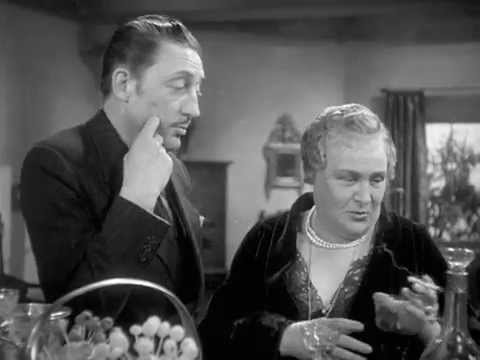
Versions of the story had been filmed in the silent era, and the film follows the story of Allan Dwan's 1929 Douglas Fairbanks version for this, its first foray in the sound era. In that, Phillipe's existence is not erased—merely expunged—by having him raised in Gascony under the care of d'Artagnan (Warren William, "the King of the Pre-Code"*) on advisement of the King's courtier Colbert (Walter Kingsford), who wishes no confusion about the line of succession, and fearing that Phillipe could be used by forces to unseat the future King. Such information is to be kept under the strictest of confidences, as it could lead to blackmail (as it does when cardinal's messenger Fouquet (Joseph Schildkraut) uses the information to become Minister of Finance under the young King Louis IV (Louis Hayward).
King Louis is a foppish lout, and Fouquet uses his position as Minister to impose a crippling tax on his people, including the ones in Glascony and that causes a bit of commotion when it comes time to pay at the d'Artagnan house, where guests Porthos (Alan Hale), Athos (Bert Roach), and Aramis (Miles Mander) hold off the tax collectors, but are captured when confronted by the King's guard. The advisor Colbert alerts Louis to the startling resemblance to him, and, knowing that an assassination plot is imminent, blackmails Phillipe to impersonate him or his friend-Musketeers will be executed.
For Louis, it's a great plan to avoid being killed, but it has a couple of negative consequences: first, when the attack does come Phillipe is able to thwart it and, rather than have them killed, spares their lives, which wins him favor in the public eye; second, Louis's betrothed, the Princess Maria Theresa (Joan Bennett) of Spain finds the false Louis far more attractive than the real king, who's carrying on an affair with the Mademoiselle de la Valliere (Marion Martin).
After a swashbuckling escape from Louis' clutches, Phillipe is recaptured and Louis decides to hang him, but a decree that no royal blood be spilled (and that Louis couldn't stand to see someone who looks like himself swinging from the gallows) gives him a more sadistic alternative—throwing his brother into the Bastille, his face hidden by an iron mask that can only be unlocked with a key in the king's possession. Phillipe will be forgotten in prison, doubly encased, until his beard grows so long inside the mask that he will be strangled by it.
Whale's work on this plays to his many strengths, displayed in his work in the 1930's, starting in 1931 with his iconic Frankenstein and its sequel, the equally iconic (but lesser known) The Old Dark House, The Invisible Man, and Show Boat. The film is designed to the 9's, with extraordinarily elaborate decors and costumes, and the dungeons of the Bastille are things of nightmare. Plus, his special effects work is fully on display in the elaborate split-screen work, allowing Louis Hayward to play both parts, without any seams or noticeable delays in dialogue. And Whale's florid directing is much in display in Hayward's wild-eyed King Louis and his Finance Minister, Fouquet, while Hayward's Phillipe approaches the hyperbolic ministrations (much as Claude Rains did in The Invisible Man) in his dungeon scenes. When one's expressions can't be seen, emotive body language supplies the desperation. It's a remarkable work, and even though produced in 1939, still is the best version of The Man in the Iron Mask I've seen.
* I'm becoming a real fan of Warren William, who is pretty much forgotten in the annals of cinema, despite the fact that he had the swashbuckling verve of Errol Flynn in this, and his heroes—including the first screen version of "Perry Mason" and a Sam Spade twice-removed in Satan Met a Lady—and his villains could be unapologetically moustache-twirling (as in Employees' Entrance).

Wednesday, April 12, 2017

Satan Met a Lady (1937)

Satan Met a Lady (William Dieterle, 1937) Warners' second adaptation of Dashiell Hammett's "The Maltese Falcoln" done with a much freer hand and less devotion to the source novel.

When confronted with the Hays Office crackdown on lascivious content in movies, Warner Bros. found a lot of their catalog unreleasable for re-issues. In the short term, they solved the problem by judicious cuts in audience favorites and by creating revamped versions of past product. A new "Maltese Falcon" was put in production a scant five years after the first's release. In the interim, another Hammett property had scored big at the box office; The Thin Man with William Powell and Myrna Loy had proved a sensation, and since nothings exceeds like success, "The Maltese Falcon" was freely adapted to be more in line with what worked with The Thin Man, more comedy and an emphasis on glamour and the high life. So, Sam Spade became detective Ted Shane, as played by Warren William, a stetson-wearing rake, seen at the start of the film as being run out of town by some city-fathers and returning to his old haunts and old job at a detective agency in San Francisco. Among his first clients is Valerie Purvis (Bette Davis) who warns of being tracked by a dangerous man, and before long, Shane's detective-partner (Porter Hall) is killed and the story begins anew.

Same story but, like Hammett's detective, the characters are significantly altered, if the track of story-line still stays basically the same. Take, for example, Joel Cairo who is transformed into a stuffy Brit played by Arthur Treacher (rather than fisticuffs, Shane and the character do some jolly breakage in Shane's apartment); Kaspar Gutman is Madame—note that—Madame Barabbas (Alison Skipworth), and Wilmer is a thick gunman named Kenneth (Maynard Holmes), whom she dotes on, and Effie Perrine, the Spade and Archer receptionist is Miss Murgatroyd (Marie Wilson), the epitome of a dumb blonde. And the falcon? It's now the legendary horn of Roland. The whole debacle is treated as farce, with more interest in having a good time than actually acquiring the MacGuffin.
The film is directed by William Dieterle, one of Warners' prestige directors, having already directed their all-star version of A Midsummer's Night's Dream in 1935, and who would go on to direct the multi-Oscar winner The Life of Emile Zola, The Devil and Daniel Webster, and projects for David O. Selznick. He keeps everything moving breezily for awhile, but the movie stops dead at the end with an exposition scene that makes up for lost dialogue and movie-time (the Huston version, four years later—the only one where the male lead is top-billed—has the same issue, but it's part and parcel of the drama). Davis was so dismissive of the script that she stayed away from filming for three days, hoping to be taken off the job, in favor of the more serious, prestigious roles which she favored.
Satan Met a Lady probably did not need a falcon, as, by itself, it is one strange bird. With its detective that is anything but private and sticks out like a sore thumb, its eccentric cross-gendering to appease the Catholics, and its game of "Who's got the horn," it does no justice to the source novel or the other Hammett adaptation its trying to ape. Five years later, John Huston, hot from his scripting duties for Warners (including Dieterle's Dr. Ehrlich's Magic Bullet) would take the property with another Warners B-player in the lead, and stay true to the novel by scratching away at the layers of lacquer demanded by the studio, to find the gold underneath. 
William and Davis not seeing eye to eye
Lorre, Greenstreet, Bogart, and Astor:
The cast of the next Maltese Falcon waiting in the wings.