Showing posts with label Anne Heche. Show all posts

Saturday, January 1, 2022

The Other Guys

Written at the time of the film's release...

Saturday is traditionally "Take Out the Trash" Day. (Remember when Adam McKay made comedies?)

"Did That Go the Way You Thought It Was Gonna Go?""Nope."
or 
"Anything You Say Can and Will Be Used...(what's the rest?)" "As a Flotation Device..."

More comedy, and this one's even very funny for its first half, but then, once one scene goes sideways and doesn't work, the whole thing falls apart like a hostage situation gone wrong.  And the audience is the hostage, waiting for it to kick back in...but it never does.

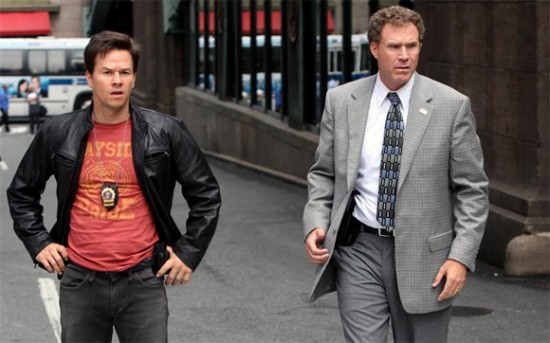
Allen Gamble (Will Ferrell) and Terry Hoitz (Mark Wahlberg) are two New York City detectives working in the considerable shadow of detectives Danson and Highsmith (Dwayne Johnson and Samuel L. Jackson in nice parodies of their "serious" screen-work), a team of glory-hounds for whom property damage is all in a day's conflagration, but who refuse to do the paperwork.  Gamble is self-described as "an accountant for law-and-order," and Hoitz is riding a desk-job after a shooting that goes wrong.* Gamble loves the mundane filing, but his partner Hoitz, itches to be "in the field." "I'm a peacock!" he is fond of remonstrating. "You've got to let me fly!" At which point, he is reminded that peacocks do not fly.** 
Unperturbed, and when advancement in the ranks becomes possible, the two glom onto a white-collar crime that Gamble has discovered that has connections to a series of high-profile robberies. 
The mis-matched pair
(Hoitz is volatile, Gamble is eerily up-beat) are completely street-dumb and their investigation is constantly being dis-railed (sometimes literally) by distractions and their lack of ability to resist the charms of their high-rolling suspect's lifestyle. Their increasing frustration with the case and each other (as well as Hoitz's relationship problems, in contrast with the milquetoast Gamble's inexplicable attractiveness to women) is fertile ground for situations that explode in conflict.
It works and works gang-busters for the first hour. The combination of loose script and improvisation is beefed up by all the actors (especially Ferrell and
Michael Keaton
, who does quick-silver wonders with the cliche "harried Captain" role), especially when the story is building and we're getting to know the characters. The "left-field" surprises come fast and loose, and the timing by the actors (and the editing) is crack. One senses trouble early on when Anne Heche (uncredited, by the way) is given a thankless role in which she's really not allowed to do anything funny...or much of anything. But Ferrell, for the most part, is at the top of his game playing the contrary stiff in a room full of crazies, and Wahlberg who, depending on the material, can be brilliant, plays pathetic frustration hilariously.  Even Eva Mendes acquits herself well in the mix, milking laughs out of the role of Gamble's absurdly perfect wife—Gamble's sexual magnetism makes for a great series of running gags throughout the movie.
But, right at the point where Bob, the union rep, gets dissed and leaves the room, the entire movie goes flat.*** Maybe the improv was getting too expensive and they decided to "coast." Maybe the assurance of an "action-filled" finale made them scrimp on the script.  Maybe the irrelevant story-line getting in the way changed the tone. Maybe everyone got tired. But, for whatever reason, The Other Guys is two movies..."Good Cop" comedy and "Bad Cop" comedy.
Interestingly, the most useful part of the movie is the end credits where the increasing disparity between the incomes of the top 1% earners and the rest of us is presented in chilling graphic detail.
"Wilhelm" Alert @ 1:30
 
* Hint:  He's called "The Yankee Clipper" around the squad-room.

** What can I say?  It's New York, and the Bronx Zoo is the closest they come to a peacock.  Peacocks do indeed fly, but it's a brief, clumsy, scary thing to watch—which I think was the point of bringing it up in the movie.

*** It's funny I can pinpoint it, because that's where the movie became NOT funny, and I thought to myself..."Well, THAT didn't work..." and watched to my amazement as very little worked after.

Tuesday, October 4, 2016

Psycho (1998)

Psycho (Gus Van Sant — after Alfred Hitchcock, 1998) What is good about Gus Van Sant's color version of the original can be laid at the feet of that film's creator, Alfred Hitchcock: the relentless pace, the choreography of the camera (matched by Van Sant and his cinematographer—the great Christopher Doyle), the various set-pieces that alternately tease and deepen the mystery manipulating the audience's needs and tensions "like an orchestra," and that the film maker breaks the director-audience "trust" by the film's mid-point.

Danny Elfman, Bernard Herrmann's No. 1 fan, lovingly recreates his score in stereo. And modern film techniques allow Van Sant to make that opening pan across Phoenix, Arizona (2:48 pm), seamlessly locate the apartment where Marion Crane (Anne Heche) and Sam Loomis (Viggo Mortensen) play out their melancholy nooner and then crawl (with no cuts) through the window.
       
 
Van Sant's semi-scrupulous recreation (right) of Hitchcock's original shot-plan (left).
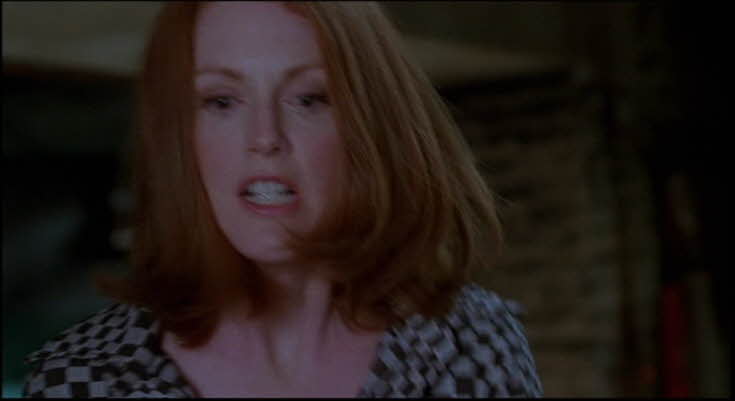
Everything that's wrong with Psycho '98 can be blamed on Van Sant: the kitschy color schemes, the bizarre inserts (see below) and the casting. Vince Vaughn had his hands full having to follow in Anthony Perkins' sashaying foot-steps as Norman Bates, so kudos to him for even showing up on-set, although he's lousy. What's surprising is how poorly Anne Heche and Julianne Moore step in for Janet Leigh and Vera Miles, even though both seem to be working harder. And it's that way down the line, including—startlingly, Viggo Mortenson's poor standing next to John Gavin (??!) and Robert Forster's shrink monologue next to...Simon Oakland? Where there is parity (or is it parody, it's hard to say how much Van Sant is taking this seriously...did Hitchcock?) is William H. Macy's Detective Arbogast compared to Martin Balsam's original, and Philip Baker Hall for John McIntire
   
  
So, why even do it? Van Sant, in his commentary, cites several reasons: today's generation of movie-goers don't know from Psycho...or Hitchcock, making this a sort of a remedial version—Hitchcock for Dummies; some movie-goers don't like black and white films, hence the move to color; changes in movie technology allow the sorts of things that Hitchcock wanted to achieve technically with Psycho but could not (and the ratings system allows for a post-censor version—lines cut by Hitchcock are re-inserted, and there is a bit more blood-and-gore); and, the most compelling reason for Van Sant—nobody'd ever done it before—at least as scrupulously. He basically follows Hitchcock's story-boards (and carried a portable DVD player with the film for reference while shooting on-set), so it is mostly a matter of interpretation, which is not that radical a concept. After all, how many different interpretations of "Hamlet" have there been? And as Hollywood seems to be running out of ideas (or continues its policy of playing it safe) we've seen remakes, re-boots and re-imaginings of Planet of the Apes, True Grit, Solaris, The Taking of Pelham 1-2-3, any book by Jane Austen or the Brontë sisters, and we've seen movie versions of teleplays, such as Traffic, State of Play, Edge of Darkness, The Girl With the Dragon Tattoo and Tinker, Tailor, Soldier Spy (and one can't forget "Americanized" versions of foreign films Is this necessarily a bad thing?  No. The Maltese Falcon had been filmed twice before when John Huston made his classic version in 1941. It is interesting that Van Sant not only remade Psycho, but also made it in Hitchcock's style using his shooting plan, acknowledging that the movie and the man who made it are inseparable.

What's different?  Van Sant follows Hitchcock's ideas pretty well...but does a sort of skewed version of them in terms of color, angle and performance. Some scenes have a more modern spin on then—for example, Lila and Sam wait for word from Arbogast (Martin Balsam in Hitchcock's version, William Macy in Van Sant's) at Sam's business, a hardware store in the 1960 version, but a flea-market in 1998, notice Sam reading the liner notes on a Judy Garland record.
In 1960, while investigating the Bates house, Lila finds children's books in Norman's room, but in 1998, it's porn.
And Mrs. Bates is found sitting in the dull basement, but in 1998, she's seen sitting in front of a diorama among live birds.
 
The biggest difference has a more feminist slant: rather than sitting back and watching the final fight, 1998's Lila takes part kicking her assailant.
But, Van Sant's entirely new additions are, frankly, unnecessary.  Sure, the first shot of the fly might have suggestions of bringing things full-circle, but the other shots—quick cut-aways (no pun intended—??) during the murders are merely distractions taking us out of "the moment" of the victims' deaths, and seem pretty frivolous.  Hitchcock does establish a "mind's eye" kind of cinema with his "voices in my head" sound overlays, and his "see that I look"/"see what I look at"/"see my reaction to it" style of silent story-telling might allow it, but it seems superfluous, and more than that, confusing, especially when we're having a shocking thing happening on-screen.
During the opening scene in the hotel room, an image of a fly on a half-eaten sandwich is inserted, paralleling the lucky fly who won't be killed in the prison cell at the end of the film.
During the first murder, a shot of a dilating pupil (presumably in the victim's eye) and a quickly moving storm-scape which presumably was witnessed previously.  
The second murder victim's flash-frames are (given that person's profession) a sleazy vice scene...
...As well as a stray cow in the middle of a road (A memory?  A potential victim?)
As well as a quick, obfuscating shot of the murderer approaching.
So...the Van Sant version of Psycho is an interesting experiment, Hitchock through the sensibilities of Van Sant, respectful but different. Does it do harm to the original? 

Well, no. Interesting story: the pulp novelist James M. Cain was told once by a person "too bad what Hollywood has done to your books," and Cain took them into his library and pointed to his own novels. "Hollywood hasn't done anything to my books. They're right there on the shelf." 

The original—Alfred Hitchcock's Psycho—will always be there.
Cameo's: Hitchcock on the left (1960) and a portly Hitchcock stand-in points at Gus Van Sant (1998).
The final card of Van Sant's Psycho—taking us beyond Hitchcock's raising of a car from the bog for a bit of perspective: all that horror has gone on just off the highway.  The distant traffic sails by, indifferent and unsuspecting of what lies out of their attention.  There's an element of that in all of Van Sant's movies—horror and secret lives occur just out of sight of normalcy.

*  In-joke (there are lots) here: The sign on The Bates Motel says "newly renovated" (a cutting remark)