Showing posts with label Anna Lee. Show all posts

Thursday, October 1, 2020

Gideon of Scotland Yard

Gideon of Scotland Yard (aka Gideon's Day, John Ford, 1958) You think you know a guy. Take John Ford. I couldn't have been more surprised to see Ford listed as an executive producer (along with King Kong producer Merian C. Cooper) on that mixture of cowboys and "Kong" stop-motion/live action hybrid, Mighty Joe Young (with effects work done by King Kong magician Willis O'Brien and a young apprentice by the name of Ray Harryhausen). It featured Ben Johnson, one of Ford's stock company, so I shouldn't have been too surprised.

But, years after being escorted off Mister Roberts and making his masterpiece The Searchers, there is this curiosity that Ford produced and directed in Britain, far afield from his westerns and military dramas. Soon after making The Bridge on the River Kwai (and starring in Ford pal Howard Hawks' Land of the Pharoahs), Jack Hawkins was picked by Ford to play Scotland Yard sleuth George Gideon from John Creasey's series of novels starting with his "Gideon's Day," written in 1955.
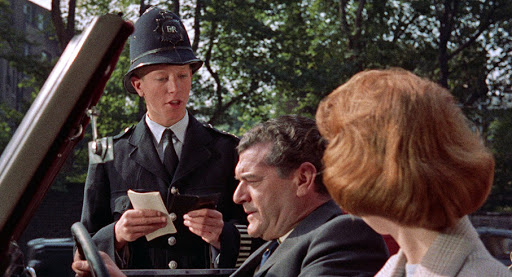
Now, Gideon is a Detective Chief Inspector and with that goes a lot of responsibility. But, that doesn't mean that you're immune from the vagaries of life, like getting enough time in the bathroom in the morning, or parking tickets from too-earnest young bobbies, family matters like making it home in time to attend your daughter's concert—her first (she's played by Anna Massey...and it was her first...film), or acquiring the salmon for the dinner you have to have with the in-law's...if you're not held up at the office by the demands of the job.
For Gideon, on this day of days, has to deal with the possible bribery charges of one of his sergeants—and that will mean personally interviewing the informant (if he can find him), the escape of a violent sex maniac rumored to be on the road to London, not to mention a couple attempted murders, bankroll robberies by a dinner-jacketed mob...and that bobby, who pops in Gideon's Day like the proverbial bad penny.
The film is an oddity, but only because it should be more well-known, as Ford, the picture-maker is working on high-gear here...with some sterling talent in the British film industry: T. E. B. Clarke (The Lavender Hill Mob) wrote the screenplay, premier art director Ken Adam designed the look, and it was photographed by master cinematographer Freddie Young. With such talent behind the scenes, the film would at least be a curiosity, but it's directed by Jack Ford, which warrants a must-see for those who "like them the way they used to make them," or need to be convinced that Ford could do more than westerns...or work with John Wayne.
Those who know Ford's work know that there is a constant struggle for the appropriate tone: Ford, especially in his later years, was fearlessly tackling darker material—making him somewhat unpopular with his studio's—while balancing it with comedy, whether it's the popping of societal balloons or muddying stuffed shirts, or merely exposing the follies of the needlessly pretentious. Characters are in constant danger of barking "Lighten up!" both to their on-screen film-peers but also to the film at large. 
Given the material, Clarke's script provides Ford an almost seamless balancing act between familial follies and often deadly serious police work, showing the pressures of maintaining a civil head while dealing with the lowest of criminal creeps. Yes, the family stuff can be a bit frothy—Anna Lee (mentioned here two days in a row!) plays Gideon's wife, hailing as she does from the county of Kent—but contrast it with the escaped rapist, which Ford films in a way eerily similar to Hitchcock's sense of dread.
Also, unusual for Ford, is a little narrative side-track of what makes a man. Now, this was something he might not have been able to try in his American Westerns...and certainly not around his apprentice, Wayne. When a vicar of a local parish is jeered by the local children for being "a sissy," he stoically turns the other cheek, refusing to talk about his commando service in order to not glorify war, but when he is attacked by a criminal, he does what he has to do to stop the violence. Both he and Gideon are appalled by violence—one preaches against it and one tries to prevent it—they face and take action when confronted by it, but, in their separate ways, avoid resorting to it.

It's a good film, by a master film-maker, but try to see it in color—that's the more complete British version. The U.S. version is in black and white.
Oh, one other thing: at the time Ford was in London filming Gideon's Day, he had the opportunity to meet one of his biggest fans, a Japanese director named Akira Kurosawa.

Wednesday, September 30, 2020

The Crimson Kimono

The Crimson Kimono (Samuel Fuller, 1959) When TCM was programming their "Asian Movie Month" this one ran three times (that I could count). It's an odd choice, but I was grateful as it's one of those Fuller movies that hasn't been all that available from any of the sources I search for these things.

As usual, it's a mixture of Fuller's higher sensibilities and his cynical carnival-barker understanding of what 'sells" to the public. Take a look at that poster; if that isn't "red meat" for an audience living in the America of 1959 where a third of the nation had laws against "mixed-race" marriages, I don't know what is. Fuller had an understanding and affection for Japanese culture—his House of Bamboo was filmed there and was one of the first American films post Second World War to do so—but, Japanese-American culture and the conflicts it imposes is a different matter. Visually, he marks the contrast by filming in L.A.'s International District with the L.A. courthouse looming only a few blocks away.

But, if you think this is a serious study of post-World War II prejudice and the intolerance of American white patriarchal traditions (it was, after all, okay for Robert Stack to woo Shirley Yamaguchi in 1955...), then you don't know Samuel Fuller.

How does he begin it? With a strip-tease sequence and the murder of same stripper (Gloria Pall) being gunned down in an L.A. street after witnessing a murder in her dressing room (a sequence that Fuller shot—with three hidden cameras—on Sixth and Main at night, without permits, which would have ruined the verisimilitude of the shot). Two detectives, Det. Sgt. Charlie Bancroft (Glenn Corbett) and Det. Joe Kojaku (James Shigeta) are assigned to the case. The two partners are as thick as thieves: they share the same apartment, and are blood-brothers, literally, as, during their Korean War service, Kojaku gave blood to save Bancroft's life. The pair are secure in their knowledge that they have each other's backs, and nothing could complicate that.

In the course of their investigations, they're going to learn different.

Their initial investigation is to the strip club in Little Tokyo, where the "ecdysiast," "Sugar Torch" was working. Her dressing room is a-clutter with renderings of Japanese-style sketches, as it turns out she was working up an act that has a little more content than the usual bump-and-grind solo, with kimono costumes and a love triangle story where she and her love are killed by a jealous karate practitioner. I guess everybody has ambitions. Charlie seeks the artist to see if he can get any background on Sugar's acquaintances, while Joe hits the local dojo's to see if Sugar had contacted them about the act.

The artist turns out to be Christine Downs (Victoria Shaw), a USC art student living in a sorority. Christine tells Charlie that the kimono drawing was a commission by a Mr. Hansel, working for Sugar on the act, and—here's a convenience!—Christine can do a pretty good sketch of the man. Also (another convenience) Charlie is attracted to Christine and flirts with her ferociously, to which she responds.
Joe's investigation bears some fruit, too. He tracks down the guy who was supposed to provide the stunts for Sugar's act, but when Joe confronts him, he panics and Joe loses him in a chase through Little Tokyo. Christine finishes her sketch and the detectives release it to the newspapers as part of their investigation. What they don't know is that this will complicate things...on many fronts. Charlie is warned by his bohemian artist-pal Mac (Anna Lee, of John Ford's stock company) that once the sketch has hit the papers, Christine won't be safe, and, indeed, someone takes a pot-shot at her at her sorority. Although it may not be the best of ideas, Charlie and Joe decide that Christine be put under police protection...by moving into their apartment—while they're working, Mac keeps an eye on her.

Joe and Charlie try to run down Hansel, fearing another attempt on Christine's life, and they talk to Roma, a wigmaker, who was doing the hair for Sugar's act. Turns out Hansel's real name is Paul Sand and used to work for the library as an "Asian specialist" and has disappeared, "gone to ground" somewhere. But, he'll show up, probably to make another attempt on Christine's life, so the search intensifies. But, the circumstances add another complication—one that is Fuller's true focus rather than the lurid murder investigation.

Joe has developed feelings for Christine. Deep feelings. And Christine has them for him. Complications lead to conflict—Joe and Charlie are best friends, but also partners in a dangerous profession. Joe knows Charlie is smitten with Christine, and he feels guilty about his coming between that. He doesn't even want to bring it up and hides it from him. But, he's of two minds in more ways than that: he also has some cultural clashes—the woman he's been seeing is Japanese, born, bred and living there and he's Nisei. His American roots has led to some doubts about continuing his relationship. And then, along comes Christine... From her side, Joe is the better man, more caring, more sensitive, less egotistical: how to break it to Charlie? As Mac sagely tells her, "Love is like a battle...Someone has to get a bloody nose."
Now, when Fuller was making this, he got push-back about it from the studio. There was pressure on Fuller to make Corbett's character "a sonofabitch" (in Fuller's words—from his biography "A Third Face"). For the studio, this would make Joe the more obvious suitor, and reassure audiences—white audiences—that the Christine character would prefer Joe and reject Charlie "even though he's white." Fuller wouldn't have any of it. "The girl chooses the Japanese guy because he's the man for her, not because the white guy's a sonofabitch. The whole idea of my picture is that both men are good cops and good citizens. The girl just happens to fall in love with the Nisei. They've got chemistry."
It's as simple as that. Joe's a good guy—Charlie's a good guy, too—but Christine is drawn more towards Joe because of who he is as a man, in colloquial terms "he's more her type." The tragedy comes, as in most triangles—if there's any conscience involved—for the third making a crowd. Joe, in this position and being sensitive to it (the very aspect that attracts her to Joe over Charlie), buries his feelings in frustration and Christine is hesitant and seemingly aloof around Joe when Charlie's around—which Charlie, at first, reads as racism on her part. It all gets very complicated, as the three stop being people and act as though they're relegated to "proper roles." Everybody begins to make assumptions about things they don't understand, and this triangle gets a little bumpy.
It's tempting to say that the story of the investigation gets pushed aside for the "love story," but, in fact, the two are mirrors of each other, both involving secrets and others filling in the holes with their own interpretations of what's going on. The film resonates more once the crime has been solved, but it only provides context for a story that, on the face of it, looks to be about racial identity. Given the completion of the movie, it looks to be more about suppression of self in order to satisfy a perceived role, especially where emotions are concerned. I've written elsewhere that love can be perceived as a form of madness—it certainly can put one off one's game, and make you do things you wouldn't do "where calmer heads prevail." It make look like prejudice, but it is subjugation, even if it's self-imposed.
The Crimson Kimono is rough around the edges. It's a pot-boiler, frequently filmed with guerilla techniques, and temperatures—and performances—can run a little hot. But, Fuller, who had a reporter's sensibilities (and a huckster's sense of flamboyance and salesmanship) tells a story fully intended to knock one out of one's safely-balanced comfort zone. His action sequences are kinetic, sometimes frantic, and he wasn't afraid to go overboard when making a point—I always imagine him directing by jabbing two fingers, with his ever-present cigar between, for emphasis. He wasn't subtle, but he'd take you places you may never have thought of before—or places you didn't want to consider. "Maverick" is the most obvious adjective. "Human" is another.

He despised that poster, by the way. Pure racism, and that is what he was railing against.
A word about James Shigeta: this was his first film role after years as a singer. It was Corbett's first film, too, but where both men are comfortable in front of the camera, Shigeta acts like he lives there, far more relaxed, less on-guard, and not afraid to take chances. He'll chew an apple through a scene, casually grilling a lead, and he's more than believable in action scenes. Fuller gave his most notable parts to women (usually), whereas the men, even men in conflict, could be stoic and pretty stiff. Not Shigeta. He's actor enough to let the audience in to feel his pain, but not enough to lose their respect. It's a very impressive debut, and one wishes he'd been given more opportunities like this throughout his career.

Of COURSE, Christine's character prefers him; who wouldn't?

Thursday, October 31, 2019

Whatever Happened to Baby Jane? (1962)

Whatever Happened to Baby Jane? (Robert Aldrich, 1962) As if Sunset Blvd wasn't perverse enough, Robert Aldrich took the 1960 novel by Harry Farrell and turned it into the Grandest of Guignol's about the passing of Hollywood glamour with two of the greatest stars of the past pitted against each other in a battle for screen supremacy. Reportedly, the filming was contentious as both Bette Davis and Joan Crawford despised each other and didn't care who knew it. That vehemence inspired two very overheated performances that reached deep into both ladies' bags of tricks—Davis' over the top Jane, and Crawford's long-suffering Blanche. Whatever one may think of the picture, no one can't resist looking at a train-wreck...in the middle of a cage-match. And director Aldrich, who could be counted on to make his own fireworks when he needed to, merely had to turn on the camera and watch the material boil over.

And, on occasion, keep it from exploding.

Cautionary placard for ticket-buyers of Whatever Happened to Baby Jane?
The Hudson family is riding a financial success in 1917, as their daughter "Baby Jane" is a beloved silent film star and doing stage appearances to promote her marketable likeness in the "Baby Jane" doll. America's little sweetheart, however, is, away from the spotlight, a spoiled-rotten brat who dominates the family who give in to her every whim and tantrum to keep the money coming in. Her sister Blanche can only look on and seethe in jealousy.
Cut to 1935. Both Blanche and Jane are appearing in films now, although Blanche's fortunes have eclipsed Jane's and the older film star is drinking to drown her sorrows. But a deliberate auto accident by one against the other reverses all fortunes.
It's modern times (1962) and both sisters live in a Los Angeles mansion in Los Angeles, Blanche (Crawford), confined to a wheelchair from the car accident, watching her old movies on television and reliving her past. Jane (Davis), meanwhile, is still drinking heavily, bitter, and delusional enough that she's teetering on the edge of a psychotic split. Jane is Blanche's "caretaker," with as opposite a definition of "care" as possible. It being 1962, movies didn't show everything involved in caring for a paraplegic, so it's limited to Jane's preparing and bringing of meals. But, in Jane's resentful state, what she uses for protein becomes more than questionable.
What she doesn't make for Blanche is pancakes, presumably because that is what she seems to be using for make-up.
Jane dresses up in woman-sized girly dresses and cakes on the foundation in an attempt to look younger* and acts like a coquettish child while interacting with strangers, but, once you get to know her, she turns into a harridan, dropping the act. Her viciousness is no act, however, and it's escalating, the further she gets away from her fabled childhood and her own dreams of Hollywood success. But Jane is used to getting her way, combined with a twisted guilt for her sister's paralysis, as she was black-out drunk when the crippling accident occurred. 
While Blanche is basically confined to the upstairs, Jane has the run of the house and takes delight in taking any joy she can from Blanche's existence. It is merely the presence of a housekeeper (Maidie Norman) that keeps Jane's more extreme activities in check, and she is beginning to resent it.

It's a battle for control between the two sisters, with Blanche seemingly at the disadvantage. But, she has control of the house, and when she announces to Jane that she intends to sell it, Jane ramps up the abuse, locking Blanche in her room, tossing out her mail and restricting access to the outside world by means of disabling their telephone. Particularly venomous are Jane's manipulation of her sister's meals, at one point using her pet parakeet as an entree, while at the same time living under the illusion that she can revive her career with personal appearances.

But, the public has long forgotten Baby Jane.

Blanche, on the other hand, defends her sister, no matter what cruelty is inflicted on her. Her long-suffering victim-hood has its own deep origins in that accident in ways that are not obvious on the outside.
It is an extraordinary, squirm-inducing example of bat-shit-crazy film-making, with an extra level of cruelty than the usual hard edge Aldrich put on his films as the two sisters have a battle of wills that almost guarantees mutually assure destruction. It has a sardonic nastiness reminiscent of Edward Albee's "Who's Afraid of Virginia Woolf?"

It would almost be unwatchable if it weren't for the two actors involved in the struggle (which spilled over to their antics against each other on-set). The casting is key with Davis and Crawford in opposite corners, diametrically opposed in both technique and performance goals, with Crawford falling back on her woman-martyr characterizations and Davis careening in the opposite direction going for manic intensity. Given how the film plays out, it shouldn't work, but both actresses can't help give it their all for screen-domination. It is one of the miracles of casting that couldn't be more ideal.

"We're getting along. Really, we are."
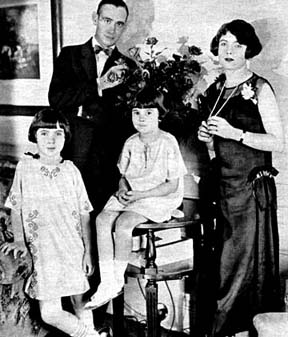
Although she seemed far more stable, there are rumors than "Baby Jane Hudson" was based on 
Diana Serra Carey, who starred in silent pictures as "Baby Peggy"

* When Davis' daughter saw her "Baby Jane" make-up, she reportedly said: "Oh, Mother, you've gone too far this time!"

Wednesday, October 29, 2014

The Ghost and Mrs. Muir

The Ghost and Mrs. Muir (Joseph L. Mankiewicz, 1947) Three years before he would realize his ultimate triumph of All About Eve, Joseph L. Mankiewicz made his fifth film for 20th Century Fox, a fantasy-romance, adapted by Phillip Dunne. Mankiewicz had already worked with star Gene Tierney on Dragonwyck and the two re-teamed here to tell the story of a young widow, Mrs. Lucy Muir, who, to get out from underneath the domineering thumbs of her in-laws, takes her young daughter (played by Natalie Wood) and rents a storied seaside cottage called Gull Cottage.

Storied might be too charitable a term. The landlord does his best to warn her that there's been quite a bit of turn-over lately in renter's owing to the rumor that the place is haunted. But, Mrs. Muir loves the place and is undeterred by the stories; she, her daughter and her maid move in.

The first night she is visited by the ghost, in the sepulchral form of Captain Daniel Gregg (Rex Harrison), the first owner of the house. He doesn't take too kindly to the living presences there, but Muir charms him, and he reluctantly agrees to a spiritual version of a renter's agreement—as they're better than past guests, he will allow them to stay, refrain from poltergeistian activities and will only check-in (fade-in) with Mrs. Muir, leaving her daughter undisturbed. Wouldn't do to scare the children, no matter the friendliness of the ghost.  And life (and after-life) settles down for the four residents.

There are disagreements, but for the most part, Gregg and Muir get along, and when Muir's in-laws pay an unexpected visit to tell of her of financial troubles that will force her eviction and her return to London, Gregg shows that the spirit is willing by scaring the in-laws out of the house.
To get her out of debt, the two devise a scheme: Gregg will dictate his memoirs to Muir, and she will then publish them and use the proceeds to buy Gull Cottage.  Gregg spins a tale of derring-do on the high seas, and his obvious love of the sea and means of expressing it, charms his biographer, and slowly, the two begin to fall in love.
But it's a love that can never be in the real world. The Captain is, after all, dead. And not just figuratively, but really and sincerely...dead. She is young, lovely, and, more to the point, alive. Suitors come and go, and Gregg watches them, disapprovingly, and is, himself, haunted by the opportunities for life that Muir might be passing by. "Life is for the living," they say. So, when Muir meets an urbane man (George Sanders) at the publisher's, Gregg convinces Muir (while she sleeps) that he is only a dream that she's had, and fades from her life to give her life, never to return.
But, life is not all it's cracked up to be. Life is hard for Mrs. Muir, and love is even harder—cruel, in reality. She lives out her life alone, without even the spirit of love she once knew.

It's simple in theme, but complex in emotion and resonance. Mrs. Muir is a widow in love with death. Mourning her husband, she finds love in a kindred spirit, in love with life, so much so that he will sacrifice himself in her interest. It is the oddest, and most haunting of love stories that ends in a love that even death dare not part.