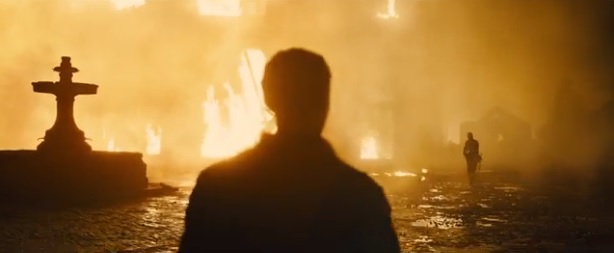
This is not unique—Hitchcock did it in 1948 with his experimental Rope, essentially a play without the proscenium arch and the audience on stage with the actors, doing 10 minute continuous shots (which was the length of a film reel) until he could focus on somebody's back for the reel-change—and has been done more frequently of late thanks to digital photography (think of Birdman, Gravity, there's a list of them on Wikipedia now). The effect has been used to create tension—when is the scene going to "break"?—ala Orson Welles' long opening to Touch of Evil. And World War I is ideally suited to this conceit, given its emphasis on trench-warfare, where the viewer is hemmed in by the narrowness of the space, used to very good advantage in tracking shots by Stanley Kubrick in Paths of Glory and emulated here by Mendes.
The film begins—as it ends (no real spoiler alert necessary)—with a soldier relaxing under a tree; Lance Corporal Schofield (George McKay) is soon told to get up by Lance Corporal Blake (Dean-Charles Chapman)—there's a mission that he's been called to carry out and he's chosen Schofield to accompany him. What's the mission? No idea, he's on his way to the bunker of General Erinmore (Colin Firth) to hear what it is. The two slop to the make-shift HQ and given the task—word is that the Germans have not retreated, as has been the thought, but diverted to the newly-formed Hindenburg line where that entrenched position will allow them to decimate the Devonshire regiment who have been planning an attack that will place them right in the path of the German artillery there. Phone lines and communication are down, so the two men must hand deliver a message to call off the attack scheduled for dawn the next day lest the 1600 men be wiped out, including Blake's older brother who is stationed there.
Time is limited. The two have to leave the trenches, weave their way through No-Man's-Land, pick their way past the German trenches, evade whatever sparse troops might be there on the way—IF they have, indeed, moved—make it to the city of Écoust, follow the river nearby and get to the Devonshires before the attack can happen. In other words, they have to go through enemy territory and any stray threats there to hand deliver written words that, they are warned before heading "over the top" by an embittered Lieutenant Leslie (Andrew Scott, always welcome) that the orders might not be believed, anyway.
The Devil of the trip is in the details and they come in the form of booby-traps, rats, blasted out landscapes, snipers, armed aerial reconnaissance and the general fog of war. Mendes' usual one-point perspectives keep a viewer focused on what's up-front, but the ever-moving camera has you exploring the edges of the frame, looking for hidden dangers that just might be slipping into view.
The focus is constantly changing, although still hampered by the camera frame, giving one a 90° vantage of what is surrounding Blake and Schofield, immersing the audience in the step-by-step journey while also limiting the field of view. Yes, it "puts you there" but it is also frustrating that your vantage is from a letter-box. At times, it has the feel of a FPS video-game (without the woozy headaches), but even then, you're controlling where the field of view looks. In this, you're just a prisoner.
Thank God, though, that the fellow who is controlling the view is Roger Deakins, one of those masters of light, a cinematographer who can make anything, even a pristine field, look magical. Technologically, the film must have seemed daunting—not just in the one-shot fluidity—but also in the various lighting situations—by candle, flash, flare, or flame—that Deakins has been honing over the last couple decades of working with demanding directors who were seeing the world a little differently from others and has managed to pull miracles out of the lenses he's been peering through. It's another wonderful example of Deakins excelling in an already crowded field of filming magicians who have moved the bar—or the f-stop—on what can be filmed, let alone imagined.
As beautiful as it is, though, one wishes there was more to it than that. For Mendes, of course, it's a personal tribute and a sentimental journey, a technical challenge well met, and impeccably done. At the end, however, one just feels a bit empty. Perhaps, that is as it should be, given that war, given that carnage, given its lasting effects on a generation—the "lost" generation, as it has become known in artistic circles. It is a story well-told, but not much of a story, as personally heroic as it might be. The monstrosity of that war and its futility has been better recounted for as long as there's been film...or near about's. Certainly as long as films have been giving out awards to itself.
It just pales in comparison to other WWI films, its technical prowess notwithstanding. And when one places it in comparison with...oh, let's say, They Shall Not Grow Old, which is also personal—interviews are with veterans, while memories are still green—and technically stunning—original Imperial War Museum footage, spit-and-polished up, sound-enhanced, digitized and colorized so as to seem new, not 100 years old, the effect historically, emotionally, viscerally is far more than 1917 can achieve. Yes, bravo for making it, but points off for making it an exercise rather than an experience.
* Slight time-error here: the mission is supposed to take six hours, so unless the soldier knicked is out for four hours this is some inevitable time-compression to allow for multiple showings at the cineplex—and that's assuming the time-estimate is based on the assumption of one or both of the soldiers being unconscious for four hours!
"Irving is one of the most dangerous spokespersons for Holocaust denial. Familiar with historical evidence, he bends it until it conforms with his ideological leanings and political agenda. A man who is convinced that Britain's great decline was accelerated by its decision to go to war with Germany, he is most facile at taking accurate information and shaping it to confirm his conclusions. A review of his recent book, Churchill's War, which appeared in New York Review of Books, accurately analyzed his practice of applying a double standard of evidence. He demands "absolute documentary proof" when it comes to proving the Germans guilty, but he relies on highly circumstantial evidence to condemn the Allies. This is an accurate description not only of Irving's tactics, but of those of deniers in general."
Sounds like every political argument I've had...well, ever. And it's become a cottage industry for the "don't confuse me with facts" crowd. "It can't be true because I don't believe it." People have an opinion and go looking for facts to support it, rather than looking at facts and drawing a conclusion about it. The latter is what intelligent people do, and that's just too inconvenient for those living in their bubble-verse to deal with. God knows, it would prevent the important work of being a "Sandy Hook denier" or a"Pizzagate" vigilante.
Irving took umbrage at this quotation I cited, appearing at one of Lipstadt's lectures—this one at deKalb College in Atlanta—(it wasn't exactly spontaneous as 1) he lives in England and 2) he brought along videographers), interrupting it and her, and challenging her to produce one shred of evidence that Hitler had authorized the extermination of the Jews in what would be called "The Final Solution." He waved $1,000 in the air, saying he'd give it to anyone who could produce that evidence. Of course, no one did because you usually don't carry documents like that into a lecture hall—just like no one brings heads of lettuce or rotten tomatoes, despite what the movies tell us.
Irving then brought suit in England, conveniently, not only for location but also strategically: in the Jolly Olde, the burden of proof isn't on the one who brings suit, it is on the ones they're complaining about. Rather than Irving having to prove his contention that he was libeled and suffered for it, it was up to Lipstadt to prove that what she wrote in the book could be proven as fact. Only then, could she win the libel suit. Given the stakes, and that she'd be the one with the most work to do, hired the legal firm run by Anthony Julius (played by Andrew Scott), who had famously represented Lady Diana in her divorce from Prince Charles and the Royal Family. Under the impression that there was nobody else who knew his material as well as he did, Irving chose to represent himself. And in so doing, he could use the court as a forum for his views on history. Tom Wilkinson plays Richard Rampton, who argued for Lipstade in court.
Trouble was, Irving was going to have to be confronted with "facts" in court. And it came down to his representation of what "facts" meant. He made much of an internal Nazi memo saying that Hitler wanted to put "The Final Solution" on "the back-burner" until after the Nazi's had won WWII, and a contention that the gas-chambers at Auschwitz were more to solve a delousing problem than as a killing device, based on something he read that contended that more Jews might have died of disease at Auschwitz than by outright murder. He chose to show as evidence of this that there were no holes in the gas-chambers through which the Nazi's could throw the pellets of Zyclon-B in order to carry out the killing, made conveniently tough by the Nazi's blowing up the chambers in 1944 to cover up the horrific crimes. Photographic evidence during the war had clearly shown them, but the usual trope of "faked photographs" was used to discount this. People believe what they want to believe, no matter the facts.
The trial was tough for Lipstadt, too. She very much wanted to expand the scope of the trial to condemn all Holocaust deniers, but was urged to keep silent and let the results of the trial speak for themselves. She very famously made no comment when the court found in her favor and against Irving. As screen-writer David Hare (author of Plenty, and the film adaptations of The Hours and The Reader) makes it clear the "denial" of the title is not only of the Holocaust, but also her own instincts to insert herself into the machinations of the trial.
Hare's screenplay is scrupulously attached to the facts. One should expect nothing less, given the subject of veracity embedded in the trial, but also (one suspects) to avoid any further litigation. If anything, the broadest thing one can accuse it of is casting Rachel Weisz as Lipstadt and Scott as Julius...and, for that matter, Timothy Spall as Irving. That may be the one concession to drama that Denial allows, and, to tell the truth, I found it refreshing, even if it may not have added to the "weekend box office" among the movie-going public. I not only found it refreshing, I found it as something of a salve for a sensibility that had been pummeled by a steady diet of lies, damn lies, and discounted statistics over the last few months and will probably not abate until it's been proven, to the point even the lowest politician could agree to, that it just doesn't "work" any more. In which case, you'll never see another commercial again.
That'll be the day. Lincoln said "You can fool some of the people all of the time and all of the people some of the time, but you can't fool all the people all the time." He might have been optimistic. But, then, he might have been alive long enough to have heard P.T. Barnum say "There's a sucker born ever minute." These days, truth is slippery. And, if you don't believe that, look it up in Wikipedia. Or Facebook. Or anything on the internet—including this movie review site. Truth will out, they say, but only if there is someone who is willing to receive it. These days, lies are spread by far too many willing accomplices. And they should be ashamed, if their arrogance allowed such a concept of "shame" to exist.
Denial reminded me of one of the most moving moments I ever saw in film, coupled with one of the most passionate speeches about humanity—in Jacob Bronowski's encyclopedic "The Ascent of Man." In the eleventh episode, "Knowledge or Certainty," (which I've included in its entirety at the bottom of the page), Bronowski, in a seamless thread, explores perception, the uncertainty principle of Heisenberg and the dangers of thinking something as absolute, even down to the microscopic level. He then goes on to talk about his friend Leo Szilard, one of the theoreticians behind the atomic bomb, of the migration of physicists from Germany during the war, and finally, ends it with this indelible moment...
This hit me like a hammer when I first saw it in 1978. And today, it is more pertinent than ever. Knowledge is ridiculed, statistics are ignored, and no one seems capable of facing facts if their opinion is in the way. It's what happens when intelligence is replaced by the very arrogance that Bronowski talks about. I see this happen all the time, and these days, it hits with a particularly resonant clang. If only there was someone to hear it...and then acknowledge it. The director of that particular episode of "The Ascent of Man" is also the director of Denial—Mick Jackson.
And, oh, by the way. It's not verifiable that P.T. Barnum ever said "There's a sucker born every minute." It's also not verifiable that Lincoln said "...you can't fool all the people all the time." If only the sentiments were not verifiable by so much bloody evidence.
Past-Tense or The Importance of Being Ernst The criminal organization S.P.E.C.T.R.E. (The Special Executive for Counter-Intelligence, Terrorism, Revenge, and Extortion) was the organization behind all the world's trouble in the first six of seven James Bond movies, and it's head, Ernst Stavro Blofeld (played by, respectively Donald Pleasance, Telly Savalas and Charles Gray) showed up for the first time in the fifth, although he'd been in two of them as a faceless entity stroking a white persian cat on his lap. In those films, his criminal organization had been responsible for toppling American missile launches, pitting the British and Russian spy networks against each other, hijacking nuclear weapons from NATO, sabotaging the Russian and American space programs to create a nuclear conflict, distributing a zero-growth virus as part of an elaborate blackmail scheme, and kidnapping a tech billionaire in order to put a laser firing satellite into orbit in order to offer nuclear supremacy to the highest bidder. These are bad-guys with a ruthlessly entrepreneurial streak. But they haven't been around for 40 years? Where have they been? Where every bad corporation ends up (unless you're Goldman Sachs)—in court. SPECTRE was created for the first attempt at a James Bond movie in the 50's in a script written by Bond's creator Ian Fleming, producer Kevin McClory, and a screenwriter named Jack Whittingham, in order to create an alternate to the Soviet Union (a potential market for distributing their movie even then), which was traditionally the badski in Fleming's spy series. When the movie didn't pan out, Fleming took the plot and SPECTRE and wrote the novel "Thunderball," based on the screenplay. His co-writers successfully sued Fleming for plagiarism and McClory was given the exclusive rights to SPECTRE and Blofeld. The Bond series couldn't use them anymore. But McClory did when he re-made Thunderball with Sean Connery in 1983's Never Say Never Again (Max von Sydow played Blofeld).
A bevy of Blofelds: Donald Pleasance, Telly Savalas, Charles Gray, Max von Sydow*
The Bond producers (the children of original producer Albert R. Broccoli) only recently acquired those rights from McClory's estate—just as they had bought back the rights to "Casino Royale" to make their own version with Daniel Craig. Now, the long dormant plot element can be legally re-inserted into the series, to be re-invented for this current run of Bond films (the old one having been—oh, "parodied" is a nice word—into unusability by the "Austin Powers" films of Mike Meyers).
SPECTRE has a ring to it: "Vanity has its dangers."
Jesus, that's a lot of back-story for a James Bond movie, but thenSPECTREhas a lot of back-story, too, encompassing the entire run of Daniel Craig's Bond. Way back in Casino Royale, there was a "Mr. White" who was part of an unnamed organization that was doing a lot of stock manipulation and he ended up killing the villain of the piece, LeChiffre, and subsequently being shot by Bond. The next film Quantum of Solace started with him being transported to Station I-Italy for questioning by Bond and "M" (Judi Dench at the time) where he cackled: "The first thing you should know about us is...we have people everywhere" then proves it by escaping with the help of one of the supposedly loyal MI-6 guards."M's" reaction was succinct: "When someone says 'We've got people everywhere', you expect it to be hyperbole! Lots of people say that. Florists use that expression. It doesn't mean that they've got somebody working for them inside the bloody room!" A deleted QOS scene had Bond squaring off against White and a British government official in bed with the organization, which was called "Quantum." It was decided that was one too many endings for the film.**
They use a lot less stainless steel at SPECTRE nowadays.
They're wonderful at recycling at EON Productions—they've managed to make a whole movie out of that deleted scene, grafting "Quantum" into another layer of inscrutability to "SPECTRE," which is a nice touch. They've also thrown in a bit of Skyfall, too. After an unsanctioned hit that causes all too much property damage in Mexico City in the film's pre-credit sequence,***Bond is disciplined by his new-boss-same-as-the-old-boss "M" (Ralph Fiennes) into some inactivity for the good of just about everybody on the planet.
Jimmy was very bad.
The planet, as it turns out, needs all the help it can get. Nobody's hijacking nukes or space-capsules these days, but there have been sporadic terrorist attacks throughout the globe, that incident in Mexico City being an example. Meanwhile, in London, MI6 is falling down, falling down—it's old HQ on the Thames crumbling from the attack in Skyfall and due for demolition. That's merely infrastructure, but inside the new Service, "M" is under siege. Whitehall is ramping up its "Homeland Security," given the MI6 attack, the previous Lady "M's" death, and the compromising of embedded agents in terrorist cells. There's a new security Czar, nicknamed "C"—Max Denbigh (played by "Sherlock's" mercurial Moriarty, Andrew Scott—whose methods of intelligence gathering involves fewer tailored boots on the ground and more intelligence gathering by remote control and electronic surveillance. There is a Global Surveillance Initiative in the works involving several nations that will soon be up for a vote and "M" is fighting against it, and the highly publicized cowboy tactics of 007 are working against him. Bond is put under heavy surveillance (like that's always worked) to keep him in line, but with the help of "Q" (Ben Whishaw) and Moneypenny (Naomie Harris), he's able to sneak off to Rome and Austria to investigate the terrorist he dispatched in Mexico, infiltrating the man's funeral and saving his widow (Monica Bellucci, finally playing a "Bond woman" after 25 years of internet speculation) from execution at the hands of her late husband's former business partners.
Caution: double entendre approaching
She gives him enough information (after some prodding) to infiltrate that organization's meeting, which is a combination Mafia conference, Mason's initiation, Illuminati planning session and WWE cage-match. He recognizes—and is recognized by—a man from his hazy past, Franz Oberhauser, (Christoph Waltz, not nearly as good as he could be) which forces an insane car-chase through the streets of Rome between Bond in a purloined Aston Martin DB10 and the assassin Hinx (a mute David Bautista) who has been assigned at that meeting to kill "The Pale King," a name Bond had heard in Mexico (but not from David Foster Wallace).
The "throne room" of "The Pale King"
Bond finds "The Pale King" in Austria and he turns out to have long connections to Bond from the beginning of his career as a "00." That visit is a nifty little scene that recalls one of Fleming's less active short stories, but it leads to a long story of revenge, inspired by another long story of revenge. It makes the final touch of the final confrontation that much more interesting and wise. Saying anything more will just spoil a lot—some shocks, some surprises, some different zigs and zags from "the formula" as well as some bright spots—as SPECTRE takes another two full hours to complete (at 148 minutes, it is the longest of any James Bond film). I've always liked the tone of the Craig Bond's—hyper-serious even in the most outlandish of circumstances—no winking, no eyebrow-raising, no double-taking pigeons, no machine-gunning grannies, a minimum of slapstick (as was present during the Moore years), and in SPECTRE just a little bit of that starts to seep into the film. You won't see Craig mugging at the camera—he's too straight an actor to do that and he is more than aware of just how quickly one can shatter the illusion of tension.**** But, he will conveniently land on a couch when a building collapses around him—that will nicely pre-figure some stuff at the end.
Look at you looking at me
Performances are good throughout—with Craig, the series' longevity and current respectability, the producers can bring in some great talent without compromise, and Léa Seydoux is a great addition to the women of Bond and that's no tragedy this time. As the chief bad guys, Waltz and Scott are tamped down from their potential, and that seems a shame. Bautista is a considerable presence without words, and man, can that guy move fast. He's one of those things that take you aback and genuinely surprise. If I have a complaint, it's that SPECTRE is not un-expected. There's a trend of making things neatly tied with bows of motivation in movies and the writers—John Logan, Purvis and Wade and Jez Butterworth—make things a bit too convenient. Everybody has fun with all the call-backs throughout the series—of course, SPECTRE HQ must be in a crater—but, one of the things about the SPECTRE stories is they had octopus-like loose ends. Not here. For all the dust-up's, everything is too tidy—right up to the point where we realize we've been watching a SPECTRE series all along.*****
For many, who have been cranky about the films not being "fun" anymore, SPECTRE will be the proverbial quantum of solace, a return to the more giddy days of Bond, just a dash of it, with a knowing panache that informs quite a number of scenes. ******A bit of silliness here and there, like sugar in the salt-shaker. For me, someone who likes his spy satires in deadly earnest, it's a bit of a tactical retreat. I like it when the Bonds grab you by the scruff of the neck and wreck some furniture, rather than tickling you to death. I like Bonds to be respectable, even if they never, ever really were...in any incarnation. One worries that it's a trend to make the films more comfortable, more complacent, more what the public expects, which usually spells an approaching sea-change in the Bond movie series. "James Bond Will Return" as the last title says, but as what and for how long?
"Think on Your Sins"
* The cat, presumably, is also different every film. That Blofeld is a persian cat-fancier is a trope that has been used since the first Blofeld "appearance" (his face wasn't shown in either From Russia With Love or Thunderball), but it was never mentioned by Fleming for the character—it was purely an invention by the writers-producers. Or was it? Here's Vincent Price as Richelieu in the M-G-M version of The Three Musketeers:
And I wonder if Marlon Brando was thinking about it when he picked up a studio stray for a scene in The Godfather.
** Which is funny. In the 60's, the "Bond formula" was that the film's ended with the big finale, only to have Bond have his post-mission relaxation spoiled by a determined henchman or something, who has to be dispatched before the credits can roll. *** That sequence is a corker. After the opening gun-barrel (yay!) the movie begins with a sequence during the Day of the Dead that starts with one long continuous shot that is so elaborate and circuitous, Martin Scorsese is considering becoming a still photographer. In fact, Stephanie Sigman's entire role is contained in that one shot, detailing Bond's stalking of a target and his subsequent attempt to kill him "by any means necessary." It is one of the dizziest and throat-lumping sequences in the series.
**** Craig's commitment to the series has garnered him something that even Sean Connery could never get and caused him to quit the series—a co-producer credit. I didn't notice it, initially, in the Main Title sequence by Daniel Kleinmann (not one of his best) as I was too distracted by inky octopi crawling over naked silhouettes—that tends to happen to me for some reason. ***** I could go into detail, but the film just came out and I don't want to spoil what goes on and how the producers make the progression, or even point out similar examples in recent movie history. That would be telling. And there must be SOME secrets to the world's most well-known spy. ****** My chief problem is the motivation of the villain, who turns out to be Ernst Stavro Blofeld, on a mission to not conquer the world, but to control the knowledge of all the world's spy agencies, a super-NSA that can tap into any phone, any CCTV, rather like...oh, the NSA. That very lack of motivation could have inspired a nice little dig. For instance, after Bond's comment that Blofeld is "just a voyeur," really, he could have followed up with: Bond: And what are you going to do with all this knowledge—this power? Feed the world? Heal the sick? (glances at Blofeld's cat) Open a spay/neuter clinic? And when he finds out that Blofeld has been, basically, making Bond's life miserable the past few films as revenge for a disappointing past: Bond: Why don't you act like a NORMAL person and just send me an insulting birthday card every year?