Showing posts with label Akitake Kôno. Show all posts

Friday, January 6, 2017

Walking Kurosawa's Road: No Regrets for Our Youth

No Regrets for our Youth (わが青春に悔なし aka Waga seishun ni kuinashi, 1946) Kurosawa expands his scope and begins to broaden his subject matter with this, his fifth film for Toho Studios. The film moves in time from 1933 to 1946 following three students of Kyoto University as they navigate through their own torturous entry into life amidst the background of Japan's entry into, and their defeat, in World War II.

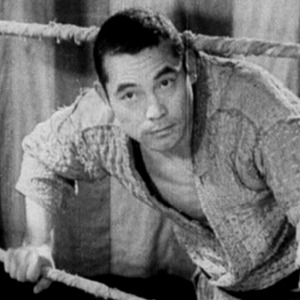
Following the "Manchurian Incident" (this occurred in 1931), Japan invades Manchuria on the false premise of securing the incident after a bombing (arranged by the Japanese military). Students at Kyoto University protest the invasion (a combination of Kurosawa's re-staging and newsreel footage). The teacher who has influenced the students, Professor Yagihara (Denjiro Okochi) is dismissed by the University's board for his leftist views. His daughter Yukie (Setsuko Hara), and aspiring pianist is being courted by two students, Noge (Susumu Fujita) one of the more ardent protesters, and Itokawa (Akitake Kôno), who is more conventional in his thinking.

The two students vie for Yukie's attention, but is becomes clear that, of the two, she is more attracted to the more passionate Noge. For practical reasons, that may seem a poor choice, for Noge soon disappears, his whereabouts unknown, but the truth is he has been arrested and thrown in jail for his part in the student protests. Yukie, however, never knows this until Itokawa tells her a year after his release from prison. It has been five years since she has seen him. The next time they are in the same room together, it is at a dinner at her father's house, organized by Itokawa, who has become a government prosecutor and who arranged for Noge's early release after vouching for his character...and something else.

The dinner does not go well. Professor Yagihara mentions that Noge would not have been released (even on Itokawa's say-so) if he hadn't renounced his earlier activity, and Noge admits that, yes, he has changed from his student days. He is no longer the fiery radical that he once was. Yukie is upset hearing this, and runs to her room, feeling the man she has loved has betrayed his principles. She only comes out again when Madame Yagihara tells her the two men are leaving and that Noge is travelling to China.

Yukie decides to move to Tokyo, where she makes a living doing menial jobs. Running into Itokawa, she hears that Noge has now moved to Tokyo and she goes to confront him, and they begin an affair that culminates in marriage. But, Noge is circumspect with her about his outside activities apart from work, and things come to a head when he is arrested by the Japanese government for spying. Yukie, herself, is arrested and interrogated but Itokawa intervenes and has her freed. Professor Yagihara travels to Tokyo to represent Noge in court, but he arrives too late; Noge has died in prison, and when Yukie is presented his ashes, she is determined to bring them to his parents.

Her reception there is not welcoming. Noge's parents, who are poor farmers, are elderly and are being shunned by their community for Noge's actions as a spy. They suspect Yukie of harboring the same prejudices, but are only convinced of her good intentions when she volunteers to plant their rice, which the father is unwilling to do, fearing a backlash from the community.

Indeed, once they've completed the back-breaking work of planting, the village , under the cover of night, destroy their work. But Yukie is defiant, determined to save the family and prove her worth to her husband's memory, his family and the community at large. It is only then that Yukie is accepted by Noge's parents, and when she is visited by Itokawa, she tells him that she will not go back to Kyoto. Her home is there, and she sends him away, telling him to never come back.

"Sacrifices must be made in the struggle for freedom." No Regrets for Our Youth  was Kurosawa's first film made completely after the second world war, with Japan under occupation by the United States. At this point, he had a bit freer reign over his subject matter than he did while being watched by the Imperial powers. He could give vent to some political talk (but not too much), and his his simple love story of devotion to higher truths and uncomplicated dedication to uncompromised decency holds true to his earlier "Sanshiro" films, but in a way far more relatable to his audience than stories about martial arts masters. No regrets speaks to every person in its desire to live with no regrets and the basic theme of it haunts: "No regrets for my life. No regrets for anything."



Wednesday, April 15, 2015

Walking Kurosawa's Road: Sanshiro Sugata, Part 2

The inability to write about the films of Akira Kurosawa to my satisfaction led me to to take a different path: start at the beginning, take each film in sequence, one after the other, and watch the progression of the man from film-maker to Master.   I'm hoping I can write more intelligently and more knowledgeably about his work by, step by step, Walking Kurosawa's Road.

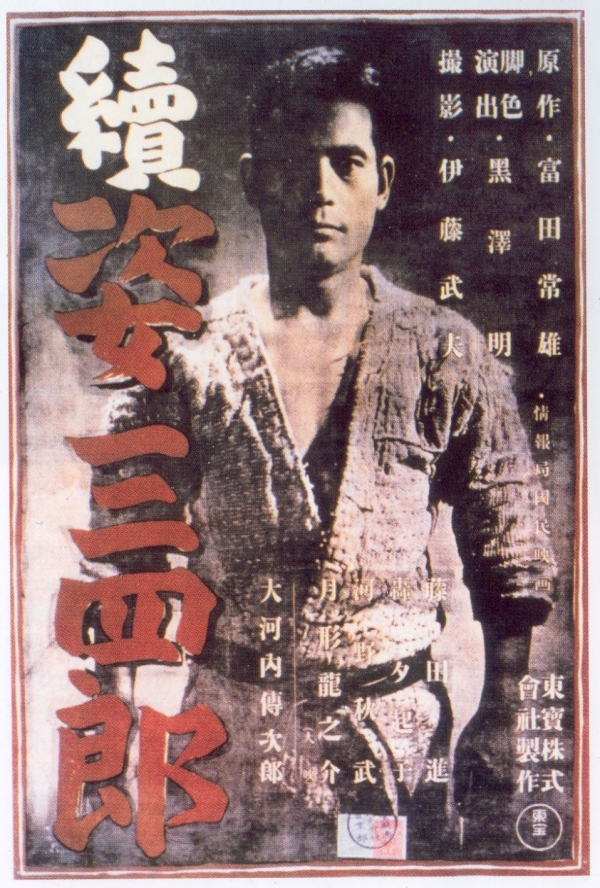
Sanshiro Sugata Part 2 (Akira Kurosawa, 1945) Any director thinking that "they don't do sequels," should bear in mind that Kurosawa did one...with only his third feature film. Before embarking on his next project, the soon-to-be Japanese Master was pressed by his financiers to follow up his popular judo film with a continuation of the story, following the path of Sanshiro, now two years in self-imposed exile, having abandoned his position as Judo champion.

Things have changed, but he hasn't. The city he comes back to is now under occupation, and the disciplines that Sanshiro struggled so mightily to learn, seem to have little significance in this new atmosphere.

Returning home, his acclaim is widespread, but he's dissatisfied. A promoter tries to entice him into participating in a match with an American heavyweight champion for money, something that is both against the rules of Sanshiro's dojo and his own hard-fought-for beliefs. He attends, however, and is disgusted when the martial artist roped into the match is summarily pummeled before the crowd of blood-thirsty Americans and Japanese.

Things had changed for Japan, as well. Defeated in World War II, and occupied by the United States, the country that Kurosawa made the sequel in was far different from the one in which he'd made the original. And one can tell by the very first sequence that he bristled at it (despite the fact that the first film, made during the war, was chopped up by Japan's ministry, to the point where no original print exists). Imagine my shock when the first words heard in this film are in English.  They come from a belligerent American sailor hectoring, then threatening his rickshaw-driver—the abuse comes in a different language, but the opening is parallel to the situation in the first film, only now it's Sanshiro who comes to the aid of the driver, in the position (flat on his back) that he was in at the beginning of the first film, before his transformation.
He retreats to his Master's dojo, but sinks into a deep depression while, simultaneously, training that young rickshaw driver he'd earlier saved. His disciplines start to fall away, as he begins to drink, his fortunes falling as his young student's rises. The dojo provides no respite and relief—he is challenged to a fight by a tag-team of brothers, the Higaki's (also brothers to Gennosuki Higaki, the previous film's final combatant), one extremely aggressive and the other, deeply insane, to exact revenge on their fallen kin. He also reunites (discretely) with the woman who loves him, and with Gennosuki, who is now in ill health and seeks a reconciliation before he dies, a far cry from his brothers' path of vengeance.
The battles Sanshiro must fight—and avoids fighting—are much like the battles raging in his own mind. With his fame, and abilities still intact, he is caught in a dilemma of purpose—should he fight with the stakes becoming decreasingly honorable? And how long can he maintain his reputation while avoiding confrontation (and does he even want that reputation—with its incumbent honor—anymore, given how cheaply and shallow the value others impose on it are?). Is his reputation worth it in such a world? And will the matches with his own demons (represented by the brothers) keep him from maintaining his own "wa?" 

It's a universal problem negotiating the minefields, internal and external, that dot our lives. But, there's something else going on here, given the context and the environment in which Kurosawa made this film. This was his first post-war film after the Japanese surrender (Kurosawa paused in the filming of The Men Who Tread on the Tiger's Tail in order to listen to Emperor Hirohito's "Gyokuon-hōsō") and for the nation this was a crushing, demoralizing defeat, especially given the fervor that the government had invested in its people.
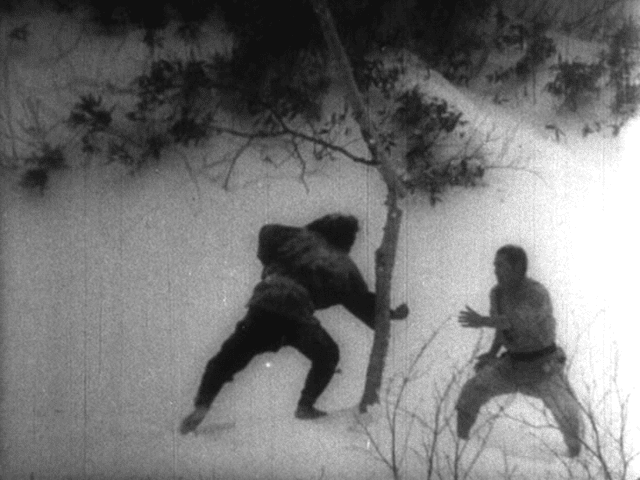
How does a nation, especially one so steeped in tradition and pride, endure after such a concession? Kurosawa encapsulates the answer in the fighting brothers who have challenged Sanshiro, one incapacitated by an epileptic "spell," the other who fights the master on a hilltop—not of frantic wind-swept grass as the first film—but a precipice blasted by snow. After a long struggle, where Sanshiro is mostly passively defensive, the revenge seeking Higaki is defeated and sent tumbling down the hill. He is saved and tended to by Sanshiro, while under the baleful watch of the younger Higaki brother, who in a moment of clarity, understands Sanshiro's purpose and responds to his brother's lament with the same words...and a beaming smile.
The influence of the good, the dedicated, the humble, and the charitable perseveres in this world of defeat and cynicism. One could take the position for seeking revenge, but how much better it is to have grace—not curling up and dying, of course—and follow the better path, as this most popular of Japanese heroes, demonstrates.

This may be the greatest sequel in all of film. But more than that, it is a gift from an up-and-coming master filmmaker to his nation, at its most desperate hour, in gratitude for the opportunities he had been given, and providing balm, solace, and wisdom, to go on. It is an amazing film, inside of itself, and outside in the world in which it was made.