Showing posts with label Aaron Sorkin. Show all posts

Wednesday, February 21, 2024

The Social Network

Written at the time of the film's release...(although, here, outdated links have been deleted and more relevant ones have been inserted...and then, I'll post the thing on "Facebook"...which is so "Meta")

"Saving Facebook" ("Every Creation-Myth Needs a Devil")
or
"There's Somethin' Happenin' Here (What It Is Ain't Exactly Clear)"

"O wonder!
How many goodly creatures are there here!
How beautious mankind is!
O brave new world,
That has such people in't!" (The Tempest, Act V, Scene 1)


Maybe it is too early to make a movie about Facebook (out of MySpace and Friendster) and the ramifications of our Brave New World of cyber-relationships. Maybe it is a little too "street-corner sage" to predict The End of the World As We are Sorta Familiar With it (But Not Really...More Acquaintances, Really). But, it is interesting to see a story about the Frankenstein behind the Monster, if only to see how each reflects the other.

And even though we're secretly rooting for The Monster.
And, at this point in time, there isn't a better team to make
The Social Network
than Aaron Sorkin and David Fincher. Sorkin, the mad savant behind some of the better TV shows of the past decade and a half, has always written about people and their "issues," and how personality impacts policy. Fincher has matured from an ILM tech (who was happy to fly cameras through coffee-maker grips**) to an intricate observer of societal pressures on the psyche. For the two of them to make this particular story is a Friend Invitation made in Hollywood Heaven.  "Accept" it. But, you can't "Ignore" it.
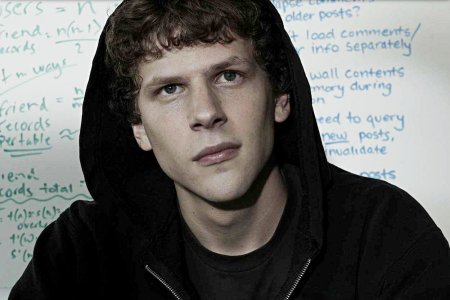
The movie begins with a date going badly between Mark Zuckerberg (Jesse Eisenberg, late of many movies with "...land" in the title) Harvard wall-flower, and Erica Albright (Rooney Mara—she'll play Lisbeth Salander opposite Daniel Craig in Fincher's big-budget version of The Girl with the Dragon Tattoo), an acquaintance. Anyone familiar with the machine-gun dialogue that writer Sorkin is known for, had better duck for cover—or wait for this on DVD so you can...play...it...slooooowly—for he now has an automatic weapon for a word-processor, and a co-conspirator in Eisenberg who can milk every nuance out of a line, despite hyperventilating it at debate-competition speed. His Zuckerberg is a "no Dolby/no squelch" type of unreadable conscience, and Eisenberg plays it with a deadness behind the eyes that interprets the world as a problem, if not necessarily a challenge. He's a bit too candid for a first date, and she stomps off, which sends him on a mission, simultaneously trashing her on his blog (LiveJournal) and culling the pictures of every woman on campus to create a "Who's Hotter" web-competition that becomes so popular so instantly that it crashes Harvard's web-infrastructure.
He becomes both famous and infamous for the stunt,
guaranteeing he'll never get a date in college, and attracting the wrath of the college's board, and the interest of two preppies attempting to create an exclusionary social network on the web. He goes them several steps better, making a system open to everyone on campus that trumps their attempts, and as it gains "friends," expands throughout the college system.
Hindsight is 20/20, and Sorkin constructs the film as a series of depositions after the fact (of Facebook's success) as everyone who thinks they've been burned by Zuckerberg testifies to his vague promises and dealings under the table.*** Of course, they have every right to sue—but they'd only sue if "The Facebook" was a success—and the underpinnings and double-dealings don't resemble a fight for satisfaction, or a Noble Quest, so much as resembling a snake eating its own tail. ****
Which brings us back to Frankenstein and his Monster. The film itself is expertly done—it is a complicated story of hidden motivations and the presentation of masks before public faces—
and Sorkin and Fincher manage to navigate us through the maze of the story, even though one feels there is no cheese at the end. The experience is a bit hollow, which may be a part of the point.
Because the Facebook experience is hollow, as well.
As hollow as Zuckerberg, as portrayed in this film, is. While it is nice that one has the opportunity to "re-connect" with old friends in a virtual environment and satisfy everyone's need to (as one friend commented on blogging) "talk about what you had for lunch," one wonders why one has to re-connect at all...especially if the relationship wasn't maintained in the first place. Not enough time in the world to meet? Because a "real" relationship takes time, takes effort, "gets messy?" Facebook provides the illusion of "staying in touch," without actually touching. Like Zuckerberg's abortive "date," a lot of time is spent broadcasting, but not interacting.
There are, of course, exceptions. But the fact of the matter is Facebook's cyber-community is not a "Brave New World" at all. Just the opposite. It provides a substitute in lieu of commitment. A panacea in a life thought to be full to bursting and without risk. The most precious commodity we can give is time—slices of our lives and our selves. Facebook is a pacifier—a mass-Hallmark card that we can spend a few heart-beats picking out, and send away without a thought and not even sweat the cost of a stamp.

It soon becomes a numbers game—a collection, like the celebration of the 1,000,000th friend portrayed in the film. But who are those million people?  Facebook doesn't know or care. It's just a number. A number of casual relationships, that may lead to something else, but probably won't. A collection, nice to look at, but more often, ignored. Trophies, and ones that don't need to be polished or buffed up.

It's a new world of blithely arrested development, in the image of its creator, where love and commitment do not compute, and the only thing close to it is "hope"—translatable as keystroke F5.

* Except for some dodgy freezing breath-work, the biggest special effect will be invisible to you until the closing credits.  Nice.

** Personally, I'd like to get back all those hours spent on "ZooWorld."

*** An image that kept coming to mind every time I thought of writing this review, where it would subsequently be published...on B/C-L's's Facebook page.

Thursday, December 16, 2021

Being the Ricardos

The
Red-Headed Scare (It's All True)

or
Looo-cy, You Got Some Sorkin' To Do
 
I had a Lucy Ricardo reaction to this project first coming to mind: curling my lip to show all my teeth and going "Ewwww." Even though Being the Ricardos is helmed by Aaron Sorkin, Sorkin, as he's demonstrated, isn't the most effective when delivering comedy material—drama with humor and irony, sure. But comedy? C'mon, I watched the entire run of "Studio 60 on the Sunset Strip." I may have been the only one.
 
Lucy's been on a lot of people's minds lately: TCM had a month of Lucy movies last month in conjunction with their "highlights" podcast about her life. This movie covers a bit of what that covered, but squeezes it all in within the space of one week of production of the "I Love Lucy" show, those issues being Desi's affairs, Lucy being pregnant just ahead of shooting a season's worth of shows, and the disclosure—on Walter Winchell's radio broadcast—that Lucy (coded as "America's favorite TV comedienne") was a communist.*
 
All true. Desi was sneaking out on Lucy. Lucy did become pregnant while shooting a season and, despite resistance from CBS, sponsors Westinghouse, and Phillip Morris, and incorporated Lucy's pregnancy into the story-line—a first (one of many) that distinguished "I Love Lucy" from the stone age of television. And Lucy was a communist, but not a practicing one. She had checked "communist" on a voter registration card in 1936, at the behest of her beloved grandfather Fred Hunt, who raised Lucy and her brother in their childhood.
It's also true that Ball and Arnaz were better together than they were apart. Both were quick-witted dedicated hard-workers with gambler's instincts and business savvy. Together, they bought the old RKO studios (which years before had released Lucy from her contract), created the 3-camera technique for documenting TV shows—which made better clarity, guaranteed delivery, and allowed episodes to re-run—clobbered television taboos, Desi gave the green-light to "The Untouchables" (narrated by Winchell, ironically) and Lucy said yes to production of TV's "Mission: Impossible" and "Star Trek." At one point, the greatest assets for Westinghouse and Phillip Morris...and CBS. They had a lot of power, but it was all power that could be taken away, if they didn't deliver. the goods.
Aaron Sorkin knows his way around television—he's made three TV series ABOUT television ("Sports Night," the afore-mentioned "Studio 60" and "The Newsroom") and the backstage turmoil involved in filling up broadcast time on a regular consistent basis. It is a meat-grinder, and anybody wanting to cut corners to make it a little easier, risks the wrath of millions of viewers. Desi-Lucy knew that. And so does Sorkin. He also knows what it's like to produce a carefully scrutinized show while your life is falling apart. Even when things are going well, personalities and egos have to be considered and worked around, editing and second-guessing happen constantly, interference from outside sources need to be batted out to the foul-zone and sometimes the drama off-stage is more intricate—and better—than the one on-stage.
Sorkin segments the film into a television work-week: Monday-"Table Reading; Tuesday—"Blocking Rehearsal"; Wednesday-"Camera Blocking"; Thursday-"Dress Rehearsal"; Friday—"Show Night". Those are the steps for the actors and technical crew to take from the first reading of the script on Day 1. Things get changed, problems get discussed, it's staged, and how it's going to be recorded is worked out, then the final touches and intricacies before the final day when it's presented before an audience. A 25 minute play produced each week, and the audience has to be "warmed up" that it's going to be a good time and they're free to enjoy themselves.They see the fun parts. They don't see the work. 
They also see the parts being played. They do not see the actors. Which brings us to casting. Cate Blanchett was first cast but dropped out. Nicole Kidman got the "Lucille Ball" part and Javier Bardem the "Desi Arnaz" part. J.K. Simmons plays William Frawley, and Nina Ariadna plays Vivian Vance. And they work. Some may grouse that Kidman doesn't look like Lucille Ball, but then we didn't see Lucille Ball, we saw "Lucy Ricardo." Lucille Ball was a tough business woman, who knew that time was a commodity and shouldn't be wasted by niceties—there was work to be done. Kidman gets that. Yeah, she can do the schtick, exploding the blue eyes and pitching the voice to screech-mode to play "Lucy"—but she spends most of her time as the intense, driven actress with a cigarette-growl and is very serious about comedy...and character. "Lucy Ricardo" didn't just happen, she was created, given what Lucille knew about getting attention and laughs. And like the silent comedians, she worried about timing and earning guffaws without doing it cheaply. It's an interpretation, not an imitation and it works. The voice is phenomenal.
Bardem doesn't have the boyish good looks of Desi Arnaz, but he's all over the charm and the drive...his scenes with Kidman are played like an old movie with too-perfect lines and better timing. And he's pretty good doing the songs. J.K. Simmons is a delight as Bill Frawley, with the rasp but not the girth, full of cranky jibes, belying a worldly wisdom (Sorkin writes a lovely line when he invites Lucy to a bar for a drink during a fraught work-day. "It's 10 am!" "Well, it's always 10:15 somewhere!") and Ariadna's Vivian Vance is a frustrated actress, worried that she'll be typecast frumpily, playing a woman "married to my grandfather."
But, Sorkin pays particular attention to the writers of "I Love Lucy" with actors portraying them at the time of the show's creation and with "witness testimony" of the same people older trying to set the record straight: Executive producer Jess Oppenheimer (played by Tony Hale and John Rubenstein), Bob Carroll (played by Jake Lacey and Ronny Cox) and Madelyn Pugh (played by Alia Shawkat and Linda Lavin!). Being a writer himself, Sorkin gives them the roles of experts, the elder versions smoothing over the inevitable pecking battles we see occurring in a bull-pen during the earlier scenes.

And—like a good sit-com—it all gets resolved in the end. Well, almost resolved. And, while it's true that Desi (in his usual role warming up the audience) did talk to the waiting crowd about the communist accusations, but he did not use the gambit Sorkin employs—although it is true that Arnaz knew the person mentioned, having met him at the race-track. Instead, Cuban-American Arnaz merely reminded the crowd that they were all Americans, and that, in this country, the accused are innocent until proven guilty. He merely appealed to their better natures. I kind of like the truth better. And Lucy was greeted, when introduced, to thunderous applause. But, Sorkin leaves out what happened after the taping: she went back to the crowd—something she never did—and said "God bless you for being so kind," then went to her dressing room and broke down.
 
Tough but not invulnerable.
Instead, Sorkin leaves us with one last enigmatic image. The crises have been averted. "I Love Lucy" goes on and no is being fired or losing their job. Sorkin shows the continuity after near-disaster, and the show going on, the actors on set, and the camera slowly moves up into the stage-lights looking down on the activity, until it hovers above the beams and bracers forming a television shaped screen around the scene below. What's he saying? Are they trapped? Is this a ploy showing the
metaphoric similarity of the Arnazes to the Ricardo's?—because if it is, it doesn't work. What's the gist here? Maybe it'll come to me, but it sure doesn't communicate.
 
And it ends with television static. I only say this because it will cause confusion when it starts streaming on monitors December 21. Do not adjust your sets.   

* I love Desi's resulting line: "maybe they're talking about Imogene Coca..."

Thursday, January 21, 2021

The Trial of the Chicago 7

"'Fictionalizing History and Sorkin It Out"
 or
"Give Me a Moment, Would You, My Friend? I've Never Been On Trial For My Thoughts Before" ("It's a Revolution. We May Have to Hurt Some Feelings")

The Trial of the Chicago 7 has been in the works since somewhere around 2006 when Aaron Sorkin was introduced to the idea of writing it by Steven Spielberg, who wanted to make it as a directing project. Seemed like a good fit; Sorkin is the "dean" of writing compelling court-room dramas and has a knack for putting emotional juice into "wonk" arguments. That work results in some rapturous writing, even if one feels like opposing arguments are given short shrift for the "slam-dunk" moment. With him, it's a—you know—"a thing"

One wonders what Spielberg would have done with it. One knows it would have been a much more precise directing exercise. One hopes that Spielberg might have taken the script and roughed if up a little, textured it with a bit more grit, and thus friction, and thrown in some ambivalence to make the thing more of a courtroom "shit-show" (as it was) than anything too neat and tidy. Maybe an "anti-polish" of the script by the Coen Brothers could do that.

Because the way Sorkin tells it, it's all very neat and tidy with a wildly "boo-yah" finish, where the defendants are convicted on one of the charges—to incite a riot (rather ironic post-01/06/2021)—but their post-conviction statement is such a rousingly heart-felt protest that the crowd in the court-room (and even the prosecution!) gets up to applaud in solidarity.

In a word..."Nah!"

To be fair, trying to organize the ramshackle case number 69 Cr 180 The United States v. David Dellinger et al. into a coherent timeline of pertinent facts that has "a wow finish" is an almost impossible task. Yes, the case was a slap-dash collecting of "usual suspects" at the behest of the Nixon Administration, so that a consistent charge was specious at best. Yes, the trial went on despite one of the defendants not having the benefit of counsel. And, yes, that defendant ended up being bound and gagged for a good section of the trial. Yes, Judge Julius Hoffman was out of his depth trying to juggle the cats involved, ending up charging 175 combined contempt charges among the defendants and their lawyers, indicating not so much that there were violations, but rather that the judge had no control over his court.
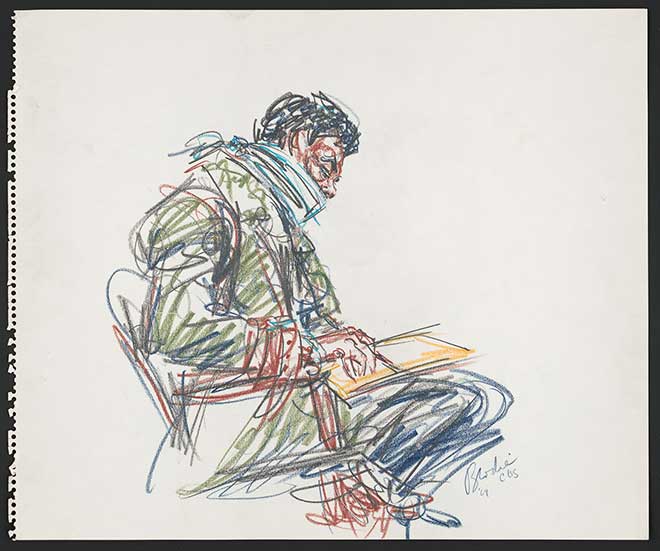
What actually happened, you can find here and here. There are so many feints, fibs, and sleights of hand in Sorkin's "portrait" (rather than "a picture" he's said about the script, something he also said about his script for Steve Jobs) that I could write the rest of the review going over them. But, they're well-documented (the least of which is that there were eight defendants counting Bobby Seale, not seven—the man was only in Chicago to give a speech, but he was lumped in with the others because putting a Black Panther on trial was "good optics" for a cynical Department of Justice, until the optics turned horrifying).
It is a "given" that, unless someone is making a documentary, film-makers will swerve away from the facts (and even documentary film-makers will cherry-pick from their sources). No one was there in the room taking down notes for dialog (although, in this case, Sorkin did have the trial transcripts), so we don't know what was said behind closed doors. There's a writer's term/cop-out for making things up: "Writing to Silence," because there is no one around to object.
Except, of course, the audience.

What is the creator's responsibility—to the audience or to truth? Tough question. It should be kept in mind by any discerning audience member that when the line "Based on a True Story" appears that it is a hedge against accuracy: the actual Perdicaris taken hostage in The Wind and the Lion was a man, not a plucky widow, and we don't know what Neil Armstrong was doing by that moon crater, even though First Man has him completing an emotional story point in the film. It might be some dramatic license to make a better story, to tie up a dramatic loose end. Or, changing the facts might be some cathartic wish-fulfilment as Quentin Tarantino provided in Inglourious Basterds or Once Upon a Time in Hollywood.
John Ford famously used the sentiment "when the legend becomes fact, print the legend" even as, in his later films, he sought to negate it.

Sorkin is not above re-writing history for the perfect dramatic punch-line...he did it quite a bit in "The Newsroom," blending real-life events with a parallel universe news organization. And one can't forget the point in A Few Good Men when he ginned up false drama by making Tom Cruise's defense attorney appear unsure and faltering before delivering his final gavel blow. It makes no sense, other than to show his protagonist at his lowest point before his turn-around to triumph. He "had" to get one more dramatic beat in to make the ending suitably triumphant. Audience manipulation. Nothing more.

But, now—after this particular Inauguration Day—perhaps we should reflect on the responsibilities to Truth. Even if it makes the side you favor look bad...or less righteous. False narratives and wishful, even magical, thinking does not make it so. Rhetoric is the art of persuasion, but that art has to stand on the fundamentals of truth. Not just how we want the truth to be. No matter who's side you're on.
Well! "Other than that, how was the play, Mrs. Lincoln?"

Sorkin does a good job mixing in contextural news footage (and some of Haskell Wexler's footage from Medium Cool) from the times, with his DP Phedon Papamichael. Given the amount of material he has to cull from, Sorkin, as both writer and director manages to keep the personalities he's interested in—that is anybody except John Froines and Lee Weiner, who are given short shrift—engaged and sparring. Acting stand-outs negotiating the dialogue are Eddie Redmayne's Tom Hayden and Mark Rylance's William Kuntsler (Jeremy Strong's Jerry Rubin is a bit of a buffoon, unfortunately). But, the stand-out is Sacha Baron Cohen's Abbie Hoffman, not so much in how good he is portraying the trial's Merry Prankster, but in how good he is in the dramatic scenes, when the veneer drops and the words become measured and sharp as a knife.

Tuesday, June 2, 2020

A Few Good Men

A Few Good Men (Rob Reiner, 1992) This a time before "The West Wing." It was before "JAG." It was before anybody knew about Aaron Sorkin and the tropes of his writing. It was the third play that Sorkin wrote and his first big success, sold to producer David Brown for an amount "well into six figures" and a tenure as a writer-for-hire at Castle Rock Entertainment—he would work on the screenplay for A Few Good Men, Malice, and The American President.

But, A Few Good Men was the first one that launched the Sorkin brand. Based on a true incident (told to him by his JAG-sister Deborah) about a near-fatal hazing incident at Guantanamo Bay, the script is both a detective story and a story of personalities under pressure. It was turned down by Tri-Star Pictures for lack of star interest, but that all changed when Reiner, one of Castle Rock's founders, expressed interest in directing it.
Lieutenant Commander Joanne Galloway (Demi Moore), a lawyer of the NIS has been following up a complaint by PFC William Santiago about an incident at Guantano Bay, Cuba, but Santiago has turned up dead—supposedly at the hands of the subject of the complaint, Lance Corporal Harold Dawson (Wolfgang Bodison) and PFC Louden Downey (James Marshall). But, Galloway looks into the two's records, and finds them spotless and begins to suspect some foul-play. 
Dawson and Downey are transferred to a Washington D.C. prison for subsequent trial and Galloway requests the case, but it is assigned to Lieutenant JG Daniel Kaffee (Tom Cruise) a Navy JAG lawyer who has never litigated a case, preferring to plea deal, instead—that may be because he's a bit of a flake, but also because his father was considered a great trial lawyer and that reputation sets a very high bar. Galloway, despite reservations signs on as Dawson's lawyer and Kaffee picks Lt. Sam Weinberg (Kevin Pollak) as legal advisor.  
Galloway is convinced that Santiago died as a result of a "Code Red," an internal disciplinary action not sanctioned by the military, a "hazing" of sorts to put peer pressure on a soldier not meeting expectations. The team begin investigations: Kaffee meets with the defendants and finds them good soldiers, but Dawson's attitude towards Kaffee holds a slight contempt for Kaffee being a less than spit-and-polish officer; the defense team gets the go-ahead to fly to Guantanamo where they meet with base commander Colonel Jessup (Jack Nicholson), executive officer Lt. Col. Markinson (J. T. Walsh) and Lt. Kendrick (Keifer Sutherland), Santiago's commanding officer. In the interview. Jessup denies ordering a "Code Red" (even though he does see it as a means of strengthening the ranks), but did approve Santiago's leaving the base "for his own safety" once the report to the NIS was made. The meeting is cordial by flinty.
The matter is complicated by Jessup's regard in the military—he is in line to take an important position with the National Security Council, and there's more than a whiff of evidence to suggest that Kaffee was picked to head the team for his proclivity for plea deals, thus ensuring that the matter never makes it to trial. Indeed, Kaffee brings up the matter with Dawson as prosecutor Jack Ross (Kevin Bacon), knowing Kaffee's inclinations, has made an offer of six months in prison for the pair along with dishonorable discharges. Dawson refuses the offer as cowardly—he was following orders—refusing to salute Kaffee when their meeting concludes.
Knowing he is not playing his strengths, Kaffee tries to resign from the case, but is convinced to go through with the case. At the grand jury hearing, Kaffee offers a plea of nor guilty, setting up a formal trial for which he is ill-prepared while the minutiae of details pile up and Markinson—Jessup's executive officer—goes missing. It becomes clear that—as Kaffee sums up—"We're going to get creamed, aren't we?" and he's going to have to do battle with well-ordered, disciplined—and colluding—witnesses. The participants and the atmosphere are hostile.
A Few Good Men—and Reiner—benefit from a cracker-jack cast, many working outside of their comfort zone. Reiner, with a solid script and a solid cast, seems to up his game and, benefiting the military formalism, demonstrates a disciplined directing style, more than displayed in the restrictive courtroom scenes where the drama intensifies into shouting matches and acting fireworks, particularly between Nicholson and Cruise—Jessup's testimony, which is the fulcrum and climax of the story; the only false note is the series of shots that suggests Kaffee doesn't know what he's doing and doesn't have the evidence needed to goad Jessup into a confession (of course he does and it's false drama to suggest he doesn't). 
Nicholson is 100% on point—even sitting in a witness chair and shot from his chest-medals up. Cruise, on the other hand, was going through his "awkward phase"; he quickly became a star in Risky Business, but his next few years he spent trying to prove himself as an actor, frequently overdoing the histrionics, like a high jumper trying not just to clear the bar, but set records.* 
And it's funny:  A Few Good Men is famous for that "You Can't Handle the Truth" scene with its fiery speeches and dagger-projecting looks. It's good stuff. So good that Jessup's speech defending his actions frequently turns up as inspirational memes. The words may inspire. But, Jessup is a flawed human being and a flawed commander, because simmering under the speeches is an overriding arrogance. 

It's actions, not words that define character. Military leaders lead by example, lest their orders be seen as empty directives. While thinking of this film, John Ford's Cavalry Trilogy burbled up in me memory—particularly his 1948 film, Fort Apache and 1950's Rio Grande—and the character of Captain Kirby York (played by John Wayne in both films), who, in the first film is passed over for the command of a frontier fort by an arrogant commander (played by Henry Fonda), who is subsequently killed in a massacre by his own foolhardiness and rigidity. For the good of the Cavalry and "the Corps," York defends the man whom he had disagreements with, and in the second film, York—now in the position of leadership—is in danger of becoming the very same type of martinet commander played by Fonda in the earlier film. That conflict forms the emotional spine, and the qualities of character and leadership were very much a consideration of Ford, who struggled with those same issues in his own life as a commanding director on-set.

What makes A Few Good Men an interesting exercise is that Cruise's Kaffee can be accused of the exact same flaw of arrogance. That the two should lock horns makes for compelling drama and makes the film just a bit more mature than a cursory look would reveal.


* When I did a "Don't Make a Scene" of the Jessup—"You can't handle the truth!"—testimony, it was rough going: I could always find a frame where Nicholson looked great, but Cruise—trying to act up a storm—frequently was caught looking a bit silly. I poured over his shots frame by frame trying to present him at his best—I think I accomplished it—but, the asides and mugging (which might be effective on the screen) was, when frozen, looked like he was preparing to get to his good part without actually getting there. He's calmed down quite a bit—even if he's now constantly in motion hanging onto the sides of airplanes and being batted around on wires—but his tendency to over-do was a real issue for years. The thing is that star-making turn in Risky Business showed just how good an actor—and charismatic a star—he is.

Sunday, June 16, 2019

Don't Make a Scene: Molly's Game

The Story: Happy Father's Day, btw

Here's another one of those scenes that you see go by on the screen and you instantly know it's a classic.* It's from Molly's Game, which was one of the films I found exceptional in 2016. Too few people have seen it.

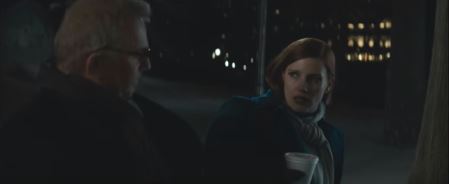
In this scene, the character of Molly Bloom, "The Poker Princess," (played by Jessica Chastain) facing federal charges, has a near meltdown before her trial begins, and, who should show up? Her estranged father (played by Kevin Costner), who made her push her through the pain when she was competing in skiing competitions when she was just a kid. Now, he's doing it again.

Great. Thanks, Dad.

But, it's a great scene, full of volatility, snarky humor, hubris and self-deprecation, and the familial contempt allowed between family members that would never pass with total strangers or mere acquaintances. It is battle, with defenses full-up and going for the jugular with the sharpest of barbs. It is sparring between opponents who know each other only too well (and where there's no place to hide) and, in fact, had hands in creating the other.

It's also about truth and bullshit.

And so much of Molly's Game is about bullshit, which is a tool in the craft of poker. Bluffing is bullshit, and the use of power over reality. Because the truth is laying the cards on the table. Everything up to that point is calculation, maneuvering, and play-acting. Subterfuge. Psychology. Reality is determined by the clubs, the spades, the diamonds...and the heart. And what you can show.

It's also a great display of acting between Chastain and Costner—he has a grand time chewing on Sorkin's dialog and tossing it away—who take a scene of bitterly sarcastic jousting and still earn its sentiment at the end.

Really, it's fine.

The Set-Up: Molly Bloom (Jessica Chastain) is a former Olympic skier whose career ended due to a freak accident during a competition. She decides to take a break after recovering rather than going to law school. Happenstance and talent leads her to running an underground high-stakes poker racket for ten years, an activity that has attracted the interest of the FBI, who have indicted her on federal racketeering charges. Her trial is about to begin and so she goes skating. Her long-absent father (Kevin Costner) shows up in the nick of time...at 30 Rock at the skating rink.

Action!

As the RINK EMPLOYEES continue to skate MOLLY off the ice like a prisoner, her father asks simply-- 

FATHER How’s it goin’? 

EXT. BENCH NEAR THE RINK - A FEW MOMENTS LATER 

MOLLY’s father puts her coat over her as she sits on the bench.
MOLLY  What are you doing in New York and how did you know I was at the skating rink?  
FATHER I’m both your father and a doctor of the mind. 
MOLLY Hah. Dad.
FATHER I’m in New York because that’s where you are and I called your mom at the hotel and she said you were here. 
FATHER Listen, it’s not a big deal but from what I saw out there I think you’re having a small breakdown.

MOLLY That's weird. I can't think of why. 
FATHER Probably because of the arrest and not knowing what's going to happen next. 
MOLLY Old man, do you really not recognize sarcasm? 
FATHER Do you? 
FATHER Here, drink this.
He hands her a Styrofoam cup.  
MOLLY I'm an alcoholic, I can't drink but thanks for remembering. 
FATHER It's hot chocolate. 
MOLLY Okay. 
FATHER And for diagnostic purposes, do you think that we're on a cocktail lounge right now? 
FATHER You seeing waiters with trays of champagne? 
FATHER I want to check your pulse.
He takes her wrist and looks at his watch. 
MOLLY Have you found a pulse? 
FATHER Yeah, 
FATHER ...just admiring my watch. 
MOLLY I can see you're getting warmed up but I really don't have the emotional bandwidth to defend my "as usual irresponsible behavior." 
FATHER I know, I got your e-mail. I get that I'm not welcome in your life right now...
FATHER ...as your father though you should know I could give a shit if I'm welcome or not. But I'm not here in my capacity as your father. 
FATHER I'm indifferent to whether your father lives or dies. 
FATHER  I'm a very expensive therapist and I'm here to give you one free session.
MOLLY You think what I need right now is a therapist? 
FATHER Yeah. 
MOLLY I have to be back at my lawyer's office soon. 
FATHER Do you like your lawyer? 
MOLLY I wasn't asking for money when I called you, Dad. I just needed my dad. 
MOLLY God forbid you part with a nickel. 
FATHER Yeah, Tiny Tim, you grew up on a lake and you've skied all over the world,
FATHER ...were those work houses tough? 
MOLLY I gotta go. 
FATHER -Molly. 
MOLLY -I gotta go. 
FATHER Molly, sit the fuck down! 
MOLLY does as she’s told. There’s a long silence before...
FATHER All right, we're gonna do three years of therapy in three minutes. 
MOLLY How? 
FATHER I'm gonna do what patients have been begging therapists to do... 
FATHER ...for a hundred years, I'm just gonna give you the answers. 
MOLLY To what? 
FATHER Well, let's start with this. Why does a young woman who, at 22, has a gold-plated resume, why does she run poker games? 
MOLLY Why did I choose to make a ton of money? That's a head scratcher. 
FATHER You were gonna be a success at anything you wanted, 
FATHER ...you know it. If you'd gone to law school you'd have owned the law firm right now. Why did you do the other thing instead? 
MOLLY I don't know. Drugs.
Her father waves that off-- 
FATHER You didn't start with the drugs until the end. They weren't the problem, they were the medicine. 
FATHER It was so you could control powerful men. 
FATHER Your addiction was having power over powerful men. 
MOLLY Is that what you really think? 
FATHER No. I know it for sure. 
FATHER You've now completed your first year of therapy. 
MOLLY I saw an opportunity, it wasn't about you. 
FATHER Nah, it wasn't just about me. 
MOLLY It wasn't at all about you. 
FATHER -It was. 
FATHER Second year, second question. 
MOLLY Do you think you were a good husband? 
FATHER What do you care? 
MOLLY I care because you were married to my mother. 
MOLLY I care because my father's an asshole. 
FATHER Congratulations, you've completed...
FATHER ...Year Two. And for the record, your father raised three kids on a college professor's salary. 

FATHER One of them is a two-time Olympian, a sixth round draft pick of the... 
FATHER ...Philadelphia Eagles and a leading philanthropist. 
FATHER The other is a cardiothorasic surgeon at Mass General... 
FATHER ...and the third managed to build a multi-million dollar business using not much more than her wits. 
MOLLY I'm about to plead guilty in federal court. 
FATHER Well, nobody's perfect. 
FATHER The point is I did a few things right. 
FATHER Last question. 
MOLLY No, I have to go. 
FATHER Last question, Mol. I'll answer it but you have to ask it. 
FATHER You have... to ask it. 
MOLLY Why didn't you like me as much as my brothers? 
FATHER There it is. 
FATHER I did. 

FATHER It only from time to time appeared that I didn't. 
MOLLY It only appeared that you didn't? 
FATHER Yeah. 
MOLLY That is some Schedule 1 bullshit. Why would-
FATHER -it only appeared- 
MOLLY- Why would--Okay, I had an attitude problem. I talked back. I broke some normal adolescent rules. I snuck phone time after curfew,
MOLLY I took your car when I wasn't allowed to-- 
FATHER And drove it into a McDonald's. 
MOLLY And kids get punished for that, but they don't-- 
FATHER Did I not say the McDonald's? I mean, did you misunderstand what drive-thru meant? 
MOLLY You turned into a different person, your voice, your face. 
FATHER -It's because I knew you knew. 
MOLLY I didn't hear what you said. 
FATHER I said I knew you knew. 
MOLLY You knew I knew what? 
FATHER (V.O.) What do you uh,...
CAMCORDER 
The birthday interview we saw at the beginning--
FATHER...think about the following concepts? Just gonna run 'em by you. Marriage. 
MOLLY It is a trap.
CUT BACK TO: 
EXT. PARK - SAME TIME 
FATHER That I was cheating on Mom. 
FATHER I knew you knew.
CAMCORDER
FATHER -Society. 
MOLLY -It is a joke.
EXT. PARK - SAME TIME 
MOLLY No, I didn't know unt-- until I was 20.  
(V.O.) People.
CAMCORDER  
MOLLY -I don't trust people.
(V.O.) No, you'd known since you were five.
EXT. PARK - SAME TIME 
FATHER You saw me in my car and you really didn't know what you saw. 

CAMCORDER
MOLLY I don't have any heroes.
EXT. PARK - SAME TIME 
FATHER You knew, honey. 
FATHER And I knew you knew, and that's... 
FATHER That's how I reacted to the shame. 
FATHER And you reacted by... 
FATHER ...showing seething contempt for me, by... 
FATHER ...driving my car into a McDonald's... 
MOLLY And wanting to have power over powerful men? 
FATHER No. 
FATHER That was a red herring just to make you mad. 
MOLLY -You're such an-- 
FATHER You tripped over a stick! OKAY? 
FATHER Twelve years ago you tripped over a stick. It was a... 
FATHER ...one-in-a-million thing. You tripped over a stick. That's what you did wrong. 
FATHER There's your session. 
FATHER It's funny how much faster you can go when you're not charging by the hour. 
FATHER I'm your father. Trying to comprehend how much I love you would be like trying to visualize the size of the universe. 
FATHER I didn't know you got beaten up until I...
FATHER ...read it in your book. It was a hell of a way to learn about it. You should know that I'm...
FATHER ...hiring someone to find the guy who did it then I'm hiring someone to kill him. 
MOLLY Don't even joke about that. 
FATHER I'm not. 
MOLLY It wasn't a purse snatcher, Dad, it was the mafia. 
FATHER I don't care...
FATHER ...if it's the leader of Hamas. 
FATHER Someone put their hands on you. They're gonna suffer. 

MOLLY looks and sees to her surprise that her father is crying. She holds him--
MOLLY -Dad, I'm fine.
Her father is holding her tight.
FATHER -No, they're gonna suffer. 
MOLLY Dad, I'm all right. 
FATHER No. They're gonna suf--
MOLLY Really, I'm fine.
They keep holding each other tight as the skaters skate in the background.

Molly's Game

Words by Aaron Sorkin

Pictures by Charlotte Bruus Christensen and Aaron Sorkin 

Molly's Game is available in DVD and Blu-Ray from Universal Pictures Home Entertainment.


* There are those who will disagree: I direct you to this article at Collider by their Senior Editor for Film, Matt Goldberg, who chose to take time off from writing click-bait to say that "I’ve seen Molly’s Game twice now and both times the scene not only grinds the movie to a halt, but also damages everything that came before." He concludes by saying "...to simply have a character randomly show up to explain that motivation, and have the explainer be the last person who should impart that information, cripples the movie. It doesn’t mean that it’s impossible to enjoy the rest of Molly’s Game, but it does show how one truly awful scene can hurt the rest of the picture." Good to know. 

It's an interesting read, but I don't agree with it...at all.