Saturday, November 26, 2016

The Sin of Harold Diddlebock

The Sin of Harold Diddlebock (Preston Sturges, 1947) (aka Mad Wednesday, 1950) Sturges' first film out of his Paramount Studios contract, and with his film company California Films in partnership with millionaire polyglot Howard Hughes. Sturges adapted his script idea "The Sin of Hilda Diddlebock" (about a young girl's misadventures in Hollywood) for a favorite silent film star, Harold Lloyd—who was under the impression that he'd get to direct some sequences.  

It must have been "going around," as Sturges was under the impression he had free reign over the film. But when it opened "soft," Hughes took over control of the film, re-editing it (in his painstaking way), finally releasing it in 1950 as "Mad Wednesday" (because a title with "sin" in it might not appeal to audiences throughout the nation—although it was probably that very enticing nature that led Sturges to title it that way in the first place).


The version we saw is the Sturges version, in desperate need of some sort of care and restoration—the black and white images are soft and dark looking, like it was shot in perpetual twilight, several splices mar the flow and interrupt a couple jokes here and there, and making one want to see the mangled version just to see if it's (ironically) in better shape.


It's hard to determine what "sin" Sturges is talking about. The film starts with a sequence from Lloyd's The Freshman (made in 1925) intercut with some recent scenes that act as bridging sequences as Lloyd's water boy manages to score a winning touchdown, impressing a business owner who (in new scenes filmed by Sturges) hires him on the spot. Sturges keeps the sequence silent and primitive to mesh with the earlier filmed sequences and Lloyd looks young enough to pass for his younger self.


But, that's where the film starts. Diddlebock's moment of glory results in his getting a job as an accountant for the man's firm. Twenty years later, he's still there, passed by by other employees, including a series of sisters he admired and all moved on, leaving the youngest as Diddlebock's work colleague. He's laid off, given a severance, and kicked out without prospects and no goal posts to run towards.
Already, the film is a commentary on American business, its spoiling of potential through pigeon-holing and compartmentalization, and the efficacy of "glory days." But this is the first ten minutes.
Out on the street, Diddlebock gets way-laid by a racetrack tout (Jimmy Conlin) who sees him as a case of arrested development—one with a lot of disposable income—and after a two decades recess, Diddlebock goes back to school, as taught on the street. First step: a bar, where he has his first adult beverage, an event that inspires the bartender (Edgar Kennedy)—"You arouse the artist in me"—to create a grand concoction of mixology, the sipping of which elicits a primal scream somewhere between the ubiquitously used red-tail hawk cry and a high-pitched ape roar. 
A couple of toots of those and it's a trip to the barber's for a complete make-over, including a garishly nightmarish checkered suit, and the investment in short-term futures at the horse track, which pays off huge dividends, further inspiring high living, a blackout for an indeterminate length of time, and the investment in a defunct circus, including a menagerie of animals and one particularly cranky male lion that becomes Diddlebock's nearly constant companion and chief collateral throughout the rest of the movie. Hilarity—and Sturges' unique brand of hysterical panic—ensues.
It's the maddest of screwball comedies with Diddlebock a cyclone of disruption wherever he goes, trying to unload the results of his bleary recent past and only finding himself with more problems, more prospects and an ever-growing number of acquaintances...the freak accidents of American success.

Even with Sturges' frenetic timing, the results are a bit off in tone and pace, as if somewhere along the way, the directorial edict became "faster..." (which, for Sturges, approaches the super-sonic). Still, even though its uneven, it's still full of bizarre child-like invention and scrupulously drawn character types.
The dialogue is snappy and so is the lion—a couple of times making a lunge for LLoyd's hand, while the plucky silent star (probably to avoid further takes with the animal which he was terrified of) keeps going with the take, not missing a beat. Amazing.

No, it wasn't successful; Sturges might have lost some of his homespun touch after so many frustrating years in Hollywood, despite his successes for Paramount. Parallels can be found with Diddlebock, who hits the jackpot and keeps on hitting, despite being beset by day-to-day "small stuff" that he has to sweat. But Sturges can still mine comedy gold out of his self-analysis, as he did with Sullivan's Travels. He would continue to struggle, while still walking the thin line between message and entertainment.  He would only make three more films.

Friday, November 25, 2016

Krisha

A confession of sorts: I've known and worked with Krisha Fairchild, the star of this film, for...(oh, let's say) "quite some time" since back in the day when she graced Seattle with her talents. She has always been jaw-droppingly good at what she does, where, as an actress, or just applying those skills to voice-work, she always imbued everything with an authentic drama that emanated, seemingly, from the marrow in her bones. I'm an admirer and a big fan, so you could say this review is a little biased.

But then...aren't they all?

Krisha of Habit
or
The Little Home-Movie That Could...

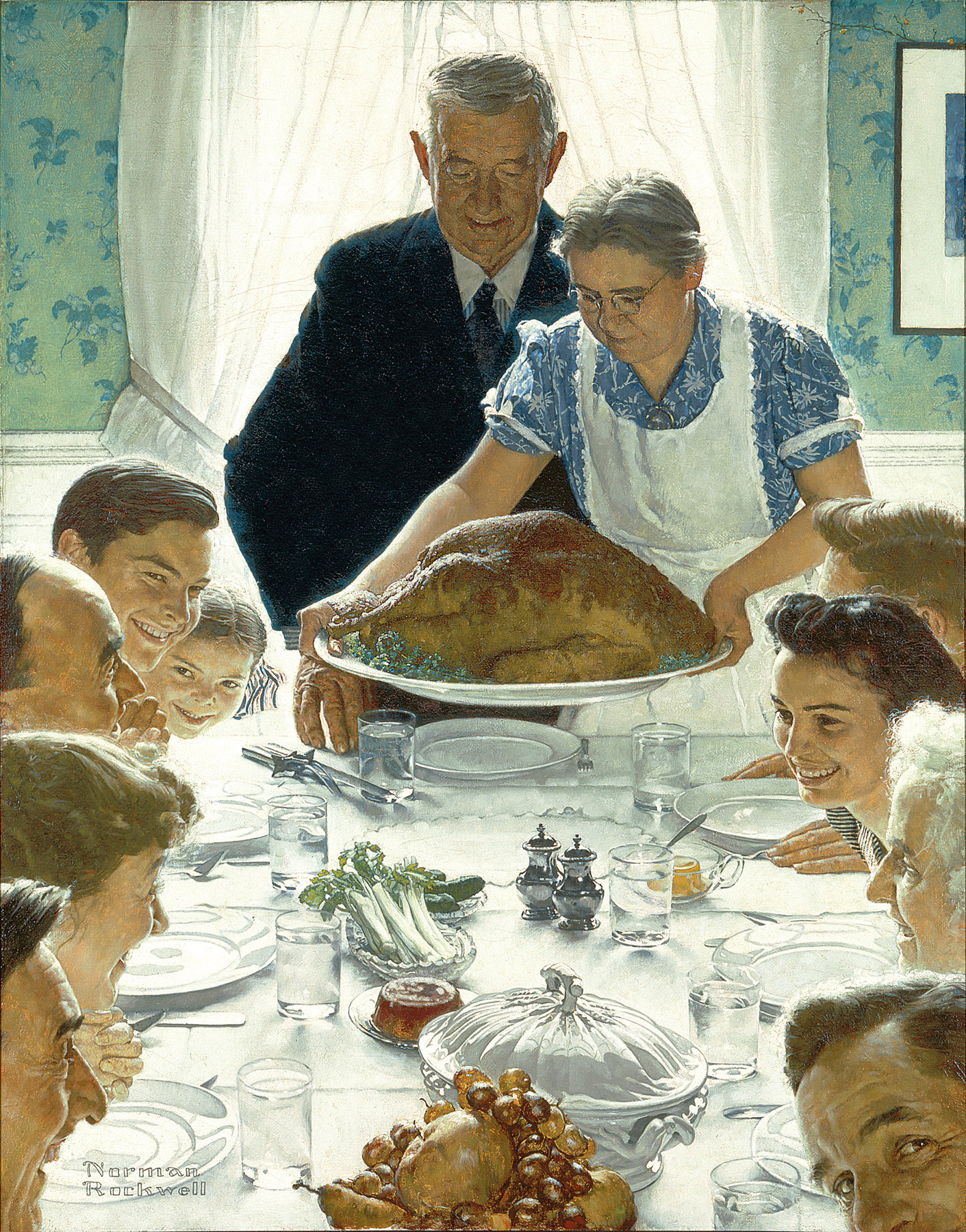
Family gatherings have been the launching point for all sorts of drama and comedy in the arts. They're such a rich source of conflict with good intentions soured by bad karma. Along with that are the family rituals culminating in "the family meal" where everyone tries to "out-Rockwell" Rockwell. But in the meantime, there's a lot of down-time where one can get into trouble, the past simmering as much as the bird in the oven.

Krisha (Krisha Fairchild) harrumphs out of her rental and stomps to her sister's house, muttering the entire way, her rolling carry-on trailing behind like so much baggage. It's been awhile since she's been there, enough that she first goes to the wrong house, then walks to the right one where she gets herself together at the stoop, puts on her "social" face before the door opens, then lights up when she's greeted, the mask looking genuine and natural.
She goes in and meets and greets, the voices high and welcoming, the hugs varied in intensity from crushing to fragile, and the chaos apparent. The household is scattered and busy, football's on and pets are astray as everybody busies themselves and occupies their time and space.
But, Krisha has an agenda. Estranged from her family, battling addiction, she's been away for years, set in her own space, finding her head. She has fences to mend—especially, critically, with her son (director Trey Edward Shults)—and binding ties that have become frayed in her absence.

That's the intent, anyway. But enough bridges have been burned in her wake that it's going to be slow-going. When she can finally have a heart-to-heart with her son, he listens petulantly, passive-aggressively. She's dying inside, really wanting to re-connect with him, but there's a wall of resentment that she's stepped out of his life. A brother-in-law (Bill Wise, the only other working actor besides Fairchild in the cast) is argumentative and has a tendency to poke raw places, which Krisha deflects as if she were hard-as-nails. She isn't. Even Teflon is temporary.

Her toughest critic stares at her in the mirror. She primps and prepares and whispers under her breath, her travelling bag of pills and an emergency bottle of booze nearby. As she paces back and forth—at one point, Shults has her compulsively circling a kitchen island in obsessively increasing orbits—the camera hovers as close as guilt, creating a building tension, which you know, deep down in your gut, is going to break. How and when is the question.
In the overview, this may seem like "Lifetime" material, but the brilliant thing about Krisha is the way Shults has conceived and shot it. It's doesn't feel like a family drama; it's done like a horror movie (I was half-way tempted to post this before Hallowe'en). The movie veers between crowded scenes of jangling activity and Krisha's isolation, creating a clear demarcation of tension between the two sides: Krisha and everybody else. She's the outsider in the family, given the benefit of the always-looming doubt. The unknown, the one being watched. We feel the palpable unease, even if candy-coated with sweetness. At any time, from the family's point of view, she might cross the line, and that line shifts depending on the family-member.
We feel the pressure because Shults always provides Krisha's point-of-view. No matter how normal the family may be, they're a challenge from this perspective—just as she is from theirs. That deep-seated antagonism and sense of dread is what differentiates Krisha from any other domestic drama not involving a hatchet. Krisha is not a monster or a psychopath, far from it, but the reactions to her are muted versions of dread and horror—family-style, with the implied normalcy. And Shults book-ends the film with the same unforgivingly naked straight-on slow zoom her face, as it tries vainly to keep composed and fails, crumbling. She is out mirror into the fragility of our souls.
Krisha was shot over 7 days, with a minimal budget and a cast consisting primarily of family members—and yet, you never catch anybody acting or seeming unnatural or stilted in their performance. The film was released to the film festival circuit where it would consistently be noticed and nominated for top honors, winning the Audience and Grand Jury Awards, then went to Cannes. Shults has garnered his share of nominations, and, suddenly, people noticed Krisha Fairchild, for her raw-nerve performance and ability to carry an entire movie on her shoulders. It is amazing work and stays with you long after you stumble out of the theater, wrecked.
Krisha haunts.

Thursday, November 24, 2016

Doctor Strange

Less Than Passing Strange
or
Mysto-babble is Dumber than Techno-babble

Hocus-pocus Marvelocus.

Marvel's mystical mage, Dr. Strange, makes it to the big-screen, with a lot of what made the comic interesting and a lot of what makes that comic problematic for writers—Strange is one of the characters that goes in and out of publication due to poor sales and then is brought back when somebody has an "innovative take" on the wizard.

Back in the 1960's (when artist Steve Ditko created it and Stan Lee provided the script), the comic was a big hit with the college-crowd, precisely for Ditko's warpy-woofy graphics (which is CGI'd ever so briefly in a tantalizingly short "trip" sequence), even becoming a black-light poster that was available in "head-shops" of the era. A direct example of "pop-art" (as opposed to Lichtenstein's "inspired" prints), it was emblematic of the psychedelic sensibilities and the *POW!* school of three-colored extremism.

In the superhero genre (and it's Marvel Universe sub-genre), this is a fair-to-middling adaptation, not as bad as some have been, nor as "fresh" as some of the recent "minor" Marvel films manage to get away with. But, Dr. Strange is no Ant-Man or Guardian of the Galaxy. He's one of the identifiable "big-league" Marvel characters—the type you wonder why they're MIA in the brand's cine-universe. Befitting a major player, it tries hard, very hard to wow with visual splendor while going a bit light in the impact/ramifications side of things. If the good Doctor stayed "out" of the MU, I'm not sure that anyone would miss him.
The narrative is rather flat. A "bad-guy" does something "bad." The "good-guy" is a jerk who must have a change of conscience in order to live up to the responsibilities that are handed him (this is especially true of the Marvel Universe) rather than being an innately good soul who sees his abilities as a gift to be shared (the DCU template). In Marvel, you gotta learn a lesson, campers, before you're going all-"Excelsior!"
The film introduces us to the magical world with a library invasion—always exciting—as Kaecilius (played by Mads Mikkelson, perpetually dyspeptic) and his coven of bad magi attempt to check out a book (without a card!). There's some business about energy whipping the caretaker and hoisting him spread-eagled—in what I believe is called a "disruption"—before beheading him (the things people do to avoid fines). Kaecilius then rips a couple of choice pages from the book they're seeking and creates a magical portal out of the library and into the streets of New York City, where he meets a yellow-garbed opponent who engages the group by literally changing the playing field, distending, convoluting, and bending the financial district. Despite all the "Eschering", "Kaeci" escapes to make good on his plans to...aw, who the hell cares. It ain't good, even if it may look impressive.

Cut to New York where Dr. Steven Strange (Benedict Cumberbatch) is a smooth operator on brains—a brilliant neurosurgeon, dismissive of all but one doctor (Rachel McAdams) at his Manhattan hospital. Egocentric, rude, and cavalier, he may know his way around brains but knows nothing about hearts. Until "one fateful night" where he crashes his car—while texting, and there's even a "Don't Do This, Kids" warning in the end-credits, sandwiched between the more-gratuitous-than-normal "sneak-peeks" at the end. He's wracked up, but the part of him that suffers the most damage is his ego—his hands are permanently disabled, and with it, his worth as a surgeon and, to his mind, as a man.

He travels to Katmandu, Shangri-la-la-land, or where-ever to seek out the secrets of tapping what there is of his soul to overcome the paralysis of his hands. After being beaten up by toughs, he is rescued by Mordo (Chiwetel Ojiofor), who takes him to the dojo of The Ancient One (Tilda Swinton, who, if she doesn't overcome the racism inherent in her casting, at least overcomes the sexism inherent in the role). She shows Strange "the ropes" (or at least the silver strings) that separate the corporeal from the spiritual self, and impressively enough that he stops being a know-it-all smart-ass and decides to go back to school.
I don't think I'm spoiling anything to say the biggest thing he learns is self-sacrifice (although if he has himself in a perpetual time-reset there's not much sacrifice) and it is amusing that he ultimately defeats the "Big Bad" by merely being annoying. But, other than that and milieu, it's fairly rote for a superhero movie. Ultimately, the only reason for having the movie is to reveal that one of the goo-gah's Strange luckily stumbles on* to get him out of scrapes contains an "Infinity stone", the "Macguffin" that Marvel has been teasing for the past (what?) five years now. Anything teased for too long tends to make that teased thing grumpy.

The film does benefit from Cumberbatch playing the lead, but though he hits his marks and does everything right, there's not a lot of inspiration to his performance (as we've come to expect). Maybe playing smart guys all the time makes you eventually run out of ideas. In any case, the performance reflects the film—uninspired but competent.

It's just not—dare I say it?—"magic."


* One of those is "The Cape of Somethingorother" which has the same anthropomorphic tendencies as inanimate objects in Disney cartoons. Oh, that's right Disney owns Marvel.

Tuesday, November 22, 2016

Arrival

Octo-Mom
or
If You Had It to Do Over Again...Would You Have an Inkling?

Science fiction is always a problematic genre, dramatically. Thesis overwhelms character. And character buries the lede. Some of the best science-fiction has been melodramatically inert, its characters cut from templates—my favorite movie, 2001: A Space Odyssey, has professional people, but one can't see much personality in them. Events are too big for traits beyond hubris to penetrate. When personality plays into the scenario—think Interstellar—it undercuts the ideas and the scale, making the grand scale of ideas a mere backdrop for the problems of the two little people in a crazy multiverse.

Science fiction asks the Big What if? And perhaps we've gotten to the saturation point where the concept of alien visitation has gotten old-hat since the time Klaatu visited, turned out all the lights, and threatened to spank if we didn't get our WMD's together.

And it shouldn't. Alien arrival—dare we say "immigration?"—would be a global game-changer, causing both societies and sects to do major pivoting in their by-laws and arcana, causing re-writes and "spins" in order to maintain their global and universal pecking orders. It was ever thus.
Arrival has no room for such speculation—the world just freaks out like they would on Independence Day, from fender-benders in parking lots to international posturing and saber-rattling without benefit of resets. Twelve crescent-shaped objects appear hovering over various parts of the planet, the only thing they have in common (as one "expert" opines) is that Sheena Easton had a #1 hit there in 1981.* The press speculates idly, trying to fill air-time while the respective governments evacuate and cordone off the touchdown sites. They ask and reverberate the same questions the populace has: why are they here?; why now?; Are they here for peaceful or harmful purposes?; if it's The Rapture, what should I wear?
The government—all the governments—ask the same questions. But, first they have to figure out how to communicate with The Visitors (if they're merely Visiting) without the benefit of them understanding English, providing a Universal Translator, Absorbascon, or music-activated light-show.** The colonel in charge of solving the problem, Col. Weber (Forest Whittaker) seeks out linguistics professor Louise Banks (Amy Adams) to apply her skills to try and decode the guttural rumbles the arrivers emit.
We've already spent some time with Dr. Banks—a prologue begins the movie with a narrated slice-of-life montage straight out of Terence Mallick of Banks as seen through the life (and death) of her daughter. She speaks over it:
"I used to think this was the beginning of your story. Memory is a strange thing. We are so bound by time, by its order. I remember moments in the middle. And this was the end. But, now I'm not so sure in beginnings and endings. There are moments that are beyond your life. Like the moment "they" arrived.
That narration had me checking the IMDB credits to see if it was Malick or Christopher Nolan who was directing the movie. But, no, it's Denis Villeneuve (who directed Incendies, Prisoners, and Sicario).

Banks first gets an inkling of events when she shows up to teach her class and only a handful have shown up—and it isn't even after homecoming. Their cell-phones start beeping, with alerts, texts, and (I'm sure) questionable Facebook posts. Banks turns on the class monitor to the TV and stares blankly at what she sees. Then, the evacuation alarm goes off. Class dismissed.


Before long, Whittaker's colonel is in her office, playing a recording of the E.T. utterances, and after some initial reluctance—on both their parts—she's whisked away to Montana to one of the ground zero's where the slightly-scalloped ships are hovering 30 feet above the ground. Ferried with her is Dr. Ian Donnelly (Jeremy Renner), who's been reading up on Banks, allowing light-hearted verbal sparring about the best approach to talking to the aliens.

"The cornerstone of civilization isn't language—it's science," he opines. "How about we talk to them before throwing math problems at them?" she counters.

The control center in Montana, where they're flown to is an amalgamation of boots on the ground and ghosts in the machine—while the troops are providing security and infrastructure, there are banks of computers analyzing and skyping other countries  reporting their progress—or lack of it. With all that intel, there's an NSA agent, Halpen (Michael Stuhlbarg), who's acting as filter for both communication and hindrance. 

The highlights of the film are, of course, the contact scenes, where Donnelly and Banks meet and greet the aliens and Villenueve creates an curious milieu for these. There is an interesting and metaphorical gravity re-orientation, and the specialists meet the "heptapods" (as they're soon labeled, although, for personal reasons, I prefer the term Krakenators)—creatures that appear like elephant-hided octopi—in an inconvenient, but dramatically-stylized movie screen-apertured tank. Most of the creativity and a fair share of the budget go into these scenes, and the efforts to interpret and correspond are editorially compressed to spare us the intricacies and timeline of establishing common-ground. We get the highlights, but no squabbling over syntax or masculine/feminine articles. 
The "heps" communicate using an inky, representational hieroglyphics, that being a better entree to understanding than trying to figure out the whale-like rumblings they use aurally. Not to get too much into detail—because that's where the most surprises come from—but before long, screen-time-wise, the bipeds get a pretty good idea what the general intentions of the heps are (and it has nothing to do with protesting our treatment of calamari, which is a good thing—you don't want to have to explain the process of deep-frying and try to put a positive spin on it).
It is Banks who makes the breakthroughs, and for whom the heptapods have the most trust—she is, after all, the first one who takes off the alarming enviro-suits to give the "heps" a good look at the fragile creatures we actually are. And more importantly, she does it not through much words and language as action, which given the species is a much more reliable presentation of intent.
Actions speak louder than linguistics, and the actions of the humans world-wide put any sort of understanding—among humans or heptapods—in jeopardy. It all hinges on Banks, who, when things come to crisis, comes up with a unique little talent that comes out of nowhere (the line from Captain America: Civil War came to mind: "Okay, anybody on our side hiding any shocking and fantastic abilities they'd like to disclose? I'm open to suggestions.") and for which there has been no...inkling...previously, and which seems really convenient.
Now, don't get all curious about that ability—don't jump to some conclusion that it has anything to do with the aliens, that Amy Adams is a secret heptapod, or they're the souls of lost loved ones, or anything like that. The twist isn't that clever...or relevant. It's merely a lucky happenstance that she's chosen to be on this team—at least lucky for the writers who might've come up with it just to get out of a third-act jam. That there is nothing that presages it makes it feel lazy...and also makes you wonder why, previously, everybody has been working so hard, as well as negating all sorts of things along the thread of the movie.
"Look! I could be in another Spielberg movie! (I was in Catch Me if You Can, remember? No?)"
The problem is not that Arrival has an unreliable narrator, so much as it has an unreliable narrative. It keeps that important piece of information from us—a sort of weak Shyamalayan-twist that has nothing to do with the circumstances of the movie's draw, and keeps the movie from feeling like an integrated whole. Here, the consequences of a world-changing event doesn't change much in the movie's sphere, at least in the intentions of the movie-makers. It's just a hook, which could have been accomplished by any means, even trivial, rather than cosmic. In which case, it's a bit of a cheat: Arrival doesn't inspire a sense of wonder, so much as a wonder why.

* In case you were wondering it's "Morning Train (9 to 5)," and, no, it has nothing to do with anything.

** Don't get me started on Google Translate®.

Monday, November 21, 2016

Don't Make a Scene: Monty Python and the Holy Grail (Scene 32)

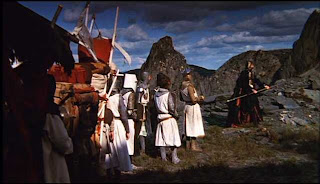
The Story: It's all funny, really...even the skewed credits in Nørsk. But my favorite part of Monty Python and the Holy Grail (not to be confused with "Spamalot" the Musical) comes deep in that very episodic and brutally low budget film (partially financed by the bands Led Zeppelin and Pink Floyd) with a three episode strip that exemplifies what is best in the comedy troupe's methods of madness; we'll be exploring these over the next three weeks.*

The first, as exemplified by this scene—which pyrotechnically blasted whole columns of the film's budget—is their use of archetypal figures...even historical figures...and use them as grist for comedy. Here, we have Merlin. But it's not Merlin. It's "Tim, the Enchanter." And Tim is only too happy to enchant by punctuating his spit-flying Scottish presentation with gasoline-fueled demonstrations of legerdemain. Because an Enchanter is only as good as his enchantments, and Hollywood and Historical Epics always needed to fit those in to "sell" their magicians.

Not that John Cleese needs any help. Cleese ran the extremes of Python performing—he could be the self-contained announcer of And Now for Something Completely Different... or he could be a screaming loon in danger of hemorrhaging, and both territories are heard from with Tim the Enchanter, which makes the tag-line ("What an eccentric performance!") especially funny because 1) it's what we're all thinking, but 2) it's breaking the wall between art and artifice, acknowledging that a) it's only a movie and b) it's just a performance. No respect. No respect at all.

The Set-Up: It has been a hard and cruel journey for King Arthur (Graham Chapman) and his knights of the Round Table in their quest for the Holy Grail. Taunted by Frenchmen, disappointed by Camelot (it's just a model), mocked by God, delayed by the Knights who say "Ni!" and the hapless Black Knight, they have recently been forced to eat their minstrels (yay!), when they come across a being who might speed things up a bit.

Action! (shhh!)

Scene 32
[The scene is a rocky countryside. A thunderous boom is heard.]

ARTHUR: Knights! Forward!
[Cut to TIM atop an outcropping, throwing pyrotechnic spells at various rocky crags. The KNIGHTS halt.]
[Suddenly, TIM summons a ball of fire on the very spot he is standing. But he is gone! Just as suddenly, TIM reappears in a cloud of smoke just a few feet away from ARTHUR. He continues to toss a couple more fiery spells.]
ARTHUR: What manner of man are you that can summon up fire without flint or tinder?
TIM: I... am an enchanter.
ARTHUR: By what name are you known?
TIM: There are some who call me... Tim?
ARTHUR: Greetings, Tim the Enchanter.
TIM: Greetings, King Arthur!
ARTHUR: You know my name?
TIM: I do.
[Blows flames from his staff]
TIM: You seek the Holy Grrrail!
ARTHUR: That is our quest. You know much that is hidden, Oh Tim.
TIM: Quite.
[Shoots a rocket from his staff at a tree, which explodes]
[KNIGHTS OF THE ROUND TABLE applaud politely.]
ARTHUR: Yes, we're, we're looking for the Grail. Our quest is to find the Holy Grail.
KNIGHTS: It is, yes, yup, yes, yeah.
ARTHUR: And so we're, we're, we're, we're looking for it.
KNIGHTS: Yes we are we are.
BEDEMIR: We have been for some time.
ROBIN: Ages.
ARTHUR: Uh, so, uh, anything you can do to, uh, to help...
ARTHUR: ... would be... very...
ARTHUR: ...helpful...
GALAHAD[Stepping forward impatiently]: Look, can you tell us wh-
[TIM throws a fireball in front of him. He stumbles back, holding his leg.]
ARTHUR: Fine, um, I don't want to waste any more of your time, but, uh I don't suppose you could, uh, tell us where we might find a, um, find a, uh, a, um, a uh--
TIM: A what...?
ARTHUR: A g--, a g--
TIM: A Grrrrrail?!
ARTHUR: Yes, I think so.
KNIGHTS: Yes, that's it. Yes.
TIM: Yes!
KNIGHTS: Oh, thank you, splendid, fine.
[TIM shoots fire from fingers at rocky slope.]
ARTHUR: Look, you're a busy man, uh--
TIM: Yes, I can help you find the Holy Grrrrail.
KNIGHTS: Oh, thank you.
TIM: To the north there lies a cave -- the cave of Caerbannog -- wherein, carved in mystic runes upon the very living rock, the last words of Olfin Bedwere of Rheged
[creates thunder]
TIM: ...make plain the last resting place of the most Holy Grail.
ARTHUR: Where could we find this cave, Oh Tim?
TIM: Follow!
TIM: [he turns back] But!! Follow only if ye be men of valor...
TIM: ...for the entrance to this cave is guarded by a creature...
TIM: ...so foul, so cruel that no man yet has fought with it and lived!
TIM: Bones of full fifty men lie strewn about its lair! So, brave knights, if you do doubt your courage or your strength, come no further...
TIM: ...for death awaits you all with nasty big pointy teeth!
ARTHUR: What an eccentric performance.

Monty Python and the Holy Grail

Words by Graham Chapman, John Cleese , Terry Gilliam, Eric Idle, Terry Jones, and Michael Palin

Pictures by Terry Bedford and Terry Jones and Terry Gilliam

Monty Python and the Holy Grail is available on DVD from Sony Pictures Home Entertainment.


* Those three being their ability to take historical concepts and toy with them, their extremely comical use of violence, their satirical use of language, and their hap-hazard way of getting out of skits.

(That's four)

Right! Four! Those FOUR being their ability...