Through the Looking-Glass
or
"That Doesn't Make Any Sense"
Alice Howland (Julianne Moore), a professor of linguistics at Columbia University is jogging though New York City when she stops, confused. She's lost, not sure where she is, or how to get back home. Alice does everything right—exercises, eats healthy, but the sensation of being lost goes beyond the simple "what's that word..." "Senior Moment" everyone has.
Besides, she's only 50, barely able to join AARP. She goes to a neurologist, who puts her through a quick battery of memory tests, which she passes with flying colors. The doctor (because he's a doctor) suggests an MRI "just to make sure." The results of the brain scan are not encouraging—she's showing physical signs of early on-set Alzheimer's. It's nothing she's done. It's genetic and there's a good chance she'll pass it on to her kids, Anna (Kate Bosworth) the oldest, Tom (Hunter Parrish) and Lydia (Kristen Stewart). She is crushed, but she's taking the prescribed medicine that might slow the progress, but not halt the disease, and she and her husband (Alec Baldwin) are both showing brave faces. Her brain is slowly dying, and it will be a long spiral, as it takes away memory—first short term, then long-term—then eventually shuts down the autonomic functions of her brain until she can no longer function—she forgets how to swallow, she forgets how to breathe. Death comes like a particularly relentless thief, taking away bits and pieces until there is nothing left.
Full disclosure: my mother died of Alzheimer's in 2001, and I have a fairly intimate knowledge of the disease and it's effects on a human being. My mother went from unexplained behaviors and attitudes that were paranoid and suspicious, to her losing chunks of her past—the home she lived in for thirty years became unfamiliar to her—she remembered her home as being the one where she grew up in Seattle, she no longer recognized her kids as her kids, and she could no longer be trusted to be self-sufficient and her family closed ranks around her with the singular mantra drummed into us by the advisers at the Alzheimer's Association—"you can not make her happy, but you MUST keep her safe." The disease was a wretched digression of self that she never acknowledged but, as her caretakers had to witness, it is a cruel, but perversely fascinating disease that gives one insight into the brain, the self, and the infinity of details that go into being human, and the essentials that make up the concept and burden of living. You learn that there is so much that is only so much distraction that has only been imposed on us by society and has nothing to do with the process of life. All that gets boiled away to a reduction where basic mechanics and personality (astonishingly) remain. Pain centers go away (mercifully) and life becomes "in the moment." What I learned from my mother's experience is that there are far worse ways to die...if one doesn't cling to their individuality so much.
There is no way that the experience of that could not color my view of Still Alice, and my reaction to it was one of annoyance. Alzheimer's affects each individual differently, but there are patterns and similarities in the disease and how it progresses and how it affects. I'm not sure what disease Moore's character is suffering from, but it sure isn't Alzheimer's, despite the advisory of half a dozen experts from the Alzheimer's Association. There is no "sundowner's." There is no bluffing and "playing through." There is no paranoia. There is no resigned "thousand yard stare." There is no "wandering," no mirror dissociation.* There is no caretaker grief. No identity crisis. This "Alzheimer's" is a blunted presentation, where they merely withhold make-up (Moore's hair never looks less than great—never unkempt), the major symptom of what's called "movie star disease." Moore's good, no doubt—she tries. This is not a "best actress" performance, however—"it's" not there. Either the filmmakers didn't know the disease or they sugar-coated it for audiences, which is particularly cowardly because there have been well-done presentations and portrayals of Alzheimer's, specifically by Judi Dench in Iris, and by Julie Christie in Away From Her (both performances were Oscar-nominated—but lost). Still Alice is Oscar-bait material, not going so far as to alienate audiences, but doing little to educate the public about the problem. It is as lily-livered as if the makers of The Theory of Everything had shown Steven Hawking without the withering.
Still Alice is almost worthless as an explanation of Alzheimer's disease, soft-pedaling and shying away from dramatically devastating material.
But it may win Julianne Moore an Oscar. If so, it'll be more of an expression of her excellent work throughout her career.
* There is something that might pass for it if one has any prior knowledge of Alzheimer's—where Alice is brushing her teeth, or attempting to, and instead, puts the toothpaste on her hand and smears it over the mirror, obscuring her face. With Alzheimer's, the patient will not recognize themselves in the mirror, expecting to see a younger version of themselves. I'm still haunted about the time my Mom told me there was another woman living in her house—she had a full length mirror just in the entry-way. Whoever that woman she saw was, she somehow made peace with her.
Saturday, February 21, 2015
Friday, February 20, 2015
Away From Her
Away From Her (Sarah Polley, 2007) Julie Christie did her homework when it came to portraying early-stage Alzheimer's--the intense concentration, and the thousand yard stare, the polite smile to the intimate stranger. And the film does a remarkable job of putting the viewer into the "Alice-in-Wonderland" world of the Alzheimer's care-giver who must endure the pain of dealing with losing the relationship while still having to deal with the patient. The commitment is still there, even though the disease has severed the knowledge of it from patient to care-giver. Sacrifice without reward--makes you realize what being a nurse is like.* And there's an aspect to Alzheimer's care-giving that's a bit like a lab experiment. Divorced from the ties that the disease has unpinned, one can observe the effect it has on the human being, given the prior knowledge of the sufferer. You can check off what goes, see the timeline disappear, the brain functions narrow and fluctuate, enjoy the false encouragement of "good days." For the Alzheimer's patient, it's a slow-motion float to death—at some stage they're not even aware of their condition. For the caregiver, it's a bit like watching a frog (a very dear frog) sitting in slowly heating water—you can only wait helplessly and steel yourself for the inevitable, as memory, identity, and life slips away. It's a slow death and a long good-bye.So, in that way, Away from Her is a good primer for the best-case Alzheimer's scenario. Christie's character, Fiona Anderson, is aware of the onset, and in an act of unselfishness, rather than go into denial and paranoia makes the decision to place herself in an assisted living facility, voluntarily giving up the freedom that so many patients cling to, kicking and screaming.Her husband of 40 years, Grant (Gordon Pinsett, he's wonderful, too) sees the relationship go away in an accelerated fashion when the facility insists on isolating the patient from family members for a required thirty days (I've never heard of such a rule, but then it takes place in Canada).By the time of Grant's first visit--one he highly anticipates--Fiona has already separated from their relationship, and he struggles mightily to regain it, a combination of wanting to halt the progress of the disease and his own selfishness.Where that yin and yang pulls him forms the crux of the story, and in my household it led to some pointed discussion about responsibility and relationships, but one must also look at the brutal reality of the disease and the unique way that it eviscerates normalcy.As I've said Away From Her paints a best-case scenario that is still far from rosy, but as a toe-dip into the issues surrounding dementia and Alzheimer's, it's a pretty effective film, and actor/director/savant Sarah Polley has found a fascinating way of deriving a positive and interestingly nuanced life-lesson out of the experience. Like Orson Welles with Citizen Kane, she was all of 25 when making it.
* The author lost his Mother to Alzheimer's in 2001, if one is so churlish to look for authority. The movie has received a lot of criticism from care-givers who think the movie soft-pedals the disease, and although it does present a best-case scenario and never goes further (actually) than early-stage Alzheimer's it does show, in a perfunctory way, the severing of emotional ties and history a patient can experience and the effect it can have on the care-giver.
Thursday, February 19, 2015
Black Narcissus
Black Narcissus (Michael Powell and Emeric Pressburger, 1947) God in heaven, this is one of the most beautiful movies ever made. In fact, this might be the contender that beats Gone With the Wind as the most gorgeous movie ever to be made from trashy material.* I haven't read the book "Black Narcissus" by Rumer Godden, so it's premature and ignorantly judgmental to call it trash, but the evidence from the film—a lust triangle between a pair of nuns and the only white man in the Himalayan neighborhood is soapy to the point of leaving rings around your eyes. It does bring up the conflicts of those devoted to faith when confronted with Earthly desires, and how tough it is for physical beings to be married to Christ when he's an absentee husband. It's just that, dramatically, the conflict is presented so turgidly as to approach the giggle reflex, despite being performed by (rather bravely, I think, or foolhardedly) the former lover of the director, Deborah Kerr, and his current lover, Kathleen Bryon (interestingly, she played the wife of elderly James Ryan in the Framing sequences in Spielberg's Saving Private Ryan), who present subtlety and hysteria (the latter, approaching Exorcist-like possession).
There is that contrast, front and center, but there are also the ones between Western faith and Eastern spiritualism in the parallel stories of the nuns (and their duties and desires) and the demands of a local girl (Jean Simmons—uh, yeah, Indian by way of Crouch Hill, London) and her arranged marriage to a young prince (Sabu), and in marked contrast to a monk who lives his life, hermit-like and with no distractions to his faith. There is some validity to the total for that, although the nuns and their belief system come out poorly in the comparison.
What is NOT in conflict (and makes it a must-see no matter the subject matter) is that Black Narcissus is one of the most beautiful movies ever made, in large part due to director Powell, production designer Alfred Junge, the amazing cinematographer Jack Cardiff, but also process shooter W. Percy Day and a young up-and-comer by the name of Peter Ellenshaw, who would create a lot of legendary magic for Disney over the years).
The photo-chemical wonders accomplished by these men is mesmerizing—one of those rare films (like The Leopard or Barry Lyndon) that you could take any frame and hang it on a wall.
The Technicolor palette pops and not subtly, and images are rich and lush, evoking a sensuality far beyond what the script calls for or evokes. Powell once said, "Sometimes in a film its theme or its colour are more important than the plot." That's certainly true of Black Narcissus. There is a sumptuous quality to the images whether they suggest the bare asceticism of the nun's cloister or the natural wildness of the Himalayan landscape (incredibly, the film was shot at Pinewood Studios and Leonardslee Gardens, West Sussex, the home of a retired Indian Army officer), the planes of the faces (Cardiff could photograph women like no other), reflected in love or contorted in hate, the warm peace of a Himalayan glade, or the terrifying verticality of the nun's cliff-side perch.
That cliff telegraphs events in the film like a deus escarpment, which manages events and resolves conflicts in a very (shall we say?) orthodox manner. Let's just say that "falling" is a major theme of the film, which manages to maintain its own balance by the strength and audacity of its images.
Tuesday, February 17, 2015
The History of John Ford: Young Mr. Lincoln
Running parallel with our series about Akira Kurosawa ("Walking Kurosawa's Road"), we're going to start running a series of pieces about the closest thing America has to Kurosawa in artistry—director John Ford. Ford rarely made films set in the present day, but (usually) made them about the past...and about America's past, specifically (when he wasn't fulfilling a passion for his Irish roots). In "The History of John Ford" we'll be gazing fondly at the work of this American Master, who started in the Silent Era, learning his craft, refining his director's eye, and continuing to work deep into the 1960's (and his 70's) to produce the greatest body of work of any American "picture-maker.".
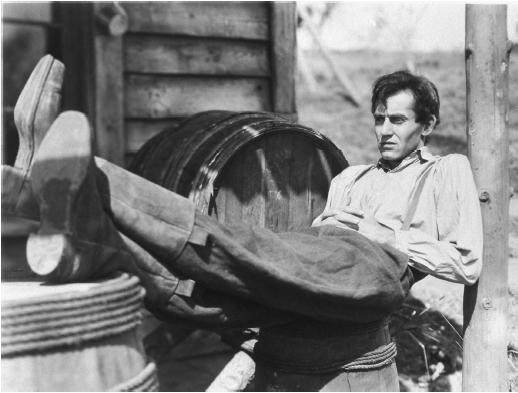
Young Mr. Lincoln (John Ford, 1939)
Essential "John Ford at Fox" movie about the "jack-legged country lawyer" who would become the 16th President at the time of the nation's sundering. The film is filled to the bursting with fore-shadowing, from Abe playing "Dixie" on a jew's harp to encountering Stephen Douglas and Mary Todd to the penultimate shot of him striding up a storm-tossed hill lit by lightning (more on that later). Henry Fonda, heel-lifted, stiff-gated and nose-puttied plays Abe with a slow "drawrl" and far-away look, the film concentrating on the young Lincoln's learning and early practice of the law in Springfield, Illinois. Along the way he's haunted by the loss of his first love, Anne Rutledge and takes part in a murder case involving an angelic country family that stirs up feelings of home. Ford has a fine time skewering the pomposity of trial proceedings and the airs of high society.
The film is a prime example of the emotional mood swings that energized Ford's films.
But it also showcases the director's eye for composition and use of Nature to reinforce story points. For example, there's this early scene where Abe and Anne tentatively express feelings. Anne is friendly with Abe, while he is tragically smitten. Ford frames them by a river where a great tree forms an arch extending from Anne and branches out to barely graze Abe.
The scene will end with Lincoln walking under that arch, alone, and throwing a rock into that swiftly-flowing river, its ripples starting a transition in time that will show the river clogged with ice, and a graveyard containing Anne's grave. In the background, a yearning violin piece serves as "her" theme, but also, generally, of memory and loss, as it keeps coming back throughout the film (23 years later, Ford would use it again in the same context in The Man Who Shot Liberty Valance.)
And there's no denying the power of that almost-final shot (a more obvious studio shot serves as the last one, followed by Lincoln Memorial views) of Lincoln's film-ending hill-climb "goin' on a-piece." The bordering fence forming a barricade and the huge sky rumbling with thunder. It's one of the most beautiful representations of Destiny ever committed to film, from the film-laureate of History and nostalgia with a painter's eye and a poet's command of metaphor.

Young Mr. Lincoln (John Ford, 1939)
Essential "John Ford at Fox" movie about the "jack-legged country lawyer" who would become the 16th President at the time of the nation's sundering. The film is filled to the bursting with fore-shadowing, from Abe playing "Dixie" on a jew's harp to encountering Stephen Douglas and Mary Todd to the penultimate shot of him striding up a storm-tossed hill lit by lightning (more on that later). Henry Fonda, heel-lifted, stiff-gated and nose-puttied plays Abe with a slow "drawrl" and far-away look, the film concentrating on the young Lincoln's learning and early practice of the law in Springfield, Illinois. Along the way he's haunted by the loss of his first love, Anne Rutledge and takes part in a murder case involving an angelic country family that stirs up feelings of home. Ford has a fine time skewering the pomposity of trial proceedings and the airs of high society.The film is a prime example of the emotional mood swings that energized Ford's films.
But it also showcases the director's eye for composition and use of Nature to reinforce story points. For example, there's this early scene where Abe and Anne tentatively express feelings. Anne is friendly with Abe, while he is tragically smitten. Ford frames them by a river where a great tree forms an arch extending from Anne and branches out to barely graze Abe.
The scene will end with Lincoln walking under that arch, alone, and throwing a rock into that swiftly-flowing river, its ripples starting a transition in time that will show the river clogged with ice, and a graveyard containing Anne's grave. In the background, a yearning violin piece serves as "her" theme, but also, generally, of memory and loss, as it keeps coming back throughout the film (23 years later, Ford would use it again in the same context in The Man Who Shot Liberty Valance.)And there's no denying the power of that almost-final shot (a more obvious studio shot serves as the last one, followed by Lincoln Memorial views) of Lincoln's film-ending hill-climb "goin' on a-piece." The bordering fence forming a barricade and the huge sky rumbling with thunder. It's one of the most beautiful representations of Destiny ever committed to film, from the film-laureate of History and nostalgia with a painter's eye and a poet's command of metaphor.

Sunday, February 15, 2015
Don't Make a Scene: L.A. Confidential
The Set-Up: "Tell Me a Story." During the month of February, we'll be showcasing scenes that feature a story in the midst of the narrative. That story may couch the plot in a new light; it may illuminate themes or present a back-story. It may be just a distraction. It may be a side-story that resonates throughout the film and casts its teller in the affections of the audience, making him immortal no matter how short his amount of screen-time. Here, it plants a clue.
It's another great performance by Kevin Spacey. In this movie, based on the James Ellroy novel, his character Jack Vincennes is a sleaze (Director Curtis Hanson told Spacey that if he was casting someone from the era, it would be Dean Martin), who has just enough memory of integrity to sleep at night. Sometimes Spacey's eyes go blank as if he's looking inward to do a "soul-check" (he does it a couple of times in this scene), which pays off mightily in one of the creepiest scenes ever pulled off by an American actor—a scene this one sets up.
One of the interesting things about doing this series is seeing how the directors and actors pull off "telling" moments. Here the actors are doing all the work. And director Hanson? He's doing straight one-shots back and forth, back and forth, and I thought "Man! There's nothing here! But it seems really familiar, somehow." And I thought "this is how they frame things when movies go to television." Then I thought, "Yeah, it could almost be television direction," and then it hit me with a "Dun-da-Dun-dun."


It looked exactly like an episode of "Dragnet," which in James Ellroy's world of L.A. Confidential is called "Badge of Honor," and it's the series that Spacey's character Jack Vincennes is the technical consultant for. Damned clever. For series star and frequent director Jack Webb, this simple style was an economical way of shooting his series fast and unpretensiously, without complications of fancy lighting or other considerations that might slow down production, raising costs.
That's fine for technique, but what's the story? Here, it's a small aside in a conversation, "assigning motive" as they say on the cop shows, and it spurs the sleeping conscience of the older, savvier Vincennes. It's also a "plant." The unusualness of the name Ed Exley attaches to his father's killer ensures that we'll remember it, and that when it pops up again, we'll recognize it.
A bunch of people are gonna regret the day they ever heard the name "Rollo Tomasi."
The Story: The killing-spree at the Night Owl coffee shop was a massacre. It killed Officer "Bud" White's (Russell Crowe) partner, it's bloody resolution made a name for pain-in-the-ranks Det. Lt. Ed Exley (Guy Pearce), and it's even touched the work of Det. Sgt. Jack Vincennes (Kevin Spacey), who's currently being punished for his recent activities by temporarily suspending his duties as technical advisor to the tv-cop show, "Badge of Honor." None of these cops like each other much, but the "Nite Owl" gives them all pause. And even though the ambitious Exley has recieved a citation for his work that resulted in the deaths of three black men suspected of the killings, something's bothering him. And "bother" is something Exley seems to spread around.
Action!
A bunch of people are gonna regret the day they ever heard the name "Rollo Tomasi."
The Story: The killing-spree at the Night Owl coffee shop was a massacre. It killed Officer "Bud" White's (Russell Crowe) partner, it's bloody resolution made a name for pain-in-the-ranks Det. Lt. Ed Exley (Guy Pearce), and it's even touched the work of Det. Sgt. Jack Vincennes (Kevin Spacey), who's currently being punished for his recent activities by temporarily suspending his duties as technical advisor to the tv-cop show, "Badge of Honor." None of these cops like each other much, but the "Nite Owl" gives them all pause. And even though the ambitious Exley has recieved a citation for his work that resulted in the deaths of three black men suspected of the killings, something's bothering him. And "bother" is something Exley seems to spread around.
Action!

Ed Exley: Vincennes, I need your help with something.Jack Vincennes (tosses down a copy of Hush-Hush magazine he'd been reading): I'm busy right now. Why don't you go ask some of your boys in Homicide.
Ed: I can't. I need someone outside of Homicide. I want you to tail Bud White 'til he comes on duty this evening.
Jack: Why don't you do me a real favor and leave me alone?
Ed: Do you make the three Negroes for the Night Owl killings?
Jack: What?
Ed: It's a simple question.
Jack: Why in the world do you want to go digging any deeper into the Night Owl killings...Lieutenant?
Ed: Rollo Tomasi.
Jack: Is there more to that or am I supposed to guess?
Ed: Rollo was a purse snatcher. My father ran into him off-duty. And he shot my father six times and got away clean. No one even knew who he was. I just made the name up to give him some personality.
Jack: What's your point?
Ed: Rollo Tomasi's the reason I became a cop. I wanted to catch the guys who thought they could get away with it.
Ed: It was supposed to be about justice. Then somewhere along the way I lost sight of that.
Ed: Why'd you become a cop?
Jack: (pause) I don't remember.
Jack: What do you want, Exley?
Ed: I just want to solve this thing.
Jack: Night Owl was solved.
Ed: No, I want to do it right.
Jack: Even if it means paying the consequences?
Ed: Mm-hmm.

Jack: (puts on his coat) Alright, college boy. I'll help. But there's a case your boys in Homicide don't care about. They think it's just another Hollywood "homo"-cide. But I don't. You help me with mine, I'll help you with yours. Deal?Ed: Deal.

L.A. Confidential
Words by Brian Helgeland and Curtis Hanson
Pictures by: Dante Spinotti and Curtis Hanson
L.A. Confidential is available on DVD from Warner Home Video.
Subscribe to:
Posts (Atom)


.jpg)


.jpg)