Sunday, September 8, 2024

Don't Make a Scene: Blue Velvet

The Story: "It's a strange world..."

Yup. And then you throw David Lynch into the mix...

Blue Velvet is a twisted re-imagining of a Hardy Boys-Nancy Drew story (you must have read them), that series of books where small town life hides a secret and it's up to plucky teen detectives to make the world right again.

But, in Lynch's world, there is no way—NO WAY!—that pluckiness doesn't get corrupted, so dark is the depths to which people can sink...and that our heroes happen to witness. Our investigators ask for trouble and they get it. In fact, one could make a case that their corruption begins with their fascination with mysteries and secrets. The Tree of Knowledge, The Original Sin, and all that, if you want to get biblical. It's possible to get cast out of even a Paradise like Lumberton.

This is one of Premiere magazine's "Classic Scenes" and it's been percolating in my head for awhile because every so once-in-awhile I'll be watching something/reading something that is particularly dispiriting and I'll blurt out, like a Tourette's tic "Why are there people like....Frank?" And that cheers me up a bit even though it's One Degree of Separation from "Why me?" in the ineffectual rant whine-cellar. I'd considered waiting to post it in the horror-filled month of October, but, Blue Velvet isn't such a horror movie... and "why are there people like..." is appropriate for every month of this political year.

One thing I will say about this scene is "Laura Dern is an acting god who even makes me believe that robins are a manifestation of love."
 
Oh! And in David Lynch's world, even white picket fences turn grimy in the dark.
 
The Set-up: Per Premiere Magazine's description: "Blue Velvet begins with a gruesome discovery—a severed ear lying in the field—and by the end goes deep into the heart of darkness, the human disease within us that destroys the soul.* Playing amateur detective in small-town Lumberton are college boy Jeffrey Beaumont (Kyle MacLachlan) and high school senior Sandy Williams (Laura Dern), who bring a Hardy Boys—Nancy Drew naïveté to the creepiness and make everything that much more disjointed. Jeffrey finds the ear and turns it over to Sandy's father, a police detective. But Jeffrey's fascination with the mystery overwhelms his sense of law-abiding complacency, and he tries to solve the mystery himself, with Sandy as his confidante. Soon he's involved in the twisted lives of Dorothy Vallens (Isabella Rossellini), a mysterious night-club singer holding a very dark secret, and Frank Booth (Dennis Hopper), a sadistic criminal who's sexually obsessed with. Here, as Jeffrey and Sandy drive to a stop in front of a church, he tells her what he's discovered so far, and she tries to relate some sense of comfort and warmth in what is fast becoming for the two of them a very horrific and cold reality."   
 
Action.
 
128. INT. WILLIAMS CAR/CHURCH - NIGHT 
Sandy laughs as she pulls the car curbside in a quiet street by a church.
The church pipe-organ music drifts softly into the night. 
SANDY
Well?
SANDY
Aren't you want gonna to tell me about it? 
JEFFREY
OK. 
JEFFREY
It's a strange world, Sandy. 
JEFFREY
This is what I have found out. What I think I have found out. Dorothy Vallens is married to a man named Don. They have a son. 
JEFFREY
I think the son and the husband have been kidnapped by a man named Frank who has now cut off both of Don's ears. I think he is holding them to make her 
JEFFREY
Frank has done this to force her to do things for him. 
JEFFREY
I think she wants to die. 
JEFFREY
The ears were for her I think Frank cut the ear I found...
JEFFREY
...off her husband as a warning to stay alive. 
There is another man involved. I call him the "yellow man". You saw his back the other day in the hall at her door. I don't know what he does but I think he's on drugs supplied by Frank
JEFFREY
Frank is...uh...
JEFFREY
... is a very dangerous man. 
SANDY
(quietly) Wow. My God...
SANDY
Should you tell my father? 
JEFFREY
I don't see how I can. And I can't prove any of this. No. I can't do that. 
JEFFREY
I can't prove any of this. I got all this information illegally. 
JEFFREY
Also it could get you You could get in a lot of trouble. 
SANDY
You saw a lot in one night. 
JEFFREY Actually. I've been in twice. 
SANDY (uneasy) Twice. Without her sensing anything? 
JEFFREY (lying) Yes. 
SANDY (pausing) Did you see her undressed? 
JEFFREY Yeah. I mean. a little, you know. 
SANDY Yeah? 
JEFFREY (a searching, slight smile) That doesn't bother you, does it? 
SANDY Who, me? Why should it? 
JEFFREY (seeing some jealousy and happy for it) That's what I thought. 
SANDY
You're sure right. It is a strange world. 
JEFFREY
Why are there people like Frank. 
JEFFREY
Why is there so much trouble in this world? 
SANDY
I don't know. 
SANDY
I had a dream. 
SANDY In fact, it was the night I met you. 
(she reflects silently on this before proceeding) 
SANDY
In the dream, there was our world 
SANDY
and the world was dark because there weren't any robins. You know, birds. 
SANDY
And the robins stood for represented love. 
SANDY
And for the longest time there was just this darkness, 
SANDY
and all of a sudden 
SANDY
thousands of robins were set free 
SANDY
and they flew down and brought this blinding light of love. 
SANDY
And it felt seemed like that love would be the only thing that would make any difference.  
SANDY
And it did.  
SANDY
So I guess it means 
SANDY
there is trouble until the robins come there is trouble
JEFFREY
Yeah I guess so. (he turns to her) You're a neat girl. 
SANDY
So are you. 
SANDY
(laughs) I mean 
SANDY
you're a neat guy. 
SANDY
I...
SANDY I guess we better get back. 
JEFFREY
I guess so. you want to help me watch Frank?. I'm going to stake out Frank's place tomorrow. With a camera
Sandy starts the car and pulls out into the street.
They begin driving back.


Words by David Lynch
 
 
Blue Velvet is available on DVD and Blu-Ray from M-G-M Home Entertainment.

* My goodness, even I'd be a little embarrassed to have written a purplish sentence like that! That's Premiere Prose. And "It's only a movie, Ingrid!"

Thursday, September 5, 2024

Project NIM

Written at the time of the film's release.

"More Human Than Human"
or
"If We Could Talk to the Animals (Speaking to a Chimp in Chimpanzee)"
 
"It was the 70's...," says one of the interviewees in Project NIM, as if in explanation.

"It was the species," says I, looking for my tranquilizer gun.

The new film by
Man on Wire
director James Marsh examines a scientific experiment by Columbia researchers to teach sign language to a chimpanzee. The chimp, NIM (son of Carolyn) Chimpsky* is taken from its mother almost at birth, to be raised by humans, and thereafter taught to communicate in a language that humans can understand (This immediately raises a red ethical flag—why not take the Goodall route and learn theirs, but if you're going to get all PETA on me, you might as well just picket the theater rather than watch it).
For just as Man on Wire is a study of hubris and the arrogance of man (which results in a marvelous, magical thing), Project NIM does the same thing, while showing just how lousy human beings are, even with the best (or most curious) of intentions. We meet a lot of talking heads in Project NIM and few can be considered the best examples of our species to teach another anything. In fact, Project NIM is more of a study of human behavior than it is anything to do with monkeys'.
The guy who devises the study is Dr. Herbert Terrace (after Project Washoe which was an earlier, more disciplined study and was more convincing of anecdotal evidence), and one wonders what his motivations are, besides the obvious personal ambitions of getting attention and using it as a means of attracting young interns.** The first person to raise NIM is Stephanie, a self-described "hippie-chick," and it's a mystery that Terrace picked her to be the initial teacher for NIM, as she had no desire to keep notes and records, did not know sign language, and eventually grew impatient with all the insistence on "process," preferring to just interact with NIM as a member of her family. Terrace makes some comment about her being a "warm" "empathetic" person and then drops the bomb that the two had had a previous "relationship," (which will prove to be a common—all-too common—theme throughout the documentary, as the humans seem more concerned with "hooking up" than concentrating on their charge—"it was the 70's, after all" says one laughing). Eventually another trainer is found for NIM, Laura-Ann, and it's readily apparent that there is no love lost between her and Stephanie, as some mutual passive-aggressive sniping occurs between the two. Laura-Ann is much more successful in teaching sign to NIM (Stephanie says on-camera "Words are a fucking nightmare to communication..." which makes one wonder about her qualifications even more) and the chimp's knowledge of ASL increases at a fast clip. Terrace and she also begin "a relationship," just as two other therapists begin working in the study. Also, at this point, Terrace steps out of the day-to-day monitoring, that is, unless a camera shows up for a photo op, or a news-story, and there are some amusing out-takes of Terrace trying to handle NIM, but being quite incapable of it. "Herb Terrace was an absentee landlord" grouses one of the researchers.
It becomes readily apparent in Marsh's timeline and necessary compression of the events that the humans were far more concerned with their own lives, and that, however much affection and wonder is expressed at NIM's progress, he is little more than an amusing lab-rat, albeit one you can talk to about food. And, as with "Frankenstein," pretty soon the subject of the study is considered less valuable, and, ultimately, disposable.
 
It cannot end well and it doesn't, even with the best of intentions, and the heroes of the story, if there can be any, come from the most unlikely of places.
What I find amazing is that Marsh, as he did with Man on Wire, can coax such naked honesty in a documentary that makes the researchers look like such creeps. Philippe Petit, the subject of Man on Wire came across as something of a jerk, but his accomplishment was so amazing one could forgive his idiosyncrasies and foibles. These men and women have no such stunts to hide behind, and although they may act like the end justifies the means, in the end, they simply abandoned a project and left the life they'd altered on its own, not quite chimp, not quite human. That ivory tower looks a little less spotless in the aftermath.   

Makes one wonder if this evolution "thing" is all it's cracked up to be, given the evidence.
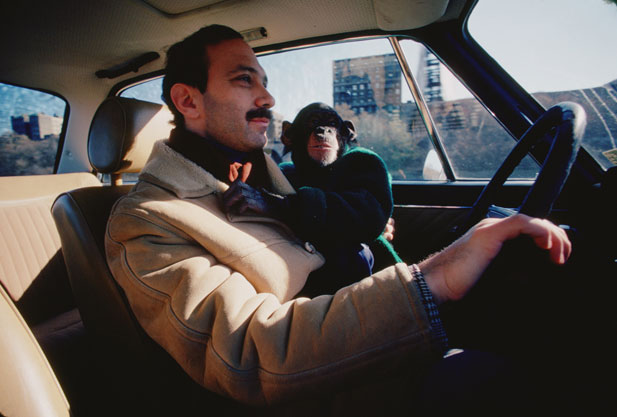
Two of "the good guys"—Bob Ingersoll and Nim Chimpsky

* After Noam Chomsky. "Get it?"

** I seem to be coming down hard on Terrace ("That's DR. Terrace..." he says at one point in the film), but he comes across as smug, arrogant...and a tad clueless in Marsh's film (Don't these folks know how they're going to come off?).  Also, slightly retributive.  After his slap-dash study—heavy on the personal agenda—ends he writes a book about the study saying "Nah...chimps don't use language because they have no syntax"—merely parroting words they've been taught to get what they want, without proper sentence structure, or tense. True. It's the same way I communicate with my dog, Smokey. We pick up on each other's "cues" of behaviors and words we recognize and respond appropriately. For example, if I command my dog to go to the bathroom (he does this by suggestion) and he doesn't "have to go," he'll simply sit.  Which tells me "No, really, it's not necessary. How about a cookie, though?" NIM was doing this with his trainers and with other apes...and taught other apes basic ASL (shades of Planet of...), just as he communicated with ape-cues to other apes. The thing that struck me about NIM (which I remember from some of the docs made when the study was going on), was that he learned to curse.  If he got mad at something, he'd make the sign for "Dirty," which was related to his toilet training. Nobody taught him that "Shit!" was an expression of frustration. He came up with that on his own. Explain that.

Wednesday, September 4, 2024

The Mackintosh Man

The Mackintosh Man
(John Huston
, 1973) One of the best kept secrets (until 1974, anyway) of the second World War was Project Ultra, the British operation centered in Bletchley Park tasked with breaking the German Enigma codes that scrambled their communications so as to be undecipherable. What the Germans did not know (because the British kept it secret) was that their dispatches were being regularly decoded and read, and their plans made known to forces in the field. This was a great boon to the generals who took advantage of the intel—many, including General Patton, did not—but there were times when the messages were merely shelved. The most egregious example might be the Coventry Blitz, although the facts are in dispute. Some authors (including the man who first shed light on Ultra) have claimed that Churchill knew of the devastating November 14, 1940 raid by the Luftwaffe, but did nothing to warn the populace or take counter-measures, lest it tip off the Germans that the code had been cracked, thus nullifying an important source of information and intelligence. If the Nazis knew their messages were being decoded, they might (probably would) make new measures to keep their transmissions secret. And so (the story goes) Coventry burned in order to keep the secret. War is not logical, and spycraft even less so, but there's an absurd madness there that parallels the Vietnam-era quote stated "we had to destroy the village in order to save it."
That logic (or lack of it) is much in display in John Huston's film of The Mackintosh Man (written by Walter Hill based on the novel "The Freedom Trap" by Desmond Bagley),
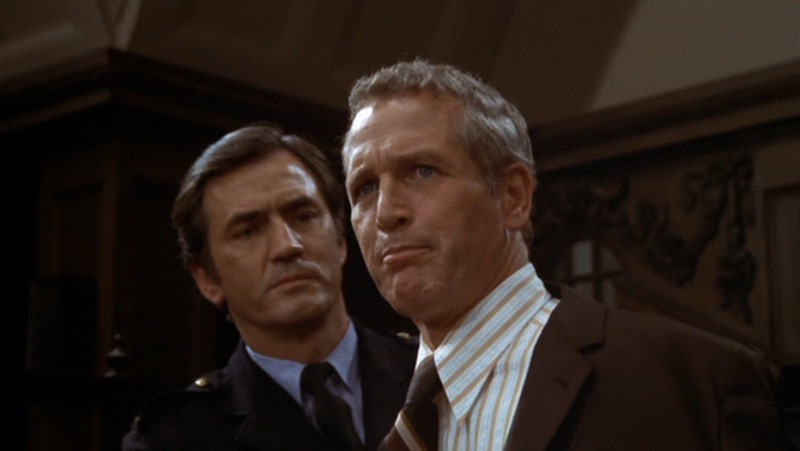
* a spy thriller the director made in Britain and Malta with Paul Newman. In it, a British Intelligence agent (Newman) is framed and sent to prison, in order to infiltrate a criminal organization. But, unknown to him, the deceit goes much deeper, as his superior, Mackintosh (Harry Andrews), is using the mission to ferret out a leak in information in the British government.
Once the agent, named Rearden, is sprung from prison by the conspirators, overseen by an enigmatic figure named "Mr. Brown" (Michael Hordren). Rearden and another prisoner, Blake (Ian Bannen), are spirited away to an unknown location, drugged and held until the police activity surrounding the prison break cools down. The escape causes a row in Parliament, led by a law-and-order lord, Sir George Wheeler (James Mason), who rails against the bumbling way in which the prisons and the law are handling it, until he is persuaded to cool down the rhetoric by Mackintosh, himself.

Things get complicated when Mackintosh is run down in the street, and the operation taken over by his deputy, Mrs. Smith (Dominique Sanda), who is now charged with a double mission—Rearden's and the murder of Mackintosh
.

Huston barely takes any of this seriously, even if Newman plays it straight, and Sanda—well, it's hard to tell if she plays it at all, her character being so enigmatic as to be undecipherable. But, it's all staged well (and photographed by the legendary Oswald Morris), especially a car chase through winding Irish country roads that looks dangerous as Hell, and Huston ends on a typically ambiguous note. But, he's made much better films about duplicity and duty (as has Hill, for that matter), and this one feels like a minor effort before tackling much more ambitious projects. His next film would be his long-planned adaptation of The Man Who Would Be King.

* This was around the era where Huston was no longer adapting classics, but beginning to take advantage of the scripts of the new college-class of film-makers, including Hill and (for his previous film) John Milius.

Tuesday, September 3, 2024

Bully (2011)

Today's the first day of school for a lot of kids. It will also be the first day of torture for a lot of kids who don't fit in and will be bullied by less mature kids who will take advantage...of any advantage. And it will be the first day that administrators of said schools will ignore the issue—say they're not responsible...until something terrible happens...and they can't run away from their irresponsibility anymore.

Written at the time of the film's release.

The Bully Pulpit

No man is an island,
Entire of itself.
Each is a piece of the continent,
A part of the main.
If a clod be washed away by the sea,
Europe is the less.
As well as if a promontory were.
As well as if a manor of thine own
Or of thine friend's were.
Each man's death diminishes me,
For I am involved in mankind.
Therefore, send not to know
For whom the bell tolls,
It tolls for thee.

John Dunne
 
 Bully (or as it was known "The Bully Project") dredged up such feelings in me, things I hadn't felt in years. The documentary, which follows several kids (hopefully surreptitiously, I worried that the cameras would just make their situations worse) through their days of being messed with, hassled, punched, tortured, abused by their erstwhile peers in school, recalled my own struggles in school. A late bloomer, a scrawny kid who always looked too young for whatever grade I was in, I had my share of bullying, frequently by the low members of totem poles of cliques, the low hanging fruit of the popular gangs, the pilot fish, the bottom-feeders of the jocks, the sosh's, who couldn't punch their way up, and so punched their way down. It always flows downhill.
The kids in the films are solitary, ill-defined. Not really excellent at things, and maybe at the wrong things. They're "weird." And so they're pushed and kicked further into their roles, segregated, marginalized. Food is stolen from their lunch trays. Pushed out of chairs. They're punished for just existing, for taking up space, breathing the same air.

A couple of them find Final Solutions for remedying those situations, leaving devastated heart-broken parents, who find it in themselves to fight back for their absent kids, against the institutions that allowed it, the thugs that took advantage of it, and the attitude that promoted it. They've gone through all the grief steps of Kubler-Ross...except for one—acceptance. The kids shouldn't have died, should have spoken out. But shame, learned helplessness, and depression prevented it. They never got out of the stage of self-blame, and their only solution was to eliminate the problem—themselves (in their mind)—and in so doing, end their pain.
A good night's sleep couldn't cure it. Talking it out would have brought embarrassment and no solutions—they would have faced the same stone walls their older and wiser parents can't negotiate after their deaths. They just took it...until they could take no more.
Efforts like "The Bully Project," and "It Gets Better" and other support systems can change the attitude of the afflicted to a limited degree...but not the attitudes of the afflicting. That would be nearly impossible; there is no listening to reason for something that can't be defended.
I related. I was picked on in school (although nothing to what is displayed in Bully). To cope, I developed a wicked sense of humor—sardonic, and barbed if it needed to be. I gravitated towards others who stood apart from the "A-Team" and formed a posse of sorts. There's safety in numbers. I developed a passive-aggressive attitude, combined with a quick temper, mercurial, fast and over-the-top, partially because it was so repressed and pent-up, but also because it was efficient. If I was in trouble, it would flash, and if that didn't work, I'd run. I also developed a chip on my shoulder and an effective sparking glare that would scare people, even girlfriends. I'm a result of that bullying and the frustration in handling it (or not). I've mellowed over the years. But it's still there, under the surface, buried in my thoughts. Long after the names of the bullies have left my mind, I still remember the slights and how I dealt with them. I've developed the attitude to just not interact and I still do. Life is short. Why waste it in frustration? Why waste it at all?  I've put away lots of childish things, but the armor developed by the bullying still remains, dormant, but a part of me.

Dormant, maybe, but Bully dredged all this up.  I won't be seeing it again. It, like everything else, is in the past. The future is all that matters. People deserve futures. It's their birth-right.

The view from 2024: The Weinstein Company, which distributed the film, got some flack for charging people to see it. "South Park" even took a dig at it, saying "If everyone should see it, why not put it on the internet for free." It is...now. On Tubi and the CW. Everybody else makes you pay...YouTube lets you see it with ads and my head spins with what they could insert that would be appropriate.  The PBS series "Independent Lens" aired it...for free, without ads...but you can't find it on their web-site.
Further addendum: And wouldn't you know. The day after I publish this...another school shooting, perpetrated by a 14 year old. No one should draw any conclusions until investigations are done as far as motivation and history. But, knowing them won't bring those two kids and those two teachers back. Neither will thoughts and prayers. Pre-emptive counseling and a decent gun-safe could've prevented it. It's just that...these things are happening like clockwork...and they shouldn't be. One may no longer be surprised...but nobody should be less than heart-broken.