
or
"A Colonialist in Chains...Now I Have Seen Everything"
When last we left (and, I'm sure, regretfully) Wakanda, they were ending their fearful (if understandable) isolation and establishing an outreach program into the wider world, no longer hiding in plain sight, sharing their culture, their knowledge, but not their wonder-mineral vibranium. The world is not ready for that (although they continue to try to possess "by any means necessary").  They're not alone in that. The U.S. is trying to get their own vibranium deposited deep in the Atlantic Ocean, with a new device that detects the stuff. But, before any extraction can be done, there's an attack on the ship where the crew inexplicably jump like lemmings into the sea, impelled by a strange sonic attack of an unknown origin, and a helicopter attempting to escape is grabbed and thrown to a catastrophic end into the sea. Was it Wakanda? How? Even Wakanda doesn't know.
 The answer comes from the sea. While Ramonda and Shuri are holding a private ritual ending their mourning by burning their ceremonial white robes, they are approached by a human rising from the water with wings on his feels and fire in his eyes. He is K'uk'ulkan or Prince Namor (Tenoch Huerta) of the undersea kingdom of Talokan and he loves what they've done with the place (the water is so clean! And the air is so fresh!), but not so much in his neck of the ocean, so he warns them. His people have stopped another attempt to take vibranium—this time from the ocean floor with a device that is specifically designed to detect it. As it is Wakanda's responsibility to police the mining of the stuff, they'd better get a handle on it, especially in his territory of the sea. If they can't, he'll see to it personally and with less restraint. His first aim is to find the person who created that vibranium detector and if Wakanda doesn't hand them over to him, he's not willing to wait and he'll take action against the people responsible and Wakanda, as well.
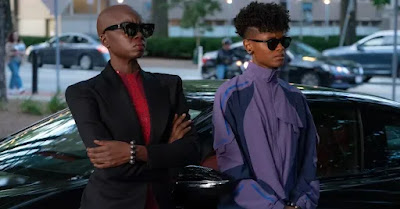 Okoye and Shuri contact their "favorite colonialist" Everett Ross (Martin Freeman), who knows who made that vibranium detector. She is MIT student Riri Williams (Dominique Thorne), who apparently has the "McGyver"-like ability to make a flux capacitor out of scraps taken from your recycle bin. Not only did she make that detector, but she's working on her own "Iron Man" suit because...well, MIT must have a liberal extracurricular activity program. But lousy security. When the two Wakandans contact Riri, they must first get by a raid by the FBI and then the Talokans, who take Shuri and Riri captive.
 Queen Ramonda is furious with this. She demotes Okoye of her rank and then sends for Nakia (Lupita Nyong'o), former Dora Milaje and War Dog spy to infiltrate Talokan and rescue the two scientific geniuses who can't seem to rescue themselves.
 Well, it just gets more complicated from there. Ultimately it turns into a war between third world countries, tribe against tribe, while both should be looking at the real threat, which is the supposedly industrialized nations (although they pale when compared to Wakanda) trying to get their empirical mitts on the resource the two warring factions share. It seems to be a case of not keeping your eye on the vibranium ball, but that's what happens when things get personal. You lose the big picture when you're the target of the attack.
 But, as frustrating as that is—and aren't all wars fundamentally frustrating?—one must acknowledge the complications. Coogler displayed in the first Black Panther a penchant for world-building that went beyond decor and here, he does the same sort of thing for the Talokans (in a way that seemed to escape the DC Aquaman movie), creating a murkier version with more natural materials, and enough back-story to create the grudges necessary to sell the thing.
 But, more than that, this movie is a bit of a miracle in that, even if it isn't as artistically successful as the first Black Panther movie, it is successful enough without its lynch-pin title character present (and its charismatic lead actor irretrievably absent) and, instead, depends on the superb supporting cast that enriched its predecessor. Imagine a Batman movie without Batman. Nope. Not gonna happen. But, Black Panther: Wakanda Forever is engaging even without a Black Panther character for the majority of its running time (consider that a SPOILER alert). I can't imagine another film franchise that would be able to pull that off and get away with it, let alone excel in its own way.


Prince Namor ("The Sub-mariner") has been around since 1939
Black Panther: Wakanda Forever begins with the acknowledgment that its MVP, Chadwick Boseman, who has played "The Black Panther" in all the previous Marvel movies, is dead. Much tribute is made, deservedly, but the most important thing the movie does right off the bat is to say that the actor (and the character) are irreplaceable, too irreplaceable to even try. In a movie industry where actors are replaced with the drop of a salary demand or a controversial tweet (and a genre that is still trying to come to grips with multiple actors playing a single character), this is refreshingly noble. And rare. Already, the movie re-establishes that air the original had of being a labor of love rather than a labor of commerce.  King T'Challa, the former Black Panther, protector of Wakanda, has died of an unspecified disease. The country mourns the loss, but none more than T'Challa's sister, Shuri (Letitia Wright), princess and technological whiz-kid, who only knows that for all her brilliance and skills, she could not save her beloved brother. Now the kingdom is ruled by Queen Ramonda (Angela Bassett) with no protector, no Black Panther, but the more-than-capable army of the Dora Milaje, led by General Okoye (Danai Gurira). She's going to need them. At a United Nations meeting, she is pressed by the U.S. (Hey, Richard Schiff's in the Marvel Universe!) and France to share Wakanda's resource of vibranium, which she steadfastly refuses.
 She gives them something else, instead. A big lesson in "Don't Mess With Me." The entrance opens and Okoye and her troop bring in some French soldiers who had tried (unsuccessfully, of course) to steal some vibranium. Ramonda lays down the law. Nobody is going to get the stuff for its potential for weaponry. If anybody tries it...well, they better not. Wakanda's memory is also forever.


As these super-hero movies start to merge together and become indistinguishable from one another, that is a remarkable accomplishment.

Wakanda forever!


