Sunday, December 5, 2021

Don't Make a Scene: Casino Royale

The Story:  In the book, it goes like this—James Bond ordering a drink (with his CIA counter-part, Felix Leiter) in the novel "Casino Royale":
'A dry martini,' he said. 'One. In a deep champagne goblet.'
'Oui, monsieur.'
'Just a moment. Three measures of Gordon's, one of vodka, half a measure of Kina Lillet. Shake it very well until it's ice-cold, then add a large thin slice of lemon peel. Got it?'
'Certainly monsieur.' The barman seemed pleased with the idea.
'Gosh, that's certainly a drink,' said Leiter.
Bond laughed. 'When I'm ... er ... concentrating,' he explained, 'I never have more than one drink before dinner. But I do like that one to be large and very strong and very cold, and very well made. I hate small portions of anything, particularly when they taste bad. This drink's my own invention. I'm going to patent it when I think of a good name.'
 
— Casino Royale, Chapter 7: Rouge et Noir

In a later chapter, he will dub it "The Vesper" after his co-worker in the assignment to bankrupt Le Chiffre, and with whom he falls in love, intending to leave The Service. Given the ensuing circumstances, Bond never mentioned the drink or ordered it as that again.

And, of course, when the films came out "the Vesper," although never called that, became part of the regular espionage kit. Although, in the first film (Dr. No) he doesn't order it, the villain does (apparently knowing everything about Bond); Bond won't order a vodka martini "shaken, not stirred" until Goldfinger. A contact in You Only Live Twice gives him his drink stirred, not shaken and Bond doesn't contradict him. And on and on until you can't have a Bond movie without it. And it's becoming so ingrained in culture that when the heroine of Last Night in Soho orders a drink, she orders a Vesper. It being the 1960's and all.
The In-vesper-ture in the series does finally occur when EON had their first chance to make their own film of Casino Royale (long litigious story)...and Daniel Craig's Bond drinks a LOT of them. Although the film-makers weren't above playing with the cliche, as when after a bitter defeat, Bond goes to the bar, orders, and the bartender asks "Shaken not stirred?" and Bond replies "Do I look like I give a fuck?" (per the original script—Daniel Craig says it was just one of the enticements to take the role, although it was tamed to "damn" as the film was already teetering on the edge of an "R" rating).
 
And, there's the debate: is it any good? The case against was wittily argued by President Jed Bartlett (Martin Sheen) on "The West Wing:"
The counter-argument is that shaking it distributes the cold more thoroughly and faster, but might "bruise" the gin portion. Then, there is the shrill argument from purists that a martini—to be a martini—must be either gin or vodka, but never both. For Fleming, the vodka killed some of the gin taste, kept the alcohol content high, and eliminated the traditional vermouth (which is a fortified wine, so "never mix, never worry, purists?").

The counter-arguments, like a bad hangover, come full circle to "the hair of the dog that bit you": Fleming, creator of both Bond and the Vesper, would later write to the Manchester Guardian (April 5, 1958): “I proceeded to invent a cocktail for Bond, which I sampled several months later and found unpalatable.”
 
As the gourmands—but not the gourmets—say, it comes down to taste, doesn't it?
 
Please drink responsibly.
The Set-Up: Newly installed "00" James Bond (Daniel Craig) has been following a string of attempted terrorist attacks that seem to be connected. After all the running around and getting bruised and battered, he's given a softer assignment: follow the money. Taking advantage of his gambling skills, he's assigned to thwart the mastermind's attempts to recoup his debts in a big poker match at the Casino Royale in Montenegro. Before he gets his money, Bond decides to get his goat...and his "tell."
 
Ante up.
Le Chiffre now lays his cards down. He holds both black 2s. Le Chiffre has a full house.

DEALER A full house... 
DEALER ...to Monsieur Le Chiffre. Deuces full of nines. 
DEALER (to Bond)
Mr. Bond?
DEALER Fold. 
Bond shakes his head, throws his cards away, provoking a buzz from the crowd.
Le Chiffre can't believe his luck, rakes in the chips, a glint of triumph as he eyes Bond.
In forcing him to show the pair of twos, Bond has stripped him naked, and Le Chiffre reads this in his eyes.

BOND (to dealer) Send the... 
BOND ...barman over, please.
The dealer is somewhat surprised at this request,
but indicates for the barman to come over.
Le Chiffre watches all this with festering irritation.
The barman arrives:
BOND A dry martini. 
BARMAN Oui, monsiuer.
He's about to go.
BOND
Wait. Three measures... 
BOND ...Gordon's, one of vodka...half of Kina Lillet, shake it over ice...
BOND ...then add a thin slice of lemon peel.
BARMAN Yes, sir.
The other players and even the dealer have been quietly mesmerized by this performance. 
As the barman starts off:
WOLPERT You know, 
WOLPERT I'll have one of those.
INFANTE So will I. 
BARMAN Certainly. 
Le Chiffre's patience is at an end, he looks about to burst. 
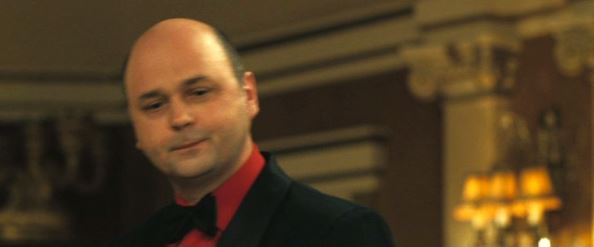
The barman starts away, 
and suddenly:
LEITER My friend, 
LEITER bring me one as well. Keep the... 
LEITER ...fruit. 
LE CHIFFRE That's it? 
LE CHIFFRE (to Bond) Hm?
LE CHIFFRE Anyone want to play poker now?
Bond smiles to himself, having succeeded in riling him.
LEITER (to Bond)
Someone's in a hurry.
The Dealer distributes cards. Le Chiffre quickly throws his cards away, disgusted with them. The player to Bond's right calls.
Bond folds.


Words by Neal Purvis and Robert Wade and Paul Haggis (and Ian Fleming)
 
 
Casino Royale is available on DVD and Blu-Ray from MGM Home Entertainment, Sony Pictures, and Fox Home Entertainment.


Saturday, December 4, 2021

The Wolverine

Written at the time of the film's release...

Ronin on Empty
or
The SNIKT Hits the Japanese Fan

The last Wolverine movie—which was also the only entry in the "X-Men: Origins" series—was not very good. But, like Wolverine healing from his wounds and coming back whole, hope springs eternal like adamantium claws, and there were enough interesting aspects to The Wolverine that one wondered if this time they might have got it right. They were basing it on the Chris Claremont/Frank Miller mini-series from way, way back, and the director is James Mangold, who did Cop Land and Walk the Line. I mean he's no Darren Aronofsky (who he replaced on the project), but maybe, just maybe...

It tries very hard.
The script went through the hands of many writers, some of them quite accomplished—Christopher McQuarrie, Scott Frank—and Mark Bomback, who wrote Unstoppable and Live Free or Die Hard. It retains some of the Claremont-Miller story, like the beginning with a self-exiled Wolverine living in the mountains, and his dealings with a bear and its careless hunter, but abandons most of it, causing it to suffer from serious story-bloat. There are echoes of the original throughout—a mention of a bullet-train from the story turns into a full-fledged battle on the top of one in this—but instead of echoes, we have the roar of something almost wholly new, adding other elements and characters from other stories in the canon (thankfully limited to this world). For example, it gives us a back-story of how Logan 
(Hugh Jackman) first met the man he will be dealing with in the movie—Yashida (Ken Yamamura in these scenes, then aging to Hal Yamanouchi).It's World War II, and he's in a Japanese prisoner of war camp, conveniently close to the city of Nagasaki, just when the second atomic bomb is dropped. Logan shields the POW guard from the effects of the blast that crisps Logan, but, no worries, he heals from the effects in five minutes, although very painfully.
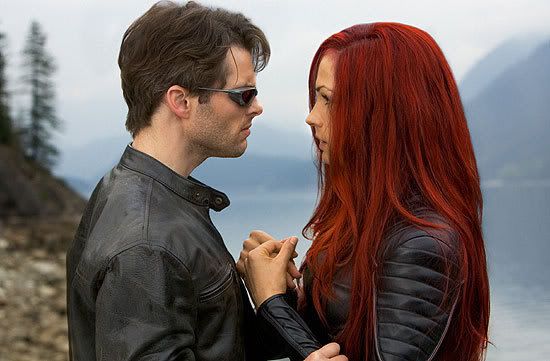
Fast forward. When we find Logan in the present, he is haunted by nightmares of his dead love Jean Grey (Famke Janssen). As she died in the egregiously terrible X-Men: The Last Stand, I know exactly how he feels—I'm still bitter about how they atomized the Scott Summers/Jean Grey relationship in that movie. While he's attending to the bear hunter in the bar, he's confronted with the pint-sized assassin Yukio (Rila Fukusima), who, in her stealth ninja style has electric red hair. Fascinating. She is in the employ of Yashida, who requests the man who saved his life at Nagasaki to do him a service before his death.* That would be in the form of relinquishing his mutant-powers to him. Makes sense—he's dying and wants to live forever, while Logan is living forever and hates it. Nobody's happy, so why don't we switch each other's green grass. Well, despite his oft-professed existential pain, the mutant either has a change of heart or he just knows how to position it and says that he would never curse someone with his everlasting powers, so, thanks but no thanks.  

Easy for him to say, he's living forever.

Yeah, I know Frank Miller likes it, but I never "bought" the
"Claws-stops-samurai sword" variation of Rock/Scissors/Paper.


Yashida dies (thanks, Wolverine!), distressing his family, including daughter Mariko (Tao Okamoto) who is attacked and threatened with kidnapping at her father's very public funeral.  So much for stealth.  At this point, it becomes a chase between the forces trying to kidnap Mariko (but who?) and some mysterious forces behind it all. Oh. And fights. And chases. And Logan gets hurt. And fixes himself, because that's what he does, even if it undermines any sort of tension that he actually might get killed.
Why do they usually change the comic-costumes of characters? 
Because they look stupid, that's why!
 
What Claremont and Miller cooked up in their mini-series was okay, if slightly uneventful. But without the Mariko-Logan back-story of the original tale, what Mangold and his writers have done is complicate things...a lot, drag in a standard Marvel villain, Viper (played by Svetlana Khodchenkova) (or Madame Hydra, as she was occasionally known and they dress her up in the customary cut-away latex thing the character always seemed to wear) and basically start from scratch, occasionally waving at the original story.
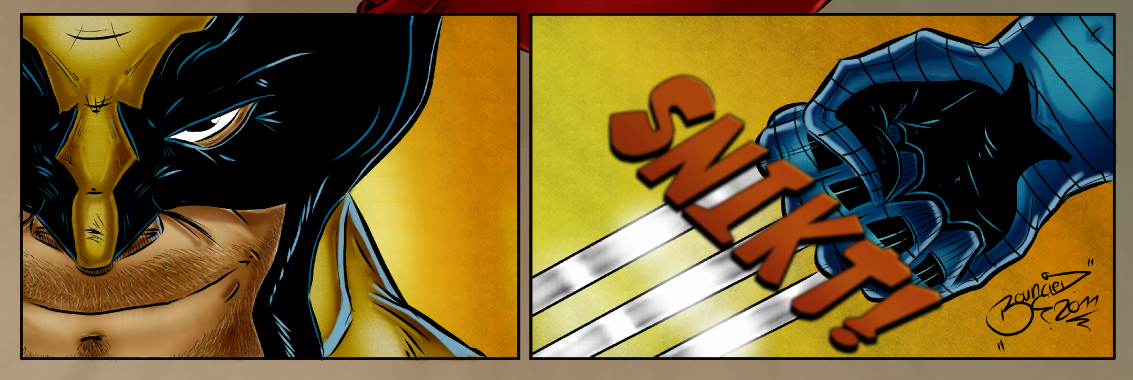
The whole thing feels convoluted and clunky and only brings some surprises if you've actually read the comic books—standard movie-goers just get the usual twists and turns that they can see coming a mile away. Mangold does try and bring something to the fights, but, with a PG-13 rating expected for the thing, there's only so much slashing that can be done in anything more than a suggestive fashion. As with the other X-men/Wolverine movies, you aren't shown the cleavage that happens when the
SNIKT! hits the fan. For all the talk of the character's bad-assery, the violence that his powers implies and the fan-boys want to see will always be ham-strung by the movie ratings system.
Despite Jackman's performance (and he'll always be associated with this role no matter how many musicals he'll do) this one doesn't feel fresh or fun, recycling a lot of material, but more so. That centerpiece fight on top of a bullet-train is the same sort of thing we've seen before—and recently in James Bond, Spider-man and The Lone Ranger—but the same stuff is being done, just faster and less impactful. Despite the constant threat of falling off or de-capitation (for Wolverine, everything will just heal), how can you make a fight on a bullet-train dull?
Well, maybe not so much dull as ludicrous.
Stick around as the credits roll out, though, for a couple of essential appearances—one of which is very surprising—that will lead into X-Men: Days of Future Past, which will attempt to unite the original X-men films with the "First Class" ret-conning to smooth out some of the two series continuity issues.  

Really, does it matter? How about just concentrating on making a better movie, like the First Class formula-blaster was?
Okay, I REALLY don't buy the claws stopping the Silver Samurai's sword.
("The Silver Samurai??")

 
* Wait a second here.  Wolverine saves HIS life at Nagasaki, and pulls him all the way to Japan to do this? I know he's an international crime-lord and all, but that's really against any "pay-back" principle or criminal code of conduct I've ever heard of. "You saved my life, so to repay you, I'm going to ask you to save it again." Oh. Well!  When you put it THAT way!

Thursday, December 2, 2021

Deadfall (1968)

Deadfall
(Bryan Forbes, 1968) Middling Bryan Forbes drama starring Michael Caine as a cat burglar hired by a safe-cracker (Eric Portman) for a nearly impossible job. Actually, the burglar, Henry Clarke had been casing this job for awhile and has checked into a sanitorium to get close to his target, but he's lured into working with the much older safe-cracker by the man's much-younger wife (Giovanna Ralli). Consulting with the couple, the Moreaus, it is decided that they will do a trial run robbing the strong-box of another socialite, with Henry scaling the walls, gaining entrance and then letting the husband, Richard, into the house to break into the safe. The socialite couple will be attending a concert on the prospective night and while they're safely enjoying the performance, the two men will do their night-time prowling, which will involve drugging guard dogs, and Clarke scaling the outside of the mansion, having to perform a maneuver, called a "deadfall", where he must drop from a rooftop to a lower ledge without benefit of a supporting rope.
Now, just the fact that I mention that should alert anyone that Clarke is taking more risks than he should. He does, after all, use a rope to scale the outside of the estate—couldn't he, then, move the rope (or take a second one) to avoid having to perform that risky maneuver? But, no, it doesn't happen that way for the sake of ginning up the suspense, the task of a night robbery being risky enough.
But, then, the whole movie is like that. There are so many lost opportunities and so many unnecessary risks in this less-than-perfect crime that you wonder why nobody questions the job, the partnership, anything for what looks, on the face of it, to be a hopeless enterprise.
Most of the blame must fall on Forbes, who wrote and directed, and had the interesting idea to stage that first robbery to a concert performance. His favored composer, John Barry, wrote an original piece for the film—"Romance for Guitar and Orchestra"—which would serve as the background for the robbery sequence, cutting back and forth between the concert, the robbery, and the villa's staff listening to the concert over the radio. It's the same strategy Alfred Hitchcock used for the meeting of the conspirators and victims at the Royal Albert Hall in his second version of The Man Who Knew Too Much, and as Hitchcock used his composer for that picture, Bernard Herrmann, to conduct on-screen, Forbes had Barry appear as conductor. Interesting little trivia item, and Barry wouldn't appear on-screen again until serving as an orchestra conductor in The Living Daylights, his last film as composer for the James Bond series.

It's a great idea—except that Forbes can't even do that right. Barry does his job—he'd been writing romance and action cues throughout the 60's, and he'd learned that he didn't need to ramp up the pace for action sequences. But, Forbes' penchant for unusual angles and POV makes the performance footage less than interesting. The interest is far more on the robbery, which is shot well, but is rather ruinous in what happens—at one point it becomes apparent to Clarke that Moreau can't open the safe and he begins yelling (Shhhh!) and comes up with a plan B to take the safe by hammering it out of the wall.
Okay, the shouting rather kills the mood of the music, a slight offense, but then, Forbes has Caine hammering the wall...in total silence. Wouldn't the noise—and vibration—alert the staff sitting, a couple hundred feet away, enjoying their dinner to something going on—even if they weren't depending on an alarm system that Clarke had already cut? Does the music playing over the radio—and the soundtrack—mask what is some very concussive noise? One cannot have it both ways and it's stylistically patting one's head while rubbing their belly. It's a very bizarre sequence And baldly contrived.
One wonders why he did it this way; there's a long history of film-heists done in silence and stealth, and this one has neither. Forbes was very much a part of the "Swinging 60's" period of British film-making, but his films were not revolutionary, despite his stagings and sometimes pointlessly arty framing. His films are curiosities, not classics, and every so often they seem to lose the point and get distracted by some half-hearted flippancy. Watching them, they seem to exist in a world that doesn't make much sense and half little to do with the real world. 
 
Good music, though...

Wednesday, December 1, 2021

Edge of Darkness (1943)

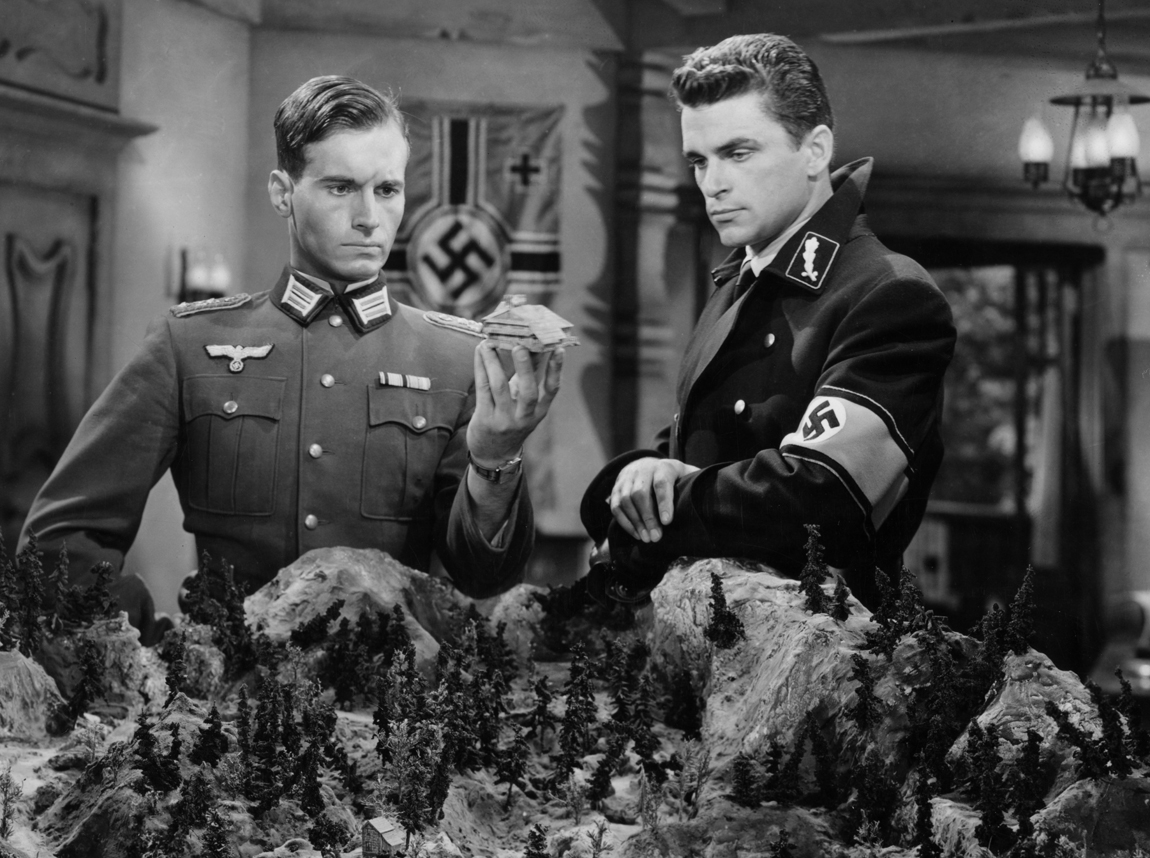
Whenever I was doing any sort of search for "Edge of Darkness"—one of the "Anytime Movies" from here—I would have to distinguish it was the 1985 British mini-series...or, eventually, the 2010 film adaptation...or another film done back in the 40's. I was always curious about that wartime propaganda film, and thanks to TCM I finally got to see it a couple weeks back.

Edge of Darkness
(Lewis Milestone, 1943) A German reconnaissance plane flies over the occupied town of Trollness, Norway to find the unusual circumstance of a Norwegian flag flying over one of the buildings. The crew radios back to send a squad to find out why the expected Nazi flag of Germany isn't flying.
 
When troops are sent out, they find a town of corpses. They're everywhere—German and Norwegian alike—filling the streets, even going up to the Nazi commandant's office, where he still sits upright in his chair, dead. There has been a massacre and Trollness is deserted, save for one townsman, raving and extolling the Nazi's. He's clearly off his head, so they execute him without a second thought. So much for loyalty.
 
Being Nazi's, they probably wouldn't have spared his life even if they'd known his past. He was Kaspar Torgerson (Charles Dingle), the well-to-do owner of the town's cannery and their strongest supporter in town: as long as the Nazi's were in control and there were no conflicts, no danger of strikes, and the cannery kept running and he was making money, what could be the issue with them? And Torgerson would only be too happy to report one of his neighbors to the Nazi's as a troublemaker (which in the Nazis' view is "every man, woman, and child!"—and here I thought Nazi's discriminated)
The thing is, most of those "troublemakers" are relatives of his. Oh, brother-in-law Dr. Martin Stensgard (Walter Huston) remains neutral—presumably to "do no harm"—and his wife, Anna (Ruth Gordon) is merely passive. It must skip a generation because one of the most ardent members of the underground is their daughter Karen (Ann Sheridan), who, with lover Gunnar Brogge (Errol Flynn), heads the Nazi resistance—there are 150 Nazi occupiers and over 800 villagers, but as the Nazi's say "we have guns and they are afraid to die"—so the villagers  must wait until arms are delivered to them from English submarines—it is, after all, a fishing village and boats are going out all the time.
Not that everybody is on board with the idea: Stensgard's son (John Beal), recently returned from university, is considered a Nazi sympathizer, and the town's priest (Richard Fraser) lectures from the pulpit about violence and God's judgment. And some folks, like the doctor, just don't want to get involved. But, if there is one thing Nazi's are good at, it's they can turn apathetic villagers to angry action. They're just like Frankenstein that way. It's the only thing they are good for.
Fairly soon, the arrogance turns to harassment then to rape and murder and even the most faint-hearted are soon flogging Nazis in the street, which allows the situation to escalate to horrific displays of aggression and violence that doesn't allow for any nuance of philosophy or conscientious objection...like any good piece of propaganda should. Made in 1943, it was a well-oiled agitprop by the studio that jumped on the war wagon first, Warner Bros. So, the performances are resolute and clear-eyed earnestness set against mustache-twisting villainy. Milestone, who'd started out in the silent era and who's All Quiet on the Western Front had won the Best Picture Oscar thirteen years earlier knows how to keep things moving quickly while not hesitating at outright manipulation to get the point across. Finish it off with Roosevelt's "Look to Norway" speech and you have a story that Americans can relate to, two years into the war effort.