Sunday, April 11, 2021

Don't Make a Scene: Four Weddings and a Funeral

The Story: This scene from Four Weddings and a Funeral is in the "Top Five Embarrassing Man-Woman Movie Scenes in a Diner"—I'm sure there's some "Internet-Click-Bait" article like that somewhere around.* In it, the deliberately scruffy and confirmed bachelor Charles—what IS his last name? (It's not even on his wedding invitation), who has had a little sexual involvement with Carrie, discuss the extent of her sexual involvement. 

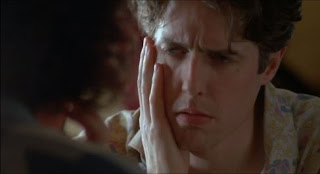
There are all sorts of sources for comedy in this scene: there is Carrie's long history, that she remembers everyone in vivid detail, that Charles is 1) surprised 2) alarmed 3) out-matched and 4) befuddled to the point where he is clawing at his face in response, and that as the answer goes on, he wishes he had never brought it up. There is the struggle he maintains to keep everything light and funny, while giving in to these sudden shocks to his system and not look like a jerk. It's a bit of a losing battle.

The cutting helps. It starts slowly back and forth, doing the "we're together/we're apart" movie "thing" starting with the two-shot of the pair just bantering together, and then, when Carrie starts to count—and recount—they're in separate corners and separate shots, the cutting back and forth favoring Carrie and coming back to Charles for reactions, which increase in rate the longer she talks.

The post-production team also play a little audio trick, not too unlike the scene in Taxi Driver where the camera exits the scene of a phone-call, reflecting the character's own desire to end the conversation. A couple of times, Carrie's words are lowered in volume to break the monologue in points where there is no obvious comedy, just more of the ticking off of numbers. In those spots the volume of the MUZAK background is dialed up, reflecting Charles "zoning out" the information due to his increasing discomfort. Nothing big, but a nice little touch.

It's a funny scene, played expertly. 

The Set-Up: "Serial monogamist" Charles (Hugh Grant) meets American Carrie (Andie MacDowell) at Wedding #1, sleeps with her, sees her again at Wedding #2 and meets her fiancĂ© (Corin Redgrave), sleeps with her—again—then runs into her after receiving her wedding invitation and helps her make a final decision on her wedding dress. They go to lunch—as Charles has 30 minutes before he goes to meet his brother—so there's time for small talk...as long as it's not long and involved, and since Charles and Carrie basically flirting, there's no danger of that...

Is there?

Action...

CARRIE:
Anyway, I reckon I've had my fair run at it. 
CHARLES:
What is a fair run these days, down your way? 
CARRIE:
I don't know. More than one. 
CHARLES: Well, come on. Tell me. I've seen the dress. We have no secrets. 
CARRIE:
Well... 
CARRIE:
 The first one - of course, not easily forgotten - was kinda nice. 
CARRIE:
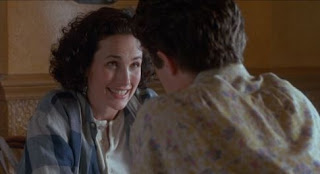
 Two... hairy back. Three, four, five... Six was on my birthday in my parents' room. - 
CHARLES:
 Which birthday? - 
CARRIE: Seventeenth. - 
CHARLES: We've only reached 17? - 
CARRIE:
 I grew up in the country. Lots of rolling around in haystacks. OK... 
CARRIE:
 Seven...
CARRIE:
 ...hmmm.
CARRIE:
 Eight, unfortunately, was quite a shock. Nine, against a fence. Very uncomfortable. Don't try it. 
CHARLES:
  I won't. 
CARRIE:
 Ten...oh, was gorgeous. 
CARRIE:
 Just heaven, just...uh, He was wonderful. - 
CHARLES:
I hate him. 
CARRIE:
 Eleven, obviously after ten, 
CARRIE:
 ...disappointing. 
CARRIE:
 12 through 17, the university years. Sensitive, caring, intelligent boys. Sexually speaking, a real low patch. 
CARRIE:
 Umm, 
CARRIE:
 18 broke my heart. Years of yearning. - 
CHARLES:
I'm sorry. 
CARRIE:
 20...Oh, my God! I can't believe I've reached twenty. 
CARRIE:
 Twenty-one, elephant tongue. 
CARRIE:
 22 kept falling asleep. That was my first year in England. 
CHARLES:
I do apologize. 
CARRIE:
 Twenty-three and 24 together. 
CARRIE:
 Now, that was something. - 
CHARLES:
Seriously? ... 
CARRIE:
 Twenty-seven...oof, that was a mistake. - 
CHARLES:
Suddenly at 27 you make a mistake? - 
CARRIE: Oh yes, he kept screaming. 
CARRIE:  Very off-putting. 
CARRIE:
 I nearly gave up on the whole thing. 
CARRIE:
 But Spencer changed my mind. That's... 
CARRIE:
 28. His father-29. 
CHARLES:
With his father? . 
CARRIE:
 Mmmm, 30, ugh. Thirty-one... 
CARRIE:
 ...Oh, my God. 
CARRIE:
 Thirty-two - was lovely. 
CARRIE:
  And then un fiancĂ©, that's 33. 
CHARLES: Wow! 
CHARLES: So...
CHARLES:
...I came after your fiancĂ©? 
CARRIE:
 No, you were 32. 
CHARLES:
Oh.
CARRIE:
 So there you go. 
CARRIE:
 Less than Madonna, 
CARRIE:
 ...more than Princess Di - I hope. 
CARRIE:
 And how about you? How many have you slept with? 
CHARLES:
Christ! Nothing like that many. 
CHARLES:
 I don't know... I don't know what the fuck I've been doing with my time. 
CHARLES:
 Work, probably. Yeah, work. I have been working late...
CHARLES:
 ...a lot.


Four Weddings and a Funeral is available on DVD and Blu-Ray from M-G-M Home Entertainment.


* I did a Google Search—and yes, there are.

Friday, April 9, 2021

Godzilla vs. Kong (2021)

We're Off to See The Lizard, the Marvelized Version of Kong
or
Four-Walling in the Time of Covid

Warner Bros. and Legendary Pictures have been making their own version of superhero movies for the past few years, starting with Godzilla in 2014, followed by Kong:Skull Island, and Godzilla: King of Monsters. The last movie teased a battle between the two movie-title monsters, now in the "Monarch" Monsterverse, referred to as "Titans" who usually hang out in the Hollow Earth, until we do something stupid to bring 'em out in the open. 

Personally, I think what brought out these movies was Guillermo del Toro's 2013 film of Pacific Rim, where he channeled his love of big monsters duking it out in big modern—vulnerable—cities. The filmed from a cell-phone version of Cloverfield (2008) might have had something to that...inspired as it is by Bong Joon Ho's The Host (2006) and Peter Jackson's remake of King Kong (2005). All that chance to use modern computer graphics and psuedo-technology to make a movie about big monsters fighting appeals to the child (and WWF fan) in all of us. If they didn't make money, they'd disappear into the sea with the setting sun— like Godzilla, but without the buzz-headache from hitting electrical lines.
So, here comes Godzilla vs. Kong, the mash-up of the two tent-poles in the "Monarch" Monsterverse, and "The Top of the Ticket" if one were to see this as an evening of boxing. It is a goofy affair, mixing up traditions of the earlier Toho films (with a much larger scale), a little Jules Verne mixed in for exotica, and a little "zhuzh" from the Marvel Universe to add merchandisable personality, and to keep the fights from seeming like endless slugfests. It also leeches any identifiable humanity out of its story, and, for that matter, The Earth, relegating people to "slow natives" status, and "chutes and ladders" to connect the big fights (of which there are four).
The film has four primary locations: Skull Island—home of King Kong—which is now encircled by a force-field enclosing the "King of the Beasts" from wandering into people's neighborhoods and eating their houses; Pensacola, Florida, where the APEX corporation is engineering A.I. technology with advanced robotics; the Antarctic, where a Monarch research station has made a foray into the "Hollow Earth" deep in the Earth (but wouldn't Skull Island be a more logical entryway, since that's where these beasties have come from?); and Hong Kong, where APEX has a vast engineering facility. With me so far? Good, because you'll get lost soon enough.
At Skull Island, Kong is being studied by Dr. Ilene Andrews (Rebecca Hall), the so-called "Kong Whisperer" who's a bit like Dian Fossey, except that her studies of The Big Guy are facilitated with the help of a native Iwi girl named Jia (Kaylee Hottle), a deaf-mute who can communicate with Kong. She is (evidently) the last Iwi tribesperson, her parents and everybody else being reduced to Skull-walker fodder or Kong toe-jam. Dr. Andrews has adopted the girl, and, as such, the whole movie would make damning evidence at a Child Welfare hearing.
She is approached by Dr. Nathan Lind (Alexander SkarsgĂĄrd), a former Monarch scientist, and developer of the "Hollow Earth" theory (which conjectures that the Earth doesn't have a core so much as a hollow center, like a chocolate bunny, from whence all the "Titans" have emerged, and evidently has never heard of the term "lava". As we get to witness (sort of) Godzilla has gone "rogue" and attacked the APEX facility in Pensacola, and Lind asks Andrews to use Kong to get a powerful energy source that emanates from the Hollow Earth to use as a weapon against The Lizard, should he ever show up and attack again. "Sounds nuts, Nathan. Even for you," she counters and then agrees to take Kong and Jia, and shackle him to a transport for a trip to Antarctica. "I regret this already," she rehearses for her trial. But, not as much as she's gonna regret it.
What caused Godzilla to attack the APEX plant is unknown to the public, but it might have something to do with a power source that is being developed there under the jurisdiction of its CEO, the laughably hissable Walter Simmons (Demián Bechir), and it is he who has recruited Lind to find and contain the "Hollow Earth" "life force" because A) they can use it against Godzilla unless he wants to exert his "cancel culture" privileges on APEX, and B) he can use it to (dare I say it?) RULE THE WORLD. Elon Musk would have started a travel agency to "Hollow Earth" but, no, Simmons wants all the power he can, and he's not going to stop at voter suppression.
This is all suspected by wackadoodle conspiracy pod-caster (and former APEX employee) Bernie Hayes (Bryan Tyree Henry) who was stealing APEX secrets at the time of Godzilla's attack, and he has a big fan in Madison Russell (Millie Bobby Brown) who has seen Godzilla up-close (in King of the Monsters) and happens to have a Dad (Kyle Chandler) who's a research scientist—he invented the ORCA device in King of the Monsters—and a Mom who was killed by Godzilla in the same movie. But, she doesn't hold a grudge; she and school-pal Josh Valentine (Julian Dennison) steal his brother's van and seek out Bernie to help him in his investigations, looking for clues in the rubble of APEX. What they find is that APEX has another site in Hong Kong and faster than you can say "convenient plot contrivance" they find a convenient plot conveyance to get them to Hong Kong.
The doctors manage to get Kong to Antarctica, but not before the first of the battles between Kong and Godzilla, this time using Navy ships as both weapons and foot-falls, and to avoid any more meetings—Andrews keeps coming up with these little factoids ("Kong bows to no one," There can't be two Alpha Titans," "They have an ancient rivalry") like she was simultaneously Kong's promoter and ring-announcer, even though, she has as much knowledge (or psychological understanding) as the crazy podcaster does. They helicopter a sleeping Kong to Antarctica—Helicopters aren't all that good at high-altitude, cold mountain rescues, and their flights are under heavy restrictions in Antarctica, but, by this time, I've already thrown away any high expectations as dubious and abandoned my skepticism. It couldn't have come at a better time, as at that point, Kong, the docs and the kid with a bunch of APEX merc's all take a trip down the biggest rabbit-hole in the world and arrive at Hollow Earth...no molten core, no crushing pressure...it's a prehistoric paradise with a rocky ceiling for a sky.
And that's about where my "sense of wonder" died. The "Godzilla" have a rich history of fantasy, quirkiness and camp kitsch, evolving from a fantastical cautionary tale of messing with the ecological balance of Nature into forays of adolescent giddiness. This one is in the latter camp. The monster battles are CGI wonders—if one doesn't wonder about casualties—and even have their own humor imagining these behemoths planting haymakers like pugilists and slamming skulls into buildings like overgrown children doing battle in a room full of furniture. It's semi-amusing, even when one questions why the CGI department hedged on putting an atmospheric haze on distant objects, making the cityscapes look like actual models—of the type the Toho studios used to throw around their guys in rubber suits—and simultaneously paying homage to the past, while compromising their attempts at photorealism.
They're the "draw" of the movie, certainly the uninspired script isn't, with its undeserved aphorisms and its pointless reaction-jolts ("Oh, this doesn't look good!"), its transitions that happen just because they have to (how does Chandler's Dr. Russell get from Florida to Hong Kong so fast?) and techno-schtick without even an attempt at trying to explain what the hell is happening and why (besides "this is a science beyond our understanding"). What would be the point? One more haymaker or body-slam and it concusses right out of your mind.
And they give Kong a big glowing axe. Any reason besides Thor-identification? I couldn't see any. Godzilla can atomic breath a hole through the Earth's crust into Hollow World? News to me. And I'm still trying to wrap my mind around there being sunlight in "Hollow World" in the center of the Earth. But, the biggest question I have is...in the midst of a pandemic, THIS is the movie Warner Brothers decided to "four-wall" on multiple-plex screens? Whoever thought that up has cajones bigger than Kong's!
The actors are brave, saying their lines and keeping straight faces. But, they're completely unnecessary to this enterprise, as worthless as story-logic, and regarded just as less. They're mere grout—no, less than that, spackle to cover up holes in the fight-fest. They might as well be Ring girls holding up "Round" signs, filling up time between bells. The lack of character motivation except the cartoon variety indicates that in our entertainment, the beasts have won. With all the ruckus and rumble, who needs human beings?

Thursday, April 8, 2021

The Curse of the Golden Flower

The Crouching Tiger in Winter

'What family doesn't have its ups and downs?" says Elanor of Aquitane in "
The Lion in Winter." Some family's more than others. 

Take the royal family in Zhang Yimou's The Curse of the Golden Flower. The Emperor (Chow Yun Fat) is poisoning the Empress (Gong Li). The Empress has slept with her step-son, the Crown Prince. The CP is sleeping with the daughter of the Emperor's physician--who's providing the poison to the Emperor for the Empress. And the daughter of the physician, she's sleeping with the Crown Prince, too, and, well, it just gets a little messy at this point. And instead of King Henry's family-war of precisely chosen words, this family battles with ever-increasing sizes of armies, internecine plots and even ninjas who call to mind the flying monkeys of The Wizard of Oz albeit with razor-sharp scythes, and throwing weapons.
A technical element that reminds of Wizard is the stunningly ravishing (in all senses of the term) color photography that hasn't been seen since they stopped using the three-color-dye Technicolor process (or since Dorothy clicked her heels together and returned to sepia-toned Kansas). Zhang, even more so than in
Hero and The House of Flying Daggers, suffuses the screen with a sumptuous chiaroscuro of reds, lavenders and golds--this is truly one of the most beautiful films to come out this year,* and it more than lives up to Zhang's past flashes of spectacle.
Dramatically, though, the film falls a little flat--setting up a confrontation that gradually escalates from hand to hand combat to eventually rivaling the endlessly epic battle set-pieces in the
The Lord of the Rings trilogy (and as the armies just kept getting bigger and bigger, it brought to my mind an old Chuck Jones cartoon where Bugs Bunny and Elmer Fudd engaged in a frantically escalating war: from knife to pistol to rifle to rolling cannon to BIG rolling cannon). 
After an extended bloody battle sequence, the movie ends where it began, only with a lot fewer characters and the biggest clean-up operation the
Forbidden City
has ever seen. Needless to say, there's going to have to be a new planning committee for next year's Chrysanthemum Festival.
The Curse of the Golden Flower
is just too beautiful and detailed to be appreciated on the small-screen, but too inconsequential to pay full-price. Find a cheap matinee and enjoy the colors.
* I rushed out to see The Curse... because of the past intimate, intricate sound design of Tao Jing, hoping that he would surpass the masterful job done on The House of Flying Daggers. Alas, although the design is a marvelous skein of chimes and movement, the best sounding film I've heard this year is The Fountain.

Wednesday, April 7, 2021

Sound of Noise (2010)

Just a note: this is not a review of Sound of Metal, which is a drama...or (for that matter) The Sound of Music...which is The Sound of Music. This from a movie with a similar sounding name that's a "caper movie" from Sweden.

Written at the time of the film's release in America.

Ruhe, Bitte
!

or
" Ett, TvĂĄ, Tre, Fyra "

What better way to celebrate Robert Moog's 78th birthday  than a look at this fascinating 2010 film, which is just making its way to local theaters in my area?

Sound of Noise is right in my wheel-house (or more appropriately) bass-trap, and is fun for anyone who might be "into" music, sampling, and sound design. It, for certain, has my vote for best "sound design" of the films I've seen so far this year (despite the filmmakers using a lot of "sounds" that seem very familiar to me).

A product of Sweden (and released there in 2010), it involves artist-types (in this case, musicians, and more extremely, drummers) who've had it with a world being satiated and lulled with a steady stream of elevator music, whether in confined spaces, or piped onto the streets themselves. "Listen to this city, contaminated with shitty music!" fumes Sanna Persson (played by...Sanna Persson), after she and her partner Magnus (played by Magnus Börjeson) perform a piece that gets them in dutch with the police. That performance is to drive the van along the freeway while Magnus drums in the back and Sanna gears up and down through the van's transmission, driving over highway turtles, in effect playing a musique concrete piece...or should that be musique asphalt? A subsequent police pursuit causes a crescendo into a local embassy, attracting the attention of the city's anti-terrorist unit, and investigator Amadeus Warnebring (Bengt Nilsson, in a terrific performance).
Warnebring has grown up in a musical family, steeped in the world, snooty with it, but for him, there was no interest. His brother became a world-class (and arrogant) conductor, and Amadeus is the silent black sheep of the family and developed a severe dislike of music in general, which has strained their relationships. 
But just because he isn't "musical," of note, doesn't mean he doesn't have gifts. Despite the hustle-bustle of the embassy crash site, while the rest of the scene is speculating whether there's a bomb in the van, he recognizes a sound, and stealthily approaches the ticking van. It's not an IED. It's a metronome, still swaying with the beat, a reminder of his youth staring at the keys of a piano.
That proclivity for silence will come in good stead on this investigation. For the musicians have composed a piece "for city and six drummers" in four parts that will wreak havoc on the city and disrupt life as we know it. Gathering up four rebel drummers (are there any other kind?) Sanna and Magnus plan four performances that "might be dangerous, certainly illegal" for the group to perform, each using "found" sound and the materials at hand to pull off.
This is where the film really gets good...and clever. Each performance (telling would be spoiling) is
intricately planned and performed, each becoming simpler and more disruptive in its effects until it becomes personal for the detective, who is always just a step behind...until the third movement. To explain further would be spoiling the surprises, and the enjoyment of the thing, but the film-makers are extraordinarily clever in the creation of the piece as a whole, working in a variety of media (including animation) to pull it off.
This is the sort of film-making that gives one hope, and although some CGI is employed (there had to be), it's of the seamless variety that doesn't over-stage, but merely supports the idea. Sound of Noise is odd, wacky, and quite extraordinary, and rises above the static of most film-making being done today.


The 2001 short film on which the feature is based...

Tuesday, April 6, 2021

News of the World

When the Reckoning Comes
or
"To move forward...you must first remember"

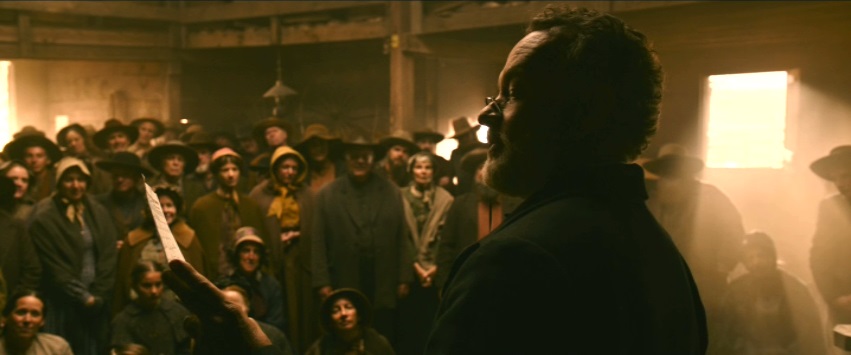
It is 1870, five years after the Surrender at Appomattox Court House, and Captain Jefferson Kyle Kidd (Tom Hanks), late of the 3rd Texas Infantry, is making his way between Indian Territory and Texas with ultimate goal of reaching—maybe—San Antonio. His peculiar job is to read the news as he travels from town to town, charging the attendees a Liberty dime for the privilege of hearing news that might not otherwise reach them by post or by messenger. He's careful about what he reads, as the bitterness of the Civil War still festers in the souls of the Southerners, only enhanced by the presence of "Blue Coats" maintaining military order in the restless, discontented villages. What Kidd finds in his listeners is a belligerence, born of Union occupation without any promised Federal help, if anything, Federal interference. When protests break out, all he can do is assuage and sympathize and encourage. "Times are hard. We all need to do our part. All of us. We're all hurtin'. These are difficult times."

He might as well be speaking to us.
Outside of Wichita Falls, he comes across a wagon overturned by some violent, unnatural means. He dismounts, warily taking his rifle, and moves down the road, ears sharpened and eyes peeled for signs of life...or malice. What he finds is a black man hanging from a tree, with a notice that Texas is a White Man's Territory. He has barely enough time to register this atrocity when a rustle in the scrub alerts him to someone else watching him. It is a young girl (Helena Zengel), blond, dressed in buckskin, and resistant to being captured, although capture her he does. The wagon's contents contain papers from the Bureau of Indian Affairs, giving the responsibility of returning this girl—named Johanna Leonburger—recently survived of a raid on Kiowa land to her nearest kin, allegedly living in Castroville, Texas.
A passing Union patrol provides no help, and just instructs Kidd to take her to the nearest Bureau office and drop her off, even as he protests that he can't be bothered with transporting a child—a child twice orphaned as it happens. The patrol has other concerns and his aren't theirs. At a checkpoint, Kidd talks to the closest Union official and is informed that the Bureau rep is on the reservation and won't be back for three weeks, so Kidd can either stay or deal with it himself. He chooses the latter, grousingly, and gets outfitted with a wagon, supplies, and a contraband gun—Kidd only has bird-shot in his rifle—by a former Infantryman of his, who warns him that the kid is wild, and then is proven right, when "Johanna" disappears while Kidd is off reading the news. Kidd finds her that night in the pouring rain on a riverbank pleading with a passing Kiowa caravan to take her back, that neither hears her, nor seems to care.
That burden, that pilgrimage, takes up the bulk of News of the World, maybe the most leisurely film director Paul Greengrass has ever made (but then he hasn't made a Western before...). Adapted—rather freely—from the best-seller by Paulette Jiles, it follows Kidd and Johanna (her Kiowa name is "Cicada") on the long trip to Castroville, episodically beset by obstructions natural and man-made that impede their journey, usually in the vicinity of some hard-scrabble settlement that will one day turn into a strip-mall suburb in modern Texas.
Greengrass' game-plan is simple: begin with a slow drone-driven shot of the landscape (most of the film was shot in New Mexico), then locate Kidd and kid in it, and take it from there. The hardships include a gang of ruffians who seem hell-bent on buying (if it comes to that) Johanna for their own purposes, an abattoir of a settlement slaughtering buffalo and ruled by an autocratic kingpin, a wagon disaster, a Kiowa band that keeps an eye on them, and a sandstorm that seems to come out of nowhere...all that besides the usual hazards of running out of provisions—especially water—and the usual feeding schedules of horses.
Only in the wagon-wreck is there any semblance of the Greengrass shaky-cam, cuisinart-editing that we've come to associate with his Bourne films or past work. The camera is still a might' restless, but, generally, the film provides good screen-capture material without the customary blurring that usually comes with Greengrass. It's not leisurely, by any means, and the editing still cuts away just before you expect it to, which provides a fair amount of subliminal tension, even if you're wondering just how long this trip is going to be without a bathroom break.
But—as in a lot of Westerns—it's the journey that's important. There's more to Kidd's traveling than news-gathering. He's avoiding something, going back to San Antonio, where he left his wife to go off to war. He hasn't been back since, and the extended travel gives us time to slowly come to terms with Kidd and to Johanna and their shared slice of life and journey. They're both untethered souls—Kidd with his memories and Johanna, twice-orphaned and belonging nowhere, form a bond of necessity and circumstance.
As they travel, Kidd tries to teach her English, and to that end—and because it makes her responses easier—he learns Kiowa, and is stunned to learn that she also can speak a little German, remembered back from before her first family was killed in a Kiowa raid, and, once adapted into a Kiowa family, seeing them killed in a Cavalry ambush. Though they're traveling the same path, Johanna's retraces the past, while Kidd's journey is one trying to forget it. Same route, different destinations.
Hanks' character in the book is supposed to be 71, and that's a far stretch for the actor. The screenwriters make him younger, without the long history of soldiering; Hanks' Kidd has had enough of it with his participation in the most recent one. Hanks does lend a weary, lived-in feel to his Kidd, but is so internalized that he's a bit of a mystery. Hanks is best when he has someone to play off of, and his work and the movie come alive when he comes across his stray charge, who's short of talk. Zengel has a performance both studied and spontaneous, where it seems like she's making it up as she goes—despite having to speak in three languages, English, Kiowa, and German—it is a naked and guileless performance. I don't care how good Hanks is, the movie lives and dies by her work in this film, and the movie seems to heave aloft whenever she's on the screen. 
News of the World doesn't jolt along as most Greengrass films do. It meanders, but doesn't poke. And has that tense element of film-storytelling that entices: with a big frontier out there, wild and loose, what will happen next, what lies around the next bend? With the nation cleaved in two, suspicions of the next stranger you run into, the corrupt grasping for power, and a sizable distance of time and space between rumor and truth, anything can happen, and one's hopes and future can seem, at best, tremulous. 

What strikes one as one watches News of the World unfold is that nothing has changed much...except the guns have gotten better.