Sunday, September 13, 2020

Don't Make a Scene (Redux): On Her Majesty's Secret Service

Dame Diana Rigg passed away this week. How could I not re-post this one?

The Story: Here's something ya don't see everyday, Chauncey (What's that, Edgar?*) A marriage proposal from James Bond.

I mean, a real marriage proposal.

And, in this month of June, we're doing this scene from On Her Majesty's Secret Service. June is traditionally the month of Dads and grads. Well, we've done those, but we've never done something for another tradition of June-weddings.

Now, Bond had gotten married before in the long-running series: a sham Japanese wedding to a pearl-diver/ninja warrior—aren't they all?—(Mie Hama) working for the Japanese Secret Service in the previous entry, You Only Live Twice. But this one is the real thing.

It's been a complicated courtship: Bond (George Lazenby, this time, the only time) rescues The Countess Teresa (née "Tracy" Draco) DiVicenzo (Diana Rigg) from a suicidal walk into the sea; rescues her again at the gaming tables when she loses and he gallantly assumes her debt; as a quid pro quo they sleep together (after she draws a gun on him and he man-handles it away) and she disappears; Bond gets car-napped by her father (Gabriele Ferzetti), the head of a European crime syndicate, and the two boys...bond...over a business arrangement—Bond will woo the the fragile Tracy and Draco will give Bond vital information as to the whereabouts of his target gone to ground: the head of S.P.E.C.T.R.E.,** Ernst Stavro Blofeld (Telly Savalas, here), who's been in charge of nearly every conspiracy Bond has thwarted since the series began.

How...um..."romantic."

It's surprising that it all goes so well. Tracy's damaged goods, a wild-child with seriously defiant authority issues, and Bond's "got a bachelor's taste for freedom." Then, Bond goes hunting for Blofeld using Draco's information, where the megalomaniac has set himself up as an "allergist," treating the eating disorders of several women cooped up in his mountain-top laboratory (hey, it beats a volcano!) And, being Ian Fleming's spy with sexual ADD, Bond blows his cover—as a gay herald of the College of Arms—by seducing as many of the women as he can—the most in any of the films. He might want to bone up on that part of the Service handbook that explains what "undercover work" means.

*sigh* Oh, James...(you whore...)

Lucky in love, unlucky at spy-missions. He's forced to flee, but can't shake the goons pursuing him...until the least likely person shows up—Tracy, who bundles him up, gets him to her car, and drives like a maniac, outrunning several cars of bad-guys.

It becomes obvious, even to the commitment-proof Bond that they were made for each other.

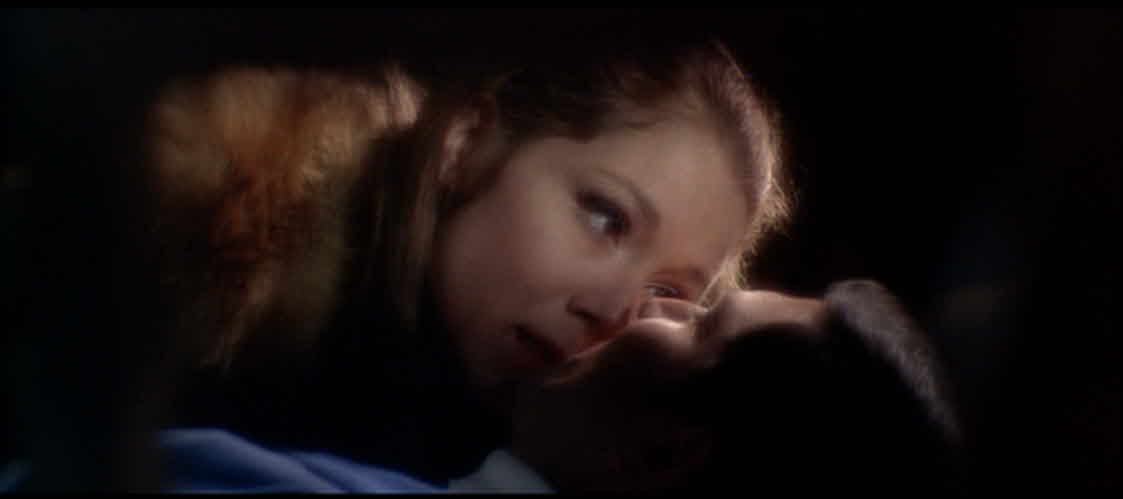
In this scene, Lazenby, no great-shakes as an actor (it was his first film, after all), nicely underplays the proposal: he mumbles, he's tired—he has just skied for his life down a mountain...on one ski (show-off!). But it's Rigg—former Avenger—who does the heavy lifting of this scene. She was never at her best in love scenes, but she plays this one for sly wit—trying to seduce an exhausted 007, and rolling her eyes when he gets all-abstinence with her.  When he "pops the  question," she hesitates and can't believe it (given his track-record, would you?), but things calm down and the best thing about the Bond-Tracy relationship, their playful-witty banter,*** comes to the fore. She can match him quip for clever quip (thanks to Simon Raven's tinkering with the script). It brings out the best in both actors, and you start to want these crazy kids to make a success of it. 

Every time a new actor takes on the mantle of Bond, it seems that the production team goes out of its way to make it that much better a film, and On Her Majesty's Secret Service is no exception. Certainly the casting of Rigg, who is invaluable to the film, proves the point. But OHMSS also shows that they were taking risks with their seemingly invulnerable hero—the element that shows up rarely that separates the superior Bond films from the rest of the pack—she saves him. And in ways beyond the firing of a bullet or a spear. She makes England's implacable blunt instrument...human. 

The Set-Up:  With the cares of the world (temporarily) behind them (including all sorts of cruel men and women pursuing with nasty ways to kill them), Bond and Tracy have found shelter from a white-out snow-storm (with the partially scattered hail of bullets) in a humble horse-barn, somewhere in the Swiss Alps.  She's just shown up like an Angel of Mercy and rescued him, and after a furious chase, things have gotten blissfully quiet. Time to rest, reflect, and as they've survived the day...ponder the future. With all the time in the world.

Action!

[wind howling]
[doors creaking]
COUNTESS TRACY DIVICENZO: What really went on up there, James?
JAMES BOND: Mm-mm. Her Majesty´s Secret Service is still my job.
TRACY: But there´s nothing you can do about your job at the moment, is there?
BOND: [grunts tiredly]
TRACY: Then why are you thinking about it now?
BOND: I´m not.
BOND: I´m thinking about us.
BOND: Tracy, an agent shouldn´t be concerned with anything but himself.
TRACY: I understand.
TRACY: We´ll just have to go on the way we are.
BOND: No. I´ll have to find something else to do.
TRACY: Are you sure, James?
BOND: I love you.
BOND: I know I'll never find another girl like you.
BOND: Will you marry me?
TRACY: D´you mean it?
BOND: I mean it.
BOND: Mr. and Mrs. James Bond.
TRACY: ...Of Acacia Avenue, Tunbridge Wells.
BOND: Mm. How about Belgrave Square?
TRACY: Or the Via Veneto, Rome?
BOND: Paris. Convenient for Le Touquet.
TRACY: Monaco. Handy for the Rainiers.
BOND: I wonder how much they´re asking for this place?
[Tracy laughs]
BOND: The proper time for this...
BOND: ...is our wedding night.
BOND: And that´s my New Year´s resolution.
TRACY: Whatever you say, darling.
BOND: And that is yours.
BOND: Good night, Tracy.
TRACY: Good night, James.
[Bond watches Tracy sleeping on the hay-bed, then reaches for a nearby crowbar]
[He kicks out the hay-bed supports sending Tracy tumbling into his arms]
TRACY: Oh!
BOND: It´s not New Year yet!


On Her Majesty's Secret Service

Words by Richard Maibaum and Simon Raven

Pictures by Michael Reed and Peter Hunt

On Her Majesty's Secret Service is available on M-G-M Home Video.


* That's a line used often in the "Rocky" and "Bullwinkle" shows, also icons of the "Cold" War.

** The Special Executive for Counter-Intelligence, Terrorism, Revenge and Extortion—not exactly the most subtle of criminal organization names.

*** Not until I put this together did I realize the full humor in the "picking a neighborhood" exchange here—partially it's my ignorance of the areas mentioned (except for Monaco) and Lazenby's lack of reaction to the Monaco reference. Tunbridge Wells is a modest middle-class area (and Acacia Avenue the common equivalent of Elm Street in America), then the real estate values escalate to the diplomatic corps, European get-away's...no wonder Bond starts to consider a dilapidated barn. Marrying a Countess can get spendy!

Saturday, September 12, 2020

The Daze After The Day the Earth Stood Still

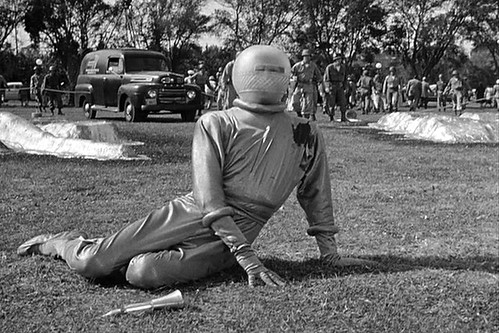
The Day The Earth Stood Still (Robert Wise, 1951) Iconic sci-fi pic that managed to be just strange enough to be spiritual without having to explain itself. Edmund H. North's script (adapted from the 1940 Harry Bates story "Farewell to the Master") just assumed that any advanced civilization's technology would seem like magic to us (ala Clarke's Third Law). It's anti-nuke theme was somewhat off-set by it's Christ allegory under-pinnings: a human-appearing being from above comes to Earth with a "message," is killed and resurrected to give mankind a lesson in humility. That the alien--Klaatu (Michael Rennie)--walks among us under the guise of a "Mr. Carpenter" just nails the significance home.

Right from the get-go, The Day The Earth Stood Still announces its intention with a "spooky" theremin-laced score (by the brilliant Bernard Herrmann), quite at odds with its message of peace. Wise shows a global humanity surrounded by its current technology (radio, television, radar) spreading the news of an invader from space, which lands in the Mall area of a tourist-clogged Washington D.C. in Spring. 

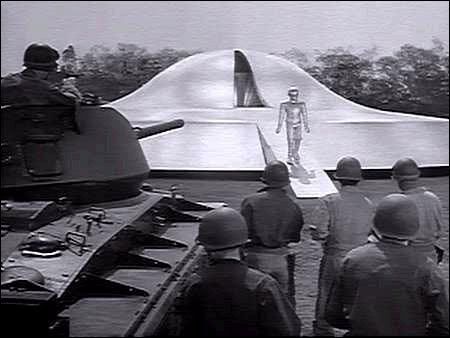
Phalanxed by a wall of tanks and military might (with a larger crowd of tourists behind it) the alien presence reveals itself and is shot by a panicky soldier for its trouble. Before you can say "Kent State," the alien is taken to Walter Reed to be treated, observed and questioned, and the formal Klaatu--patient, curious, but with a hint of passive condescension--does his own analysis, escaping from the hospital and blending with the populace as "Mr. Carpenter"--taking a room at a boarding house, becoming involved with a widowed secretary (Patricia Neal)--it IS the '50's, after all--and her son, with the intent of seeing humanity first-hand.
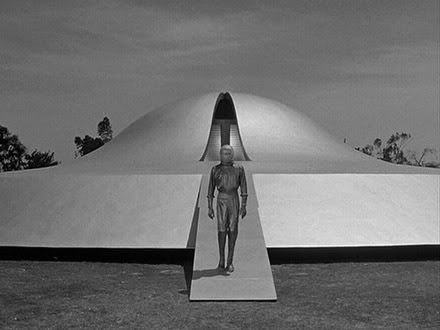
Meanwhile, his Enforcer, Gort, a lumbering, laser-cyclopsed, soft-metal robot stands guard over the saucer, turning his evil eye on any hint of aggression, without any regard to how much of the GNP was flushed to make those tanks. If Gort could laugh when he turned on his eye-light, he'd probably do it with glee.
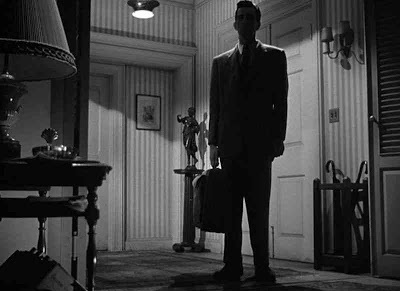
There are so many small details that delight: Patricia Neal's uncommonly common working Mom, with a wary eye towards Mr. Carpenter--there's not even the hint of romance there; Sam Jaffe's cameo as Einstein stand-in Dr. Barnhardt, looking at his business-suited stranger visitor from another planet with eyes of dazzled wonder; the whole design of the thing that has so permeated our culture with sleek silver surfaces that fold in and out of each other seamlessly; "Gort, Klaatu Barada Nikto!" which, indicative of the race's parsimoniousness, roughly translates to: "Robot, take Klaatu's body back to the space-ship and repair whatever damage has been done to it, bring him back to life, and oh! while you're at it, don't turn me into a smoking pile of ash, thank you very much*"--talk about "Three Little Words!"; Robert Wise's unerring sense of staging and for putting the camera in the exact, most effective place without making you aware that it's the most effective place. Wise is always given short-shrift as a director, implying a yeomanlike sensibility rather than an artistic one, but the Man Who Edited Citizen Kane also conceived beautiful, eerie, creepy shots like this:
Thanks to Glenn Kenny of "Some Came Running," who reminded me **

The Day the Earth Stood Still is a classic film—a time-capsule, of a kind—from a different time and place and space that reminds, yes, with great power comes great responsibility--but there's always someone more powerful, who might take yours away, and make you stop and smell the fall-out.
—————————————————————————————————————————————————————
Written at the time of the film's release...

"Everything New (Testament) is Old Again"
or

"Yeah. I'm Thinkin' I'm Back!"

So why remake it? Well, it's a question that Klaatu's United Planets couldn't negotiate--and Gort's Galactic Police Force would probably give you the eye. But the agent of Keanu Reeves saw a poster of the original and dollar signs swam into his head and here, we have it. And Scott Derrickson (who put a different head-spin on The Exorcism of Emily Rose) thought he could turn it into a warning about global warming, and Reeves thought that, though the original Klaatu preached peace, he did so threatening force, which he found "fascist."

Sigh.

That sounds noble in thought (if a tad simplistic). On-screen, it's a different matter entirely.

Because it's a "re-imagining" (rather than "a remake"), there is no "
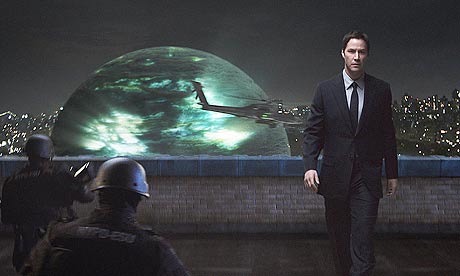
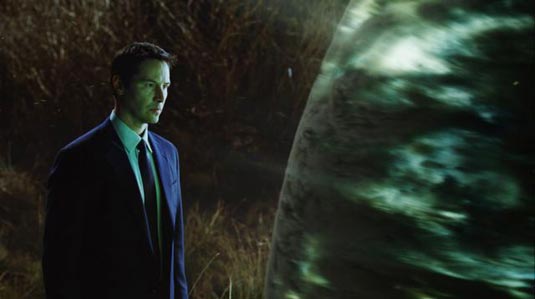
flying saucer," but a cloudy, spacy "orb" (all the better to remind you of the planet, but I kept wondering what kept it in place), and rather than the military, scientists are in the front line (with Princeton astro-biologist Helen Benson, played by Jennifer Connelly, as the point-person). The military is back-up.***

The scenario starts the same: Land-Bang-End up in Hospital. And there things start to change. The original Klaatu had no special powers. Gort was the "muscle" (and here, the robot is 20 feet tall, gun-metal gray in color, and a completely CG construct--it's actually simplified from the original's design--and, as with the first Gort, its unreadability makes it a genuinely creepy sight). Keanu Reeves' Klaatu has a nasty way with bio-feedback that does damage. So much for pacifism. But, this Klaatu isn't Christ-in-a-business-suit. This one goes back a few chapters, back to the Old Testament. Particularly those parts dealing with Noah and Moses. The threat is environmental, rather than nuclear, and to sustain one of "the handful of planets that can support life," Keanu-Klaatu's United Planets are thinking of a little Silent Spring Cleaning of the life-form doing the most damage. Good thing he doesn't carry around a cook-book!
The following section is SPOILER material, so if you want to be surprised how it ends—if you care—don't highlight the next paragraph which, like the Earth, gets blacked out:

That scouring consists of billions of nanite-sized metal locusts (why they have to specifically look like insects, I have no idea, but I'd guess it has something to do with why Klaatu's named "Mr. Carpenter" in the first one). So, this "plague" starts doing its damage, devouring metal of all kinds, sports-arenas and such, and one can only hope that it can distinguish "green" technology, like solar panels and wind-generators, from the other kinds, but I suspect not--that might involve thinking! Keatu, or Klaanu, or whatever you want to call him, decides at the last minute that because humans have the capacity for change, they maybe, just maybe, could save their environment, so he sacrifices himself sabotaging the plague, leaving humans with no electricity, no technology, and presumably the resolve to stop the global warming crisis with, as a much wiser alien once inventoried, "stone knives and bear-skins." Thanks, Kleatu or Kono, or whatever your name is, thanks a lot. Who's gonna pick up these continents of dead nanites corrupting the soil, Mr. "Ecology?" And they thought the first one gave off mixed signals?

Keanu Reeves has the most limited range of any actor who hasn't suffered a stroke, but he does have two specialties at which he excels: endearingly stupid, or robotic. The latter serves him well, as in Speedthe portions of The Matrix when he was portrayed by pixels, and this film. His strange visitor from another planet is a nice piece of craft, slightly more human than Jeff Bridges' Starman, and extremely efficient in his movements--when he turns his head to look you right in the eye, you'd better take him seriously. He's quite effective in the role. Jennifer Connelly delivers the techno-babble expertly (as she did in Hulk), but she really doesn't have much more to do than Patricia Neal did, as the role is basically reduced to "concerned mother." As the child she's concerned about, Jaden Smith at least doesn't fall into the "predictable child" category. He finds different ways of doing things than the "stock-child" role. Kathy Bates is too good for her role of Secretary of Defense, Jon Hamm, of "Mad Men," doesn't really separate himself from the pack, but Robert Knepper does a fine job as a Colonel in charge of trying to stop a tidal wave with a tea-cup. It's always great to see cameo's by James Hong, and John Cleese, who plays Prof. Barnhardt in this version.****
But, ultimately, there wasn't much point in doing this, other than to give people jobs, and give some Hollywood-types more "green" cred. The production was carbon-neutral (wouldn't that have been ironic?), which means they presumably paid carbon credits used to destroy old-growth forests for eucalyptus plantations.

"The Universe wastes nothing," Keatu says at one point.

He's never been to Hollywood.

* I hope there's a "please" in there, somewhere!

** Kenny has a wonderful illustrated tribute to director Robert Mulligan. It's far better than anything I could contribute.


*** There is one amusing bit--when Benson is shanghaied to participate in the landing investigation by the military, it's set-up and photographed exactly as it was done in The Andromeda Strain...directed by original TDTESS director Robert Wise. Coincidence? Nothing's a coincidence in a "re-imagining."

**** I hate playing the "If only..." game—it smacks of frustrated screenwriters—but, as they had an Albert Einstein-clone in the original, it would have been interesting to have a Stephen Hawking in this one—brilliant, but crippled, talking through a voice-box. If Klaatu wanted inspiration from the human race, who better? Then, imagine this scenario: the group leaves, but Klaatu hangs back, turning to look at the wheelchair-bound pysicist. "I could cure you..." Pause. The voice-box rasps: "Save...the...world."

But, they didn't.

Friday, September 11, 2020

Zero Dark Thirty

Written at the time of the film's release.

"You Know That Thing We Talked About"
or
How Are Things in Tora Bora?

Writer Mark Boal and director Katheryn Bigelow have made the two most important dramatic films about The War on Terror: the 2009 Best Picture Oscar Winner The Hurt Locker and now, Zero Dark Thirty, which covers the behind the scenes investigations to track down Usama bin Laden and the subsequent Operation Neptune Spear in Abottabad, Pakistan.

The film originally started as a feature about the carpet bombing of Tora Bora, and the field work leading to the decision and was scheduled to begin filming when the raid occurred. Immediately, the other film was shelved, and Boal began writing this, incorporating his research from the previous work which dovetailed with the earlier effort. It's a fascinating, troubling story of human beings waging war on an intimate level, trying to secure threads of information on a specific target, while also trying to keep track of new terror acts that might occur any time, any where.

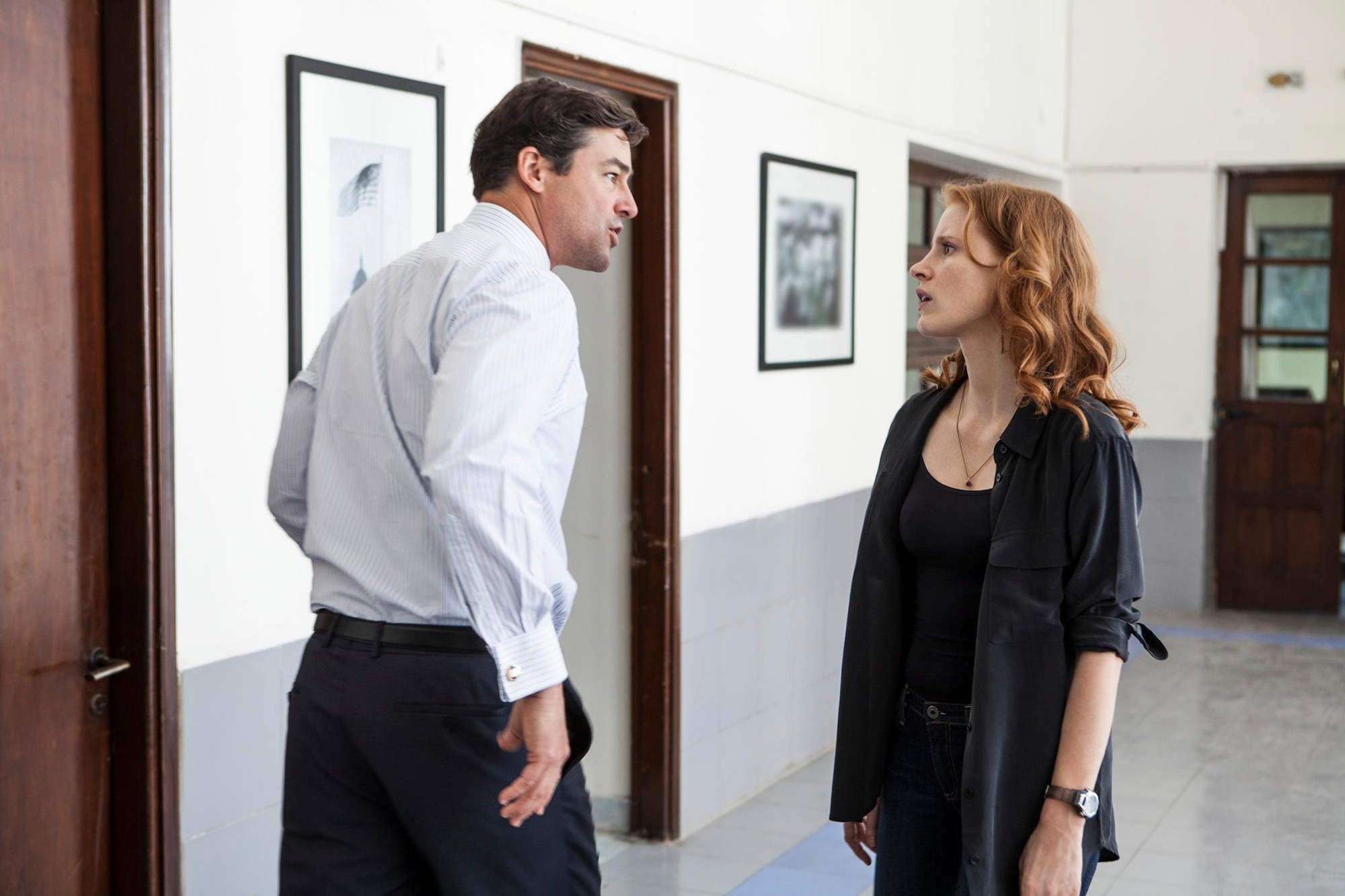
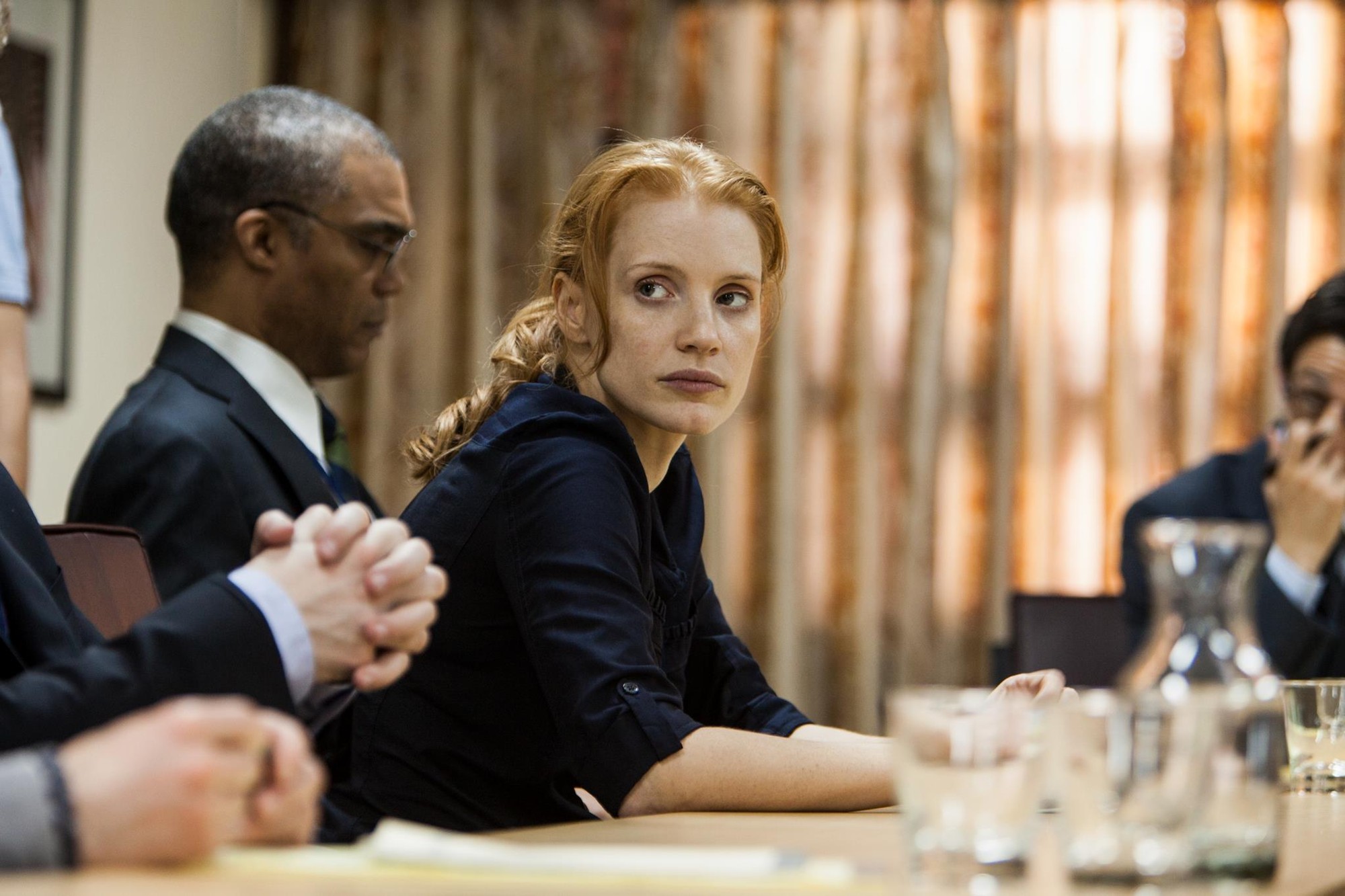
It focuses on one woman, a CIA analyst named Maya (played by Jessica Chastain)—her IM handle is "Maya173", but "Mark Owen," the nom de plume of one of the Navy Seals participating in the raid, refers to her in his book "No Easy Day," as "Jen." Maya is book-smart, street-savvy, but must learn "the ropes," literally, of interrogation by any means necessary. She is trained in the way of torture by Dan (Jason Clarke), who has been at this for awhile and has it down to a science—the speech "If you lie to me, I will hurt you," the loss of control, the humiliation, the physical and mental stresses, the releases from which information may come. Dan offers to keep Maya out of it, but she demurs. She will participate. She will actively sweat information out of the "detainees" in the euphemisms for prisons like "CIA Black Sites." "You are not being fulsome in your replies" she yells as she slams her hand in the interrogation table.  And when she's not participating, she's poring over other interrogations, reams of intelligence, and being a general pain in the rear to her superiors and colleagues. For station chief Joseph Bradley (Kyle Chandler), the job is to walk the razor's edge of politics and prevent more terrorism—he doesn't even care about bin Laden anymore, as there are too many attacks he's trying to prevent—every attempt that gets by is a failure.
But, for Maya, bin Laden is an obsession, her white Muslim whale, and it takes a zealot to find another zealot. She'll veer off into other investigations, particularly when some of her own are killed in an attack, but time only intensifies her resolve, almost becoming a mania, and her patient investigation is off-set by a gloves-off approach to her superiors (when asked her role in the briefing by the C.I.A. director—at the time, Leon Panetta—played by James Gandolfini, she replies "I'm the m#####-f##### who found this place, sir"), almost as if her persistent pressure torture techniques are being applied up the chain.* The Obama White House dithers over action until absolute proof is obtained that bin Laden is held up at the Abottabad compound, but Maya is resolute. When more cautionary analysts give the odds at 60%, she defiantly ups the odds to 100%—"Okay, 95%, because I know certainty freaks you guys out." But, it's that certainty that fuels Seal Team 6 in their mission—in the videos below, she's specifically mentioned and lauded in Mark Owen's account.
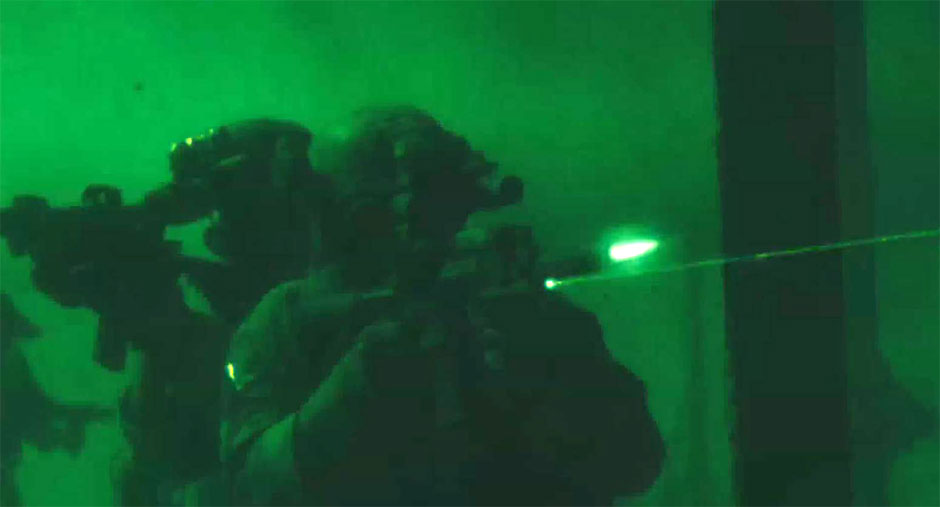
It is a fascinating movie, but a draining one, starting with torture scenes and ending with a recreation of the raid as it went down, shot mostly in tense disorienting night-vision. The character of Maya, or "Jen" or whoever she is, is a fascinating one, a portrait of obsession and the toll it bears—she's repeatedly told that she looks "terrible" throughout the movie—and when she lashes out at her superiors for their lassitude, or just plain pusillanimousness, there is a definite sense of someone unhinged—controlled, but pushed to the breaking point. A fury waiting to unleash, she is our version of a Holy Terror, a match for her enemies, and one can't help but wish her peace...suspecting that it will never happen.
2020 Addendum: Zero Dark Thirty came under some attack at the time of the release for its presentation of torture and its techniques and the implication that information obtained by it led to the critical information that led to the Abottabad raid. The movie is vague enough and the information so voluminous that one comes away with the impression that it wasn't critical to the intel (indeed, the location was confirmed by other means). As for the portrayals being an endorsement of torture, that's a little hysterical—to not portray it would have been 1) a whitewash of what was going on and 2) leaving out a specific chunk of the shaping experience of Chastain's "Maya"—one might just have well kept out the car-bomb attack that killed her colleagues. The character is driven by her experiences, hardened by them...and by her personal need for revenge. Her torture training is part and parcel of it. 

I came away from the film seeing a revenge drama that ended up, not in triumph, but in hollowness. The dead are still dead and the threat is just as real. There's no "Mission Accomplished." Just an "X" placed in a ledger that never empties.

I'll repeat what I said in the asterisked point. Zero Dark Thirty walks such a fine line that one can see whatever they want to in it.

The FBI's notice of bin Laden's death and the Situation Room during the raid.
Bear in mind, one helicopter went down during the raid.

* There are torture scenes, but they're not commented on, and any politicizing of it is so much hot-air—one can see in the film any position they want.  It walks a very fine line, merely presenting, and if someone tries to see their point of view in it, they're merely counter-projecting.  

Thursday, September 10, 2020

Olde Review: Follow the Fleet

This was part of a series of reviews of the ASUW Film series back in the '70's. Except for some punctuation, I haven't changed anything from the way it was presented, giving the snarky, clueless kid I was back then a break. 

What was that line from Hondo? "Him very young. Will learn." "If he lives..."

Any stray thoughts and updates I've included with the inevitable asterisked post-scripts.

Follow the Fleet (Mark Sandrich, 1936) They begin this way: From the black the upper hemisphere of a globe revolves in a cloud-filled sky. Perched atop the globe at its very hub, is a gigantic radio tower that beeps out the insignia "An RKO Radio Picture." 

That trademark holds something special for me, for it announces that it was made by the RKO Studios--the studios that fostered such film classics as Citizen Kane and the truly original King Kong. RKO made its share of turkeys but even in those, RKO's studios put a certain feel into their films. It comes from their sets. It comes from the equipment. It comes from the team. That's why M-G-M musicals look so glossily over-produced, and current Universal films look so cheesy. 

The two films in 130 Kane Hall this Friday are both RKO films and they are Follow the Fleet and Stage Door.

Follow the Fleet is very generally a Fred Astaire-Ginger Rogers musical. And it is a pleasant enough entertainment. Oh, there are some things that will not be tolerated, I'm sure--there are a few lines that a lot of feminists will hiss at, and you can chuckle over some of the clothes,* the dances and the more's displayed in the film. After all, we are so much more advanced and sophisticated nowadays and Saturday's films--The Rocky Horrow Picture Show, and Private Parts shows this to be so.**


But there are some very neat things here, too. Some familiar faces--Fred and Ginger, Randolph Scott
, Harriett Hillyard (who would become world-famous as the TV and real-life wife of bandleader Ozzie Nelson), and in lesser roles, Betty Grable and Lucille Ball. There are the songs by Irving Berlin ("Let Yourself Go," "Let's Face the Music and Dance") orchestrated by film music great Max Steiner

And then there are the dance numbers--the reason this film was made, its the reason this film is structured the way it was, and it's what made Astaire and Rogers stars, doubly and singly. There is a mutual smash-up-your-partners'-work dance rehearsal about 3/4 through the film that will undoubtedly impress as a great number of stumbles, but is actually as well-choreographed as any of the other dance numbers in the film.*** 

So, gee whiz gosh, folks, why don't you forget your 70's whatever-it-is attitude and enjoy yourself.


There's not much I can add, other than to say that Follow the Fleet introduced the standard "Let's Face the Music and Dance," and that the choreography of Astaire (with Hermes Pan) and the dance performance of Astaire and Rogers (and remember, "she had to do everything he did...only backwards and in high-heels!") are some of the most sublimely beautiful things you will see in movies. In all the years since I've seen this film and the others, I've never seen anything that can compare. Sure, Gene Kelly had that ferocious athletic aggressiveness...but Astaire and Rogers achieved Grace with a capital "G."

2020 Addendum: Oh, there's a LOT I can add: Astaire (originally Frederick Austerlitz—on imdb.com, he is "nm0000001/") had a disastrous screen-test at RKO: "Can't sing. Can't act. Balding. Can dance a little." read the card-synopsis; producer David O. Selznick—who signed Astaire to his RKO contract wrote in one of his famous memo's "I am uncertain about the man, but I feel, in spite of his enormous ears and bad chin line, that his charm is so tremendous that it comes through even on this wretched test." Astaire's first film for RKO, Flying Down to Rio, had him fifth-billed—right after Ginger Rogers. He didn't want to be part of another dance duo (he started out on-stage with his sister Adele); he wrote his agent "I don't mind making another picture with her, but as for this 'team' idea, it's 'out!' I've just managed to live down one partnership and I don't want to be bothered with any more." But, they made nine films together in one of the greatest pairings in film.

Katherine Hepburn (who'd worked with Rogers on Stage Door) said of them: "He gives her class and she gives him sex appeal." Astaire said of her: "Ginger had never danced with a partner before Flying Down to Rio. She faked it an awful lot. She couldn't tap and she couldn't do this and that ... but Ginger had style and talent and improved as she went along. She got so that after a while everyone else who danced with me looked wrong." Part of that is Ginger Rogers proved to be a consummate actress. Yes, she could get the routines "down," but most importantly, she could act the dance and its emotional effect—like a good opera singer who can hit all the notes, but also emote beyond them to touch the audience. It's athleticism and skill to hit the marks, but the acting makes it less of a spectator sport and brings the audience in to become part of the experience.  Astaire was likable, but Rogers made him a romantic lead—just by her acting.

One might not like musicals. One might not like dancing in films. But, watching Astaire and Rogers is experiencing artistry...and that is thrilling, whatever one's prejudices.  Excellence always beats them.

* Now, bear in mind, I was writing this during the "disco" 70's! Everybody was wearing platform shoes and bell-bottoms, fergodsake.

** I believe I was being sarcastic here, but I'm not sure. I think I was merely pandering to the audience of a 10 watt rock station on the University campus and this was the first review I'd written (I think).  I was being unsure and general—why else would I start with an explanation of RKO Radio Pictures" (it would be "explained" musically in Rocky Horror on the next night, after all), plus I thought I had to "sell" an Astaire-Rogers musical to the "hipsters" on campus. Balderdash. 
Anyway, the review of The Rocky Horror Picture Show is here and the one for Private Parts is here

Stage Door, we will represent next week.

***


Tuesday, September 8, 2020

Milk

Written at the time of the film's release....

"The Plural of 'Us's' is 'I'"

I had all these cute little headlines to put at the top of this review, reflecting my disappointment with Gus Van Sant's bio-pic of slain San Francisco supervisor Harvey Milk—"Condensed Milk," "2% Milk"—but ultimately it comes down to this: you owe it to yourself to see The Times of Harvey Milk, the Oscar-winning documentary on Milk and his efforts to fight discrimination. 

It'll cost you 90 minutes of your time—and I can't find it online without some kind of rental fee. But, it is definitive, and, frankly, more effective. The new film, Milk acknowledges its debt to this film in its final credits. Indeed, you'll see a lot of archive footage shared by both films. And Milk, a features recreations of footage from this film. The film ends with Sean Penn, as Milk, saying the words that you'll find in the video at the bottom of this review into his tape recorder for the prescient "In the Event of My Death by Assassination" tape he made. But that sentiment was not a private one. And the film does a disservice to Milk making it so.
It also inadvertently plays into stereotypes by suggesting that Milk's assassin Dan White was a closeted gay man instead of the mentally ill person he was. White's angry (and public) resignation during a meeting of the Board of Supervisors is also made private in the film. White's sneaking into the city hall with a loaded weapon to avoid metal detectors is alluded to, but not that White re-loaded his pistol after shooting Mayor Moscone and heading to the Supervisor offices to kill three other board members (Milk was the only one present). That the crimes were deliberate seems incontrovertible. But White was only convicted of manslaughter and released after serving five years in prison.
And one can quibble about Penn's performance as well, making Milk more fey in his mannerisms (Milk had hidden his sexuality in New York for years), and giving him a thick Bronx accent more Harvey Fierstein than Harvey Milk (ironically, Fierstein narrates the "Times" documentary).
Still, ya gotta do what ya gotta do. The original documentary is 25 years old and is probably past its shelf-life. A dramatic re-telling of the tale was probably due (a twin project "The Mayor of Castro Street" has been in the works, first by Oliver Stone and more recently by writer Christopher McQuarrie and Bryan Singer for years, and has, for the time being, been abandoned) if only to keep reminding people of the toll closeted life inflicted on the gay population. The battle continues to put a familiar face on homosexuality. And if a melodramatic re-telling of a pivotal story is required, so be it.
Van Sant does a fine job of mixed media cutting between vintage footage, newscasts, and recreations. And he gets great work out of his cast, particularly Penn, who's never seemed so relaxed in a role, James Franco (who gets better with each movie) as his first partner in San Francisco, and Emile Hirsch from Penn's Into the Wild as one of his youngest recruits.