The Story: Authors cringe when you talk about making a movie from their work. I remember seeing an author on the old "Dick Cavett Show" who grumbled that helping to write the movie's screenplay was akin to "holding the coat of the man who's molesting your child."
I don't know how Heller felt about Mike Nichols' film of his most famous best-seller, overall, but I do know this: he loved this scene.
He loved this scene so much, he told its author, Buck Henry, that he wished he'd thought of it for the book.
High praise, and why this is the scene for the week.
The Set-Up: Every war movie has its "scrounger," the "get" guy, the "dog-robber," the "King Rat"—the one who can acquire the things that people need and want and sets up a black-market lemonade stand of his stores. Joseph Heller took the concept and used it to satirize the monstrous greed of 50's Corporate America in the character of Milo Minderbinder ("What's good for MM Enterprises is good for America"), who would sell the pilot's parachute silk for profits, leaving the air-crews with promisary notes for shares in his "Syndicate." Mike Nichols and Buck Henry took the idea a bit further and made Heller's Milo a wheeler-deeler turned fascist dictator. In this scene, Yossarian (Alan Arkin) confronts Milo (Jon Voight) over Milo's deal with the German government to bomb the Allied air-base, which managed to kill Nately (Art Garfunkel). Milo would have no trouble sitting on the board of Enron or Halliburton. Why, who knows how far he could have gone? Or would have gone? Goldman Sachs, maybe? Goldman Sachs, probably. Action! Yossarian runs after Milo's motorcade and attempts to board the jeep where Milo is standing in the glow of the klieg lights. Milo's police contingent hold Yossarian back. Yossarian: Milo, I'm gonna kill you, you murdering son of a bitch! Milo Minderbinder: Don't hurt him. Milo: I know how you feel... Milo: ...but it wasn't my fault. Yossarian: Who's fault was it? Milo: No one. Nately was the victim of certain economic pressures, the laws of supply and demand. Yossarian: You unbelievable bastard! (The MMP's punch Yossarian in the stomach, and he crumples.) Uhhh! Milo: Do you want me to take you to her? Yossarian:(gasping) Who? Milo: Nately's whore. Aren't you looking for her? Yossarian:(gasping) You know where she is? Milo: Of course I do. (Milo gestures and the MMP's load Yossarian onto the Jeep) Milo: You're AWOL, Yossarian. I thought you knew better than that. That's not smart. Nately wouldn't do anything that dumb. Yossarian: He's dead. Milo: It's too bad. He was a nice fellow. Yossarian: And your boys made a nice direct hit on him. Milo: But he died a rich man. He had over 60 shares in the Syndicate. Yossarian: What good is that? He's dead. Milo: Then his family will get it. Yossarian: He didn't have time to have a family. Milo: Then his parents get it. Yossarian: They don't need it, they're rich. Milo: Then they'll understand. (Milo gestures to the MMP's and Yossarian is thrown out of the Jeep) Catch-22
Acts of Domestic Terrorism
or Getting the Story Wrong
"No Good Deed Goes Unpunished"
Unattributed, although ascribed to many
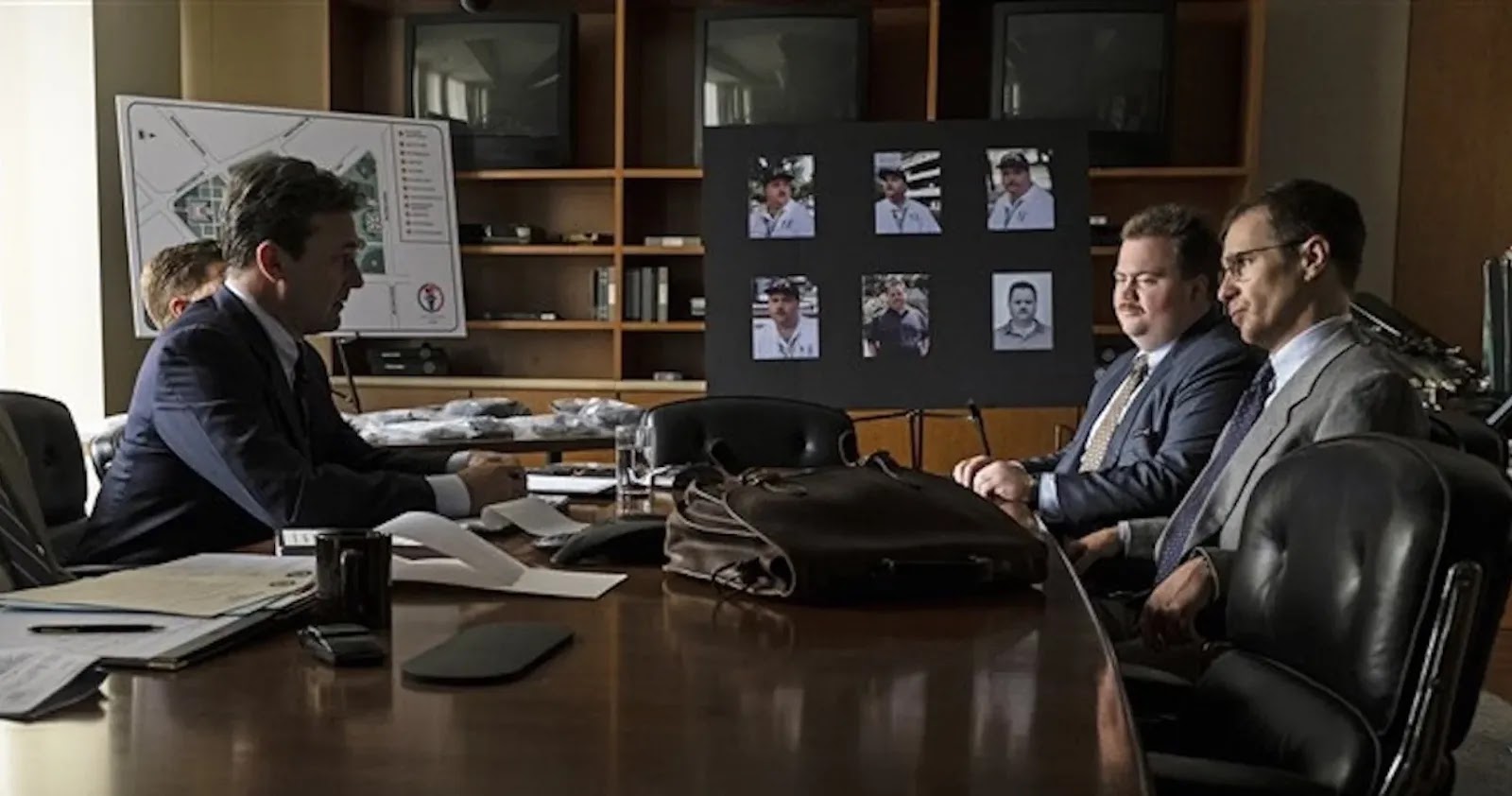
Clint Eastwood's new film,Richard Jewell, should be fairly cut and dried, seeing how it is "based on a true story" and a well-documented story at that, enough that the tag-line has been altered to "Based on the True Story of the Atlanta Bombing," as if anybody actually remembered it. But, no, it's isn't cut-and-dried, it's controversial, when it shouldn't be. Oh, the facts are there—the bombing of Atlanta's Centennial Park during the 1996 Summer Olympic Games; the sudden elevation of a low level security guard Richard Jewell as a hero for finding the bomb and preventing more destruction than the two deaths that were were recorded—one direct and one indirect and 111 injuries; his just-as-sudden FBI suspicion of being the one responsible for the bomb (despite a 9-1-1 call from a distant pay-phone ten minutes before the explosion when he was trying to convince police and security that there might be an actual threat); the media frenzy over the Jewell investigation leaked by the FBI, when it was based on rather hazy, and misapplied, profiling and, when that didn't work, conspiracy theories.
Meanwhile, Jewell was put through a head-spinning change of fortunes, partially based on his own behavior characteristics and his unquestioning respect for authority. Jewell wanted to be in law enforcement, but he was physically unfit for the job and seemed to have a chip on his shoulder that others didn't hold the same respect for the law that he did. Jewell was "by the book" and held people to their word, making him contradictorily diligent and detail-oriented and yet incredibly naive. Those qualities made him the perfect guy to find the bomb—there was a LOT of security there that night that did not—over-react, and, while doing the right thing, getting people's noses out of joint. Better than having nails explode in your face, though.
And better than the the trial-by-gauntlet Jewell faced being part of a headline story being covered 24/7 by an already entrenched media firing squad. It was the Olympics and the whole world was watching. One would think, with such attention, the idea would be to get the story right than to get the story out. But, as has been seen time and again with "Breaking News" there's a lot of mis-information that comes out initially. And there is no subsequent rush—when "news breaks"—to fix it.
Jewell, initially hailed as a hero for his actions—in a crowded park, full of police, security and FBI (all fussing over who has jurisdiction). Jewell is trotted before the intense "up close and personal" Olympic coverage on television. Then, the investigation begins under the same glare of spotlights and confusion. Given the scrutiny from all sides, the pressure results on being first, with egos and reputations on the line.
Without any hard evidence, despite an FBI sweep of his apartment shared with his mother, and some rather dodgy techniques to trick Jewell into some form of entrapment, he is made the initial focus of the investigation and this gets leaked to the news media, particularly The Atlantic Journal-Constitution, which runs it as a headline in an Extra edition and at that point, everything escalates, with speculation, mobs of reporters outside the Jewell residence. The only thing the movie doesn't get into is the pressure from FBI headquarters to nail down the search, quickly.
All fairly laid out as it transpired—and the best source of information is Marie Brenner's "Vanity Fair" article "American Nightmare: The Ballad of Richard Jewell," which goes into a bit more detail about the then FBI director Louis Freeh's heavy hand in it, as well as the FBI agents who have been morphed into the character of "Tom Shaw" (played by Jon Hamm), who, under pressure for results—he is even placed at the scene of the bombing, giving him a sense of guilty responsibility.
Eastwood's film is, first of all, well-acted. It's Sam Rockwell's first film with Eastwood and his role as Jewell friend and legal adviser Watson Bryant is another of his extraordinary performances that feels lived in and natural, while spicing it up with just a notch of theatricality. He's the backbone of the picture, the guy with the attitude and the perspective, he's the text of the film's view. Kathy Bates plays Jewell's mother and she's the heart of it, showing the destruction of one's psyche when everything trusted is turned against her.
Both of these actors provide the emotional fireworks,*the outrage and sorrow not prevalent in the character of Jewell (played by the relatively unknown Paul Walter Hauser, but whose quirky turn in I, Tonya made him someone interesting to watch). Hauser makes Jewell aggravating but still sympathetic, at times prideful and pathetic, perpetually having his balloon popped—intelligent, certainly, but not above having it overwhelmed by an inferiority complex. Hauser is amazing, but then, he always has been, infusing his roles with a dash of unglamorized normalcy. He's not theatrical, but he's quickly elastic with no irony applied. It's a naked, raw performance that makes you wonder if Eastwood just snatched up the real guy again (he didn't, of course—Jewell died in 2007).
They're the "good guys." The elephant in the internet is Eastwood's "bad guys." The one that's getting the headlines is Olivia Wilde's AC reporter Kathy Scruggs. There have been charges of sexism against an ambitious female reporter...because she's an ambitious female reporter (I've been trying to think of a female reporter in any movie that isn't) and that Scruggs is treated unfairly and inaccurately. It is harsh, but one should reiterate that it is her name on the byline of the story. It is alleged in the film that Scruggs traded sex for information from an FBI informant—more on him in a bit—but there is no evidence for that and may be the screenwriter reading more into Marie Brenner's characterizing Scruggs as "a police groupie" than there is (although most of the "police groupies" I know are male). Scruggs, in the movie, is given a redeeming character arc that implies conscience and a kind of redemption that has never been displayed by the paper in its long legal battles against Jewell's civil suits, and it is the only news organization that did not settle in its civil lawsuit, saying that their story was "factually true at the time."
No one, however, is complaining about Hamm's FBI agent who is, even at the end of the film and despite evidence to the contrary, completely sure of Jewell's guilt. There is no ax to grind here, apparently—Eastwood, after all, made the controversial J. Edgar with one of the Richard Jewell's exec's, Leonardo DeCaprio—no need to blow up the interwebs over that. Nor, has anyone made mention of the fact that Jewell, Scruggs and the compendium "Shaw" can all be tarred with the same brush that brought Jewell under suspicion in the first place—being over-zealous. Irony doesn't play well in social media, evidently.
One shouldn't be surprised that the very entities with with reputations to tarnish should be the ones to squawk the loudest when they are put in a defensive position by something that might exert a change in the power dynamic they enjoy. But, then, an unfair power dynamic lies at the heart of the film, and has been at the heart of so many of Eastwood's films. It is amazing that in a time when film-makers are reaching down for the common denominator, that Eastwood's films still stir people up, allowing people to see what they want to see, a sort of litmus test for those who dare to take it.
Jewell's nightmare that would solve all problems—covering the bomb with his body.
The real Jewell—holding the evidence.
* Oh. Did I mention that there's an explosion in the movie? Damn, it made me and the rest of the theater patrons jump. Cover your popcorn, people!
Not a "car-guy." Never have been. Give me an engine and four wheels and I'm happy. I don't associate myself with horse power, don't give a damn about "cubes," and don't equate my manhood with the make and model of what gets me around. And I'm enough of a cynic that, although I have a model of James Bond's Aston Martin DB5 sitting on my window sill, I resist the urge to see if it's leaking oil on its base as per its reputation (it's not that accurate!). For me, if it goes, it's good. So, racing movies leave me cold. Whether The Crowd Roars or Speedway or Grand Prix or Le Mans or Herbie: Fully Loaded, they're empty movies with a lot of hardware beauty shots and cardboard characters who can't really explain the pull of the mystique of racing, when it boils down to making a lot of left turns at high speed.
Ron Howard's Rush came closest to a good racing film because, although it had its own fair share of carburetor-porn, it was about two racers with a love/hate relationship that lasted over years and tracks, and how the two bickered and supported each other owing to their personalities and how it extended over the years because, and in spite of, the competition. They saw each other's value beyond who was first and who was second. So, at the end, racing movies have had a checkered past. But, director James Mangold'sFord v Ferrariis the first one I've seen that is entertaining, has its requisite gross weight of Ford/Ferrari fetishism, and even turns the corner on attempting to communicate the need for speed and the intellectual pursuit of putting as much potential energy into a motor engine.
The story, which is based—for the most part—on fact, tells of how the Ford Motor Company, under the leadership of Henry Ford II (in the film, Tracy Letts), and at the urging of Lee Iacocca (played in the film by Jon Bernthal), sought to change the image of Ford, which had suffered set-backs in the family-vehicle field, especially with their Edsel model. Iacocca saw Ford as staid and wanted to make it hip and jazzy to appeal to the Baby-Boomers who were just entering their market share. For Iacocca, it was a matter of style over substance and he wanted to push the planned "Mustang" model as pure "sports-car" material by pushing it into racing. This was to attempt to bite into the Italian car-market, especially Ferrari, whose cars had been dominating the 24 hours of LeMans.
After Iacocca fails to come to terms with Enzo Ferrari over the acquisition of his car company, it turns into a grudge match—Ford II becomes determined to beat Ferrari at LeMans—and Iacocca turns to former LeMans winner Carol Shelby (Matt Damon) to modify a Mustang GT to compete at the French race, and gives him 6 weeks to do it.
It is a daunting task, and to drive, Shelby turns to Ken Miles (Christian Bale) a professional driver and mechanic who is brilliant at what he does, but is self-described as "not a people-person" (which, if I recall, was not a phrase used in the early 1960's). Uncompromising, a perfectionist at engineering and on the race course, Miles thinks making a Ford car race-worthy is an impossible task ("unless you got two, three hundred years"), especially given the corporate group-think entrenched at Ford.*
But, an IRS lien of Miles' garage makes him think twice, and he takes on the job, rubbing—as he does—the Ford execs the wrong way. Those middle-men—especially Leo Beebe (played by Josh Lucas) tolerate Miles' tinkering with the T, which he feels has potential when working with Ford engineers and the Shelby team to shave the design of the model, while also fine-tuning the engine to achieve maximum RPM's. But, when it comes to Miles actually driving the car in the race, that's where they drop the yellow flag. Miles is not a "Ford man," he's not a team player. So when the first race-prepping for LeMans occurs, Shelby is strong-armed to replace him with a more "acceptable" driver...to the Ford execs.
The result is not a "win" putting the entire racing project into question—especially when Ford II's ego is on the line—and Shelby has to use tough-talk and a challenging personal relationship with the CEO to not compromise in his efforts, especially in response to the interference of Ford middle-men.
It's an interesting dynamic. Innovation against corporate interests, all engaged in their own war with different concepts of what constitutes "winning," and pushed to the point where the very goal of winning is in jeopardy as compromise compromises the intended goal. For all the "we're all on the same team here" happy-speak, it is impossible if the goals are different. Sometimes, getting your way gets in the way.
Getting in the way is only a defensive measure on the race-track. And how Ford v. Ferrari characterizes Miles makes him the perfect-combination of driver-engineer, able to perceive not just the performance of his vehicle, but its potential to outlast and out-perform his competition, giving him an advantage in moments of opportunity. The race sequences are thrilling and kinetic, and, combined with its emphasis on character and stakes makes it far more involving than most films of the type coming down the pike.
And Ford v. Ferrari is unique in that it manages to convey that adrenaline kick that fuels drivers and their love of the competition. It does that so well, it should also should have a warning suggesting a designated driver for the ride home.
Damon and Bale, Miles and Shelby
* Yeah, yeah (I hear you say) how are the performances. Terrific. Damon calls forth his inner Matthew McConaughey for the twangy, charismatic Shelby and Bale (rail thin again) is a wonderfully mocking Ken Miles—the person you come away remembering the most.
"Oh, God, Lloyd! Don't Ruin My Childhood!"
or "This is More About YOU Than It Is About Mr. Rogers!"
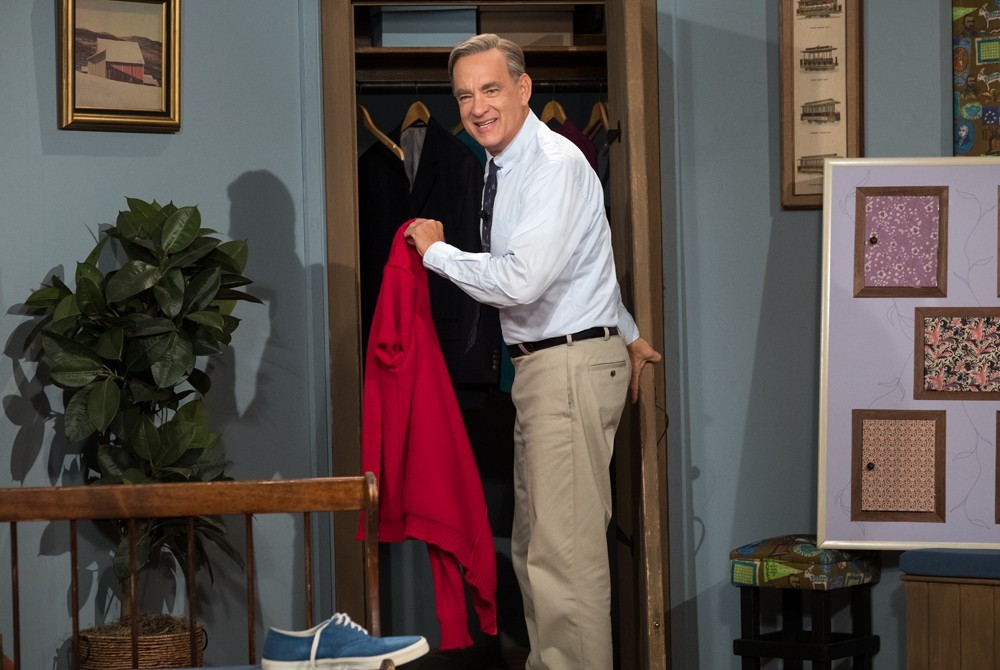
Tom Hanks plays Fred Rogers and it's just wrong. Oh, Hanks does a fair imitation, but it's an imitation and Rogers was an original. The cadence is there and the carefulness, but when Hanks smiles there's a crinkly creepiness that borders on mild irritation and that was something you never saw in Rogers, whether on his long-running "Mr. Rogers' Neighborhood" program on PBS ("THANK you!") or in his public appearances, or in the very well-crafted 2018 Morgan Neville documentary Won't You Be My Neighbor? or the many Rogers tribute compilations trotted out by PBS during their fund-raisers.* Rogers smile was genuine, never calculated, and always seemed to be ready to dawn, even when he was talking seriously. That's missing in the "Neighborhood" recreations done inABeautiful Day in the Neighborhood(although every other recreation of the set is meticulous). There was a lack of artfulness to the Rogers persona, which seemed pure, whereas Hanks is pure calculation.
The film starts out preciously, with the standard "Mister Rogers' Neighborhood" open: Rogers walks through the set-door, singing "It's a Beautiful Day in the Neighborhood," his signature song, takes off his sports coat, hangs it carefully, puts on and zips up a sweater, and sits down, taking off his loafers and putting on a pair of boat-shoes. Then presents a picture-board with little doors that reveal members of the cast. Then, he opens a door that reveal a man who looks stunned and a little beat-up: "I want you to meet my new friend, Lloyd Vogle. Somebody has hurt him and not just his face."
Cut to Lloyd Vogel (Matthew Rhys) in New York—recreated in toy dimensions as if part of Rogers' "Land of Make-Believe"—where he's receiving an award for his writing. Now, you need to know something about Lloyd Vogle. He doesn't exist. The movie is based around a Fred Rogers profile done for Esquire magazine by Tom Junod, who is a fine writer (he wrote the stunning "The Falling Man" article after 9-11) and, if you read that article (which I highly recommend), you'll find a lot of the incidences that A Beautiful Day in the Neighborhood dramatizes. But, a lot of it, certainly the personal stuff about Vogle (as Junod writes in a piece for The Atlantic) is entirely the invention of writers Micah Fitzerman-Blue and Noah Harpster, whose screenplay made it to The Black List in 2013 (where it was called "I'm Proud of You"—curiously, also on that year's list was a Rogers biography script entitled "A Beautiful Day in the Neighborhood" by Alexis Jolly). Now, the film warns us about this with a title that says "Inspired By a True Story" which means it's a couple of steps of separation removed from the usual "Based on a True Story" which, in itself, is no guarantee of veracity. So, there's some futzing going on here, though the general arc of the film is based on the Rogers-Junod story—a cynical reporter finds his "Obi-Wan Kenobi" in Fred Rogers and becomes a better person for it. Close enough for The Movies.
Back to the movie: Lloyd comes home to his gorgeous wife, Andrea (Susan Kelechi Watson) and his new baby boy and is greeted by the news that his father (Chris Cooper) is coming to his sister's wedding. Vogel darkens at the mention of his fathe, so there's history there. His wife asks if this means he's not going to attend? "No, I look forward to Sis' wedding every year..."
Well, it doesn't go well. Not at all. Dad, "Jerry," gets a little drunk, a little egotistical, a little pushy. At the reception, "Jerry" takes Lloyd aside and wants to have "a conversation," which, of course, is the last thing Vogel wants to do. Things are already a little bit antagonistic, and then Jerry's leaving Vogel's mother when she was sick leaving the kids comes up, so do fists. Lloyd socks Dad and a security guard socks Lloyd...but I'm sure the prime rib was delicious. Lloyd can put some on that on the shiner he gets from the incident.
Lloyd goes back to work sporting a black eye that he explains away from a wayward accident playing baseball over the weekend. People politely buy it. That's when he gets assigned the Rogers story by his editor (Christine Lahti), the idea of which Lloyd loathes. But, he does his due diligence, watching hours and hours of "Mr. Rogers' Neighborhood" in preparation for an interview, which after some delay, he gets. Rogers' producer Bill Isler (Enrico Colantoni) doesn't want Fred to do it and has given him some of Vogel's past articles. Despite this, Rogers says yes and quite enthusiastically.
At public television station WQED, he visits the "Neighborhood" studio where Rogers is being visited by an autistic fan-child. The studio crew is getting nervous—Fred is taking too long with the kid and the shooting schedule is tight. The director, crew—everybody—are rolling their collective eyes, but Rogers persists, focusing his attention on the child above all else. Then, he whispers something in the kid's ear, and the kid starts to focus on Rogers and gives him a big bear hug. They leave and Lloyd gets to meet Rogers. His subject is gracious, welcoming, giving him a greeting before starting a scene. When a take is completed and Rogers takes a look at it for his approval, Rogers takes a seat and the interview process begins.
But, it's an interview that Vogle has never experienced before and is, frankly, for him, a little counter-productive. He starts to ask Rogers questions and he answers deferentially, humbly, but then turns it around and starts to ask Vogle questions, asking him what his childhood was like, if he had a "special friend" when he was a kid, and, sure, Vogel had a plush toy that he called "Old Rabbit" and Rogers takes an interest in "Old Rabbit" and asks him about "him" and Vogel is a little freaked out about these questions about a ratty old toy that was tossed long ago, and, hey, he's the one doing the interview here. And Rogers is called away for another segment-taping, but, the conversation will continue soon.
This is where Hanks' interpretation gets a little off-target. Hanks' Rogers listens, but there's an appraising look in his eyes that is less open, more searching, scrutinizing, and there's enough footage of Rogers in interviews and interactions extant that the Hanks seemingly judgmental squint doesn't convey the man he's portraying. It's a small point, but it bugs me. Because I like Mr. Rogers and consider him to be a person that one should aspire to be. But—damn it—get it right, especially in a medium like the movies that could overshadow reality—and especially this movie where the reality is already suspect. "Inspired by...?" Sure. But, not in the way the actual Mr. Rogers inspires.
In the film, Rogers helps Vogel deal with his father when it reaches a crisis point, and, under Rogers' tutelage, there is a resolution and a reckoning and something that feels like closure. Those events in the film didn't happen, but the effect on Vogel is much the same as on Junod, and the two stayed friends and colleagues until Rogers' death in 2003.
And Rogers loved the article, both in the film and in real life.
Where the movie is successful is when it takes something specific that Junod related in the article and just lets it be—Rogers' openness, his taking on of burdens, his one-on-one personableness, his ability to make something good out of tragedy, his inclusiveness and his giving of self. Where it fails is in the fabrications it imposes in its framework, falling back on inspiring tropes of religious-themed "true stories," those "very special episodes" of TV sit-coms in the 1980's, and of the current crop of dog movies—you know the ones...where a dog presents important life-lessons to his human companions who are struggling through life, when all we care to see is "the dog." And "Mr. Rogers," in this, is "the dog." When I saw the previews for this, that was the impression I was getting. And, unfortunately, the movie bears out those fears.
But, there may be something to that. Rogers represents something that is missing in a cynical age. I worked for a producer ages ago, who was telling me about the wonders the show instilled in her own child, and when she asked him why he was riveted by "Mr. Rogers Neighborhood," the child said simply "He likes me!" Rogers through the TV-tube was never afraid to look a kid in the eye and tell them they had value, no matter what circumstances they lived in, what afflictions they had, what difficulties they faced in their lives. He did not present barriers to children, only possibilities. He was, and in re-runs is, an adult who could relate to kids, an authority figure who did not flaunt that authority but shared it and gave that singular kid he was looking at through the cathode-ray tube something that they also ascribe to dogs—unconditional love.
The "real" (and very nervous) Fred Rogers charms $20 million from the clenched fists of Sen. John Pastore.
* Those would be "Mr. Rogers and Me" and "PBS Presents: It's You I Like" (hosted by one of Fred Rogers' former employees, Michael Douglas, who would change his name professionally to Michael Keaton.

 Yossarian: Milo, I'm gonna kill you, you murdering son of a bitch!
 Milo Minderbinder: Don't hurt him.
 Milo: I know how you feel...
 Milo: ...but it wasn't my fault.
 Yossarian: Who's fault was it?
 Milo: No one. Nately was the victim of certain economic pressures, the laws of supply and demand.
 Yossarian: You unbelievable bastard! (The MMP's punch Yossarian in the stomach, and he crumples.) Uhhh!
 Milo: Do you want me to take you to her?
 Yossarian: (gasping) You know where she is?
 Milo: Of course I do.
 (Milo gestures and the MMP's load Yossarian onto the Jeep)
 Milo: You're AWOL, Yossarian. I thought you knew better than that. That's not smart. Nately wouldn't do anything that dumb.
 Yossarian: He's dead.
 Milo: But he died a rich man. He had over 60 shares in the Syndicate.
 Milo: Then they'll understand.
 (Milo gestures to the MMP's and Yossarian is thrown out of the Jeep)