Saturday, February 10, 2018

Brute Force (1947)

Brute Force (Jules Dassin, 1947) Westgate Penitentiary, in the middle on nowhere identifiable—Its "gates only open three times: when you come in, when you've served your time, and when you're dead!" One of the latter is going out now, a 62 year old prisoner forced to work in the prison's most dangerous area, what they call "the drainpipe." His cellmates in Cell R17 crowd around the the barred window of their too-small enclosure to watch. They are Stack (Jeff Corey), Spencer (John Hoyt)-in for gambling and grifting, Kid Coy (John Overman)-ex-boxer in for assault just moved, in taking the place of the guy who died, Becker "the Soldier" (Howard Duff)-in for murder (he took the rap for his lover), Lister (Whit Bissell)-in for embezzlement. Their main interest is because one of their own is coming back: mobster Joe Collins (Burt Lancaster) is coming out of solitary after 10 days after a stool pigeon planted a knife on him. The Chief Guard Munsey (Hume Cronyn) talks briefly to him, telling him he needs to show respect, to not be so hard, and to cooperate. Collins tells him what he wants to hear and he goes back to his cell.
The others crowd around him and give him a dry cigarette and a light and updates on the situation, including their plans for taking care of the stoolie who ratted him out (without going into specifics) and tell him that everything is okay. Collins spits out his response (in just the way you can hear Lancaster doing it): "Everything's okay? What's okay? Nothing's okay. It never was, and it never will be. Not till we're out. You get that? Out."
Brute Force may be the Citizen Kane of prison movies. Or at least a "Grand Gray-Bar Hotel." Produced by Mark Hellinger in the same hard-bitten style of his previous movie The Killers and written by a young up-and-coming script-writer named Richard Brooks.* Brute Force is a prison movie on the surface and a life-metaphor once you get below around drainpipe level. And, except for some motivational flashback sequences demanded by Hellinger so he could throw some female exploitation into the mix, it's directed by Jules Dassin with a noir attitude so bleak it approaches hysteria...then burns right through it. At the time, it was remarked for its violence, but it's not so much the violence—there are patches that are arresting—it's the vehemence, the hot and cold anger behind it, that is truly remarkable.
"Ya know, I was just thinkin'. An insurance company could go flat broke in this prison." Beyond the casual cruelty of the guards, the first outbreak of violence is the one that settles all matters about Collins' framing: in the prison work-room, that stoolie (James O'Rear) begins to suspect that a diversionary fight clearing the area of guards is a trap; it is, as he's cornered by Coy, Spencer, and Stack triangulating him with acetylene torches until he backs into a working industrial press. Nobody knows anything. Nobody saw anything. Just bad luck, "falling" into that press.
This makes a bad situation worse for the warden (Roman Bohnen); he's already been called on the carpet by some lackey of the governor threatening the man with his job if there are any more violent incidents; the guy's just a mouth-piece—he doesn't have any more answers than anybody else in the room does. But, threatening the warden with his job stings. He's been doing the job so long he doesn't know what else he would do without it. He's in a similar situation as the prison doctor (Art Smith), who's doing a job he hates (and self-medicates to get through it), but he's too old to do anything else. Everybody at Westgate has their own flavor of prison, it seems.
Except Munsey. The Chief Guard sits back during that bitch-fest with the governor's man and the warden and the doctor and just listens, biding his time, feigning concern, and solicitously acting as a go-between and interpreter ("I think what the doctor is saying..."), but not revealing his hand. That's because he's a spider, waiting for the prey to be weakened before he takes them out. The prison is his web and he has full control of it, pushing the guards, brutalizing the men, using all the methods at his disposal to have absolute power over the facility and anyone unlucky enough to enter its gates. He's not above any torture, physical or psychological, to maintain his control—at one point, he'll even beat information out of a prisoner (Sam Levene) while listening to Wagner on the phonograph (as if the ties to fascism weren't obvious enough)
That's the situation the prisoners of R17 are in. But there's added urgency: Collins is told by his lawyer that the girl who's waiting for him on the outside (Ann Blyth) needs an operation for cancer, but she won't unless Collins is with her. She doesn't know he's in prison and the lawyer is under strict instructions not to tell her. Collins has to work the angles, but his plan is to escape and never look back, and with ideas from his cell-mates, he hatches an idea—but it will mean being assigned to the very duty that killed the prisoner at the beginning of the movie—working "the drainpipe."
It's mean, it's tough, and it's violent and sometimes a little florid in its prison-yard dialog, but the part the filmmakers weren't crazy about (except the producer) was the insistence on interrupting the story with flash-backs involving the women in their lives. Producer Hellinger wanted female appeal and so the characters played by Hoyt, Bissell, Duff, and Lancaster briefly escape the prison walls (cinematiclly, of course) for scenes with the women in their pasts (played by Anita Colby, Ella Raines, Yvonne De Carlo and Blyth). The scenes don't do much as far as back-story—Hoyt's is even done without dialog and simply his voice-over—and the effect is jarring and removes suspense, pacing, and an ever-increasing feeling of doom that permeates the entire movie. Director Dassin had a substitute in mind—a surreal portrait ripped from a magazine in the cell that reminds all of them of "the girl outside." That was as sentimental as they wanted to get. 
When the escape attempt comes, it is filmed with all the energy, desperation, and hopelessness that can be bled out of the material, both visually and viscerally, like an amped-up war movie—the attempt is based on an attack strategy seen by Duff's "Soldier" during the second world war—and it all seems a bit like a suicide mission that quickly turns from gaining freedom to merely getting revenge and taking out as many guards as possible.
It is dark, but once the smoke clears, the fires are put out, and the dead carried through those implacable doors—ultimately, they make it out, ironically, only when they're dead—the film gets even darker, equating life itself with a prison. Jules Dassin was a master of the film-noir—a genre he wasn't that crazy about—but, he was interested in social justice and in making statements—and his turgid prison/war movie is one of the darkest of the type. It's no wonder tough guys in film-noirs wanted to avoid prison—Brute Force shows a world bleaker than bleak.
"Nobody escapes. Nobody ever really escapes."


* Yeah, if you know anything about movies, the name will be familiar: Brooks would go on to direct, starting with 1950's Cary Grant picture Crisis, work with Bogart on Deadline U.S.A. and Battle Circus, break the rock and roll barrier with Blackboard Jungle, and then veer from programmers (Take the High Ground!, The Last Hunt, The Professionals) to high profile prestige pictures (Lord Jim, the Brothers Karamazov, Elmer Gantry, Sweet Bird of Youth), to exploitation films (In Cold Blood, Looking for Mr. Goodbar). His last film was Fever Pitch in 1985.

Friday, February 9, 2018

The Ox-Bow Incident (1943)

The Ox-Bow Incident (William A. Wellman, 1943)  Guy (Henry Fonda) walks into a bar with his buddy (Henry—nee Harry—Morgan). He just came off the trail and is a might ornery. His girl's left town without a word, he hasn't had a bath in...well, he can't seem to remember...but, the whiskey's good, even if the company ain't. Then the fight happens; before too long, Fonda's character is just full enough of piss and vinegar (and whiskey, which from the looks of the bar, could be the same thing) that he picks a fight with a local tough (Marc Lawrence) using the bar to support him while delivering a nasty double kick to his head, until the barkeep clobbers him with a bottle of inventory which shatters over his thick skull, and sends him (rather blissfully) into the arms of Morgan, who drags him like a sack of potatoes to a waiting cane-chair, choreographed like it had happened before.
Welcome to the rough-and-tumble world of "Wild" Bill Wellman, a director of such sensibilities that you can practically smell the sweat coming off the denizens of Bridger's Wells, Nevada. In a simple scene, Wellman differentiates himself from the more genteel sensibilities of Ford and Hawks, and into his own greasier, meaner, no-nonsense view of the West. He's the better choice to present an immorality tale like The Ox-Bow Incident, about rough, western "justice" being meted out for the murder of a local rancher by a team of cattle rustlers. The Sheriff's out of town, the deputy's itching for action, the local judge is an ineffective blow-hard, and the posse-in-lynch-mob clothing have motivations, diverse but petty, such as false moral rectitude, mean-spiritedness, opportunism, and just plain boredom. Truth to tell, they're a pack of hungry wolves waiting for any prey to abuse.
They find three mena new rancher nobody knows (Dana Andrews), who's had recent dealings with the dead man, an old, demented hand (Francis Ford, John's brother), and a Latino tough (Anthony Quinn) just corrupt enough to know not to play along...with anybody. Lip-service is paid to justice, process, and prayers, but ultimately, like politicians reacting to the #MeToo movement, it's just lip-service; the purpose is to string the three up and get revenge as quickly as possible. In this court by mob-rule, the flimsiest of circumstantial evidence is not as important as the sturdiness of the rope, and waiting for facts just gets in the way of the excitement—it's a necktie party in every sense, except the common one. The cooler heads are seen as weak, obstructing, or just plain kill-joys.
No good can come of it and Wellman (working with Lamar Trotti from Walter Van Tilburg Clark's 1940 novel) writes a case for due process whatever the cost, even if the only thing wasted is time. Vigilance is not the same as vigilantism and the two should be frequently opposed to each other. And if one were to be so foolish to think that Westerns are no longer relevant to the issues of today, you haven't been reading the papers.
This was one of Henry Fonda's favorite films he appeared in (the others being The Grapes of Wrath—also featuring Jane Darwell—and Twelve Angry Men), and in 1998, The Ox-Bow Incident became part of the National Film Registry.
The Ox-Bow Incident mural emblazoning Stage 9 on the Fox lot

Thursday, February 8, 2018

Hostiles (2017)

Outpost Traumatic Stress Disorder
or
"'Deserves' Got Nothing to Do With It"

Donald E. Stewart died in 1999 after a career as a screenwriter (you may remember his scripts for The Hunt for Red October, Patriot Games, A Clear and Present Danger, and Missing). Now, this is curious: he left a "manuscript" for a project for what was to be Hostiles in the 1980's and Scott Cooper (who directed Black Mass, Crazy Heart, and Out of the Furnace) took up the mantle of the film, seeing it through to completion last year.

Hostiles is in theaters now and the promotion of it, the ads on television of it, has led to a lot of questions on my part—it's a Western (a rarity these days) but what type of "Western" is it going to be? Is it going to be myth or truth? Is it going be clean or messy? Tragedy or triumph? Is it Nation-building or genocide? Is it going to hearken back to Westerns of the past or plow new ground? What sort of animal is this "Western" going to be?

It's opening quote by D.H.Lawrence doesn't help much, except in retrospect: "The essential American soul is hard, isolate, stoic, and a killer. It has never yet melted."

Yep.

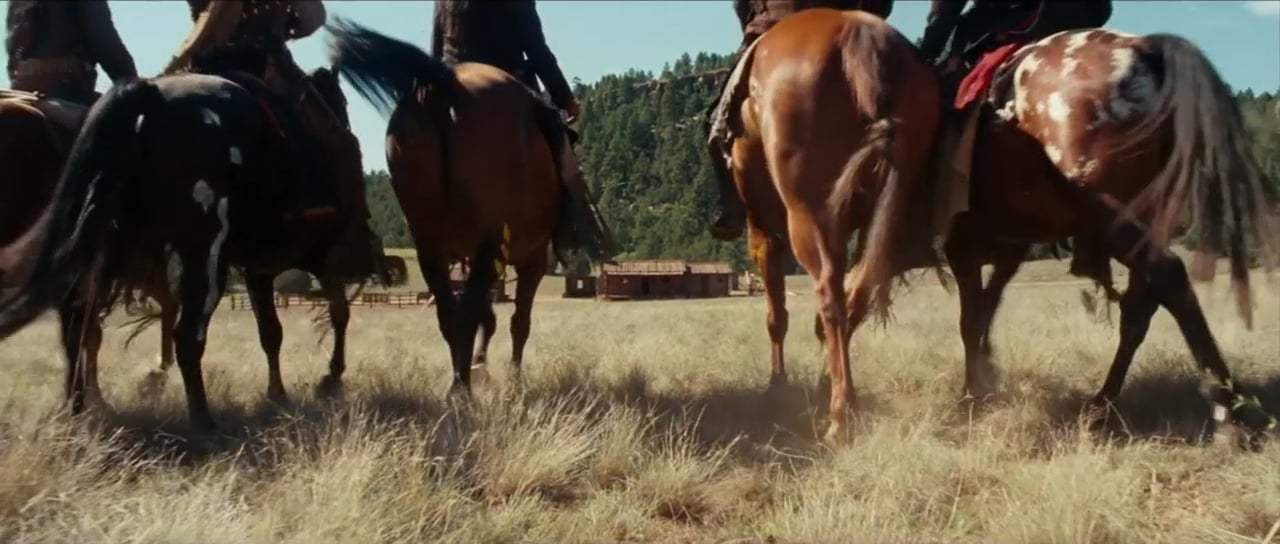
We're told it's 1892 in New Mexico and in a valley of scrub squats a naked farmhouse. Riders approach. Wesley Quaid (Scott Shepherd) is working when he sees the five horses appear over a ridge, his wife Rosalie (Rosamund Pike) is teaching adverbs to her daughters ("how where and when"), with the baby asleep in the next room, when Wesley busts in and tells her to run to the woods like they'd planned and don't look back. But, she can't. Wesley shoots, but almost immediately he is shot full of arrows and scalped. Running with the baby in her arms, she is horrified that her daughters are picked off with rifle-fire, but she still runs and hides. The Comanche raiders can't find her, but they set fire to the house. The baby is dead in her arms from a bullet that didn't reach her. 

Captain Joseph Blocker (Christian Bale) returns to Fort Berringer, New Mexico, after capturing an Apache family that has escaped. He and Master Sergeant Tommy Metz (Rory Cochrane) share a bottle and reminisce about their long campaigns fighting the South and then the Plains Indians; Metz has been relieved of his guns due to "melancholia" ("There's no such thing" says Blocker) and confesses he's going to retire, but the Army, as it always does, has other plans.

Berringer's commander, Biggs, (Stephen Lang) has orders—"a cause celehbray"—from President Harrison: one of the fort's prisoners, a Cheyenne Chief named Yellow Hawk (Wes Studi), is dying of the cancer and Biggs wants Blocker—and no one else—to escort him and his family back to "The Valley of the Bear" in Montana so he can die in his homeland. Blocker is adamantly opposed to the idea and refuses, to the point of insubordination. As a conveniently expository reporter for Harper's Weekly informs us, Blocker has probably scalped more men than Sitting Bull "himself," and while Blocker acknowledges that it is not his place to disagree, he will not carry out the orders and would just as soon cut the throats of every member of the family. Biggs tells him to sleep on it; he leaves in the morning.

After a night straight out of a Terrence Malick movie where Blocker walks out to the prairie with a thunderstorm in the distance and screams his protests about it, he gears up and takes a squad with him: Metz (of course); buffalo soldier Corp. Henry Woodson (Jonathan Majors); a rookie out of West Point, Lt. Rudy Kidder (Jesse Plemons); and a Pvt. Phillipe Dejardin (Timothee Chalamet), who everybody calls "Frenchie." Once out of sight of the fort, Blocker stops the party saying "the fuckin' parade's over," takes out two Bowie knives and orders Yellow Hawk to dismount, offering him one of the knives. The Chief scrutinizes the Captain "I do not fear death" he says in Cheyenne, and Blocker orders the two Cheyenne males to be chained up for the rest of journey to Montana.
They don't get too far until they find the Quaid farm, still smoking, the dead unburied, and Mrs. Quaid sitting in the burned out husk of her home, still holding her dead infant, with her daughters tucked neatly into bed. She demands that they not be disturbed, and Blocker, with a career of dealing with tragedies like this, places the emphasis on comfort rather than pushing the realities of the tragedy on someone still in shock. Even the offer of burial of the loved ones is dropped...immediately...when the woman, in her grief, demands she do the job herself. She digs and digs why the soldiers stand by, finally pawing in the dirt (much like Blocker raked the ground in the "Malick segment") until assistance is gently offered and she acquiesces, allowing for a service to be performed just after the sun has dropped below sight.
This hasn't gone unnoticed by Yellow Hawk and his party. The old chief goes to Blocker and requests that he and his son be unchained to better assist in any defense against the Comanche renegades. He is entirely practical and sees danger for all parties "They are snake people," he tells Blocker in Cheyenne. "They do not discriminate." The words weigh on the captain but he will not relent. The chief may make sense, but not enough to soften his caution. For him, it comes down to deeds, not words. It is only after an encounter with the Comanche that leaves Woodson wounded and Dejardin dead (and three of the Comanche dead, one by Yellow Hawk running over him with his horse and another by his son, Black Hawk (Adam Beach) strangling him with the very chains that bind him does he relent. The Captain can be practical, too.  
He's also different than most Western heroes. You know the type. Most of them are fierce subscribers to the idea of "Manifest Destiny," (as in "there's a wilderness to be tamed and, by God, I'm the one to do it"*). The wilderness is one thing, but the indigenous peoples living on it before them is quite another. Most of the time, we just get the settlers' view of things, but about 50 years after movies were created (and "the Western" along with it, scarce decades after the real thing happened), we started to get a thread of the viewpoint of the First Peoples' point-of-view which can be summed up as "there goes the neighborhood" or more contemporaneously "who let all these foreigners in here?" The making of the nation was pretty much boiled down to a governmental experiment combined with a continental race war. But, it really wasn't until John Ford made The Searchers in 1955 that we got to see the racial aspects of the Western, and it was write large when its top-billed star—John Wayne—played the character of Ethan Edwards, a complete and total (and unrepentant) racist.**
Your initial impression of Captain Joseph Blocker leads you to think he runs along the same lines—and director Cooper nudges the cine-philes in that direction by opening with a similar family massacre and a shot from the interior of the house that frames Nature in a doorway in the same manner that The Searchers did in its initial images. But, Blocker does not see things as merely black or white, but more of a shade of mordant gray. He's not a strict racist, per se (and his tearful leave-taking of Corporal Woodson is meant to dispel the notion), he just hates Indians—at least his experience as a soldier has taught him that that should be his first line of defense. He's seen too much death, and, in turn, caused too much of it to think that any business with Natives is not a good business. And it comes to him as naturally as putting on his uniform.***
And, as if to prove the point, Cooper takes it a step further; at a Colorado outpost along the way (where Woodson can be doctored) and Mrs. Quaid might take her leave, Blocker and his troop are given another task—escort Sgt. Charles Willis (Ben Foster) to Montana to be hanged for murder. He's given a couple more guards, and, despite the offer of sanctuary, Mrs. Quaid opts to continue to ride with the troop to Montana. And it is this portion where most of the reviews of Hostiles has been a might unfriendly.
Some of the accusations against Hostiles comes to its length at just this point—some folks think you don't need the Willis character, but I see it as a bit of reinforcement to shore up what might be a too-easy character arc for Blocker if it did not exist. Willis provides him a chance to look in a dark mirror, and see what might transpire of a man who goes down a wrong path. Willis—who once served with Blocker, and was at Wounded Knee with him—has taken his military experience and gone off the rails, murdering civilians, crimes for which he has been convicted and is on his way to be punished for. It may pad the movie a bit, but it does allow the alternative side to be heard from; Willis and Blocker are not the same man, but their paths are marked by similar times and occurrences, the accumulation of which have created the men they've become. Blocker could let those instances influence his choices, let the past influence the future, holding the names of the men killed under his command as a shield...or an excuse. His prisoner is the bad angel tempting him from the path he appears to be taking—made manifest (in all senses of the term) with his own destiny hanging in the outcome.
As you might be able to guess, I love Westerns. It's one of the two genres (besides science-fiction) that puts a mirror to our current age, speaking to us from the past (or the future), from the "when" about the present, about us and where we are today—about the "why" and the "how". Somehow, putting us in another frame of time puts us in another frame of mind, as well. The locale is different, but we can still recognize the human condition while it teaches us from a different perspective than the familiar, if we choose to recognize it.
Hostiles is of an age, 'way past the films of John Ford (although it pays homage to The Searchers), which dared to even bring up the matter of race in movies that were considered just "cowboys 'n injuns," to consider the Western as myth—and, as such, makes more than a passing reference to Eastwood's Unforgiven (even cribbing a line from it) and bringing a certain spin on the same director's The Outlaw Josey Wales—in how the battle to build a Nation exposes the best and worst of our natures, and, if we survive it, how, after the last echoes of gunfire fade, we choose to continue the journey—by looking back or looking forward? Do we continue it by building or by retrenching? Do we look to our bloody past or look to an uncertain future? Where is there security in either?  
Hostiles has a preference, obviously, but, in its penultimate sequence it still challenges those assumptions, by putting another challenge—another dark mirror—in the way of civilization...of nation-building. The choices are elemental, the ramifications complex, but it comes down to choosing sides...and what side you're on.
Like I said, I love Westerns, and I like them best when they're challenging. And Hostiles is one of the most challenging of the breed.


* See also: "a man's gotta do what a man's gotta do."

** If you could get past the fact that the character was played by traditional Western hero, John Wayne (which a lot of people couldn't). Some people see him as a hero without noticing that the one GOOD thing he does goes entirely AGAINST his previous intentions and inclinations...and that the movie basically shuns the character and bars him from civilization.

*** Christian Bale has a funny little character "tic" when his character is thinking—he rubs his scalp at the line of his hair...as if he's valuing it and saying good-bye to it for the last time if he thinks wrong. 

Wednesday, February 7, 2018

Superman II: The Richard Donner Cut

Superman II: The Richard Donner Cut (Richard Donner, Richard Lester, Michael Thau, 2006) Perhaps one should call it "The Richard Donner Cut" in name only. This is because Superman's original director, Richard Donner, had very little to do with this restoration, re-assemblage and re-edit,* other than give it his tacit approval—and express amazement that anyone cared so much to find all of the lost footage that he had shot (while simultaneously directing both Superman: the Movie and Superman II as was the plan) and assemble it to make some semblance of the film that he and the film's final script-writer Tom Mankiewicz (after the initial draft by Mario Puzo, the revised script by Robert Benton, and David and Leslie Newman) had in mind from the beginning. Donner has always been appreciative of how his efforts on the film have been appreciated, but moved on after he was fired.
But a lot of fan-boys did care, noting a slight change of tone in the three years between I and II. A lot had happened: the firing of Richard Donner over "creative differences" (those being he spent too much money, he cared too much about the movie to worry about the budget, and he wasn't a toadie to the producers), and the replacement with Richard Lester, no slouch as a director, but who didn't give a rat's ass about superhero movies. Web-sites had for years been acruing sightings of bits and pieces of "Donner" grail from International versions and "Expanded" television showings, and Michael Thau who assembled this thing, created new effects (a bit crude), re-edited John Williams' original score and Ken Thorne's work on II,, and grabbed whatever footage he could (including for one crucial scene only available from Margot Kidder's and Christopher Reeve's auditions) to create this dog's breakfast of a "movie."** It is incomplete with big holes in the narrative, and with only crucial Lester-directed scenes grudgingly included—Donner and Mankiewicz grouse and complain about the changes made to "their" movie in the commentary track but do give Lester (never named) and the re-writers some credit once. It makes a one-on-one comparison dodgy and a bit unfair, in both movies' favors.
The first thing one misses (after goggling over alternate takes and a wealth of new Marlon Brando and Gene Hackman footage--all shot by Donner, he only had them for a limited amount of time) is the cracker-jack/spin-on-a-dime editing of Stuart Baird, who cut the first Chris Reeve "Superman" film. The relative pace of this film, by comparison, is slack, alarmingly so. Donner and Baird in the first were far more brutal in their cutting and it made for a dynamic experience.
But I have to give the nod to the Donner cut, first, because they remained faithful to the source, and, second, because they made a far-more interesting two-movie arc than combining the first with
Lester's Version. Let me explain.

Whatever money the Salkinds made, they blew it artistically, because "Superman"/"Superman II" as Donner/Mankiewicz intended, was one of those rare things--a "religious film without Jesus." Yes, there are those direct parallels that Bryan Singer picked up on (and made too much out of in his "Superman Returns") of the Father who bequeaths his Only Son for Mankind. But it goes further. It also makes a direct, dramatic use of that ambiguous phrase Jor-El line "The Son becomes the Father, and The Father, the Son." It brings closure to Superman's ties to his home-planet and abandons him completely to Earth. It also shows why Kal-el deserves the name of "Superman." And it showed a much better performance by Christopher Reeve, than was ever displayed again in the series. The actor in Reeve played Part One, so he could sink his acting chops into Part Two. Not using the Donner segments robbed people of seeing a pretty incredible Reeve performance.
Jor-El, Superman's father--played by Marlon Brando, plays a critical role in Part II. When Lois Lane's movie-length attempt to unmask Clark Kent as Superman comes to fruition, they whisk away to his Fortress of Solitude for some alone-time, and Dad does not approve, chastising Kal-el for hubris and selfishness, telling him his reward is the happiness his good works provides. But Kal wants Lois ("this human," Jor-El dismisses her), and to do that, he must live as one of them, and have his powers removed permanently by a "red-sun generator,"*** which will make him an ordinary man. Kal-El steps into the chamber and as the process strips him of his powers, Jor-El casts a disapproving look at Lois Lane.
The human couple, Clark and Lois, leave the Fortress, the diner scene happens where Clark gets beat up, and learns about the Kryptonian villains taking over the U.S. government. Realizing what he's done, and there's no one but him who could stop them. he treks back to the empty Fortress, the crystal controls he used to communicate with Jor-El obliterated. Kal-El breaks down, acknowledges his weakness and mistake and hears nothing in reply. Finally, he cries out "Father!"Donner (and Thau) cuts to a far-shot as the cry echoes in the crossed beams of the Fortress. And one recalls the words of Christ on the Cross: "My God, My God, why have you abandoned me?"

But there is a shred of hope. Or a shard. Amidst the rubble, the original green, glowing crystal that Kal found in his Exodus-ship is still glowing, and with it, he is able to contact Jor-El one last time.

Jor-El admonishes Kal for his transgression, and tells him that there is only one way to get his powers back, and that is to transfer the final energies that allows them contact; for Superman to regain his powers will destroy the last vestiges of energy that is the Jor-El "program." Kal-El is reluctant, but Jor-El begins the process, appearing to him corporeally to touch as they say goodbye and to transfer his power to his son, destroying himself: The Son becomes the Father, and the Father becomes the Son.
Kal is knocked unconscious, the other crystal conduits are destroyed. There's the battle with the Kryptonian villains (but without the expanding sticky "S"-shields and simulacrum tricks, per Newman and Lester--what? Superman's powers aren't enough?), Luthor is carted away, and then the coda: Superman flies Lois out of the Fortress, turns, gives it one last look, opens his eyes...wide, and destroys the Empty Fortress with his heat-vision. Here are frames from that sequence, without any further explanation--but one more Bible quote:
"When I was a child, I spoke as a child, I felt as a child, I thought as a child. Now that I have become a man, I have put away childish things."
1 Corinthians 13:11


Yeah, I wouldn't call it "The Richard Donner Cut." I'd call it "The Last Temptation of Superman."


For all its patchwork quality, for its holes and inconsistent effects, I'd still have to say I prefer "The Donner Cut," as it maintains the consistent vision of the first movie and brings the story proper to a conclusion. The Lester Version let go of the internal logic for thirty pieces of silver, and undermined the biblical implications to replace it with slapstick and inconsistencies from out of left-field. One is left unsatisfied with both, and pining for what would have been the greatest super-hero film ever made.
------------------------------------------------------------------------------------------------


* Donner was much more involved with "The Extended Cut" that Warner Brothers commissioned after Christopher Reeve's death, where Donner was able to go in and add some sequences that the producers and Warner Brothers wanted removed to cut down the length of the film—and in that way squeeze in a couple more showings per night at your local theater.

** Okay, some history: Between the first and second films, Donner was "let go" (probably because he was carefully doing his directing chores and running over budget —to the point where filming of the second film was cut short) and Lester (a "fast" director who usually "printed" his first take) was hired. For financial reasons (the producers didn't want to pay him his full salary), all of Marlon Brando's scenes for the second film were scrapped and Susannah York brought back in to play Lara, Kal-el's mother (who never appeared post-Krypton explosion in the first film) from beyond the grave. Gene Hackman's footage was used, but cut way down. Why? In order for Lester to receive the director credit, he must have directed at least 50% of the movie, and so a lot of Donner footage was edited out to bring about that mathematical percentage, thus, Hackman's role of Lex Luthor was greatly reduced. A pity as Hackman is terrific in the movie (in Lester's scenes, Lex Luthor is usually facing AWAY from the camera so as not to see that a stand-in was used).

*** Okay, non-comic-book nerds bear with me: See, Krypton, Superman's home planet, had a red sun, so bathing him in "red solar energy" takes away all the powers that Earth's "yellow sun" gives him, and at this point everything breaks down because once Kal-el goes outside, he should get his powers back, but let's just GO with it, because by the movie's internal logic, he should still have a "dense molecular structure" that makes him invulnerable, and he could still put up a fight with that. But why bring all this up, really? It's all dogma, which, I guess, is appropriate. Comic books, like a religion, require the faith of a child, willing to believe.

Tuesday, February 6, 2018

Ernie Pyle's Story of G.I. Joe

"Ernie Pyle's 'Story of G.I.Joe'" (William A. Wellman, 1945) One of 2009's films designated to be preserved by the Library of Congress—and boy, does it need it, the current DVD displaying scratches, bad splices, and scenes truncated in the middle of dialogue—"The Story of G.I. Joe" was an uncommon war movie, especially for one produced in the middle of the conflict it portrayed, showing a less-varnished portrait of war and the soldiers fighting it. Done with the co-operation of the military and advice from an office-load of war correspondents, the film is an unglamorous, non-propagandistic look at the life of the common infantryman. In it, the grunt's are grimey, muddy, ass-scratching, spitting dog-faces, who get exhausted, make mistakes, leave behind fallen comrades, but keep slogging.

But then, it had to be.
Ernie Pyle, a Scripps-Howard correspondent covering the European theater took the tough route with his reportage, staying out of the clean briefing rooms and jumping into the fox-holes with the entrenched common soldiers. Through the course of his work, he became a beloved go-between for the soldiers and the folks back home aching for something other than the Big Picture and the Campaign—there were plenty of other Corona jockeys to do that—but on the soldiers following orders, following dirt roads, punching through entrenched enemy forces—their kids. Pyle's writing was clear-eyed, unsentimental and just discreet enough for the censors, written usually with the help of a bottle. He won the Pulitzer for his correspondent work in 1944, and had a hand in shaping the film.

And he was the one to get William "Wild Bill" Wellman to direct the film.Wellman was an inspired choice, as he was the one who insisted on the weather-beaten look of the film. But the director was a fighter pilot in World War I, and was subject to the same inter-corps squabbling of most servicemen, and had a low opinion of the infantry, only strengthened by his run-ins with a recalcitrant Army adviser on his film "Wings." And the film has several instances of "mea culpa's" from the director,* extolling the scrappy courage of the guys with boots on the ground, as opposed to the guys with their heads in the clouds.
Burgess Meredith got a deferment to play the part of Ernie Pyle—he was picked over other actors because he wasn't well known and had an odd home-spun quality and a crusty voice that could make the tough joshing resonate with warmth. Every war film has a cuddly troop mascot, but not every film has someone ask (in humor) "Haven't you eaten this dog yet?" As the Captain in charge of the men, Robert Mitchum plays his role in the manner he used to the end of his days, looking authentic and undramatic, like he shipped in with the other ringers—only a lot taller—and hadn't slept in days, born with the weight of the world on his shoulders, but still balanced on his aching feet. Or maybe it was the mud that was holding him up.
It was the only time he was nominated for an Oscar for his acting.

Pyle never saw the movie. Two weeks before the premiere,
he was killed by a sniper on Ie Island off Okinawa in the Pacific. He was still with the troops, reporting their struggles.

* Besides a couple of on-the-nose comparisons between Army and Air Force—that seem to come out of nowhere—one of the various character arcs is for an infantryman dubbed "Wingless" (played by John R. Reilly), who starts the film depressed that he was drummed out of the Air Corps but soon comes around to a respect for the common foot-soldier.