Sunday, December 10, 2017

Don't Make a Scene: All About Eve

The Story: I've done previous "Don't Make a Scene" features with All About Eve: "Eve's Story," and one featuring Marilyn Monroe and my favorite exchange from it. I could probably do one for just about every section of the film, as it crackles (and cackles) with good dialogue, good ideas, great performances, and is wickedly good fun.

Then, there's this one that has been waiting in the wings for awhile, ending with the ninth greatest film dialogue of AFI's 100 Great Movie Quotes. The scene is full of great lines, zingers, bon mots and neat turns of phrase, zestily delivered, but that capper, timed for effect, presentation, and ominous portent has been embraced, borrowed, purloined, and championed by drama queens of both (and all) sexes.

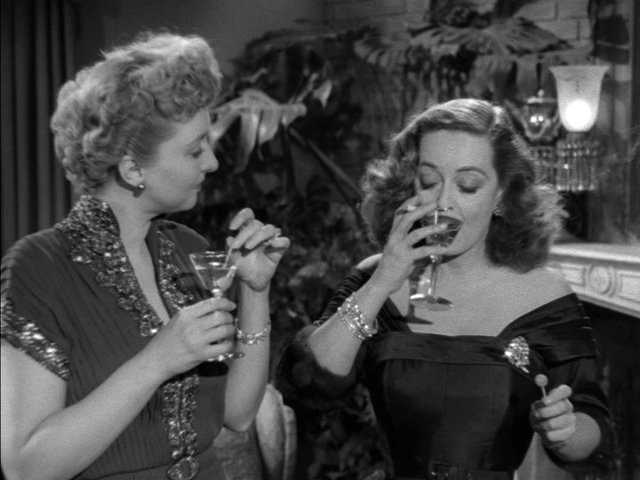
The Set-Up: Margo Channing (Bette Davis) is not in a role she wants to play. While beau Bill Simpson* (Gary Merrill) has been off to Hollywood to direct a film, Margo has been having issues with problem she's none too acquainted with—self-doubt. She's worried about her relationship with Simpson—that he might have been stepping out with younger women on the West Coast—and her personal assistant Eve Harrington (Anne Baxter), who seems to be encroaching on Margo's life. Before Simpson's combination welcome home/birthday party there's a little pre-function friction after Margo happens upon him talking to Eve. Once she leaves, Margo and Bill are reunited (where's that seat belt?).

Action!

(Eve)leaves. A short lull. Margo looks into cigarette boxes. Bill eyes her curiosity, crosses to the fire.
BILL Looks like I'm going to have a very fancy party... 
MARGO I thought you were going to be late- 
BILL When I'm guest of honor? 
MARGO I had no idea you were even here. 
BILL I ran into Eve on my way upstairs; she told me you were dressing. 
MARGO That never stopped you before. 
BILL Well, we started talking, she wanted to know all about Hollywood, she seemed so interested... 
MARGO She's a girl of so many interests. 
BILL It's a pretty rare quality these days. 
MARGO She's a girl of so many rare qualities. 
BILL So she seems. 
MARGO (the steel begins to flash) So you've pointed out, so
often. So many qualities, so often. Her loyalty, efficiency, devotion, warmth, affection - and so young. So young and so fair... 
Bill catches the drift. Incredulously.
BILL I can't believe you're making this up - it sounds like something out of an old Clyde Fitch play... 
MARGO Clyde Fitch, though you may not think so, was well before my time! 
BILL (laughs) I've always denied the legend that you were in 'Our American Cousin' the night Lincoln was shot... 
MARGO I don't think that's funny! 
BILL Of course it's funny - this is all too laughable to be anything else. You know what I think about this - this age obsession of yours - and now this ridiculous attempt to whip yourself up into a jealous froth because I spent ten minutes with a stage-struck kid- 
MARGO Twenty minutes! 
BILL Thirty minutes, forty minutes! What of it? 
MARGO Stage-struck kid... she's a young lady - of qualities. 
MARGO And I'll have you know I'm fed up with both the young lady and her qualities! Studying me as if - as if I were a play or a set of blueprints! 
MARGO How I walk, talk, think, eat, sleep! 
BILL Now how can you take offense at a kid trying in every way to be as much like her ideal as possible! 
MARGO Stop calling her a kid! 
MARGO It so happens there are particular aspects of my life to which I would like to maintain sole and exclusive rights and privileges! 
BILL For instance what? 
MARGO For instance - you! 
BILL This is my cue to take you in my arms and reassure you - but I'm not going to. I'm too mad- 
MARGO - guilty. 
BILL Mad! 
BILL Darling, there are certain characteristics for which you are famous - on stage and off. I love you for some of them - and in spite of others. I haven't let those become too important to me. They're part of your equipment for getting along in what is laughably called out environment - you've got to keep your teeth sharp. All right. But you will not sharpen them on me - or on Eve... 
MARGO What about her teeth? What about her fangs? 
BILL She hasn't cut them yet, and you know it! So when you start judging an idealistic dreamy-eyed kid by the barroom, Benzedrine standards of this megalomaniac society - I won't have it! 
BILL Eve Harrington has never by word, look, thought or suggestion indicated anything to me but her adoration for you and her happiness at our being in love! And to intimate anything else doesn't spell jealousy to me - it spells a paranoic insecurity that you should be ashamed of! 
MARGO Cut! Print it! What happens in the next reel? Do I get dragged off screaming to the snake pit? 
EVE'S VOICE (quietly) Miss Channing? 
Bill and Margo look off. Eve is in the room. They have no way of knowing how long she's been there. 
EVE The hors d'oeuvres are here. Is there anything else I can do? 
MARGO Thank you, Eve. I'd like a Martini - very dry.
BILL I'll get it. 
(he crosses to Eve) 
BILL What'll you have?
Eve, involuntarily, looks to Margo. 
MARGO A milkshake? 
Eve smiles, turns to Bill.
EVE  A Martini. Very dry, please... 
Bill smiles back and starts across the landing toward the pantry. As he crosses the stairs, Karen, Lloyd and Max come up from the street level below. General greetings. Bill continues up to pantry. Eve and then Margo come up to add their welcome...
EVE (to Karen) May I have your coat? 
KAREN Don't bother, I can take it up myself... 
EVE Please...
Karen yields with a "thank you, Eve-." Eve goes up with the coat. Lloyd looks after her approvingly. 
LLOYD I like that girl. That quality of quiet graciousness...  MARGO  ... Among so many quiet qualities.
They start for the living room. 
KAREN Margo, nothing you've ever done has made me as happy as your taking Eve in... 
MARGO I'm so happy you're happy. 
MAX Look, you haven't been running a settlement house exactly - the kid's earned her way. You had a pretty mixed-up inventory when she took over - merchandise laying all over the shop... 
LLOYD You've got Margo mixed up with a five-and-ten-cent store...
MARGO Make it Bergdorf Goodman... and now everything is on its proper shelf, eh, Max? Done up in little ribbons. 
MARGO I could die right now and nobody'd be confused. How about you, Max? 
MAX How about me what?
They've come to a halt near the fireplace. 
MARGO Supposed you dropped dead. What about your inventory? 
MAX I ain't gonna die. Not with a hit. 
KAREN This is the most ghoulish conversation...
Bill brings two Martinis. He hands one to Margo. 
MARGO (it drips ice) Thank you. 
BILL Nothing, really... 
MARGO The kid - junior, that is - will be right down. Unless you'd like to take her drink up to her... 
BILL (smiles) I can always get a fresh one. Karen - you're a Gibson girl...
He hands Eve's drink to Karen. Max has wandered off. Other guests are arriving. Margo gulps her drink, hands Bill the empty glass. He puts it on a passing tray. Margo takes a fresh one at the same time. 
LLOYD The general atmosphere is very Macbethish. What has or is about to happen? 
MARGO (to Bill) What is he talking about? 
BILL Macbeth. 
KAREN (to Margo) We know you, we've seen you before like this. Is it over - or just beginning? 
Margo surveys them all.
MARGO Fasten your seat belts. 
MARGO It's going to be a bumpy night.

All About Eve

Words by Joseph L. Mankiewicz

Pictures by Milton Krasner and Joseph L. Makiewicz

All About Eve is available on DVD from Fox Home Video.


* When I published this on another site it provoked a bit of a reaction. I had Gary Merrill's character's name as "Bill Simpson." Someone wrote in saying "Gary Merrill's name is Bill SAMPSON. It's hard to take you seriously when you make mistakes like that." Two things struck me about that: 1) anyone would take me seriously and 2) Although I recall the name being SAMPSON in the film, in IMDB it's SIMPSON (so I put it that way), Wikipedia has it as SAMPSON. TCM has it as Simpson [Sampson]. And in the film?  Take a look.
Anyway, I'll stick with Simpson, even though it SOUNDS like Sampson in the film. SOME-body got it wrong...and I still take All About Eve seriously.

Saturday, December 9, 2017

The Naked City

The Naked City (Jules Dassin, 1948) It started with Weegee. The homunculous photographer of New York's gritty, seemy side had published a book of his night-time photos of back-alley rendezvous, police-work, wet and dry, and New York's underbelly (fleas and all) bathed in the harsh glow of neon or Weegee's harsher strobe-flash. The book had the provocative title "Naked City," so, of course, it became a best-seller.

Producer
Mark Hellinger bought the rights to make a movie of it with the intention of making a pot-boiler with the city of New York as the focal point and star. No big stars, just character actors would appear in it, and it would reflect Weegee's photography with the story of a police investigation of a lurid murder amid real New York locations. He hired screenwriters Albert Maltz and Malvin Wald for the screenplay, and to direct he brought in director Jules Dassin, whose prison drama Brute Force showed he had an unsentimental flair for that material.

"Ladies and Gentlemen, the motion picture you are about to see is called 'The Naked City.' My name is Mark Hellinger. I was in charge of its production. But I may as well tell you frankly that it's a bit different from most films you've ever seen. It was written by Albert Maltz and Alvin Wald, photographed by William Daniels and directed by Jules Dassin. As you see, you're flying over an island. A city. A particular city. And this is the story of a number of people. A story, also, of the city itself. It was not photographed in a studio. Quite the contrary, Barry Fitzgerald our star, Howard Duff, Dorothy Hart, Don Taylor, Ted deCorsia and the other actors played out their roles in the streets, in the apartment houses, in the sky-scrapers of New York itself. And along with them a great many thousand New Yorkers played out their roles, also. This is the city as it is. Hot city pavements. Children at play. The building in its naked stone. People without make-up."
And for the most part, they succeeded.
Dassin can be quite "arty" in his direction, but restricted to real locations in the New York area in the middle of the day, he sometimes had to get what shot he could any way he could—hiding the camera in trucks, newsstands, anything that would keep from drawing a sizable crowd. A gawking clutch of citizenry would ruin the effect of a real story being played out. With the exception of a couple of process shots inside cars, the film pretty much keeps its promise.
But there is a disconnect. Despite the verisimilitude of the staging, the actors are still very much acting. The script, especially in its dialogue, is a bit too clever, and follows the conventions of Hollywood story construction exactly to code. This type of film had been done before with The House on 92nd Street directed by Henry Hathaway, during the noir/cost-cutting days of the studios, and would be done again with Panic in the Streets, directed by Elia Kazan. The city may be New York in 1948, but the story takes place somewhere between reality and artifice.
Hellinger, who also narrates the film (in a grand-standing display of ego that would only be equalled by Cecil B. DeMille, and less so, by John Huston and Orson Welles), succumbed to a heart attack when the film was being previewed, at the age of 44, ending a colorful career as newspaperman, screenwriter, producer, film executive, and New York gad-about. Despite the number of classic films with his name attached, Hellinger may be best remembered for the last line of his last film, which has endured and entered the pop culture.
"It is one o'clock in the morning again and this is the city. And these are the lights a child born to the name of Petori hungered for. Her passion has been played out now. Her name, her face, her history were worth five cents a day for six days. Tomorrow, a new case will hit the headlines. Yet some will remember Jean Dexter. She won't be entirely forgotten. Not entirely. Not altogether. There are eight million stories in the Naked City. This has been one of them."
In 2007, The Naked City was chosen by the Library of Congress to be a part of the National Film Registry.

There are 700 movies in the Film Registry.
* The Naked City is one of them.


Keeping tabs on the Naked City filming are Weegee and a pal,
a young photographer for Look magazine named Stanley Kubrick.

* They're listed here. This year's films will be announced at the end of the year.

Friday, December 8, 2017

The Disaster Artist

Cogito Ego Sum
or
"You're Deconstructing Me Apart, Lisa!"

Have you ever seen The Room? First off, (SPOILER ALERT), don't bother. The Room is a 2003 character drama conceived, written by, produced, directed, and starring Tommy Wiseau an actor-hyphenate of indeterminate origin and talent who has been known by a select few who have seen the film and regard the guy as something extraordinary. He is a bit like piano-playing cats in that he is extraordinary meme material. And to find out if somebody in your relative sphere is familiar with him, all you have to do is clench your fists to your face and with a pained expression on your face (the veins in your forehead have to look like they're ready to explode if you need a directing tip) cry out "You're Tearing Me Apart, Lisa!!"

Go ahead. I'll wait.


The Room is one of those movies that is so bad and amateurish that I haven't even bothered to post a review of it. It is almost surrealistically dumb and amateurish, a train-wreck with the interesting parts cut out, a relationship film where it is hard to follow if the characters are the same people from scene to scene. I would liken it to an Ed Wood-directed movie, but without aspirations, imagination, crew camaraderie, and ingenuity in coping with a small budget. Nobody looks like they're having a good time, so earnest are the cast-members in hitting their marks and making sure-that-they-are-getting-the-words-right. The only reason to see it is if one is in a really bad, vindictive mood and just feels the need to tear into something with malice. I wouldn't even suggest seeing it high, as it is disorienting enough that it might make you want to check into an emergency room (but it's not you, it's not the weed—it's the movie). I might even suggest it as a suicide preventive measure (even though—SPOILER!—the lead kills himself), as after seeing it, one might find something positive about themselves to keep on living—"Geez, even I could do better than that!" Somebody's parents are mighty proud (well, except for the sex scenes, of course), in the same charitably forgiving-Christmas-play kind of way. But, that's it. 

Okay, you don't believe me. Here is YouTube channel CinemaSins video of The Room (in which they broke the "Sins" meter). I'll wait:   

Well, it is legendarily bad. So much so that in Los Angeles (of course...) it is legend...regularly playing at midnight shows...enough to make back its six million dollar (yes, really) budget. A bewildered article in Entertainment Weekly appeared. The film became a staple of the podcast "How Did This Get Made?"—which features Los Angeles fringies back-biting projects that they or their friends were not involved with, and one episode ,featuring Wisseau's friend, co-star, and line-producer for The Room, Greg Sestero, kicked a thought-about a book on the film into high gear. 
The rest is history. James Franco's Disaster Artist (from the Sestero book, adapted by Scott Neustadter and Michael Weber, who did the, for various reasons, wonderful (500) Days of Summer, The Spectacular Now, and The Fault in Our Stars), do an extraordinary job in recreating the madness that went into the making of the film and its results (and, let's face it, Franco made it easy on himself choosing this subject—not exactly a high bar).* After a flurry of "witness" interviews—with Kristen Bell, Danny McBride, Keegan Michael-Keye, Adam Scott, J.J. Abrams, and Kevin Smith—talking about what an amazing thing The Room is, the film starts with the first meeting of Wiseau (Franco, James) and Greg Sestero (Franco, Dave) in an acting class (taught by Melanie Griffith, I should say) where Sestero is frozen by fear and Wiseau is alarmingly voluble and, frankly, a little bit freakish. Sestero is entranced, though, and asks Wiseau to do some scenes with him. After being initially skeptical, Wiseau relents and his positiveness—his "all things are possible" instinct—turns them into fast friends, eventually deciding to become room-mates in L.A. (Wiseau has apartments in both San Francisco and Los Angeles, sparking one of the mysteries of the guy—where does he get all this money?
Sestero is able to make some headway towards acting—he gets an agent (Sharon Stone), if not any work in particular. But, Wiseau comes up against a brick wall with acting coaches, agents, and all the niche-workers who think he'd make a good vampire, but that's about it. Wiseau becomes despondent until Sestero, trying to cheer him up, tells him, heck, let's make our own movie. Hey, Judy and Mickey did that! 
And so, they did. With a script by Wiseau—that is handed out scene by scene on a "need-to-know" basis like it was the latest Star Wars script, and it might be leaked to the media, they find a studio, buy (rather than rent) equipment, shoot in BOTH HD and 35 mm and shoot entirely inside the studio, even if, rather than shooting on an alley set, there's a perfectly fine alley right outside the stage door. Based on Sestero's reportage, it was a chaotic shoot, with a lot of bad behavior on Wiseau's part and an extraordinary number of takes when he was on-camera. Franco can't quite duplicate the deadness in Wiseau's eyes when he's on-camera, like he's one "z" away from falling asleep, but other than that, it is a freakishly accurate performance. It would remind one of Ed Wood, Tim Burton's tribute film to the worst director in Hollywood, if for the lack of any real acceptance of its subject actually having a "vision-thing." Burton celebrated Wood's "gee-whizery" about making movies. Franco does not have that luxury, as Wiseau has no vision other than what is of the moment.
One is reminded of the phrase that a good movie is something of a miracle—a good movie has ingeniousness, good planning as well as that indefinable something that cannot be explained or, by sheer rigor, has eliminated everything that can possibly stand in its way. Martin Scorsese said that every first assemblage of footage should make you want to throw up—it is only in the editing room that a good movie "finds itself" and is born from the raw material that is purged from the self-indulgence that created the movie. But, what if there is nothing there but self-indulgence...?
It does celebrate something in that only in America could a marginally talented person achieve his dreams as long as he has enough money (yes, I'm talking about Tommy Wiseau) and that, even though it may be totally garbage, it will still find an audience who will embrace it. America is that diverse—and capable of absorbing and creating enough self-rationalizing bullshit—that someone, somewhere will find value in it. 

* And, in apparent effort to either show off how exacting it was or just how bad the original is, in case no one believes it, Franco ends the film with side by side comparisons. Stick around for the end for the post-credit scene in which Wiseau plays a L.A. party-goer having a conversation with Franco's portrayal. Think that's odd? When the character of Greg goes to have a meeting with a talent agent (played by Sharon Stone) he is first interviewed by an assistant who is played by...wait for it...Greg Sesteros! Oh! It's like space and time folding in on its cinematic self!! (Although, not really).

Thursday, December 7, 2017

Night and the City (1950)

Night and the City (Jules Dassin, 1950) Frenetic film noir directed by Jules Dassin two steps ahead of the HUAC that was trying to get him to name names. Dassin fled to London under the auspices of Darryl F. Zanuck to direct this turgid Film-Noir-in-London about a Charlie Hustle tout, Harry Fabian (Richard Widmark), exploiting people's passions trying to make a big score any way he can, this time through wrestling tournaments, encroaching on the turf of Kristo (Herbert Lom), who'll do anything to stop him. Everything that is, except cross his father, who just happens to be Fabian's new business partner.

The first time we see Fabian, he's running. He spends a lot of time running in the film, trying to out-pace his creditors, or the next guy who wants to kill him, or dashing after The Next Big Thing, but the line between him running to something or from is a bit blurred now. And there's not much difference between the patter he spins his long-suffering girlfriend (
Gene Tierney, whose small role belies her second billing placement) or any of the marks he's trying to hustle. Fabian's sincerity is veneer-thick, just enough to make you think he's on somebody's side besides his own. When he stands helplessly on the sidelines while his meal-ticket fights for his life (a brutal sequence amazingly staged by Dassin and the two wrestlers involved), you get the sense that he's distraught because his future could go up in smoke.

The thing is, Fabian's a rat in a trap, which is visually communicated by Dassin's many shots of him stuck in place, or running the maze-like side-streets and ruins of London, as well as the cages that substitute for offices in the sleazy back-world the denizens inhabit. Despite the squalor, the film is beautiful to look at, with Dassin and his cinematographer Mutz Greenbaum bending the shadows into Gothic patterns that rival those of Citizen Kane.
Night and the City is a fascinating film, with an animated (perhaps too animated) Widmark performance-probably to make his character a bit more sympathetic; the British actors have their emotions checked in reserve and come off best, while Tierney's performance is all Fox-ingenue. And the desperate, frantic sense feels like it was made by a man on the run. Dassin stayed in Europe, continuing his career, which hit an international career-peak with Never On Sunday in 1960. He died March 31st this year in his adopted home of Greece.
Night and the City was remade in 1992, starring Robert DeNiro and Jessica Lange. It was not improved on.

Wednesday, December 6, 2017

Nazi Agent

Nazi Agent (Jules Dassin, 1942) The first film of director Jules Dassin—for no less a studio than M-G-M—was a tough one to start with, both technically and politically. Nazi Agent was released in March of 1942, just four months after the attack on Pearl Harbor, Hawaii—the U.S. only declared war on Nazi Germany (and Imperial Japan) on December 11, 1941. It was certainly in production before those events (filming started in November of 1941). Even after the Nazi's invaded Poland in 1939, Hollywood kept fairly silent on the subject, even if British films were more vocal. Before Pearl Harbor, there were Chaplin's The Great Dictator, Hawks' Sergeant York (obliquely promoting vigilance), Confessions of a Nazi Spy, and A Yank in the R.A.F. (written by Darryl F. Zanuck under a pseudonym). There was a reason for this: there was a strident line of isolationist viewpoints in the U.S.—"America First," if you will—that very publicly urged against the intervention of the States in any conflict in Europe—among them were British Ambassador Joseph P. Kennedy and famed pilot Charles Lindbergh—either because they saw Hitler as no threat or because the government needed to concentrate on issues at home (America was still re-building its economy after 1929 stock market crash). President Roosevelt was under constant pressure to keep the U.S. out of the conflict, even while European allies were urging him to take action (before the shipping of supplies, that is).

Things were such that the U.S. Senate launched an investigation in September of 1941 into any attempt Hollywood might be making to try and fan the flames of war, citing that "at least twenty pictures in the last year designed to drug the reason of the American people, set aflame their emotions, turn their hatred into a blaze, fill them with fear that Hitler will come over here and capture them." It was pointed out that the heads of the studios were mostly Jewish and might be suspected of promoting some sort of propaganda over alleged "holocausts." Imagine that. In fact, the studio's were quite mindful of the criticisms and deliberately chose a path of least controversy for fear of offending European audiences and even firing "non-Aryan" employees of the German offices at the Reich's request.


So, you can see why making a film like Nazi Agent might be a concern.

On the other hand, it is also a daunting first film in that it relies on a "trick," both artistic and technical: the story of twin brothers—one now a naturalized citizen and the other, a Nazi spy using his position as the German consul to the U.S.—it relied on the lead actor to play two different parts of different temperaments, as well as for the gentler of the two to pose as his more ruthless brother for a time; the film required trick photography with the actor portraying different characters on different sides of the screen, conversing with each other, meeting each others' eye-lines—this was well-done by a veteran director like John Ford in The Whole Town's Talking, but for a first-time director like Dassin?
To say it is credible work—to the point where you don't question it—says a lot. Dassin has an able ally in lead actor Conrad Veidt—he would play the Nazi Major Heinrich Strasser in Casablanca in a few months and played a similar role, shortly before, as a U.S. Nazi ring-leader (also with Bogart) in Warners' All Through the Night—who had been acting in films since 1916, appearing in the landmark The Cabinet of Dr. Caligari and top-lined in films on both sides of the Atlantic, playing both romantic leads and villains.* Veidt manages to clearly delineate each brother instantly with expression and body language (he did start in silent films, after all) and, when the "good" twin takes over the role of the "bad" one, is just capable enough to pull off the masquerade to convince his fellow German spies without betraying to the audience that he is still the same man that we have sympathy for. 

It's an amazing performance of the "prince-and-pauper" variety and Dassin's technical skills complete the illusion by never calling attention to the trickery, keeping the set-up's dramatically neutral and focusing on the performances (uh...performance?) which is where the real magic is happening.

In the meantime, the film manages to deliver the intended message—Nazi's look just like us. So be vigilant.

And in 2017, they still do. And now is not the time to let your guard down.

* Veidt acted in Germany until he fled with his Jewish wife Ilona to Britain in 1933. He moved to Hollywood in 1941—donating his life savings to the British government for their war effort—in the hopes that he would be cast as Nazi's (he had it in his contract that they should always be villains) to encourage the making of films promoting the U.S. entering the war. After Casablanca, he would make one more film before dying of a massive heart attack while playing golf on April 3rd, 1943.

Tuesday, December 5, 2017

Rififi

Rififi (aka "Du Rififi Chez Les Hommes") (Jules Dassin, 1955)


It's not a word that people use/
Among the "swells" and "Who's Who"/
Rififi
It's the lingo of the streetwise/
The battle cry of real tough guys/
So don't try your brain and grumble/
All it means is "rough and tumble"
Rififi

A vital missing piece (in my viewing, anyway) in the career of director Jules Dassin (of Middleton Connecticut, Harlem and the Bronx—it's pronounced "Dass'-in,") is this second European film of his exile from America and the Hollywood Black List (he had not made a film since 1950's Night and the City, which he'd filmed in London at the behest of producer Darryl F. Zanuck). Rififi is not well regarded as literature (Francois Truffaut said at the time of its release "Out of the worst crime novels I ever read, Jules Dassin has made the best crime film I've ever seen."), and Dassin was not the first choice as director (that was Jean-Pierre Melville-I'll have to look at Le Samouraï one of these days), but he needed a job, and managed to turn the book (which he also didn't like) into a cracklingly dark caper movie about a motley crew of thieves knocking over a jewelry store. The leader, Tony le Stéphanois (Jean Servais in a nicely played, tubercular performance that recalls Humphrey Bogart) isn't interested, having just served a stretch in prison for a previous crime, but relents after finding his girl having taken up with a local gangster. Rather than the fast snatch-and-grab proposed to him, though, he up's the ante, going all in only if, rather than just grabbing some jewels, the group steals the entire contents of the store's safe, the latest in security.
The scheme is elaborate, involving casing the joint for police walk-by's, then doing a home-invasion of the apartment above it, and drilling through the floor/ceiling to gain access in order to disarm the high-tech, high-sensitivity alarm system. This sequence, which works out to nearly half an hour of screen-time is un-scored, reliant on natural sound...and as the heist occurs in the middle of the night, every screeching, tearing, hammering sound could betray the entire operation. It's a nail-biter, one of the better crimes in film history, and the model for every highly planned knock-over since.
The robbery is the big set-piece, but it's merely the middle of the film. It's buttressed by the set-up and subsequent fall-out resulting in a rival gang's extortion, a kidnapping, and the gradual dissolution of the gang, a section that, after the tension of the robbery, becomes more and more free-wheeling, taking off, playing on the relationships established in the film's first third, the audience's complicity in the robbery, and by itself, becoming a tour de force. At the same time, it makes an interesting change-up from the rest of the film as "le Stéphanois" becomes a one-man wrecking crew, balefully upholding his criminal code while also trying to "do the right thing," culminating in a desperate drive through Paris that has a thrilling manic intensity with nary a car crash nor explosion (why, they don't even crash through a fruit-stand).
Rififi is a showcase for Dassin's talents* as an adapter and director, taking the noir film back to the place where the phrase was first coined, by one of "da guys" in Hollywood who'd created and perfected the dark mysteries of the genre, and making it work no matter which city streets are drenched with a forbidding rain.  


* The production of Rififi was so hurried—Dassin wrote the script in six days—and strapped for cash that when an Italian actor he'd chosen for the safe-cracker failed to receive his contract, Dassin just took over the role himself.  There is some irony there: (SPOILER ALERT) the character of Cesar ultimately gives away the mob to a rival gang and suffers a fate for it. Dassin, had fled the the U.S. and his successful Hollywood career as director Edward Dmytryk had named him as a communist before the House Un-American Activities Committee.