Sunday, December 3, 2017

Don't Make a Scene: Bridge of Spies

The Story: A quick change-up from what was planned as this seems a bit more timely. There are a lot of negotiations that go on in Bridge of Spies, Steven Spielberg's film of the efforts by James B. Donovan to secure a prisoner exchange with the Russians for the release of Francis Gary Powers, the U-2 spy-plane pilot captured by the Soviets in 1960. Those negotiations are wordy, exact in their terms (at Donovan's insistence), and nuanced to the point of view that everything is negotiable to the letter of the law.

But what law? At any number of times during the proceedings, rules are broken, agreements are broken, addenda and riders tacked on and the situation is fluid, malleable, and in constant danger of failing. Not only that, it is closely watched and monitored by governments and their watch-dogs, spies in secret, who are looking out for the best interests of each other's governments and the "gamesmanship" of who can come out with the best results.

And that's trouble. That's where rules are ignored and proprieties slip which can endanger the negotiations, but also hedge whatever good can come of it with a lot of "bad."

But, not to Donovan. In this exchange, and there are quite a few good ones in Bridge of Spies, he lays out the rules to his own private "watch-dog" from the CIA, an agent named Hoffman, who will develop a complicated relationship that is mutually respectful, but mutually irritating. Both men will follow their own rules towards the end-goal, despite how counter-productive it might be to the other.

But, here, they are as adversarial as they get. Because the ground-rules haven't been laid out, and Donovan hasn't let on that 1) he won't be intimidated by power and 2) he won't be compromised by threats. He does that by letting the agent know the bottom line of what he measures his limits by, something that might be overlooked by the agent in his lines of inquiry. And that is absolute and it is resolute.

And it is a far cry from the current POV of government part-time-job-holders who think more like the agent than they do by the lawyer. In that regard, this scene and the current situation in Washington are very similar. 

They provide an education.


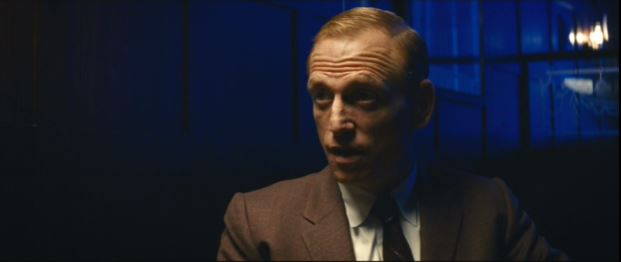
The Set-Up: James B. Donovan (Tom Hanks) has had quite the day. Tasked with providing a defense for accused Russian spy Rudolf Abel (Mark Rylance) by his legal firm, he has been rebuffed by the judge on the case for a delay of trial, not for any practical reason but because he wants the case rushed through for political expediency. Then, while walking home, Donovan has been followed, and not innocently and quite deliberately. Thinking that he has lost him, Donovan is surprised when he is confronted by the man, an agent for the CIA (Scott Shepard). Rather than have it out in the rain, the two retreat to a bar.

Action!

BAR
Donovan faces the man, looking at identification, which he hands back.
DONOVAN CIA.
MAN Yeah. 
MAN Just wanted to chat. 
MAN How’s the case going?
DONOVAN The case is going great. Couldn’t be better.
MAN Uh-huh. Has your guy talked?
DONOVAN ...Excuse me?
MAN You met him, has he talked? Has he said anything yet?
Donovan stares at him. Then:
DONOVAN We’re not having this conversation.
The man nods agreeably.
MAN No, of course not.
DONOVAN No, I mean we’re really not having it. 
DONOVAN You’re asking me to violate attorney-client privilege.
MAN Oh c’mon counselor, you --
DONOVAN And I wish people like you would quit saying “Oh c’mon, counselor.” 
DONOVAN I didn’t like it the first time it happened today, a judge said it to me twice, and the more I hear it, the more I don’t like it.
MAN Ok, well listen, I understand attorney-client privilege. 
MAN I understand all the legal gamesmanship and I understand that that’s how you make a living. 
MAN But I’m talking to you about something else -- the security of your country. 
MAN I’m sorry if the way I put it offends you, but we need to know what Abel is telling you. 
MAN You understand me, Donovan? 
MAN We need to know. Don’t go Boy Scout on me -- 
MAN ...we don’t have a rule book here.
Donovan takes a beat, sizing the man up.
DONOVAN You’re agent Hoffman, yeah?
HOFFMAN Yeah.
DONOVAN German extraction?
HOFFMAN Yeah, so?
DONOVAN My name is Donovan, Irish. Both sides, mother and father.
DONOVAN I’m Irish, you’re German, but what makes us both Americans? 
DONOVAN Just one thing, 
DONOVAN one one one. 
DONOVAN The rule book. 
DONOVAN We call it the Constitution. We agree to the rules, and that’s what makes us Americans, it’s all that makes us Americans. 
DONOVAN So don’t tell me there’s no rule book and don’t nod at me like that you sonof...
DONOVAN ...abitch.
The man stops nodding and just looks at Donovan appraising him. 
Donovan smiles and gets up from the table, gathers his things.
HOFFMAN  Do we need to worry about you?
DONOVAN Not if I’m left alone 
DONOVAN ...to do my job.
He grabs a peanut from the dish on the table and walks away as he pops it into his mouth.

Bridge of Spies

Words by Matt Charman and Joel and Ethan Coen

Pictures by Janusz Kaminski and Steven Spielberg

Bridge of Spies is available on DVD and Blu-Ray from Touchstone Home Entertainment.

Saturday, December 2, 2017

Doc Savage: The Man of Bronze

Dog Savage: Man of Bronze (Michael Anderson, 1975) Lester Dent (writing as Kenneth Robeson) produced the "Doc Savage" series of stories for Street & Smith Publications from its first issue in March, 1933 (based on a first outline by publisher Henry Ralston and editor John Nanovic) through the summer of 1949, "pulp" publications, known for the low quality paper used to print them. "Doc" Savage was of the gruesome adventure variety, a kind of Sherlock Holmes without the deductive gifts, more the type along the lines of "The Shadow" (also published by Street & Smith), Fu Manchu, and "The Avenger" ("Justice, Inc." variety), heroes with a sense of the exotic and the somewhat mystical. The "Savage" series made a phoenix-like resurrection in the 1960's with their re-printing in paperback editions (one per month!) published by Bantam Books (with those freakishly attractive Larry Bama covers.)

But "Doc" Savage (real name: Clark Savage Jr.),apart from the dark edge of the stories, had a shining bright side—a giddily altruistic hero, scientist, inventor, surgeon, biologist and all-around paragon of virtue and athleticism, a soldier-of-fortune without need of wealth, altruistic to the point of not considering romance (despite opportunity) to protect any loved ones from being a target for revenge.


This doesn't stop him from surrounding himself with a devoted clutch of idiosyncratic specialists who serve as both Dei ex Machina and comic relief when Doc gets in a jam. personally or professionally. For this reason—"The Fabulous Five" as they're nicknamed—if anybody does another Doc Savage adaptation (and there are talks of Dwayne Johnson being approached as a sort of "Rock" Savage), it is going to be very crowded.
If anyone does another Doc Savage film, the 1975 version is a must-see...for what not to do. The last film to be produced by the ingenious producer-director George Pal (The War of the Worlds, The Time Machine, Destination Moon, The Seven Faces of Dr. Lao, to name a few), the film is a-clutter with his design sense, but none of his sensibility. Whatever genre Pal put his imagination to—science fiction, fantasy, puppetry—there was a seriousness of purpose, even for a project as rife with puerile pot-holes as Robinson Crusoe on Mars
This was 1975, the year before the U.S. bicentennial, but two years after the resignation of President Richard Nixon before he could be impeached. In the years after Watergate, cynicism about anything, let alone altruism, was the easy answer—the knee-jerk reaction—of the day. Heroes were not to be believed, but, rather mocked, not just because they were "too-good-to-be-true," but because such a "goody-goody" attitude was naive...and stupid. After all, If you can't trust your President, who can you trust? Roger Moore was James Bond (Moore didn't believe in that type of hero and played him as such). And in a litigious society, where everybody is "lawyered up," and PR is a major industry in a perpetual "spin-cycle" to make their shady clients look good, the mere appearance of honesty leaves one suspect.* 
Directed by Michael Anderson, who always seemed to make any film, no matter the budget, look a little cheap-jack, Doc Savage: Man of Bronze engenders worrisome thoughts from the get-go. A tiny American flag gyrates over a frozen wasteland. That flag is attached to a snowmobile, one embossed with a "Doc Savage" logo on it (apparently all of his vehicles, be they cars, autogyro's, what-have-you, will have it) as it approaches a perfectly made igloo on the snow surface. Doffing his parka-hood, Ron Ely makes his first appearance, revealing a shock of blond hair and a literal, animated twinkle in his eye as Narrator Paul Frees intones "This is Doc Savage...The Man of Bronze!" Then the music comes up—the subsequent title will say "Music by John Phillip Sousa" specifically "The Thunderer" as it is adapted by Frank DeVol—a fine craftsman, but even he can't do anything with something that's 100% joke material.
Oh, good Lord. The thing sets out to "out-camp" the "Batman" television series from the 1960's. Some of that is part of the "'Doc' Savage" appeal—for instance, check out the "Code of Doc Savage" below. My favorite line in it is a perfect example, as Savage explains to the female lead (Pamela Helmsley, not the most expressive of actresses unless she was playing "the bad guy") why he can never have a woman in his life after she has suddenly (and somewhat inexplicably) blurted out her love for him. "I understand," she says, betraying just a hint of disappointment behind her stoicism. Doc gently cuffs her chin and says amicably, "Mona...you're a brick." I seem to remember that line from the book and chortling over it, but, how "camp" is that? 
Ron Ely plays Doc Savage the way Charlton Heston played everything. Given the circumstances and the silliness with which the whole thing is presented, he could have taken "camp" lessons from Adam West, who at least managed to "play straight" while always letting you know he knew there was a joke going on. The main villain is played by Paul Wexler, who seems to have no appetite for scenery-chewing (which is disappointing, especially when one of the villains has the habit of sleeping in a crib) or maybe he just didn't know how to do it entertainingly. The whole thing is horrendously "dubbed" the sets look cheap, the locations very "back-lot" and one has to put the blame on Anderson, who even managed to make his next film, Logan's Run, look cheap despite a budget of nine million dollars (Compare it to Star Wars which was made a year later for 13). Whatever is clever in the movie can be sourced to the novel—Doc's amazing inventions, for instance—but, in the year in which Jaws was released, Doc Savage: The Man of Bronze bombed horribly at the box-office.
Like so much of what passes for humor in movies these days, you have to be a little bit high, or in some other way impaired, in order to appreciate this film—any number of pharmaceuticals and concoctions can be used to lower the bar—and taste—sufficiently. But, look, if you can make a series of "Indiana Jones" parodies of B-movie serials, Lara Croft video-game movies, you can certainly make a serious (if tongue in cheek) version of the "Doc Savage" series and do it somewhat competently.
The film ends with this title card—part of it was filmed  but shelved when
The Man of Bronze did poorly at the box-office. Still, the second film boasted a screenplay by Phillip Jose Farmer, which one can only see as a missed opportunity.


I once talked to a lawyer over a contentious issue where he brought up "The Golden Rule," which he declared was "the one with the gold makes the rules" and I replied "Is that what they taught you in law school? I grew up with "The Golden Rule" being "Do unto others as you would have them do unto you." He looked at me with a pitying look, and I decided the best "do unto you" was not to strangle him by his cheap neck-tie.

Friday, December 1, 2017

Three Billboards Outside Ebbing, Missouri

Mutiny and Rage
or
"You're So Pretty. But She's Still Dead."

A line from Seven Psychopaths might be a good preamble for Three Billboards Outside Ebbing, Missouri: "An eye for an eye leaves the whole world blind."

A timely film about the dangers of acting without filters, Martin McDonagh's new film (after In Bruges and Seven Psychopaths) shows what can happen when the thirst for revenge overruns your life: it escalates, creates consequences, and expands in ever-increasing ripples of cause and effect. You want revenge? Don't stop at digging two graves.

Three Billboards defies pigeon-holing and genre-fication. It's too commonplace to be a thriller. It's too intense to be a drama. It's too dark to be a comedy. But it's all of those things at one time (the comedy being more of the Black-Irish variety). It is too sunny and rural to be a noir, but it does share one quality with that type of film: there is no merciful God in evidence in Three Billboards Outside Ebbing, Missouri.
Driving on the seldom-used road by her house, Mildred Hayes (Frances McDormand) sees three billboards in disrepair that haven't been used in decades. She stops, backs up and takes in all three of them and the impact they'd have driving past them—1...2...3. And something sparks her. She takes five thousand in cash and strides into the local marketing agency and announces she wants to rent those billboards. After going what can't be on the signs ("Well, I think I'll be alright then" she says), she signs the contract and soon, the billboards are up, and their message is provocative.
The first person to see them is Deputy Dixon (Sam Rockwell), a not-too-competent law officer, who drives by one night and is shocked, angered and his first reaction is to call the Ebbing chief of police Bill Willoughby (Woody Harrelson) as the billboards are a direct challenge to him. The chief is trying to have dinner with his family and Dixon's a hot-head that, for some reason, Willoughby keeps on the force, but his a cooler head and not nearly as reactionary. He'll wait and talk to Mildred in the morning.
News of the billboards has now spread throughout Ebbing and the subject is divisive. The chief has a lot of friends and Mildred has made a few enemies because of them. But a visit from the Chief to try and mollify the situation does help things any much. The Chief wants the billboards down, but he understands the situation; it's been seven months since Mildred's daughter Angela (Kathryn Newton) was raped and murdered, her body burned in the very area of the billboards, and, as they accuse, no arrests have been made in the case. Angela is dead and buried, but Mildred and her son Robbie (Lucas Hedges) have been living with the consequences and their own consciences ever since. Mildred's abusive husband (John Hawkes) has moved out and taken up with a 19 year old intern at the zoo (Samara Weaving).
The Chief is empathetic to Mildred—he has been trying to solve the case and it has been frustrating that there is no forensic evidence to follow up on and tells her that, eventually—in these cases—someone will say something out of turn, someone will slip up, some code of silence will be broken and then, they can act. And as aggrieved as he is about events, he still thinks the billboards are unnecessary. "I don't think those billboards are very fair," he says. Mildred has none of it. "The time it took you to get out here whining like a bitch, Willoughby, some other poor girl's probably out there being butchered." Even telling her that he has cancer doesn't soften her resolve or her frustration. The billboards will stay, come what will.
Dixon is pissed. He wants something done. But, he's under a bureaucratic cloud for beating up an African-American while in custody. He's the loudest and crudest of the local constabulary and has very little anger-management skills—something he probably learned from his mother (Sandy Martin), with whom he still lives. Willoughby can barely contain him during a visit to the ad office—across from the police station—to pressure them to take the signs down, but don't press the point when they realize that they really have no justification within the law to do it. Willoughby, however, starts to re-examine the evidence and crime scene to see if there is something—anything—he might have missed in the initial investigation. 
Confrontations with Dixon (at a bar where he regularly drinks himself into a stupor) and some of the locals causes Mildred to be arrested, but she remains committed to keeping the signs up and the pressure on. Neither side is going to budge, and it's only Willoughby's keeping things from escalating that keeps the town from exploding or Dixon from doing something stupid...or more stupid than is typical for him.
It is that constant, simmering feel of menace that makes Three Billboards a thriller. It is the unblinking directness of everybody's words and actions (and their inability to hedge anything) that makes it funny. It is the utter helplessness and casual brutality that makes it a noir. You begin to wonder if anybody has a shred of decency in the whole thing, but they're inhabiting an indecent uncaring world and the posturing, the implied threats, the "scorched Earth" unequivocation, and the tit-for-tat intensification of hostilities has to come to a head. Before the movie's over, things will flare up to a combustible heat, leaving behind devastation in its wake, if not entirely due to the actions/reactions taken, even if, in the circle outside the fire, it's perceived to be.
Three Billboards is a great movie and, dare I say it, a sign of our times. It is tough—it is not for the blue-hairs and the easily offended (because there is something to offend just about everybody). It has the huevos to to put a lie to the phrase "profound rage." There is nothing "profound" about it (perhaps another word should be found to be paired with it, lest there be any confusion), certainly not in this context. A terrible wrong committed by arrogance has occurred, in the quest for vengeance it gets compounded, and then compounded and then compounded again. We as a people (urged on by simplistic morality plays, such as can be found at the movies) are spoon-fed viscerally satisfying revenge-scenarios that make us think such a thing is commonplace and normal in a philosophy that is based on "an eye for an eye." If we could stop with just an eye, maybe it could work, but the instinct is escalate and with no end in our cyclopean sight.
The performances in this things are brilliant. McDormand is totally unafraid to make her Mildred ugly, both in spirit and face. Keeping her chin up has solidified it to granite, and cocked it forward with a invitation to, go ahead, take a swipe at it...at your peril. A monologue planting flowers near the billboards where her daughter was murdered reveals a person so consumed by grief and guilt and anger that nothing in this world, no miracle, could pull her out of her single-minded need to see somebody pay...and it can be anyone, so far as she's concerned. Thought has left the building. The un-nuanced need for revenge has replaced it. Interestingly, an inspiration for her performance came from John Ford's The Man Who Shot Liberty Valance. Every morning, McDormand sat in her make-up chair staring at pictures of John Wayne, while Rockwell's mirror was covered by pictures of Lee Marvin...and Barney Fife (from "The Andy Griffith Show"). Apt.
I've listened to some hand-wringing on public radio about the movie being insensitive to some issues—like spousal abuse and race-baiting—and being caustic in its humor, which is mostly ironic in nature (folks don't know what they're saying is innately absurd) and that "there is no one to root for." Well, no shit, Sherlock. This isn't a super-hero movie (which, by the way, are based on the notion of crowd-pleasing revenge at any costs). This is about people so burning with anger and self-righteousness that they believe they can do anything, within or without the borders of lawfulness or decency, in the pursuit of their personal cause, effects be damned. We're seeing a lot of that in the world today—letting the world burn because the "cause" is right, without the foresight to see what might be the consequence. If anything, the movie is closer to the "Incredible Mess" version of comedy, where people just dig themselves a deeper hole for themselves without the perspective to see that things are getting more dire the harder they pursue it. In that realm, there is very little to distinguish between comedy and tragedy.
Even it's ending is maddeningly ambiguous, as the most unlikely of partners go off in pursuit of the most tenuous of missions, leaving the audience with (if they're of the mind) only the most thread-bare of hope that someone will come to their senses. But, it's a bit like hoping you can convince someone to consider that they might be wrong. It doesn't work for ideologues, Trump-voters, Nazi's, the PC-GI's...Hell, it doesn't even work for film-critics. Ahab must be led to the whirlpool, and fools hoisted on their own petard. Because doubt is perceived to be weakness in a patriarchy, as opposed to being thought of as open-mindedness and thoughtfulness.

So it goes. Until we can find something better.