Sunday, December 14, 2014

Don't Make a Scene: A Hard Day's Night

The Story: In the press conference sequence of A Hard Day's Night, it is scripted that Ringo is asked: "Are you a "mod" or a "rocker?" And his reply is "I'm more of a mocker.." Truer words...

That was part of the charm of The Beatles (in order of joining: John Lennon, Paul McCartney, George Harrison, Ringo Starr) they mocked everything. Oh, they took the music seriously, and their jobs. But, everything else was material for lampooning.  The questions from the Press, the Press itself, the fan's reactions, their hair, their life-styles, their "talent"—they made more fun of themselves (and each other) than anything. And, as a consequence, they became more fun to watch, too, apart from their songs.

A Hard Day's Night has them as themselves (to a point), in their London, in their circumstances, dealing with their notoriety and all the complications that entails, from logistics, to travel, to exploitation, to loneliness, to "cabin fever." It examines the price of fame and the cost of living in a Beatle bubble.

But, contrarily, it's hysterical. I was at the premiere when it opened in Seattle (thanks for getting the tickets, Dad, and for being amused, rather than alarmed, at Beatlemania), and it was a mob scene—you couldn't hear half the dialogue over the screams in the audience.* But, I always remembered this scene, and have memories of actually seeing it and being amazed by it. It zapped my head when I was 9 years old.

I loved comedy as a child, and always pestered adults with jokes to test "what was funny." But, this was different. This was absurd. Abstract. This was play. This was a discussion that centered around nothing, that kept building and building to the perfect punch-line (dubbed in later).

We assume the discussion centers around whether John Lennon resembles John of The Beatles, but it's never stated outright, and, in point of fact, it is never even mentioned, and avoided. Who Millie mistakes him for could be Winston Churchill, for all we know. That's the comedy aspect, like the drunk who asks the celebrity: "Do you know who you are?" ** They both know who they're talking about (or...do they?), and that absurd void is danced around, like Charlie Chaplin roller-skating around a man-hole, and comes to a conclusion without any resolution.  And that all stems from the mutual Beatles/Richard Lester/Beatles producer George Martin association with The Goons (Spike Milligan, Peter Sellers, Harry Secombe, et al.), the British comedy troupe much beloved for their embrace of the absurd and the bizarre, part and parcel of the strange jitterbug in A Hard Day's Night, that catalogs two Days in the Life of The Beatles.

The Set-Up:  The Beatles have just had a momentary burst of freedom, playing in a field before being summarily kicked off of it.  Now, they must return to the dungeon-like studio where they await another rehearsal, another show.  But, even there, The Beatles can't escape attention, and the weird price of Fame.

Action!

Ad-Libbed sections are in YELLOW

48A. INTERIOR CORRIDOR AS BOYS PASS THRU ON WAY TO DRESSING ROOM
JOHN is behind them. JOHN, BOYS and MILLIE are walking towards each other.
MILLIE (as all pass) Hello.
JOHN (stopping... the boys carry on past, not noticing her) Hello.
MILLIE Oh, wait a minute, don't tell me you're ...
JOHN No, not me.
MILLIE (insistently) Oh you are, I know you are.
JOHN No, I'm not.
MILLIE You are.
JOHN I'm not, no.
MILLIE Well, you look like him.
JOHN Oh do I?
JOHN You're the first one who ever said that.
MILLIE Oh you do, look.
JOHN looks at himself in the mirror.
JOHN examines himself in the mirror carefully.
JOHN My eyes are lighter.
EXTRA: Excuse me...
JOHN: All right, noddy...
MILLIE (agreeing) Oh yes.
JOHN And my nose...
MILLIE Well, yes your nose is. Very.
JOHN Is it? 
MILLIE I would have said so.
JOHN Aye, but you know him well.
MILLIE (indignantly) No I don't, he's only a casual acquaintance.
JOHN (knowingly) That's what you tell me.
MILLIE (suspiciously) What have you heard?
JOHN (blandly) It's all over the place, everyone knows.
MILLIE Is it? Is it really?
JOHN Mind you, I stood up for you, I mean I wouldn't have it.
MILLIE I knew I could rely on you.
JOHN (modestly) Thanks.
MILLIE touches his arm then walks away. After a moment she turns.
MILLIE You don't look like him at all.
JOHN walks away, indignantly
JOHN (to himself) She looks more like him than I do...

A Hard Day's Night

Words by Alun Owen

Pictures by Gilbert Taylor and Richard Lester

A Hard Day's Night is available on DVD from Criterion Home Video.


* Yes, the "youngsters" were screaming at the Beatles' image on the movie screen.  As George Harrison has pithily remarked, "We gave them an excuse to go insane."

** I've actually seen this happen in real life.  All you can do is be amazed.  Celebrity turns a lot of us to babbling goo.

Wednesday, December 10, 2014

Walking Kurosawa's Road: Sanshiro Sugata (1943)

The inability to write about the films of Akira Kurosawa to my satisfaction led me to to take a different path: start at the beginning, take each film in sequence, one after the other, and watch the progression of the man from film-maker to Master. I'm hoping I can write more intelligently and more knowledgeably about his work by, step by step, Walking Kurosawa's Road.


Sanshiro Sugata (aka: 姿三四郎; aka Judo Saga) (Akira Kurosawa, 1943) Every hero's journey begins with the first step; it is true in this film's story and in reel life, this being the first full-length feature of legendary film director and stylist Akira Kurosawa. One already sees reflections and echoes of the Master's work and influence rippling out from this one, even as it, itself, builds on the reverberations of Western film-making traditions.

Made during the Second World War and heavily cut by the Japanese government for sentiments that some petty bureaucrat probably imagined might hurt the war effort, Kurosawa's first big effort and first success has never recovered from the sword of the censor—the missing pieces have never been found. 

But, what there is proves enlightening...and telling.

It is a hero's journey. Sugata (Susumu Fujita) is a novice fighter who wants to learn jujitsu, but is given short shrift by the school of martial artists he joins.  When they hear a master of the rival judo order is in town, the entire group decides to confront the man, Shogoro Yano (Denjirô Ôkôchi). In a fight at a canal's edge, Yano takes on all comers, dispatching them into the frigid water—the first of many examples of the "last man standing" scenes that would dominate Kurosawa's film and his students, Sergio Leone (and also Clint Eastwood). Those impressive results are all Sugata needs to switch disciplines, studying the ways of judo with Yano.
But, what the apprentice gains in skill he lacks in discipline, squandering his unfocused talents getting into sporadic street-fights that disappoint his Master.  In a desperate bid to win Yano's respect, Sugata dives into the freezing waters at the judo temple, risking his life, but also gaining an understanding of "satori," represented by the sight of a single blooming flower, growing straight and tall in the frigid waters. The strength of Nature is revealed to him, and the apprentice has found the inner truth to master his craft. 

At that point, Sugata becomes renowned as the toughest fighter in town to beat, and he is challenged by jujitsu fighters determined to best him. One can't help seeing the "gunslinger" analogy here, as the new guns and old challenge the now-humble, wiser Sugata to matches of skill to the death, like he was the "fastest draw." Just as, no doubt, Kurosawa drew on Westerns for his martial arts saga, his work would come full-circle, inspiring Westernized versions of his work—specifically, The Magnificent 7 and A Fistful of Dollars.

It's an analogy to life itself—you make your way through it, and you may have what it takes, but it is only by knowing oneself and seeing the Bigger Picture that one can truly make a success of life.  Already, Kurosawa is tackling big themes.  But, you can already see his command of staging with Nature acting as an emotional well-storm, culminating in a passionate fight between two rivals for one woman's hand, on a wind-swept hill of violently whipping tall grass.
I have so many Kurosawa film reviews sitting in various drafts, never feeling secure in my grasp of his work, so I've decided I'm going to start at the beginning and work my way through his career. In the next few weeks, you'll be seeing more and more of his films cropping up here, a result of my own faltering tentative journey observing his remarkable work. Hopefully, somewhere along the path, focusing on his work, I can achieve some wisdom about it.

Tuesday, December 9, 2014

Tora! Tora! Tora!

Tora! Tora! Tora! aka (トラ・トラ・トラ!) (Kinji Fukasaku/Toshio Masuda/Richard Fleischer, 1970) "The American Pacific Fleet was attacked and partially destroyed by Japan on . . . Sunday Morning December 7, 1941. This attack led to the entering of the United States into World War II. All of the events and characters depicted are true to historical fact."

20th Century Fox's former studio head
Darryl F. Zanuck had served in the second World War, and spent his senior years at 20th by the overseeing of large movies showcasing major battles of that war, his most prominent being The Longest Day, based on Cornelius Ryan's book documenting the Normandy Invasion.  But, in 1966 plans were put in place to make an historically accurate film about the Pearl Harbor attack, based on Ladislas Farago's "The Broken Seal."  Ambitious in its scope, the film would be made with both Japanese and American crews, and for a great deal of the pre-production the man in charge of the Japanese unit was director Akira Kurosawa (who did extensive work on the screenplay).  Kurosawa agreed to the film, thinking that David Lean was making the American section, but when he discovered it was, instead, Richard Fleischer, the Japanese master bent some rules in order to allow himself to be "fired" from the film.  He was replaced by two directors known to be as efficient and workmanlike at bringing films in on-time and under-budget as Fleischer.  The intention was not to make great art, but to make an historically accurate film, devoid of trumped-up drama (From Here to Eternity had done that already) and stick to the main subject of the planning and execution of the attack.
The result, although accurate, is rather flat. Fleischer's American scenes seem drab and stale and, peopled with character actors like Jason Robards, E.G. Marshall, Joseph Cotten and Martin Balsam, lacking in star power.* The Japanese sequences, perhaps because they have less of an American film studio-feel, seem to have more verve and energy...and better performances. The movie seems to reflect the situation of the real life events: the Japanese have all the bright ideas, while the Americans have the lethargy associated with "a sleeping giant."** Still, the battle sequences and attack footage is extraordinarily well done, a combination of L.B. Abbott's and A.D. Flowers' model work and the Fox Studio's sometimes hair-raising practical effects crews and stuntmen.
I attended the premiere of Tora! Tora! Tora! with my family at a special showing at the old Paramount theater in Seattle. It was a special preview for the local chapter of the Pearl Harbor Survivors, of which my father, John Wilson, late of the U.S.S. Missouri, was a member. The only story my Father ever told of the war was the events of December 7th, when he was waiting on the dock of the U.S.S. Arizona to attend on-board church services with his friend, Howie Whims, who, for whatever reason, was late. Were it not for his buddy's tardiness, my Father would have been aboard the doomed Arizona at the time of the attack, and likely might have joined the ranks of the sailors who are still entombed there.***
It was an odd thing sitting in that audience with that audience. 29 years previously, they had witnessed the true horrific events of what was being fictionalized on screen. The mistakes made (by both sides) that made the devastation so complete was laid out for all to see. But, however good the effects and pyrotechnics, they couldn't recreate the carnage of that day: the deafening noise, the stench of burning oil that enveloped Pearl for weeks, the bodies, the desperation; the sight of good friends and comrades-in-arms caught in the gears of the attack and lost forever.**** 
The retired sailors sat stonily, watching the film—no doubt poor competition for the memories unreeling in their own heads and hearts and souls. There was a smattering of applause when a Japanese zero was shot down, but it was unenthusiastic, hardly celebratory. For them, it was a film about—and I say this hopefully—the worst day of their lives. However artfully done, however accurately portrayed, who would want to sit through that?  As Sam Fuller succinctly put it in The Big Red One, "Surviving is the only glory in war."  

I hope, on that day, they could appreciate their own glory.


As part of the marketing of the film, 20th Century Fox had artist Robert McCall do a series of designs for use in poster art (as he had with 2001: a Space Odyssey). The images are quite extraordinary.

* Actually, it's not a bad strategy.  Less attention is paid to the actors on-screen to the advantage of the story.  Films such as Zanuck's The Longest Day or A Bridge Too Far become parlor games after awhile ("Look!  There's Sal Mineo and Richard Beymer! Isn't Gene Hackman in this movie?")

** That's taken from the thing the movie is most famous for—Yamamoto's assessment of the attack ("I fear all we have done is to awaken a sleeping giant and fill him with a terrible resolve").  Even Michael Bay's Pearl Harbor used it.  It's a good line, making the Imperial General seem both prescient and tragic.  Unfortunately, it appears that, historically, Yamamoto never actually said it.

*** It's one of the reasons I have no patience with Michael Bay's post-Titanic disaster, Pearl Harbor: there is one shot, meticulously recreated, following the path of the most damaging bomb that struck the ship—one of those CGI-sailors scrambling for cover below could likely be my Father, and it irks me that Bay's sensibilities had more gung-ho enthusiasm for the bombs than for the victims.

**** Those sailors' names are etched in stone at the Pearl Harbor Memorial, which is constructed over the still capsized hulk of the Arizona, which still burbles oil to the surface to this day.  But, there's another section, a more recent section, with fresher names cut into the rectangular portal that leads under the surface to the Arizona.  It's for survivors of the attack, who after living through the war, living a full life with wives and families, still chose as their final resting place the ship in the Harbor where they lost so many friends.  I never fully understood "survivor's guilt" until I saw that.

Sunday, December 7, 2014

Don't Make a Scene: Catch-22

The Story: Authors cringe when you talk about making a movie from their work. I remember seeing an author on the old "Dick Cavett Show" who grumbled that helping to write the movie's screenplay was akin to "holding the coat of the man who's molesting your child."

And so, Joseph Heller's "Catch-22."

I don't know how Heller felt about Mike Nichols' film of his most famous best-seller, overall, but I do know this: he loved this scene.

He loved this scene so much, he told its author, Buck Henry, that he wished he'd thought of it for the book.

High praise, and why this is the scene for the week.

The Set-Up: Every war movie has its "scrounger," the "get" guy, the "dog-robber," the "King Rat"—the one who can acquire the things that people need and want and sets up a black-market lemonade stand of his stores. Joseph Heller took the concept and used it to satirize the monstrous greed of 50's Corporate America in the character of Milo Minderbinder ("What's good for MM Enterprises is good for America"), who would sell the pilot's parachute silk for profits, leaving the air-crews with promisary notes for shares in his "Syndicate." Mike Nichols and Buck Henry took the idea a bit further and made Heller's Milo a wheeler-deeler turned fascist dictator. In this scene, Yossarian (Alan Arkin) confronts Milo (Jon Voight) over Milo's deal with the German government to bomb the Allied air-base, which managed to kill Nately (Art Garfunkel). Milo would have no trouble sitting on the board of Enron or Halliburton. Why, who knows how far he could have gone? Or would have gone?


Goldman Sachs, maybe?  Goldman Sachs, probably.

Action!

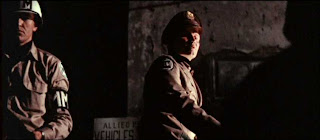
Yossarian runs after Milo's motorcade and attempts to board the jeep where Milo is standing in the glow of the klieg lights. Milo's police contingent hold Yossarian back.
Yossarian: Milo, I'm gonna kill you, you murdering son of a bitch!
Milo Minderbinder: Don't hurt him.
Milo: I know how you feel...
Milo: ...but it wasn't my fault.
Yossarian: Who's fault was it?
Milo: No one. Nately was the victim of certain economic pressures, the laws of supply and demand.
Yossarian: You unbelievable bastard! (The MMP's punch Yossarian in the stomach, and he crumples.) Uhhh!
Milo: Do you want me to take you to her?
Yossarian: (gasping) Who?
Milo: Nately's whore. Aren't you looking for her?
Yossarian: (gasping) You know where she is?
Milo: Of course I do.
(Milo gestures and the MMP's load Yossarian onto the Jeep)
Milo: You're AWOL, Yossarian. I thought you knew better than that. That's not smart. Nately wouldn't do anything that dumb.
Yossarian: He's dead.
Milo: It's too bad. He was a nice fellow.
Yossarian: And your boys made a nice direct hit on him.
Milo: But he died a rich man. He had over 60 shares in the Syndicate.
Yossarian: What good is that? He's dead.
Milo: Then his family will get it.
Yossarian: He didn't have time to have a family.
Milo: Then his parents get it.
Yossarian: They don't need it, they're rich.
Milo: Then they'll understand.
(Milo gestures to the MMP's and Yossarian is thrown out of the Jeep)

Catch-22

Words by Buck Henry

Pictures by David Watkin and Mike Nichols

Catch-22 is available on DVD from Paramount Home Video.

The scene begins about 3:00 in.

Saturday, December 6, 2014

Olde Review: Purple Noon

This was part of a series of reviews of the ASUW Film series back in the '70's. Except for some punctuation, I haven't changed anything from the way it was presented, giving the snarky, clueless kid I was back then a break. Any stray thoughts and updates I've included with the inevitable asterisked post-scripts.

This Saturday's films in 130 Kane at 7:30 pm are thrillers: one sophisticated; the other unsophisticated, but God, it's neat, and they are Rene Clément's "Purple Noon" and Brian DePalma's "Sisters"

"Purple Noon" or "Plein Soleil" (René Clément, 1960) Clément's "Purple Noon" was shown on TV Thursday night under a different title—"Lust for Evil"—and in a dubbed English version. Even if you saw it on Channel 9,* you should go see it Saturday night because, let's face it, movies always lose something on the television screen,** especially if they're dubbed in a sort of ill-fitting English as the televised version was.

"Purple Noon" is the story of two somewhat irresponsible young men. They tour the streets at night looking for trouble, rousting whoever they can. And in the course of the plot, one of them is murdered by the other. But how can
Alain Delon, who plays the murderer, get away with it? Well, it happened out at sea, they were alone on the victim's boat (the victim's fiancé in a fit of pique had gone ashore), there were no witnesses.

But won't people, especially those close to the victim notice his disappearance?
Delon has a plan for that: he is an excellent forger, he has the victim's belongings, his passport, and he can imitate his voice. And the fascination in this story is in the second portion. Will Delon be detected by those who knew the victim—especially the fiancé? Will he get out of all the close calls? How will he avoid it? It's a run through a maze and it culminates without a nice surprise ending.
Maurice Ronet, Marie Laforêt, and Alain Delon as the talented Mr. Ripley
And Clément's direction can sometimes come up with pleasant little touches that leave the viewer just a little bit amazed, as in the murder on the boat (that is over so quickly) only to be replaced by the problem of getting rid of the body, a task that is made more difficult by a sudden storm at sea that seems to rise up in moral vindictiveness over Delon's act. It's a nice touch, and "Purple Noon" is a nice, somewhat sedate little thriller.

Broadcast February 12, 1977
Mr. Ripley's one true love
I didn't know from Patricia Highsmith in college. I discovered her quite later. Her delightfully dark amoral little tales (like Strangers on a Train adapted very, very well by Alfred Hitchcock) filled a musty little hole in my heart for years. I did not know Highsmith when I saw Purple Noon in college, nor could I know that what I was seeing was the original, slimmed down and altogether superior French version of The Talented Mr. Ripley.
Clément isolates Ripley and gives him a dull off-kilter halo

It's bad form to speak ill of the dead (although Ripley would do it with his usual lack of conscience), but Anthony Minghella's 1999 version of the tale starring Matt Damon, Jude Law and Gwyneth Paltrow was too puffed up and proud of itself to make an effective thriller, despite an impressive cast. It felt staged and lethargic (and that is the last thing a Ripley movie should be), whereas Clément is a witty, nimble director who will never let any cruel irony go unexploited.

Highsmith wrote five "Ripley's"—called "The Ripliad," only three of them have been made into films, two of them twice—and four other men have played Ripley besides Delon. Dennis Hopper played him in Wim Wenders' The American Friend (adapted from "Ripley's Game"), Matt Damon in the Minghella film, John Malkovich in the second Ripley's Game adaptation, and Barry Pepper in Ripley Under Ground

Highsmith died in 1995 of leukemia (not foul play).

* Channel 9 was, and is, Seattle's main PBS affiliate—public television—and at the time of initial writing in 1977 played movies on Friday nights. They still do, usually on Saturdays, still without interruption and now in full format—The fare is now  some package—usually out of Turner—of American movies that might have fallen off the populist radar—for every Lone Star there's a Fiddler on the Roof—that are old enough that they're not on standard rotation on the so-called "movie channels." I suspect they wouldn't be caught dead playing a foreign film these days—unless it involved cooking.

** Bear in mind this was the 70's—pre-HD, pre-plasma-screens, pre-home theater—when the ol' cathode-ray tubes didn't do justice to the pan-and-scanned images that were culled from the wide-screen prints—which was because they were 36" in diagonal.