Sunday, March 2, 2014

Don't Make a Scene: The Godfather

The Story: It's important to get to a movie early enough--it's not just good manners to the folks who did plan ahead to see the entire show--because sometimes the most important part of the movie--the theme, the thesis statement--is tied up in the first few minutes of the film. You miss that, you might as well miss the whole thing.

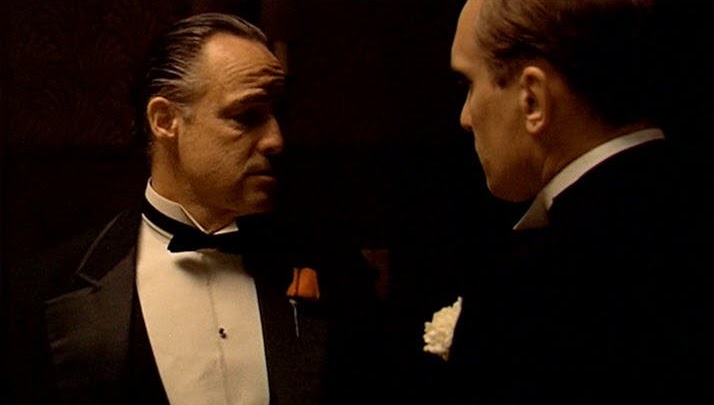
Such a movie is Francis Ford Coppola's The Godfather.* There are speeches throughout the thing where the characters justify the things they do and explain their paths. But the opening is significantly powerful and all-encompassing. Its first few minutes, with a character that is, in the scheme of things, unimportant, sets up an entire world. The world of La Cosa Nostra doesn't operate like the real world, but it does operate like a mad-house magnified version of the Corporate World. Make a mistake and it's not your job--it goes a step further--into your grave, or an anonymous cornerstone. The fiefdom of The Godfather with its favors, its fealty and its family ties has rules of honor and service far tighter than a mere contract can bestow, a necessity for order when working to bend rules and subvert honesty. In the topsy-turvy underworld The Godfather demands loyalty, friendship and respect from the very men who do not respect the ways or the rules of the rest of the world. And for those intangibles he will use his sway to make the world bend to your needs. In the first few minutes of The Godfather a desperate man—pointedly and ironically, an undertaker**—asks of Don Vito Corleone (Marlon Brando) to re-align his immigrant's dream of a perfect life in America, which has now been threatened, for both his family and his soul. He has tread the righteous path up until now, but it has failed him, and in desperation he turns to the one man he had hoped to avoid for fear of losing that dream. He must now go to the devil to beat the devil, as Faith is no longer enough.

The Godfather starts with a title card over a mournful peasant tune played on a lone trumpet, and in the pitch blackness, a solo voice emerges...


Bonasera: I believe in America.
Bonasera: America’s made my fortune. And I raised my daughter in the American fashion. I gave her freedom, but I taught her never to dishonor her family.
Bonasera: She found a boyfriend—not an Italian. She went to the movies with him. She stayed out late. I didn’t protest.
Bonasera: Two months ago, he took her for a drive, with another boyfriend. They made her drink whiskey, and then they tried to take advantage of her. She resisted. She kept her honor.
Bonasera: So they beat her...like an animal.
Bonasera: When I went to the hospital, her nose was broken. Her jaw was shattered--held together by wire. She couldn’t even weep because of the pain. But I wept. Why did I weep? She was the light of my life.
Bonasera: Beautiful girl. Now she will never be beautiful again. Sorry. Sorry.
(Bonasera breaks down, and the Don signals to an unseen man in the room to bring him a drink, which he gratefully takes)
Bonasera: I went to the police—like a good American. These boys were brought to trial. The judge sentenced them to three years in prison, and suspend the sentence.
Bonasera: Suspend the sentence?! They went free that very day. I stood in the court-room like a fool...
Bonasera:...and these two bastards, they smiled at me. Then I said to my wife, “For justice, we must go to Don Corleone.”
Corleone: Why did you go to the police? Why didn’t you come to me first?*
Bonasera: What do you want of me?
Bonasera: Tell me anything, but do what I beg you to do.
Corleone: What is that?
(Bonasera gets up, and whispers in the Don's ear. The Don sits back)
Corleone: That I cannot do.
(There are two other men in the room. The Don's son, Sonny (James Caan) and The Don's legal adviser, Tom Hagen (Robert Duvall).
Bonasera: I’ll give you anything you ask.
Corleone: We’ve known each other many years, but this the first time you ever came to me for council or for help. I can’t remember the last time you invited me to your house for a cup of coffee. Even though my wife is god-mother to your only child.
Corleone: But let’s be frank. You never wanted my friendship...and...you were afraid to be in my debt.
Bonasera: I didn’t want to get into trouble.
Corleone: I understand. You found paradise in America. You had a good trade, made a good living, the police protected you and there were courts of law. But, uh...now you come to me and you say “Don Corleone, give me justice.” But you don’t ask with respect. You don’t offer friendship. You don’t even think to call me “Godfather.” Instead you come into my house on the day my daughter is to be married and you ask me to commit murder...for money.
Bonasera: I ask you for justice.
Corleone: That is not justice. Your daughter is still alive.
Bonasera: Make them suffer, then...as she suffers. How much shall I pay you?
(Corleone looks at Bonasera with disgust, and gets up from his desk, the others in the room shift nervously)
Corleone: Bonasera...Bonasera...What did I ever do to make you treat my so disrespectfully. If you’d come to me in friendship, then this scum that ruined your daughter would be suffering this very day.
Corleone: And if a honest man like yourself should make enemies, they would become my enemies...
Corleone: And then they will fear you.
Bonasera: Be my friend?....
(Corleone shrugs in indifference, and Bonasera bends low, takes the Don's hand and kisses it)
Bonasera:....”Godfather?”
Corleone: Good.
Corleone: Some day...and that day may never come...
Corleone: I will ask you to perform a service for me. But until that day, accept this justice as a gift on my daughter’s wedding day.
Bonasera: Grazie
Corleone: Prego.
(Bonasera leaves the room, the Don closes the door.)
Corleone(to Hagen): Uh...give this to Clemenza. I want reliable people, people that aren’t going to be carried away. I mean, we’re not murderers, despite what this undertaker says.


Words by Mario Puzo and Francis Ford Coppola


The Godfather is available in many different iterations on DVD and Blu-Ray on Paramount Home Video.


* There are many hands present in the creation of The Godfather but without Coppola at the helm it would have been a completely different movie: no Brando, no Pacino, no period structure, and the style of shooting would have been completely different. The movie bears a lot of Coppola's personal stamp, despite the fact that he basically took the film on as a job to pay off his debts.

** "Bonasera" is played by Salvatore Corsitto, a "novice" actor, who showed up at an open casting session. His undertaker feels real, and his performance at the opening of the film gives it an emotional weight that evokes empathy--he gains the sympathy of the audience from the way his monologue is played, and that sympathy is a gateway to the plight of the immigrant in America, and an argument for the subsequent reliance on "social clubs" and "secret societies" to gain a modicum of power in this country. Marlon Brando called it the best performance in the movie. Considering the talent involved in The Godfather--Pacino, Caan, Duvall, Keaton, Cazale, Hayden, Marley, Conte, Castellano, Brando himself...that's a tremendous compliment. But it's true. Perhaps because of the familiarity of his face and voice, or for the fact that he wasn't a "professional" actor--or the residuals from this one movie and its many versions--Corsitto has only appeared in one other film...on television.

*** When Coppola cut The Godfather and The Godfather, Part II into a linear "Novel for Television" for NBC—which subsequently became known in video release as The Godfather Saga—he re-looped this line with Robert De Niro's voice as the Don.  Not a very good match, and alarming when someone knows the movie backwards and forwards.  Ya know, folks are all over George Lucas about refining his movies, but nobody ever goes after Coppola, or Ridley Scott, or Oliver Stone.  Nobody.

The Wolf of Wall Street

Down Wall Street Lay Many Socio-Paths
or
The Bacchanal Stops Here (in the Raging Bull Market)

"May you live in interesting times" says the old Chinese proverb.  With the Chinese holding a good chunk of the U.S. debt and the financial stakes being held by the likes of the degenerates of The Wolf of Wall Street, these are interesting times, indeed, as Martin Scorsese and his frequent collaborator Leonardo DiCaprio present a contemporary tale of Roman excess, only slightly more believable than the horrors they collaborated on with Shutter Island by hoodlums only slightly more endearing than the gangsters of Goodfellas.

That it is also Sorsese's most roaringly entertaining film in awhile says something else.


One must be prepared to be shocked going in—the film starts with a dwarf-tossing contest as a way of letting off steam on "casual Friday" and that's just the beginning—within ten minutes we'll be treated to a rather delicately composed shot of DiCaprio's Jordan Belfort, the late 20th Century descendant of Horatio Alger and Sammy Glick, snorting cocaine from a highly unusual receptacle, and still thoroughly plowed out of his mind that he crashes his personal helicopter onto his property. And over the next three hours—don't worry, the movie zips by, jumping from extreme to extreme every ten minutes like battles in a space epic—we follow a familiar path in the films of Scorsese, of the rise, fall and subsequent grovelling of its protagonist, forced to a penance of knowing how good he had it and never being able to get there again—of having "the secret" and not being able to use it. There has been a critical backlash that perhaps Scorsese and his screenwriter Terence Winter haven't been quite so judgmental in their portrayal of the events of the film, but that's because they've chosen for their principal point of view that of Belfort, himself, who, while breaking every rule in the book to get whatever he wants, violates the fourth wall, continually, as well, addressing the audience and explaining enthusiastically "How He Did It." It's the perverse counter-point to the kind of seminars on selling that Belfort conducts now to make money...and avoid the constant glare of the authorities who took him down.
DiCaprio's Belfort Explains it All to You
It's also the American Dream turned into an American Nightmare. Belfort takes the get-up-and-go spirit of American capitalism and never puts on the brakes. In America, he hears nothing but the sound of opportunity knocking—at every opportunity, in business or his own pleasure—and, like any addictive personality, can't stop. He is given a lunch-lecture on the perverse nature of Wall Street brokering by a mentor Mark Hanna (Matthew McCounaghey, scarily entertaining, again), downing martinis and snorting cocaine at the table, explaining in a rambling monologue about the pressures on brokers pushing "fugazi's" while enjoining Belfort to join him in a fraternal caveman chest-thumping that becomes emblematic of the low-mindedness of every enterprise Belfort takes on subsequently.  For awhile, he does okay, then gets blown out of his job, thanks to the Crash of '87.

He's reduced to making cold-calls on penny-stocks for a boiler room in a strip mall, where Belfort soon establishes himself as a top-tier hustler there, adapting an attitude of hyper-optimism for gullible first-time investors, finding as he does so that he is actually making more money as he gets higher commissions pushing worthless stocks. To push his credibility with buyers further, he establishes a new firm with a neighbor Donnie Azoff (Jonah Hill) and a line-up of friends who are bottom-feeder salesmen and drug pushers. They start a firm with the prestige-dripping name of Stratton Oakmont, aggressively playing the market by promoting bad stocks, then cashing out once the stocks reach a peak, a strategy scam called "pump and dump."
Soon, Belfort and Co. have more money than Croesus, which they re-invest in extravagent lifestyles, primarily booze, drugs—primarily cocaine and quaaludes—and hookers, which are claimed on taxes as entertainment expenses. "
On a daily basis I consume enough drugs to sedate Manhattan, Long Island, and Queens for a month," he crows in voice-over. "I take Quaaludes 10-15 times a day for my "back pain",Adderall to stay focused, Xanax to take the edge off, pot to mellow me out, cocaine to wake me back up again, and morphine...well, because it's awesome." Before too long, he's in a toxic affair with Naomi Lapaglia (Margot Robbie), "a former model and Miller Lite girl," which gets found out by his wife, he's divorced, and married again to his blond dream girl.

"Cinema is a matter of what's in the frame and what's out"--Martin Scorsese
Margot Robbie as "Naomi" Belfort
But, that's not enough. There is no limit to his appetite or avarice. And before long, he's noticed by the IRA and the FBI, which leads him to Swiss banks and offshore investments, and an escalating series of disasters as the risks he takes (along with the drugs) increases.
It culminates in one of the funniest, scariest sequences in movies this year, as Belfort has to call his lawyer from an "outside phone" (his have been tapped by investigators) at the same time a few quaaludes ("Lemmon 714's") past their shelf-date by a few years finally kick in, and leave him a drooling, crawling, babbling mess unable to function, at anything above an autonomic level. Here's that scene, but be warned, this is
NSFW, has multiple f-bombs (this film set a record for fictional films of 569 times over three hours, averaging 3.18 per minute, the clip is five minutes long, so you do the math), and will look bizarre out of context, as it is bizarre and zany enough in the film.

DiCaprio's work here is hilarious, but the entire performance may be the best of his career, a prancing walk-and-talk act with the kind of pugnacious grace that Cagney gave to his gangster roles and Malcolm McDowell gave to his thug in A Clockwork Orange. There's a mad-cap joy to his work, and a genuine desire to make Belfort look as dysfunctional as possible, a prince in the boardroom, but a sad-sack in his private life, that's only matched by Jonah Hill's second-in-command who knows no shame, and may be more out-of-control than Belfort. Margot Robie will be wise to de-glam her next few roles, if she doesn't want to do the next ten "It-girl" roles—after Sharon Stone, Nicole Kidman, Charlize Theron, Angelina Jolie, and every model who's tried to act—as she's barbie-doll-objectified to perfection, but also given some roaring good scenes to spit out. Kyle Chandler is the hang-dogged FBI agent assigned to Belfort, and the movie is full of nice work by a long line of character actors, including bits with Jean Dujardin and Rob Reiner.
As I said, it's the "fullest" film of Scorsese's recent decade of movies, but it won't be everybody's cup of arsenic—the film has been attacked for being sexist and not condemning Belfort more. Both attacks seem a little spurious, as Belfort and Stratton Oakmont were as "Old Boys Club" as it comes, and reveled in declass
é behavior of all stripes—"not only was he a degenerate and a crook but he didn't have a high opinion of women, either" wins the "Sherlock" award for stating the obvious. And, again, the condemnation?  It's there. Belfort out of control looks as ridiculous on-screen as the filmmakers can conspire to make him, short of giving him a "Bozo" nose; just because he is too full of himself (or some other substance) to recognize his ridiculousness does not mean that depiction does not exist. It just means that the character is maintaining his conscienceless attitude and his sociopathic detachment, especially regarding himself. In the Scorsese mixture of bull-headed comedy and tragedy, the protagonists don't recognize condemnation, even if they get it.
It is, after all, "based on a true story."  And a real creep.
The real Jordan and Nadine Belfort in happier, if less sober, times

That "Forbes" article they talk about in the movie.

Saturday, March 1, 2014

Philomena

I Dream in 8MM Home Movies
or 
Driving Miss Philomena

Stephen Frears' film of Philomena, from Steve Coogan's co-written screenplay (he's also the second hand of what is basically a two actor piece) feels awfully precious in the viewing, even if the story, overall, is a fascinating detective story about faith and family, over the repressive dictates of a religion giving lip-service to both.

Martin Sixsmith (Coogan) is an ex-reporter, recently exited from Tony Blair's Labour government over an internal squabble. At a loss over what to do next, and considering writing a history of Russia (which meets with indifference whenever mentioned), he's approached at a party by a bar-maid, who tells him the story of her mother, Philomena Lee (Judi Dench), who has been searching fruitlessly for the whereabouts of her son, born fifty years earlier. Lee was a good Catholic girl who got pregnant, and her Irish father, in anger and shame and for bringing dishonor to the family, gave her to the nuns of the Rose Crea Abbey for the Sisters of the Sacred Heart, who put her to work, delivered her child, provided an orphanages for that child and required Philomena to work for the nuns for the next four years to repay her debt.

At some point, her son, Anthony, was adopted, and never seen again. And Philomena is haunted by him fifty years on. Sixsmith is cool to the idea of "doing a story" on it, dismissive, in fact, saying it was "human interest"—the kind of work reporters do "about weak-minded, ignorant people for equally weak-minded, ignorant people.'  


But, nobody is acting too excited about that Russian history.

Sixsmith agrees to meet Philomena and finds her a little dotty, a little marmish, and not very sophisticated. But, he's got interest in her story, so he takes a trip with her to the abbey to, once again, try and get some more information about Anthony and what became of him. All records have been destroyed in a fire, they're told, and Sixsmith finds the abbey more than unhelpful in giving an information.

It isn't long before they get some information through Sixsmith's government connections in the UK and the U.S. To say any more from that point spoils the movie, and that's the best part of the film. The actors are great, their characters at points supportive and contentious, clashing personalities on almost any topic.

But, it feels slight, and vaguely insulting to the Philomena character. In particular, there is a long episode in an airport where she prattles on about a book she's read that Sixsmith would consider "trash" ("Oh, look, it's a series!" he mocks.) It's supposed to be whimsical and charming—isn't she a delight and isn't he a curmudgeon—and the movie has nowhere to go at the end but reiterate the same joke, rather than to say something meaningful or profound at the end.
* It's a movie for "blue hairs" at the matinee, and aspires to nothing more. But, the performances are terrific, the story interesting, and Frears' direction serviceable, except for some lily-gilding of flash-backs and other things that might be in the service of "over-explaining."


Of all the Best Picture nominees, this is the one that feels a bit out of place.


Dame Judi Dench and Philomena Lee

* Actually, it does, but T.S. Eliot said it: “We shall not cease from exploration and the end of all our exploring will be to arrive where we started... and know the place for the first time.”