or
Snow White (and the Height-Challenged, but Competently-Abled and Platonic POSSLQ's)—There, That "Woke" Enough For Ya?
The
seven dwarfs were each on different little trips. Happy was into grass
and grass alone … Happy, that's all he did. Sleepy was into reds.
Grumpy, too much speed. Sneezy was a full blown coke freak. Doc was a
connection. Dopey was into everything. Any old orifice will do for
Dopey. He's always got his arm out and his leg up. And then, the one we
always forget, because he was Bashful. Bashful didn't use drugs. He was
paranoid on his own. Didn't need any help on that ladder.
George Carlin
Disney made the first Snow White and the Seven Dwarfs in the mid-1930's, and gosh, "not much has changed". I'm being sarcastic, of course. It premiered during The Great Depression, Hitler had not yet attacked Poland (but the Japanese had invaded China). And the world was about to evolve, rendering the tropes of "Snow White"—the biases, the weak role of women, the "princessy" thing, the deus ex machina of the necessity of a rescuing handsome prince—all of that would age as gracefully as an Evil Queen into a Crone. It's almost unfathomable that, at the time, Disney's Snow White and the Seven Dwarfs was something of a revolution in the animated art-form. It was the first cel-animated feature film (the ads announced it "in multiplane technicolor"), and the first animated feature ever made in the United States. At the time, Disney was discouraged by business partners, other Hollywood moguls, and potential backers that a feature cartoon just couldn't "work," for diametrically opposed reasons: either it couldnt hold an audience's attention for longer than the accustomed 7 to 10 minute running time, or the length would simply exhaust them (and in fact, at the time, the young Disney company depended on the more robust RKO Studios to distribute the film to theaters—Disney is still very much around; RKO is not). It's release and success changed everything, and despite its calcified ideals, it remains a classic of the form, still topping recent 10 best lists for animated films. And, in fact, the United States Library of Congress deemed the film "culturally, historically, or aesthetically significant" and selected it as one of the very first 25 films for preservation in the National Film Registry in its first year in existence in 1989. So, why remake it? To make money, of course (one does have to go back to the mine...and the well). And maybe, aesthetically, as a way to "update" it for a new generation not born in the previous century. Then, also, there's the legal matter that the original 1937 film is going to become part of the public domain in 1933. There is that. Plus, there has been an awful lot of competition lately from other versions of the exact same story: Snow White and the Huntsman (2012) and its Snow White-less sequel (2014), Tarsem's Mirror, Mirror (2012), Snow White: A Tale of Terror (1997). Of the Grimm fairy tales, it is the most adapted for film. And Disney's version is iconic. Were it not for the 1937 film, one doubts the other versions would exist.
 Now, the optimal movie-going experience is to go in without prejudices or expectations (I mean, if one is doing it "right"). However, as this is a remake, you can pretty much throw that out the window. This puts me on an even par with about every single movie reviewer or internet hack, as the grousing, bitching, and over-dramatic moaning about this release has reached new levels of "hair-on-fire." Me, I wanted to see what they could do to make it less of a dinosaur of the Depression-era (I mean, the first feature came out before Gone With the Wind!), how much of the classic songs were retained, and if the new film-makers—Marc Webb, primarily, he of the Andrew Garfield Spider-mans, the films (500) Days of Summer and Gifted, and I'm something of a fan—could make their third act top the action scene of the dw...oh, let's call them "colliers", shall we? (nobody can argue with that unless they're being trenchantly snippy)...chasing the evil crone who poisoned Snow White to fall off a cliff. And if they could balance the light and dark as effectively as old Walt did back in the day (the thing that's always impressed me about Disney is that he could scare of the tar out of his intended audience of children, and in such a way that he'd gain the cynical respect of their parents).
 So...how is it? Actually, quite good, better than I was anticipating.


And there are a bunch of new ones. One song in particular stands out, as it makes a point of calling out the story's short-comings and considers the world at large (much more than the film's opening "world-building" number "Good Things Grow") and that there might be bigger fish to fry than Snow's deposition and loss of status, and that is the ingeniously titled "Princess Problems":
Self-aware and brings up a point that if you're living under an evil regime, there might be some people suffering worse than you. I found that refreshing—but, then, I've never been concerned with the "plights" of royalty. How about that ending, which was visceral and exciting (if a little too much an easy fix)? Well, I can't say this one's that exciting, although it does work in a story-logic kind of way and I like how, metaphorically, the Queen (Gal Gadot) is dispatched by her own narcissism. It just doesn't get the heart pumping as much, but then Disney animators have always had a penchant for making dramatically hysterical resolutions.
 Okay, you want to know about the casting. Let's start with Snow White. As far back as my review of Spielberg's version of West Side Story, I've thought that Zegler seems to have been genetically engineered to be a Disney princess with eyes too big for her head just like she was animated that way (it's a Disney design trope to draw big eyes in order inspire warm feelings like you were looking at a baby). So, she looks preternaturally perfect for this. And the thing is, Snow is a tough sell—just as Maria in West Side Story is—where the character is just so cutesy—and not in a self-aware way—you want to sit her down on a tuffet and tell her to wise up and stop being such a victim. Snow in this has a bit more grit and certainly is more expressive than the plasticene-rotoscoping allowed in the 1937 version. And she's not a sap...or a simp. I like that. Plus, Zegler's singing voice has always been astounding and she belts out the songs the way every Disney princess should, full-throated but with enough character to make her more relatable when she drops the arias.
 And Gal Gadot is great as the Evil Queen. I don't know what she's done to deserve this "bad-Kevin-Costner" phase of her career, But she trods the thin line between camp and making her Evil Queen a serious threat, which is what she should do. It's the same tactic Michelle Pfeiffer takes when playing villains: be evil but show you're enjoying it, like any good autocrat. There's one moment when Gadot's Queen snaps her head in fury at the huntsman (Ansu Kabia) ordered to kill Snow White and I swear she did it in a mere film-frame of time that was jolting. And the theatricality she throws into her musical numbers threatens the set-rafters, CGI or not.
 So...uh...how are the "colliers?" I must admit, I was a bit taken aback by them, but then they don't have the rubbery cartoonishness of their animated ancestors. They're a lot more starchy and have a bizarre facial structure that makes them all-jaw—they look like hummel figurines you'd find in a some rural backyard in Ochsenwerder (Hey, why didn't we just call them "gnomes" in the first place?) and they're the same attribute-centric personalities they were in the 1937 version ( rejected contenders at the time were Hoppy, Jumpy, Baldy, Hickey, Stuffy, Burpy, Tubby and Dizzy). After awhile, you get used to them, although the character of Dopey kept reminding me of Alfred E. Neuman of Mad Magazine fame.
 Children (as I witnessed) will be delighted by it. "Bro's" who haven't grown up...won't (Hence, the film's low IMDB score perpetrated by basement-dwellers who haven't actually seen it, as IMDB has no way of checking veracity). There's a big difference between having prejudices (as I had) and agendas.**


Those are quibbles. I find the 2025 to be a fairly successful effort to make a problematic—if beloved—part of history a bit more "present". It's certainly nothing—nothing—to engender the vitriol I've been seeing online. Look. I'm as evil as they come when I see something bad and write something snarky. But, then, I don't have an "agenda" other than a critical one and I certainly don't make a living at it, amping up my outrage as a cottage industry). I don't know what they're "on" or "on about" but it's not there in the movie.

So, the new truncated Snow White is good, sometimes incrementally better in places and a good effort, but it is hardly revolutionary. And so nobody should treat it as if it is.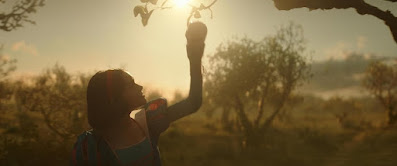

* Even if it can't quite shake the specter of how the song was satirized and mocked by—of all things—Disney's own Enchanted. Sometimes, you just have to hand it to the Mouse-house for being so smart, clever, and self-aware:
** Oh, one little piece of advice to the "bro's" out there who swamped IMDB with negative scores—don't do the job "too well" or the basic law of averages will point out the obviousness of the ploy. Live by the aggregate, die by the aggregate.