Baby Face (Alfred Green, 1933) The movie Baby Face is notorious for a bunch of reasons. It is "Pre-Code," that period of film-making between the introduction of sound (in 1927) and 1934 (the introduction of Shirley Temple) where Hollywood was aggressively flirting with more mature subject matter, to the point where religious groups particularly the Catholic Legion of Decency started fingering their beads in worry. Horror films became more explicit, gangster films started to rise in popularity with the one-two punch of The Great Depression and the Prohibition Era, and branched off to a sequel genre, the prison film.
And then there was sex. That subject crossed all genres. Even if the film was a cautionary tale about loose behavior you couldn't actually SHOW that loose behavior lest it then influence the behavior you're being warned about. It's the cinematic equivalent of restricting your sex education class to the subject of "abstinence."
As is usually the case with these things, "The Code" was a way to tamp down permissive, or even progressive, behavior in the movies—producers were persuaded to follow a path that was straight and narrow-minded, and so there was watchfulness for subversive behavior, political discontent, and overt sexuality. Somehow, the Marx brothers got past all that.
But, Baby Face didn't. Like a lot of pre-code films, once the Hays Office had their way, the most objectionable bits were excised like a ruptured appendix. The lucky ones were re-distributed with the shorter running times. The unlucky ones were simply re-made, sometimes scant months after the release of the original, and, with any luck, the original wasn't "filed" in the Hudson River, where in the more permissive 1980's, they started to crop up in home video releases. Baby Face was found at the Library of Congress, a "dupe negative" had survived uncut and it was first screened in 2004.

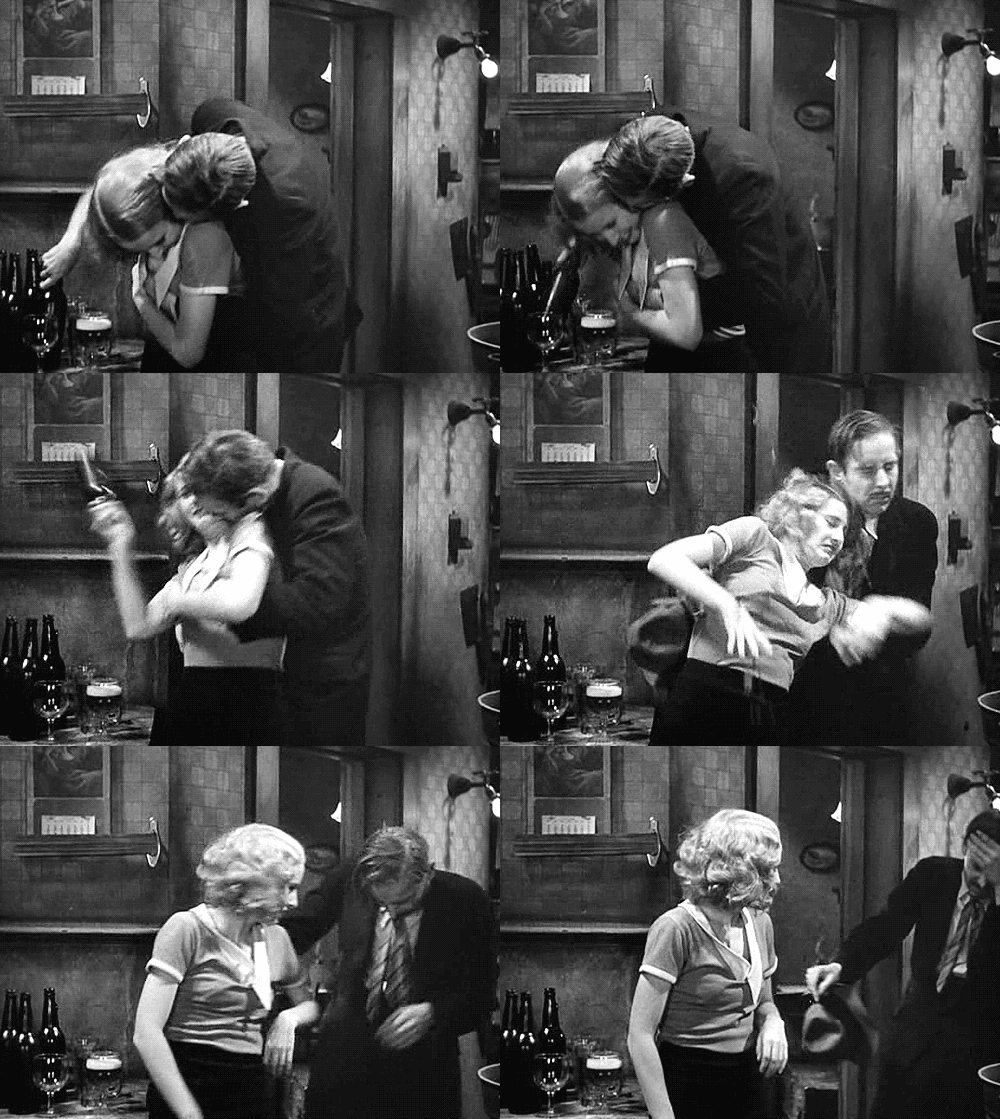
What they saw was Barbara Stanwyck starring as Lily Powers, a waitress/bartender at the speakeasy of her corrupt father (Robert Barrat). Lily has grown up tough, not for the least reason is that dear old dad had been using her as a chief draw to keep his business going, throwing men her way since she was 14. She's contemptuous of men, and why not? The dregs of society come through her father's door and she treats their low expectations of her with a biting sarcasm that only makes them weaker. "All the kindness and gentleness in me has been killed," she says at one point. And it's been a death of a thousand cuts, every grope, every grab, every compromise. She's trapped with no way out.

But, there is one door, and one day, a potential mentor walks through it—Cragg (Alphonse Ethier), a cobbler, with a bent toward philosophy, manages to break through her hard exterior with a book he insists she reads, written by Nietzsche. He tells her that she already has the weapons and the drive ("her potentialities") to get ahead in the world.
"A woman, young, beautiful, like you, can get anything she wants in the world. Because you have Power over men! But you must use men! Not let them use you. You must be a master! Not a slave. Look, here, Nietzsche says, "All life, no matter how we idealize it, is nothing more nor less than exploitation." That's what I'm telling you! Exploit yourself! Go to some big city where you will find opportunities. Use men! Be strong! Defiant! Use men! To get the things you want."

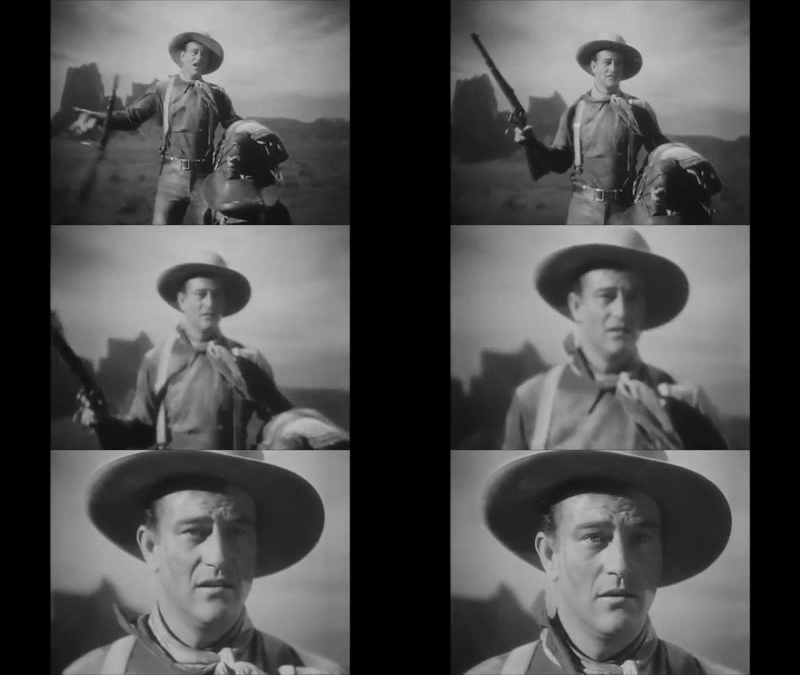
And so she does. She kicks the sawdust of the speakeasy off her shoes and leaves the night-crawlers behind, moving to the big city and sets aim on conquering the world of commerce, finagling her way (if one can use the term) into getting a job in the secretarial pool and sleeping, and blackmailing her way up the chain of command (Interesting to see John Wayne show up as one of her early disposable conquests—it's the only time these two power-houses worked together in their careers, and, of course, Stanwyck walks all over him, so early in his career).

Set to the songs "St. Louis Blues" and the newly popularized hit "Baby Face," Baby Face deconstructs the pot-boiler to bare essentials, under-pinning it with a philosophical base (Hitler was coming to power at the time, using the same sort of philosophy) and the screen-writers (from a story by one Mark Canfield) are street-smart and uncompromising in how Lily plays the middle-management suck-up's until she finally bags the big prize—the wealthy scion (George Brent) of the bank's founder.

If there's anything wrong with Baby Face, it might be that the writers are a little too fond of the double entendre's they spew out, accompanied by a punctuating eye-roll. They and the director go to that well a few too many times (to the point where my eyes started to instinctively roll), but there are so many surprises, so many chances being taken, that you give the movie a lot of latitude in taking things so far. And Stanwyck is always a joy to watch, even this early in her career. She is one of the great (great!) screen actors to come out of the pre-code era and she had the ability to grow and mature beyong just holding the attention of the camera.
Oh. And Mark Canfield, who wrote the story? He sold the treatment to Warner Brothers for a single dollar. Then skipped the studio to make a name for himself over at 20th Century Fox. His real name, by the way, was Darryl F. Zanuck.






 "Red" Grant: Keep still.
 Grant: All right then, get up on your knees.
 Grant: Put your hands in your pockets.
 Grant: Keep 'em there.
 James Bond: Red wine with fish. Well, that should have told me something.
 Grant: You may know the right wines, but you're the one on your knees.
 Grant: How does it feel, old man?
 Bond: "Old man?" Is that what you chaps in SMERSH call each other?
 Grant: SMERSH?
 Bond: Of course....SPECTRE. Then it wasn't the Russians' show at all. You've been playing us off against each other, haven't you? And it was SPECTRE who killed the Russian agent in the Mosque. You?
 Grant: Mm-hmm.
 Bond: Kerim and the other man?
 Grant: Mm-hmm.
 Bond: And Nash?
 Grant: Oh, I don't mind talking. I get a kick out of watching the great James Bond finding out what a bloody fool he's been making of himself. We're pro's, Mr. Bond.
 Grant: We sweated your recognition code...
 Grant: ...out of one of your men in Tokyo...
 Grant: ...before he died. I've been keeping tabs on you.
 Grant: I've been your guardian angel.
 Grant: Saved your life at the gypsy camp.
 Bond: Oh. Yes. I'm much obliged.
 Grant: We were keeping you alive until you could get us the Lektor.
 Bond: So, you had me deliver it to you on a plate. It's brilliant. Go on. I'm fascinated.
 Grant: Now that we've got it, you and the girl are expendable. Between here and Trieste.
 Bond: The girl? Isn't she SPECTRE, too?
 Grant: No. She thinks she's doing it all for Mother Russia. She takes her orders from Colonel Klebb.
 Bond: But, Rosa Klebb's Russian. Head of operations for SMERSH.
 Grant: Was. Klebb works for SPECTRE now. The girl doesn't know that.
 Bond: Well then, why kill her?
 Grant: Orders. That's only half of it, old man.
 Grant: Here's a roll of film. She'll have this in her handbag.
 Grant: And on you, they'll find this letter.
 Grant: It's from her, threatening to give the film to the press unless you marry her for helping you get the Lektor.
 Bond: What film?
 Grant: Taken in the bridal suite at your hotel. Something else the girl didn't know about—or you.
 Bond: Must be a pretty sick collection of minds to dream up a plan like that.
 Grant: You see the headlines? "British Agents Murders Beautiful Russian Spy Then Commits Suicide!"
 Bond: Tell me, which lunatic asylum did they get you out of?
 Grant: Don't make it any tougher of yourself.

 Grant: My orders are to kill you and deliver the Lektor. How I do it's my business. It'll be slow and painful.
 Bond: How much are they paying you?
 Grant: What's it to you?
 Bond: We'll double it.
 Grant: Your word of honor? As an English gentleman?

 Grant: The first one won't kill you.
 Grant: Nor the second. Not even the third.
 Grant: Not 'til you crawl over here and you kiss my foot!
 Bond: how 'bout a cigarette?
 Grant: Not a chance.
 Bond: I'll pay for it.
 Grant: What with?
 Bond: 50 gold sovereigns.
 Grant: Where are they?
 Bond: Up there in my case.


 Grant: You show me.

 Bond: Here you are. What about that cigarette?
 Grant: Throw 'em down there.
 Grant: Any more in the other case?
 Bond: I should imagine so, it's a standard kit. I'll have a look.
 Grant: Put your hands back in your pockets.
 (Bond watches pensively as Grant throws one latch, then the other)


 (Grant opens the cases with the latches turned vertically, and when the case is opened, the tear-gas cartridge explodes in his face. A fight ensues...)


