Showing posts with label Pre-Code. Show all posts

Saturday, May 15, 2021

Speak Easily

Saturday is traditionally "Take Out the Trash" Day...and this one is painful.

Speak Easily
(Edward Sedgwick, 1932)
As regular readers—the two of you—know, I'm a big fan of Buster Keaton, and when you see his films and trace his career, you come to a point of heart-break. That's when he sold his studio to M-G-M (bad business advice from his brother-in-law) and the studio's geniuses, with the best of intentions and the worst of results, destroyed his career.

For all the talk of Irving Thalberg as a "boy-genius" at Metro, he was abysmally out of his depth with comedy, as his work with Keaton and The Marx Brothers show. The Marx Brothers M-G-M films are still watchable, but a step below what they were achieving at the end of their run for Paramount. Keaton, however, went to M-G-M at the top of his game as a silent comedian/actor/director and very shortly, was down-graded to a has-been, and regarded a broken relic in the new, better world of "Talking Pictures." 
Keaton plays Professor Post, a rather idiosyncratic Classics professor at Potts College, who has "never enjoyed life." Post has a good reason for that—money. After 12 years of teaching, he has saved $4,564.32—which he is saving for a rainy day. He's told "Poor Professor Pervison said that and it rained the day of his funeral." The guy who says that decides (for his own good) to trick Potts into thinking he's inherited $750,000, the news of which compels Post to walk away from his teaching to see the world.

First stop is a train station for a trip to New York, where he encounters a dance troupe and a dancer named Pansy Peets (Ruth Selwyn), with whom he becomes so infatuated that complications ensue and he is saved from being kicked off the train by Jimmy Dodge (Jimmy Durante), a piano player/comedian with the troupe. Post makes it all the way to the town of Fish's Switch, where in his protracted good-byes to the troupe (who are getting off), he misses getting back on the train for the rest of his journey. 
There's nothing left for him to do but go to the burg's lone hotel—where the dance troupe is staying—and catch their show. He enjoys it enough to tell them he'll invest and work as producer—still thinking that $750,000 is real—and to stay close to Pansy.

The complications are numerous—including a new member of the troupe (Thelma Todd), with intentions to be the star of the show and to seduce Post—leading up to issues with contractors who want to get paid, possible police action, and a disastrous opening night in which Post gets caught up in a spinning back-drop while the stage-crew run around trying to save him.
Durante is there to keep the soundtrack full and fast—something Keaton's prevaricating professor can't do—and except for a sequence in which Keaton and Todd get drunk resulting in a watered-down version of earlier film's sequences in which the two become crash-test-dummies for a couch is the only—and Keatonesque—highlight.

Keaton, at his best—or even at his middling best—played an Everyman against Nature, the nature of people or against Nature itself (even if it was merely the laws of physics). Speak Easily reduced him from being a character to whom the audience could relate to merely being a prop.

Wednesday, September 18, 2019

Wild Boys of the Road

Wild Boys of the Road (William Wellman, 1933) Warner Brothers continued their tough Depression era stories with this look at juvenile transiency in the wake of the Depression, where kids who were a burden to their financially strapped families took to the road as hobos rather than going to orphanages or foster homes. With the country in the midst of a vast migration in search for work or to escape the dust-bowl

Tommy Gordon (Edwin Phillips) and Eddie Smith (Frankie Darro) are high school kids who have it pretty good. They go out on double dates with their best girls in Eddie's jalopy and the only thing they have to argue about is who gets the rumble seat. 

But, Tommy has some bad news. He tells Eddie that he's going to drop out of school to look for work so he can help his family. Aw, that's too bad, Tommy, maybe my Dad can help out. Dad can't. Times are hard and Dad Smith has lost his job, too, and he can't help Tommy, he can't even help his own family. Seeing his father in distress and being a good boy, Eddie sells his flivver and gives Dad the $22 bucks he sold it for.

Having given the last of his worldly possessions to his family, and with them facing eviction, Eddie joins up with Tommy in a quest to find work to provide for their families. They jump a train and start riding the rails. They hook up with other boys, learning what they need to in order to avoid the "bulls" on the rail-line looking for any such vagrants using it for free transportation.
One of the "boys" turns out to be a girl—Sally (Dorothy Coonan)—one of the few who disguise themselves as boys to fit in and protect themselves from attack. Sally is on the way to Chicago, where she hopes she can move in with her aunt until she can find work. It's as good a plan as any and Tommy and Eddie run interference for Sally while they make a transition from train to train. Once in Chicago, they find their situation hasn't improved, as work is impossible to find and the local police are picking up vagrants, but Sally gets past it with a note from her aunt and claiming the boys are her cousins.
They make it to Aunt Carrie's (Minnie Gomball), but the stay is short-lived. Seems Aunt Carrie is running a brothel out of her place (Don'cha love pre-Code films?) and the police raid it that night—not a good thing for runaway and vagrants. They beat it out of a window and hook back up with the kids in the rail-yard.
But, life only gets harder for them: one girl, Lola (Ann Hovey) is discovered by a train brakeman (Ward Bond, uncredited probably because the character is so despicable) and raped, which inspires the others to trap the bum and beat him within an inch of his life, leading the brakeman to fall out of a compartment and die a well-deserved death. Once in Columbus, they hop off the train, but Tommy misses his footing, stumbles, and is clocked by a railroad switch and knocked across the tracks.
Wellman stages one of the grittiest set-pieces he ever produced—the other kids watch helplessly as Tommy, unconscious, one leg splayed over the tracks has his foot cut off by a speeding train, crippling him. Only the help of a visiting doctor saves his life as he has to have his leg amputated. Things are tough on the road, and they're only made tougher by Tommy having to make his way with a crutch when speed is of the essence. But, the incidents near Columbus only steel the group of kids making them tougher, bitter, and, rather than running from authority, ready to take it on and fight it.
The group makes it to Cleveland, where they camp in what was called "Pipe-towns" during the Depression—make-shift shelters made from sewer conduits stacked in a supply yard. The kids call it "Sewer Pipe City" and for awhile it's a stable community in the unstable lives of the kids. It's short-lived, however, as authorities move in to take it down to prevent any lawlessness in town, turning water hoses on the group. The past incidences have hardened the young vagrants and they take on the police, beating them back and getting on another train, pelting the law with rocks and whatever else they can use as weapons.
Finally, they end up at the end of the line in New York, living in a municipal dump and things begin to look up, Tommy in line to get a job, if he can just scratch up enough cash to get a decent jacket. But, even that creates complications that get them mixed up with the law and an appearance before a local judge. This gives Eddie a chance to make a bitter speech on their treatment that has an eerie echo recalling the current issue of homelessness: 
I knew all that stuff about you helping us was baloney. I'll tell you why we can't go home--because our folks are poor. They can't get jobs and there isn't enough to eat. What good will it do you to send us home to starve? You say you've got to send us to jail to keep us off the streets. Well, that's a lie. You're sending us to jail because you don't want to see us. You want to forget us. But you can't do it because I'm not the only one. There's thousands just like me, and there's more hitting the road every day.
Wild Boys of the Road was made in 1933, and runs a tight 68 minutes, but its story of Society's way of dealing (or not dealing) with the issues of those souls who have fallen through the cracks of the economic infrastructure still resonates today.
Wild Boys of the Road was voted into the National Film Registry in 2013.

Thursday, February 14, 2019

Parole Girl

Parole Girl (Edward S. Cline, 1932) Sylvia Day (Mae Clarke of Frankenstein and The Public Enemy) is a rookie grifter working scams on department stores—when her partner accuses her of being a pick-pocket in public, she threatens the store with legal action, which the managers are  only too willing to avoid by writing a compensatory check ("We don't hold people up! We got a racket!" says her partner, Tony, played by Hale Hamilton)—when she is caught and thrown in prison for a year, after the store's manager won't let her go on directions from the store's insurance agency. As she's carted off she vows vengeance on the man, Joe Smith (Ralph Bellamy), saying she's going to ruin his life the way that he's ruining hers.

In the slammer she meets Jeanie (Marie Prevost), who's in for being an accomplice ("Can you beat a hold-up? Me? I wouldn't do anything as crooked as that! There's too many honest ways for a girl to make a livin': blackmail, forgery and just plain framing a guy in a hotel room...").
With dialog like that, you know it's a Pre-Code film, that era in movies when gangster and socially-minded films told stories of the wages of sin and the value of redemption by openly exploiting the very licentiousness they were warning against in order to attract audiences. They "got away" with a lot in that time before the Hays Code was established. The exploitative aspects of the film were ballyhooed to attract the rubes who were expecting flashes of the seamier side of life, only to be served conventional outcomes and moralistic preaching to keep the Protectors of Society at bay. It's a bit of a shell-game, hearkening back to the roots of hucksters trying to attract a crowd.
Sylvia devises a way to get out. Her old crony on the outside smuggles matches to her, and when assigned to the soft-works factory manages to stage a fire (one should note that this is only 22 years after the Triangle Shirtwaist Factory fire in 1911) and while the other women panic, trying to get out of the locked door, Sylvia grabs the nearest extinguisher she spies and puts out the worst of the fire, then passes out (or pretends to) to get sent to the prison hospital. A grateful warden awards her clemency and she's sprung to seek her revenge on the store executive who had her sent away.

Fortunately, for her, he's all too susceptible: he's just received a promotion, and while he's out celebrating, she finds him and encourages his binge. Fade to black-out.
Smith wakes up with a massive hang-over and a woman's pump in his bed. Sylvia's in the bathroom, ready to give him a chaser—she announces that the two of them are now married, for better and probably worse. No matter that her partner posed as the judge—Smith doesn't know that—and she begins to spend Smith's money like it's going out of style. Plus, there may be an issue of bigamy—Joe might be married, and therefore in trouble with the law. It's a nice little honey-trap and Smith has no idea whether it's true or he's being bamboozled, all he can do is protest that Fate is against him and she must be a woman.
Parole Girl is rather crudely directed with smart, sassy performances and an eye towards moving the show as quickly as possible to keep people from poking holes in the plot. It would inspire a whole sub-genre of noir where the female component has the upper hands over the males and we'll be looking at a few of them—some, the originals and their more recent remakes—in this month of Valentine's.

Thursday, October 11, 2018

Hell's Angels (1930)

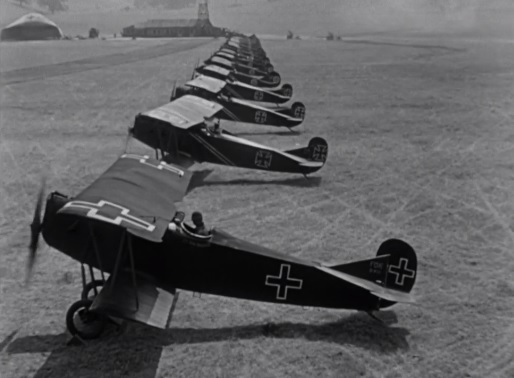
Hell's Angels (Howard Hughes, James Whale, 1930) You watch Howard Hughes' production of Hell's Angels and you're struck by the almost multi-media aspect to it all. I like film's that employ different ways to tell a story—isn't that what the current deluge of CGI films is, really?—but Hell's Angels veers from format to format.

It wasn't intentional. Hell's Angels began production—actual shooting—on October 31, 1927 and premiered on May 27th, 1930. In that time, directors were fired (Marshall Nielan),hired (James Whale was brought in to re-do whole sequences already shot, but this time in sound, making it his film directorial debut), the deaths of three stunt-pilots and a mechanic during the aerial sequences, and a considerable amount of footage staged and shot by producer Hughes himself, who flew overhead and radioed directions to the pilots—Hughes even performed a stunt his pilots considered too dangerous and, as they predicted, he ended up crashing while performing the stunt, fracturing his skull and requiring plastic surgery.
And...during the production of Hell's Angels, The Movies changed. Hughes, not wanting to be caught putting out an inferior product that was "behind the times" began to re-shoot sequences already filmed, so the film goes from silent to silent-tinted, to sound (the Whale sequences) and even to Technicolor—if 3-D was around, I'm sure Hughes would have done that, too. Plus, Hughes tinkered excessively in the editing room, re-cutting sequences to get the maximum jolt out of his footage and adding sound effects to silent sequences, further delaying its release. Then, because he was taking so much time, Darryl F. Zanuck had the window to produce a competing WWI flying film, The Dawn Patrol, directed by Howard Hawks—despite Hughes' attempt to sabotage the production by buying up all the vintage aircraft he could to stop the rival film, and, failing that, suing the production company for plagiarism. The strategy didn't work—not only was The Dawn Patrol released first and Hughes lost his lawsuit, but The Dawn Patrol won an Academy Award for best ORIGINAL screenplay.
There's a good reason for that. The story is slight, about two British brothers, the Rutledges—Roy (James Hall) and Monte (Ben Lyon), as different as Cain and Abel (which might have been the point).  Roy is a straight arrow, the "good" son of the Rutledge siblings. Monte, on the other—groping—hand is a bit of a lout, an incurable flirt and womanizer, he doesn't have much of a moral core, making him a good candidate for politics. On vacation in Europe from Oxford, Monte gets mixed up with the wife of Col. Baron von Kranz (Lucien Prival), who challenges the young upstart to a duel. Monte, never one to meet a challenge head-on, skips off back to Oxford, leaving Roy to take his place in a duel at dawn. Roy is wounded in the arm and returns to Oxford, where Monte is unrepentant, still living a life of boozing and hi-jinks and low-lifery. Why, even the thought of meeting a nice girl turns his stomach, as he excuses himself when Roy takes him to meet Helen.
*
Roy has fallen in love with Helen (Jean Harlow), a beautiful but slightly flighty girl, who is quite forward and, frankly, bowls him over. He is completely besotted, but, returning to campus, he meets Monte and their German drinking buddy, Karl (John Darrow) when they learn that Germany has declared war on France, ironic as Karl had earlier scoffed that the two nations would ever go to war. Oh, the naivete of students. Later, Karl is conscripted into the German Army. England becomes embroiled, and Roy enlists in the Royal Flying Corps. Helen is thrilled; Monte calls him a fool. But, Monte gets caught up in mob-fever and foolishly enlists on a dare...and the promise of a kiss from a girl helping recruitment.
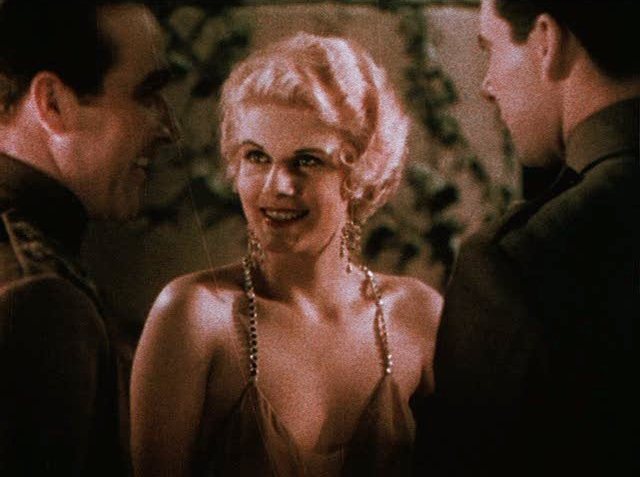
Monte finally meets Roy's Helen at "Lady Randolph's Charity Ball"—and if one isn't already disoriented by the switching from silent film to sound and monochrome to tinted, then the Ball sequence must be a head-spinner. Filmed in Multicolor by printed in Technicolor, it is the only one presented in full-color—save for the tinted silent sequences in the film. Plus—as the film was made in the scandalous "pre-Code" era, Helen's dress may cause some raised eyebrows as it's completely backless and shows a lot of decolletage from all angles. It's probably why, as one can see from the various posters promoting the film, that Harlow is prominently featured, despite the fact that she may be only on-screen for all of 20 minutes.
For the sound sequences, the originally filmed, heavily accented Norwegian actress
Greta Nissen was bought off and replaced by 18 year old Jean Harlow in her first film
and in the only color sequences in her entire, short film career.
The Ball proves fateful, as sparks fly as soon as Helen and Monte meet, with Roy—who may be a straight arrow but is also decidedly not the most observant chap. Maybe it's all that color. But, while Roy is distracted by the host's demands, Monte gets to dance with Helen and the two get very close...to the point when Roy and Helen sneak off for a private chat, she confesses that she's thinking of Monte...and the stupid sap is actually pleased about it, thinking that it might cement their relationship and make them closer. Nothing could be further from the truth. 
While Roy is being escorted around and introduced to the hoi-polloi, Helen gets bored and asks Monte to drive her home. Monte—being a no-good heel—is only too happy to volunteer AND go up to Helen's apartment for a night-cap or be quite eager when Helen excuses herself with one of the most famous lines in Hollywood: "Would you be shocked if I put on something more comfortable?" The robe she slips into may be more comfortable, but it has decidedly more material than what she was dressed in for the ball. Nevertheless, Monte is seduced—hey, he signed up for the RFC for less—and he spends the night, immediately regretting it the next morning. Helen and he have a fight when she tells him that she could never love someone as boring as Roy and she kicks him out. He slinks back to his post, waking Roy, telling him that he went to a bar after dropping off Helen and warning him about her, telling him "women are all the same!" Roy won't have any of it and slunks back to sleep, leaving Monte to contemplate just how low he can go by betraying his own brother. But, one begins to wonder where the film-makers' sympathies lie—with the louse Monte or the easily duped Roy?
What follows is the first action set-piece of the movie, as a German dirigible moves through cloudy skies on a planned bombing run to hit London. On board we find the Rutledge's friend Karl, who is given the assignment of being lowered beneath the cloaking cloud cover in a sky basket to find the target for the mission—Trafalgar Square. Karl, being an Oxford student has a change of heart and radios the ship to drop its munitions in a lake, exploding harmlessly—if spectacularly. The ship starts heading back to Germany under cloud-cover, while Karl is being winched back to the air-ship. What they don't count on, though, is three biplanes coming after them, in one of which is Roy and Monte.
The model work of the sequence is amazing, especially for the era and the blue-tinted nighttime scenes have a spooky glow to them. The shots on the planes are all studio shots, but they are well-managed and cut together seamlessly with the model-work.

As the German airship commander realizes that they are being pursued, he orders the engines at full-speed, but it's not enough to out-pace the fighter-planes. When he's told he needs to drop weight to increase the air-speed, the first thing he thinks of is the spy-basket with Karl still inside. Then, even more horrific, ballast is dropped as well as many volunteers of the lower ranks who jump to their deaths for "the Kaiser and the fatherland."

During the battle, two of the aircraft are shot down, including the one containing Roy and Monte, Roy managing to bank the bi-plane to an inelegant landing. They can only watch from the ground as the last bi-plane, its guns jammed, rams into the dirigible making it explode in the sky and crashing to the ground, narrowly avoiding the Rutledge brothers. 
Whew! Time for a 10 minute intermission.

Roy finds Helen working a bar and being very friendly with a supercilious Captain. The two insult each other and Helen upbraids Roy for making fun of her friend. Back at headquarters, Monte is feigning illness to get out of duty and one of the man substituting for him has been killed—"Somebody always gets it on the night patrol." But, Monte is sneered at for being a coward and he's given a speech—the longest of the movie—which Lyon delivers with a little too much Whalesian melodrama: "I'm not yellow! I can see things as they are, that's all. And I'm sick of this rotten business. Fools! Why do you let them kid you like this? What are you fighting for? Patriotism? Duty? Are you mad? Can't you see they're just words? Words caused by politicians and profiteers to convince you into fighting for them! What's a word compared with life? The only life you've got! I'll give 'em a word. Murder! That's what this dirty, rotten, politician war is! Murder! You know it as well as I do. Yellow, am I? You're the ones that are yellow! I've got guts to say what I think! You're afraid to say it! So afraid to be called yellow, you'll kill first! You fools! You poor, stupid fools!" 

Needless to say, no one is very impressed, especially Monte's commander. But good old Roy has a way around that—he volunteers himself and Monte for a suicide mission to cross enemy lines and destroy a munitions depot in advance of an assault by land forces. Thoughtful. But, Roy worries that he'll never see Helen again, so he goes to the bar to say good-bye, only to find her later at a speakeasy canoodling with that effete Captain from earlier. They get into a fight and Helen finally tells Roy that she never had any fun with him "and his high-minded ideals" and that the sight of him makes her sick. Devastated, Roy is led away by Monte who tells him to "don't take it so hard. Never love a woman, just make love TO her." It's only hours before their mission take-off at 3 am and the two get drunk before setting out.
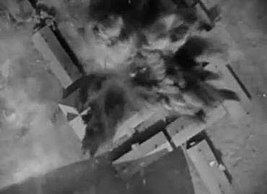
That mission is the highlight of the movie—a spectacularly filmed bombing run followed by an aerial dogfight filmed (except for insert shots of firing guns and damage) entirely in the air—no rear-projection screens—and the many aircraft dotting the frame like gnats. Whether the munitions explosions are real-size and large models, it's incredible action filmed mostly from the air, debris and smoke flying up to the camera lens.
Lasting some 20 minutes, t's a technical marvel of a sequence between the positioning of the planes high above spectacular clouds to the explosions done on the ground. Very impressive—and scary!—are the in-cabin views of pilots shot during the battle as they wheel out of control and fall away from the action above. As it's Pre-Code, there are scenes of pilots in their burning cabins that are horrific, and the language is surprisingly rough and wouldn't have passed censors in films 10, 20, even 30 years later (it would end up with a PG rating today.
But, what lingers is the nihilistic, decadent pall that runs throughout the film (except for an elaborate last shot that has the British overtaking a German bunker in triumph—because, after all, you gotta end on a high note). Bad guys get away with murder, women can't be trusted, the virtuous are taken advantage of—more than one time Roy takes a bullet for Monte—and heroism and patriotism, they really are just words in Hell's Angels. There is no glamour in the sacrificing of lives.
War really is Hell in Hell's Angels.


A shot from Martin Scorsese's The Aviator showing Howard Hughes 
(Leonardo DiCaprio) endlessly watching Hell's Angels.

* Stanley Kubrick listed Hell's Angels as one of his favorite films in 1962.  One can see that film's influence in the opening duel of Barry Lyndon.

Wednesday, September 26, 2018

The Dawn Patrol (1930)

The Dawn Patrol (aka "Flight Commander")(Howard Hawks, 1930) Howard Hawks was a director-producer adept at many genres of film—adventure, detective (including noir), gangster, comedy, musical, even sci-fi—but what is surprising is that Hawks rarely made a war film, despite having a style-template that would prove a natural of that genre—a Hawks film usually features a disparate collection of individuals from different backgrounds and different attitudes coming together with a common goal. That summation forms the basis of most war films that one could name, but from other film-makers taking the Hawks play-book as its core. Hawks wasn't interested in war, he was interested in the challenges of creation, of the challenge itself and achieving a goal, not destruction. For Hawks, as evidenced by omission, war seemed to be a waste...and a waste of time. Even during World War II, when Hollywood was cranking out war films, Hawks made only one of his three—Air Force, which told the story of a "lost" flight that takes off with the United States at peace and lands with the United States under attack.* And when he did make war films, they were different—Sergeant York celebrated an American hero who did not want to go to war, Air Force about the challenges when the world has changed and there's no infrastructure. And The Dawn Patrol—1930 edition—is about the brotherhood of pilots at the dawn of flight who are learning the nuances of fighting in the air...but are being decimated by a combination of bureaucratic impatience and incompetence and...not giving a damn. 
A war film that celebrates the bravery of the fighters while also decrying the waste that sends them to an early grave? That's an anti-war film.

Remember The Dawn Patrol? Eight years earlier, Howard Hawks made the first version during the "Pre-Code" era, based on a story by John Monk Saunders and his own experiences as an aviation instructor during the first World War—Hawks piloted and appeared as one of the German fighters in this film—so impressive were the aerial scenes of the Hawks version that many of the flying sequences were directly incorporated into the remake. But, there are differences, although the story is basically the same.
Mostly, it's a difference in how it is played. The Erroll Flynn-David Niven-Basil Rathbone version is a bit more larky, and the relationships between Richard Barthlemess, Douglas Fairbanks Jr. and Neil Hamilton (playing the same characters) are quite a bit different, particularly in the character of Major Brand. Rathbone plays him with a stiff upper lip and a martinet's cool. But, Hamilton's Brand is a man snapping under pressure, and although the actor's playing of it is (to put it charitably) over the top, it speaks more to the point of the film's central theme—although the pilots are the targets, it is Brand who is in the barrel, fighting a battle he cannot win and only seeing casualties, confronted with it every day, ("It's a slaughterhouse out there and I'm the executioner!") paying the price for overseeing a revolving door of death which he must oversee.
The film begins with a foreword: "The late Fall of 1915 in France, when a great country was forced to entrust its salvation to youth -- painfully young, inexperienced, bewildered--but gloriously reckless with patriotism -- proud and eager to rush hopelessly into combat against the veteran warriors of the enemy."

That's the last we'll hear in the movie of patriotism. The rest will be personal honor and respect among the fliers extended even to the enemy who salute the pilots they shoot down. And, as in Only Angels Have Wings, little to no time is wasted on sentimentality—mourning is bad taste and bad for morale—instead, the dead are celebrated in impromptu wakes at the aerodrome's bar, which does a steady business long into the night.
The conflict is done less in the air and against the enemy as it is against "the system." In a dark page out of "Catch-22," the aerial missions are usually dangerous—the pilots are targets for anti-aircraft guns and the German fliers on the other side determined to shoot them down. There are inevitable casualties among the fliers, and replacements are called upon to replace them.

Those recruits become increasingly younger and less experienced. And the main conflict that Richard Barthlemess' Courtney has with Brand is that the new kids are sent into the air with absolutely no training for the missions, making them easy targets and to the veteran pilot's mind unnecessary ones. But Brand is under orders to send them up as soon as possible and his vehement protests are ignored by the commanders giving the orders over the telephone, not even making an appearance so close to the front lines.
It is the unseen commanders that Hawks obviously has the most contempt for, and sees as the real enemy of the war, above even the Germans on the other side. Years later, in The Big Sleep, Hawks would have Bogart's version of Philip Marlowe bitterly curl his broken lip when describing a high society gangster as "a killer by remote control"—unwilling to take responsibility or get his hands or reputation dirty by doing the act himself. Hawks doesn't even give the officers and generals any screen-time, allowing their voices to be heard over the phone—they're not even there—just emotionless button-pushers with no regard for the fliers they send to their death, and have no repercussions for their actions.
Brand cracks under the pressure and strain, but that doesn't stop him being promoted, and taunting Courtney that, as senior pilot, he has been chosen to replace him, so that he can be placed in the same impossible bind of his adversary. That "promotion" will also separate him from the other fliers, as he is now seen as responsible for the deaths that the pilots regularly drink to forget. 

One could say that Courtney, too, "cracks" under the strain of the job, but in an entirely different, "professional" manner that Hawks would approve of, solving a problem that his duties demand of him, but not the essential one of a conflict that wastes lives and talent that would seem intolerable to a director who chose to celebrate life, even in the darkest of times.

* Hawks did make Sergeant York starring Gary Cooper before the attack on Pearl Harbor—sailors at Pearl were watching it on December 6th—but Hawks was hired as director in a project he didn't initiate and at the behest of Gary Cooper.