
But, this guy's asking for Jeff Bailey (Robert Mitchum). You know, Jeff, "the mysterious Jeff Bailey" who owns the local gas station. What does he want with Jeff?—he's a guy on the level. Treats people decent, even the local deaf kid (Dickie Moore). Plus, Jeff is gone for the day, out fishing with Ann Miller (Virginia Huston), who's sweet on him. Her folks don't approve, though. Neither does Jim (Richard Webb)—you know Jim, he's been trying forever. Then, Jeff came into town and Jim's been playing second fiddle ever since. And this guy's asking for Jeff. The Kid finds him while the city-guy pokes around the diner, and even though The Kid can't hear/can't speak, Jeff merely has to see him to know that something's up and the fishing has to be curtailed. The fishing in the lake, anyway. Jeff can relate. To the fish, I mean.
 Turns out the guy is an "old chum from old times." And he has a message for him. Whit wants to see him. In Tahoe. Jeff's not a guy to telegraph what he's thinking or say what he's thinking. "I never found out much listening to myself," he says once. But, this...this is something he left miles out of the way. And Out of the Past.
 Out of the Past came from a novel by Daniel Mainwaring, who used to be a private eye and a reporter before getting into pictures. He was a prolific writer of books and pictures and he was the natural go-to to adapt his novel "Build My Gallows High" (written under his pseudonym Geoffrey Homes). Humphrey Bogart read the script and liked it, but his bosses at Warner Bros. didn't. RKO bought it and were pleased enough with it to attach a good budget and a guy who knew his way around noir, Edward Dmytryk, to direct. But, there were conflicts with his schedule and so Jacques Tourneur (late of the Val Lewton horror unit) was brought in. Robert Mitchum was set to top-line and the script was punched up for him by Frank Fenton—who'd put words in Mitchum's mouth before—and James M. Cain, the godfather of noir, who'd written the novels of "The Postman Always Rings Twice," "Double Indemnity," and "Mildred Pierce." Together, these writers would craft dialog of a quality that was top-notch noir, that at its best is verbal shadow-boxing with its metaphors, its feints and jabs and dead-ends (but no knock-outs), a kind of gutter-poetry that evokes gruff chuckles or haunted thoughts.
 So, Jeff has an appointment in Tahoe with a thing of his past. Best to take care of the present, so he goes to see Ann, maybe for the last time, and square up accounts and speak the truth, not avoiding it, even though "some of it's going to hurt". First, she tells him that the man she knows isn't him. He's Jeff Markham, and he was a private detective at one time, who had a reputation for being smart and honest, and a partner (Steve Brodie) who was neither. He'd been brought in by a "big op"—"an operator, a gambler" named Whit Sterling (Kirk Douglas, in only his third film) about "some dame (who) took four shots at him with his own .38. Made one of 'em good." Whit's only slightly wounded, but what really smarts is she took $40 G's with her when she beat feet. Her name is Kathie Moffat (Jane Greer), and he wants the money back, the girl is just interest.
 After some digging and some hoofing, Jeff found her in Acapulco...and found her fascinating. Maybe it's the heat, or the waiting, or the anticipation, but when she walked into a bar, she walked away telling him were he might find her again...and walked away with his heart. He knew he was being a sucker, taking her side just because it was a nice place to be. And, as the waitress who works across from his future garage is given to say: "Seems like everything people ought to know, they just don't want to hear. I guess that's the big problem with the world." Jeff puts it more succinctly to Kathie: "Baby, I don't care."


"Baby, I don't care"
Famous last words. Jeff stops being smart, and he stops being honest...at least with his employer, Whit, who comes down to Acapulco to check on his progress. He doesn't tell him that he's found Kathie and that he's planning on leaving town with her that very day. They run to San Francisco, but the ends of the Earth wouldn't be far enough. He and Kathie are found by Jeff's old partner, Fisher, who tries to blackmail them for keeping quiet. Kathie shoots him, then runs out, leaving Jeff to dispose of the body. He never sees her again, and that's when he made his way to Bridgeport, to Ann, thinking he'd left his past behind.


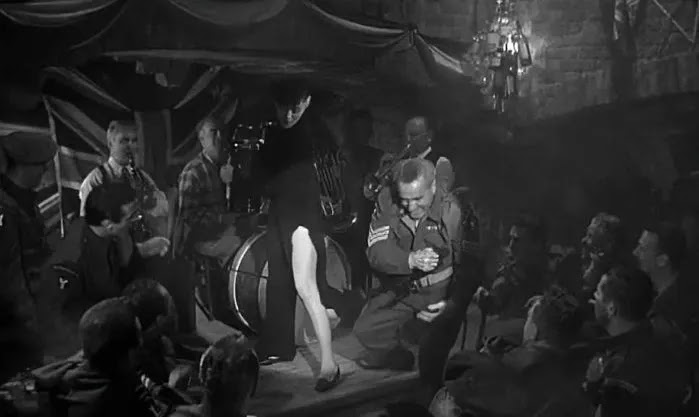
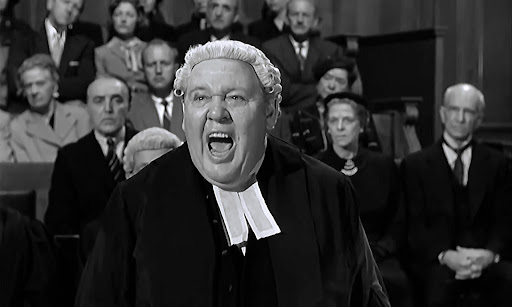


.jpg)


 DIRECTOR: Take two, cue Howard.
 HOWARD BEALE: I don't have to tell you things are bad. Everybody knows things are bad. It's a depression.
 BEALE: Everybody's out of work, or scared of losing their job. The dollar buys a nickel's worth, banks are going bust, shopkeepers keep a gun under the counter. Punks are running wild in the street...
 BEALE: ...and there's nobody anywhere who seems to know what to do, and there's no end to it.
 BEALE: Well, I'm not going to leave you alone. I want you to get mad. I don't want you to protest. I don't want you to riot.
 BEALE: I don't want you to write to your congressman because I wouldn't know what to tell you to write. I don't know what to do about the depression and the inflation and the Russians and the crime in the street. All I know is that first you've got to get mad.
 BEALE: You've got to say, "I'm a human being, goddamn it! My life has value!"

 BEALE: So I want you to get up now, I want all of you to get up out of your chairs.
 BEALE: I want you to get up right now and go to the window, open it and stick your head out, and yell, "I'm as mad as hell, and I'm not going to take this anymore!"
 HARRY HUNTER: (in the control room): Stay with him, stay with him!
 DIRECTOR: Everybody, stay with him!
 BEALE: I want you to get up right now, get up, go to your windows, open them, and stick your head out and yell, "I'm as mad as hell, and I'm not going to take this anymore!"
 DIANA CHRISTENSEN: How many stations does this go out live to?
 HUNTER: Sixty seven! I know it goes to Louisville and Atlanta and...
 BEALE: You've got to say, "I'm as mad as hell, and I'm not going to take this anymore!" Then we'll figure out what to do about the depression and the inflation and the oil crisis.
 (Former news-director Max Schumacher sits at home with his wife and daughter watching the screen as Howard rants. Max is alarmed)
 BEALE: But first get up out of your chairs, open the window...
 BEALE: ...stick your head out, and yell, and say:
 BEALE: "I'm as mad as hell...
 BEALE: ...and I'm not going to take this anymore!"
 CHRISTENSEN(walking into executive Herb Thackeray's office): Who are you talking to, Herb?
 BEALE: But first you've got to get mad! You've got to say, "I'm as mad as hell, and I'm not going to take this anymore!"
 RAY PITOFSKY (handing the phone to Christensen): They're yelling in Baton Rouge.
 BEALE: Get up! Get up out of your chairs!!
 CHRISTENSEN (throwing the phone into the air): Son-of-a-bitch! We've struck the mother lode!
 BEALE: Stick your head out of the window, open it, stick your head out and yell and keep yelling, "I'm as mad as hell and I'm not going to take this anymore." Just get up from your chairs...right now..
 LOUISE SCHUMACHER: What are you doing?
 BEALE: Stick your head out and start yelling, and keep yelling...
 (It's already started. More and more windows start to open, and people come out and begin yelling in different tones, different accents, different cadences "I'm mad as hell, and I'm not going to take it anymore!!")
 "I'm as mad as hell, and I'm not going to take it anymore!"
 (A thunderstorm begins overhead, and its thunder can't drown out the, by now, hundreds of voices shouting out into the night.)
 (Max Schumacher listens for a moment, then he shakes his head, and closes the window, shutting out the noise.)

_01.jpg)


