Friday, September 27, 2019

Walking Kurosawa's Road: Drunken Angel

The inability to write about the films of Akira Kurosawa to my satisfaction led me to to take a different path: start at the beginning, take each film in sequence, one after the other, and watch the progression of the man from film-maker to Master. I'm hoping I can write more intelligently and more knowledgeably about his work by, step by step, Walking Kurosawa's Road.


Drunken Angel aka "Yoidore tenshi" aka 酔いどれ天使 (Akira Kurosawa, 1948) Corruption is at the heart and soul of Kurosawa's third film—the story of a village doctor and his realtionship with the town, and in particular, one yakuza gangster suffering from tuberculosis. Kurosawa, making films under the post-war U.S. occupation, uses corruption as a mataphor for the West's influence on Japanese culture, by showing his yakuza as criminals straight out of a Warner Bros. picture. Toshirô Mifune's Matsunaga (his first role in a Kurosawa film) reminds one of a young Anthony Quinn, and Reisaburo Yamamoto's hood is reminiscent of Bogart at his shadiest.

But the focus of the film is Doctor Sanada (Takashi Shimura), a portrait straight out of a John Ford movie of a self-medicating physician, battling disease as best he can, when the source of much of it lies in the heart of the very city he is serving. A river now is clogged with garbage, refuse and God knows what else, and pestilence carrying mosquitoes are everywhere, especially given the fetid heat of the town. 

It's enough to drive a doctor to sake to drown the depression that must come from daily fighting a losing battle. Not just because the town is turning rancid, but because most of the towns-people ignore what he says—kids wash in the river even when the doc yells at them about typhus, TB patients are out getting drunk, but he can't help himself—"Once you get a patient, you can't stop fussing over them" says his assistant Miyo (Chieko Nakakita from One Wonderful Sunday). But, his bluntness and lousy bedside manner guarantees he'll never get a more cushy, high paying practice.
Early on, he's visited by a young tough, complaining that he slammed his hand in a door. Sanada unwraps the makeshift bandage and eyes the young hoodlum—this is more than slamming a hand in a door. "There was a nail in it," says Matsunaga (Mifune) lamely. But, when Sanada explores the wound, he pulls out a bullet. "You call that a nail?" he gives the kid a look as he drops it on the table. "I won't make any trouble," grins Matsunaga. "I hear you take care of my guys." Sanada is not impressed. "I'm warning you," he tells the tough. "I'm pretty pricey. I make it a policy to rip off deadbeats."
But, the gangster is also subject to coughing fits. And Sanada insists on testing him for tuberculosis. Matsunaga is reluctant, but the doctor brow-beats him into it with cutting remarks—"You've always got a line, don't you?" Matsunaga will snear at him at one point. But, when he listens to the young man's breathing, Sanada is sure he's got a hole in his lung, but an X-ray will confirm the diagnosis. Matsunaga lashes out at him in anger, admittedly as much as he can do with a bandaged hand. But, the doctor seeks him out the next day and insists that he get an X-ray taken with a specialist.
Later on at dinner, Sanada wonders why he cares—he speculates because the yakuza reminds him of himself at that age, all-attitude and posturing. There's another concern: Matsunaga's old boss, Okada (Yamamoto) will be getting out of prison soon, after four years, and Miyo, Sanada's assistant, used to be his moll. And Miyo is consumed with guilt and fear—guilt that she might bring Okada's wrath on the doctor's house and practice and fear of being found out by her old lover. She confesses that it might be better just to go back to him once he's sprung. But, Sanada will have nothing of it and tells her to stay with her new life.
Matsunaga visits the the doctor again and tells him he tore up the X-rays. This enrages Sanada, accusing Matsunaga of being a coward for not facing his fears, despite the trappings of being a tough guy in the yakuza. They fight again, but eventually, he does bring the X-rays for Sanada to examine, and he learns the truth—the TB is far more advanced than thought. And Matsunaga promises Sanada that he will give up drinking and smoking in an attempt to beat the disease.
But, Okada gets released, and one of the first things he does is seek out Matsunaga, gets him drunk and humiliates him in a power play to establish who is boss of the town. After so brief an attempt to heal himself, Matsunaga is worse than ever, coughing up blood, and Sanada is sent for to see after him. Rather than berate him, the doctor opens up a music box and tells the gangster to "dream of your childhood."
But, Matsunaga's dreams, instead, are troubled and have nothing to do with childhood. In a surreal sequence, he dreams of himself, well-dressed, walking along the beach, the waves tempestuous and violent. He finds a coffin adrift in the waves, and, breaking it open with an ax, finds his diseased self in the coffin, which rises from the coffin and chases him down the beach. He wakes up just before he is caught by his fate.
Matsunaga is under attack, from without and within. At the time Sanada is berating him to save his own life, Matsunaga ignores him to attack Okada to try and retain his status, and hold off Okada's attempts to bullying Miyo back—although why he cares is unclear as he's stolen Matsunaga's social-climbing girlfriend (Michiyo Kogure). Dr. Sanada, though, is just belligerent enough to think he can hold off Okada himself—plus, he has another more traditional, "rational" (his favorite term) strategy by getting the police involved.
But, Matsunaga has a code of the yakuza to follow—Okada has no such code, evidently. So, he leaves his sick-bed, gets dressed, gets by Miyo, who's tries to stop him (he locks her in a room) and goes out to take on Okada. Sick and weak, he goes to Okada to fight it out, in one of the most inelegant fight sequences ever not choreographed. Where Kurosawa has kept the camera-expressiveness down, the fight is filmed at odd angles and the actors are encouraged to over-emote like animals. It's a bizarre scene, clumsy and desperate...and deadly.
Drunken Angel marks a turning point for Kurosawa. He has been expressive, emotional, surely, but this film may be his first masterpiece. Everything comes together and supports the disparate elements that clash and unite throughout the film.
It also should be noted that it is the first film where Kurosawa featured the actor Toshirô Mifune,who would be the cornerstone of so many of Kurosawa's films. Every actor in Drunken Angel is at the top of their game, but Mifune's portrayal of a once-vibrant tough systematically dying by his own actions is impressive in tis ability to evoke tragedy. Kurosawa re-worked the screenplay once he knew what he had in Mifune's performance, taking some of the emphasis from Shimura's doctor to the charismatic self-destructive tough, giving the film a more tragic air befitting the toxic environment in which the the film is set. But, despite the hopeless setting, the film-maker manages to give his two protagonists moments of redemption, allowing the doctor to appreciate one small victory in a moment of tragedy in his efforts to eradicate the TB epidemic, and for Matsunaga an honorable death, his body coated with white paint, indicating purity.
Kurosawa begins the film with the fetid, bubbling swamp and keeps returning to it throughout the film. But, he ends it in the city as two of the film's survivors disappear into a throng of people, supplying the viewer with a final image, providing us, as well, with a kind of redemption, certainly one of hope.


Wednesday, September 25, 2019

Inside Job

Written at the time of the film's release...


Scoundrel-time
or
No End in Sight, Part $

Charles Ferguson's last documentary was No End in Sight, the very fine examination of how the militarily successful invasion of Iraq could turn into a stunningly inept (and contrary) example of nation-building. Like the handling of the Katrina aftermath, it was a case of arrogance, of sticking to what the Administration thought was going to happen (or merely wanted to), as opposed to reacting to what did happen. Ferguson used archive footage to present the timeline, devoting most of the time to interviews with witnesses, which broke down into two groups, those with boots on the ground (generally bitter and remorseful) and the idealogues (cluelessly in denial). It becomes very clear in the viewing that key decisions by officials who couldn't be bothered to go the source made very early but critical decisions from which the situation never recovered, compounded when the mistakes weren't acknowledged or denied.
Inside Job, which looks at the banking melt-down, takes a different tack. It begins with the recent economic story of Iceland, a microcosm of what happened in the United States and globally, and then once the basic principles of over-extending becomes clear, expands the scope to take on the massive task of explaining the intricacies of the U.S. disaster and its subsequent bail-out.
The difference in this one is the talking heads (and I'm being kind using that particular part of the anatomy). Yes, there are interviews with international bankers who have an objective view, plus writers for financial publications who looked at the situation with a reporters's overview. So many of the interviewees, though, are U.S. financial advisers, many of whom either benefited from the crisis—through bonuses or receiving cushy jobs in other financial sectors—or had a hand in causing it. Their interviews are examples of arrogance in action, dodging their responsibility, dodging the camera ("Can we turn that off?" asks one of the camera), or getting suddenly pissy when Ferguson dares to ask pointed questions ("You have three minutes," says one of Bush's financial architects. "Give it your best shot." I'm only surprised that he didn't say "Bring it on.").
None of these guys were elected by us, and yet, their actions have affected all of our lives—all of ours. They screwed up, and yet they are still in business, still profiting, and there is nothing we can do about it. Except make our voices heard in protest (to which these Masters of the Universe react with hurt feelings, releasing their statements of outrage from the multiple houses they are in no danger of losing*). There are no investigations into their mis-deeds because so many are still deeply embedded in the very government that should be running those inquiries. Many of them, as Inside Job points out, are hiding in the ivory towers of financial academia, ensuring that their ideas are carried on to future Masters. Think they're teaching any ethics classes? Probably not. The priority is crunching numbers...and lives.
It's depressing stuff. There was a lot of disgruntled grumbling as viewers filed out of the theater (it was a full house, which was encouraging), but no cries for revolution, no pitch-forks, and probably, at home, no mattresses stuffed with cash. People are still "gruntled" enough to trust the situation...and business to people who protest that they know what they're doing (and we can't), but so obviously screwed up, greedily driving the car as fast as it would go so close to the cliff's edge. And they fight mightily if someone wants to include any kind of brake in the vehicle.

It is funny, now, to hear so many people upset about taxing the upper 1% of American earners bleating into their golden microphones that this is (horrors!) "class warfare." Yes, it is. But that war was started years ago against the middle-class, the american people in general and the nation. These weasels, after drawing first blood, just don't want anybody to fight back.  

2019 Update:
Inside Job won the 2013 Academy Award for Best Documentary Feature.

And no one has gone to jail.

* I saw Inside Job the week after George W. Bush made his promotional book-tour on the talk-shows bitching that the worst thing that happened to him during the Administration was being called "a racist" by Kanye West.  He got off easy during his tenure...so many American did not.  It's good to be the King.


Tuesday, September 24, 2019

Ad Astra

I should caution before you go any further that this review is full of spoilers.

To the Stars, Alice! (Zoom! Pow!)
or
In Space, No One Should Hear You Voice-Over
or
Ameliorating With Extreme Prejudice

Science Fiction is a fascinating genre. At its best, it is mind-expanding, forcing you to ponder the imponderable and think the unthinkable...to look at things in new ways and never see them again as you once did, or even think about why things are, and how they managed to get there in the first place...and why not another.

That's "science fiction," the concept. It is rarely science fiction, the reality. As one of it's practitioners, Theodore Sturgeon, once opined "90% of science fiction is crap...but then, 90% of everything is crap." 

With the exception of science fiction movies, where the percentage is upwards of 95%.* And if you think I'm being too harsh, then consider one of the hallmarks of science fiction movies is The Planet of the Apes. Frankly, really good science fiction is above the heads of casual movie-goers—you throw two or three advanced concepts out of their comfort zone and it'll turn into a giggle-fest. In movies, a "successful" science fiction movie is, by and large, another reliable story or concept that is set in the future or in space. The familiar off-sets the strange and, as a bonus, keeps the familiar hidden in plain sight.
So, James Gray is a good director. His last movie, an adaptation of the daunting book The Lost City of Z was very good and too little seen. It was backed by Brad Pitt's Plan B company (and, at one point, Pitt was going to star). Whatever returns the movie made, Pitt is one of the folks behind Gray's new film Ad Astra—Latin for "To the Stars"—about an Earth in "the near future," at which time four things seem to be occurring: 1) Earth has expanded colonizing other planets; 2) we commercialize those colonies to the hilt—there's a Pioneer Hotel and Casino on the Moon, judging by the "Vegas Vic" neon sign**; 3) humans are spending an inordinate amount of time searching for intelligent life...with at least two major projects—an Earth-based antenna array that extends from the Earth's surface into space and a deep-space manned mission called the Lima Project sent to do exactly the same thing on the outer rim of the solar system***; and 4) the Earth is being buffeted by something called "The Surge" which acts like a high altitude nuclear weapon disrupting and shutting down power grids across the Earth...and the Moon.
It's that last one that gets the narrative ball rolling—Pitt plays astronaut Major Roy McBride, considered top-notch in his field because he's emotionally stable (despite being something of an space-"orphan"—more on that in a moment) who stays cool under any circumstance proven by the fact that his heart-rate has never risen above 80 BPM—not even when, during one of these "surge" events, he's knocked off the Earth-based antenna seeking extraterrestrial signals from space. He survives the high-altitude fall despite having his parachute slightly damaged on the way down and he's called on by U.S. Space Command (SpaceCom) to undertake a top secret mission.
It seems those "surge" blasts have been tracked originating from the planet Neptune. That particular planet is where The Lima Project, commanded by McBride's father, H. Clifford McBride (Tommy Lee Jones), was sent to search for E.T. signals at the outer reaches of the solar system. His father is considered dead, as nothing has been heard from the Lima probe for sixteen years, but, those surge blasts are coming from Neptune...and there's some techno-babble about it having to do with anti-matter, and the power source for Lima did have an element of anti-matter to it. They put "2" and "-2" together and came up with a Neptune-sized "0". McBride is asked to go to Mars, which has an underground facility not affected by the "surge" to relay a message to the Lima Project—and, hopefully, his father—to find out what the heck Dad is doing out there. If he truly is "Out There."
But, first, they have to go to the Moon. Commercial flights are available (on Virgin) and McBride is joined by an old colleague of his father's, Col. Pruitt (Donald Sutherland, sure, because he and Jones were in Space Cowboys together), who has been brought out of retirement to keep an eye on McBride and has his own ideas about what happened "out there." Seems the older McBride was upset that Pruitt quit SpaceCom, calling him "a traitor," and, given his father's nature, "a voyage of exploration can be used for escape. We think your father is hiding."
The trip to the Moon is uneventful, if still based on the rather wasteful first stage/second stage way of going into space now. The lunar colony is now a tourist destination, which Roy says—in his ever-present narration****—is "covered with drink stands and T-shirt vendors—just a recreation of what they were running away from on Earth—if my Dad saw this, he'd tear it all down." Well, he just might be doing that, sonny-boy. Better head for the next leg of the journey—from Moon to Mars. Trouble is, there's a little territoriality going on, Moon-side. Seems mining interests (maybe led by Sam Rockwell—or Rockwells) are in dispute, and there have been incidences of violence and theft by pirates.

Pirates? On the Moon? Arrrr, I HATE those!
As goofy and entertaining as a rove-by shooting on the Moon is, it's just there to provide "an incident bump" so that something is happening besides watching ships move in a straight line and Pitt's constant navel-gazing (no, ladies, not literally). It is not necessary to the plot. It is not necessary at all. All it does is get rid of Pruitt's character and gives McBride an opportunity to know something that Pruitt is hiding about the mission, something that would have been revealed later, anyway. Grant the sequence this, though: it's staged like one of John Ford's "we've got company" Indian attacks (on the Moon!) and it does a marvelous job of recreating the hummocky lunar landscapes familiar from the Moon landings. If only they could fake it that well in the 1960's!
So, McBride gets to go on his trip to Mars to deliver the message to his father, and it's not a commercial flight, it's more like a trucker line—McBride refers to the astronauts as "long-haulers." They basically launch from the Moon base and then point themselves at the spot where Mars is going to be when they get there in 19 days. Fast trip. But, too long for a movie unless something happens along the way. The movie needs another "bump." So, they get a "May-Day" signal from a "bio-medical" facility called Vesta IX and decide to investigate. McBride puts up a protest that he is on a top-secret mission and the pilot cannot risk screwing it up. The pilot, says, sure, but this is a "May-Day" and he has to investigate, especially since he's not getting any return hails. McBride thinks it's stupid, but ultimately agrees, even volunteering to join the pilot when he notices the co-pilot is a bit reluctant to go (which brings up the "Captain Kirk" rule—the commander should stay on the ship and let the "red-shirts" handle it, but, no, not on this ship). 
There, then begins the "Alien" episode, where McBride and the pilot split off on the Vesta, looking for the crew...bad idea, but, we're starting to get used to bad ideas on this trip...and this movie. I would like to be spoiler-free in this review, but I don't think Ad Astra is worth seeing, and, also, I can't resist using the phrase "Crazy-Killer-Baboons-From-Space." Yes. They go there. It was about this time I gave up on the movie (but stuck it out until the end).
But, one other thing about the sequence disturbed me—it's impossible. The transport is going in a straight-line (with gravity variants) to Mars (or where it will be in 19 days) and getting there pretty damn fast. Unless the Vesta facility is on the same trajectory going at the same speed, the pilot wouldn't be able to just "change course" like on "Star Trek" and sidle on over to the other ship—they don't have brakes in space, they would have to stop their momentum (which is a lot to ask) in order to rendezvous, and then, once they're done, restart the engines to regain that same speed to continue on to "where-Mars-will-be-in-19-days-plus-the-amount-of-time-wasted-on-the-'May-day' signal." This is "Star Wars"-science, meaning it's not science at all.
They make it to Mars, not easily—another "Surge" happens just as they're trying to land and McBride is welcomed to the underground Mars-base by its manager Helen Lantos (Ruth Negga), who escorts him to his destination, but she is dismissed by SpaceCom authorities as "not authorized at this level." He is escorted into a sound-proofed booth, handed a script and reads it—if you've forgotten because of the rove-by shootings and killer space baboons, that is that mission to read a message to his father, who might be alive near Neptune. McBride's script is "just the facts, ma'am" formal, and no reply is received after Roy reads it. Neptune does not respond.
But, Roy is freaking out. He spends a lot of time in "comfort-rooms" that project Earth-scenes on the walls and voice-overing about his father and him and their lack of relationship and how they're more alike than he might know and wonders what the long-form Lima Project might have done to "my Dad. Did it break him? Or was he already broken?" At that point, the H. Clifford McBride character starts to take on the mythos of Marlon Brando's Col. Kurtz in Apocalypse Now. Old messages have messianic overtones and a devotion to the search for E.T.'s that slightly creep one out. 
Next time, Roy goes in the booth to broadcast a signal, he goes off-script, appealing to his father directly, using personal details and ending with "Your loving son, Roy." He waits, and when there is more activity in the control room, he understand what it means "You heard from him, didn't you?" When he is not given an official reply to his questions, he starts to get angry. Now, it's personal and that's just what SpaceCom doesn't want. "Thank you, Major. For your service, we will return you to Earth. Your connection makes you unsuitable for the Mission."

Now, they tell him.
Roy's security clearance is revoked, and all he can do is go to a comfort room and stare at the fish. Then, Lantos makes a visit and asks "They never told you what happened to him out there, did they?" Well, no, they didn't, and it's surprising that she knows as she'd previously been told she was "not cleared at this level." Lantos reveals to McBride that her parents were also part of Lima and that his father killed everybody else on the project to quell an apparent mutiny—something Pruitt was aware of. She shows him a classified tape of the older McBride reporting the incident to Earth: "I'm disclosing a tragedy...I have killed the innocent and the guilty."

Then, she drops a bomb on him. The ship he came in on is being re-purposed with nuclear weapons to go out to Neptune and destroy Lima. All Roy can think about is that he has to get back on that ship and get to Neptune.
I've dropped so many spoilers, I'm not compounding any damage to say that he does. But, how he does it is eye-rollingly stupid, and once he gets there, things go downhill just as the ship is launching, because apparently there are no such things as G-forces during a launch. What then happens is a contrivance that just ensures that Roy is the only one to make the long, lonely trek to confront his Father and...as the SpaceCom boys say "ameliorate the situation."
And with that, the film plays out more for the sake of convenience than any sort of Big Theme about the nature of man or his place in the Universe, other than the notion that to be obsessed with life off the Earth and ignore it at home is crazy and crazy-making. What good is proving we're not alone in the Universe, when we're isolating ourselves on Earth?

Well, the quest for knowledge, for one thing. If human beings don't have all the answers, it would be nice to get a second opinion. But, the movie is too involved with self-involvement to ponder that. But, one should go into space with more goals than merely to solve "Daddy Issues."
So, (the movie says) astronauts are cold and distant...because their destinations are. And the farther we go, the more distant, physically and emotionally, they're going to become. Not a big revelation or a revolutionary statement. That's why there are no space-romance movies unless they throw out the physics book, and when they don't, you get creepy things like...Passengers (shudder). All you had to do was take a look at astronaut divorce statistics: all that training, all that time away from families...and that's for trips that took up to a week. With the ISIS and extended-stay missions, the toll on families must be enormous. The toll on families must be irrevocable.
But, James Gray obviously didn't know that. I've known it since Frank Poole's birthday party...and you know something? David Bowie and Elton John, who are not film-makers or involved in space-programs, knew it, too, some 40+ years ago. And it should be obvious—explorers do not make good partners...because they will not value others above their personal goals. They are selfish, self-involved, and frequently obsessed. They have a singular vision, and "singular" doesn't involve sharing. Gray's The Lost City of Z had that as a sub-text. Putting the story in space doesn't change the point. We're merely repeating ourselves somewhere else.
And that's not science fiction, not if we're trying to expand things, or think new thoughts. It's not much of anything, really.

Ad Astra is a waste of time...and space.


* No, I haven't forgotten about 2001: A Space Odyssey, Stanley Kubrick's "proverbial GOOD science fiction movie" ("You new here?"). In fact, I've written about it so often, that I avoid mentioning it whenever I can. It's part of the 10% that isn't crap, and actually achieves what I proposed as the mission of science fiction—"to go (boldly) where no mind has gone before."

** Someone should tell the director or art director or CGI-ist's that the Pioneer Club shut down in 1995 "in the near past" and became a souvenir shop. The sign remains in Vegas  for nostalgic reasons. And because...Vegas.

*** Neil deGrasse Tyson will have a field day with this one: why off of God's green Earth would you send a manned probe to search for messages from outer space to Neptune when those messages will arrive at Earth 4 hours and 2 minutes later? What's the hurry? If somebody wants to come up with some woo-woo explanation like "because of the Van Allen belts" I would reply...then set 'em up away from them on the Moon, dummy! Why go to Neptune...except to gin up false drama?


**** This continuous narration is annoying. Maybe it was a nod to Willard's narration in Apocalypse Now (which the movie resembles—I kept thinking over some of the montages "Space transit. Shi-iit. I'm still in Space transit"), but it's closer to the "hit-you-over-the- head" narration of the theater version of Blade Runner. It would have been a far gutsier—albeit riskier—move to just eliminate it, even if it left some of the audience in the lunar dust. Pitt's performance is internalized and well-done and one can tell that his McBride is dealing with a lack of engagement to counter-act his separation anxiety issues without having to tell us.. I'm not sure that the narration provides anything that Gray doesn't already provide visually and it feels like the voice-over was put in at the studio's insistence...due to cold corporate feet. I'm thinking there'll be a non-narration director's cut "in the near future."

Sunday, September 22, 2019

Don't Make a Scene (Redux): When Harry Met Sally

It takes a lot of time to do the "Don't Make a Scene" feature that I put up every Sunday (all those screen-caps!), so while I'm preparing a bunch more, I'm going to take a break and re-post the ones that have gotten the most "hits," counting down from the 10th highest to the first. When I started compiling them, I was totally baffled by the results (enough that I'm considering posting a couple of my favorites that resonate a lot with me, once we're done with this). I would never have thought that these would be the most looked at, but here they are, as part of "Don't Make a Scene (Redux)."
The Set-up: When Harry Met Sally gets a lot of guff from folks who saw it as warmed-over Woody Allen. Yeah, one can see that argument. It's set in New York, after all. And there's a lot of neurotic behavior going on, so much so that you want to slap somebody now and again.

But the big difference is tone. I don't know anybody who talks like the folks talk in a Woody Allen movie (Allen writes all the parts, after all, and they all have a tendency to sound like him), but I know a lot of people who talk like the folks in this scene. And there's another quality missing from When Harry Met Sally.


Cruelty.

Specifically, Woody Allen's cruelty. Let's compare scenes. In When Harry Met Sally, there's a scene (the one immediately preceding the one featured) where Harry runs into his ex-wife and her new lover at a "Sharper Image."

Compare that to the scene in Manhattan where Isaac Davis (Woody) meets Mary Wilkie's (Diane Keaton) ex in a store, and it's Wallace Shawn. Shawn's character has been held up as this towering intellect, and, after seeing him, Woody expresses shock that he's "this little homunculus." I forget which critic said it, but it was pointed out that Allen picked the one guy in New York homelier than Allen to play that role, whereas in Harry, Ira, is fairly normal-looking, if slightly uncomfortable in the situation. Allen stacks the deck in his favor. Reiner doesn't make a point of it--it's the humiliation of meeting the new lover in the store that's the point, not his appearance. But Allen had enough ego to belabor (and take advantage of) the point.

I love Woody Allen movies, but I like the people in When Harry Met Sally better...and I recognize them as human beings, as opposed to merely being entertaining aspects of Woody Allen's psyche.

There's nothing fancy about the presentation of the scene. Reiner starts by focusing on the object of discussion and moves out from there to include the participants, all shot at eye-level, and with an emphasis on expression. There are no fancy moves with the camera (a trademark of the style when cinematographer Barry Sonenfeld directs!); it's all in the presentation and how the scene is played. Allen is the better director than Reiner compositionally, but Reiner's is a classic, unpretentious shooting style that doesn't emphasize close-ups for conversion to television, although it is framed with the participants grouped in the middle of the screen, should that prove necessary. Reiner is shooting a movie, not TV, and it's evident in every frame. And his handling of Ephron's material is miles ahead of her directing her own stuff (Bewitched? Hello?)

The scene feels real. Relatable. And we're not borrowing from Bergman or Chekhov or Tolstoy to get there.*


This is a lot of complaining about a film-maker I like. Even watching Allen's uneasy musical Everyone Say I Love You (which I did a couple of days ago) exhibits a multitude of joys. I guess the issue I have is with the film's critics using the phrase "warmed-over Woody Allen."

To which I reply "This is a bad thing?"

Maybe I have a fondness for this scene because I have so much stuff in storage (Gotta clean that stuff out...).**

The Scene: Friends Harry Burns (Billy Crystal) and Sally Albright (Meg Ryan) are on a shopping outing, when Harry runs into his ex-wife Helen and her new lover, Ira, which devastates him. The feelings spill over later while helping their best friends Jess and Marie (Bruno Kirby and *sigh* Carrie Fisher) move in together.

Action!


Jess: I like it. It works. It says “home” to me.
Marie: All right, all right, We’ll let Harry and Sally be the judge. What do you think?
Harry: It’s nice.
Jess: Case closed.
Marie: Of course, he likes it, he’s a guy. Sally?
(Sally screws up her face “no”)
Jess: What’s so awful about it?
Marie: It’s so awful there’s no way to even begin to explain what’s so awful about it.
Jess: Honey, I don’t object to any of your things.
Marie: If we had an extra room we could put all of your things there, including your bar-stools.
Jess: Wait, wait. wait, Honey, wait, wait, wait. You don’t like my bar-stools? Harry! Come on! Someone has to be on my side!
Marie: I’m on your side! I’m just trying to help you have good taste.
Jess: I have good taste
Marie: Everybody thinks they have good taste and a sense of humor but they couldn’t possibly all have good taste..
Harry: You know, it’s funny. We started out like this, Helen and I. Harry: We had blank walls, we hung things, we picked out tiles together. Harry: Then you know what happens? Six years later you find yourself singing “Surrey with the Fringe on Top” in front of IRA!!
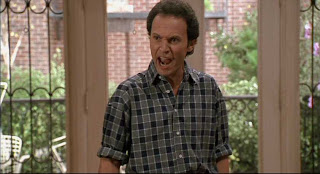
Sally: Do we have to talk about this right now?Harry: Yes, I think “right now” actually is the perfect time to talk about this because I want my friends to benefit from the wisdom of my experience. Harry: Right now, everything is great. Everyone is happy. Everyone is in love. And that’s wonderful! Harry: But you gotta know…sooner or later, you’re gonna be screaming at each other about who’s going to get this dish. This eight dollar dish is gonna cost you a THOUSAND dollars in phone calls to the legal firm of "This is mine, This is yours”

Sally: Harry…
Harry: Please. Jess. Marie. Do me a favor for your own good. Put your names in your books right now. Before they get mixed up and you don’t know who’s is who’s... Harry: ...'Cause someday, believe it or not, you’ll go fifteen rounds over who’s going to get this coffee table. Harry: This STUPID-WAGON-WHEEL-ROY-ROGERS-GARAGE-SALE-WAGON-WHEEL COFFEE-TABLE!! (He stomps off)
Jess: I thought you liked it!
Harry: I WAS BEING NICE!!!
Sally: He just bumped into Helen. (She leaves after Harry)
Marie: I want you to know...that I will never...want that wagon-wheel coffee-table.
(Sally goes outside and sighs)
Harry: I know, I know, I shouldn't have done it….
Sally: Harry, you’re going to have to try and find a way of not expressing every feeling that you have every moment that you have them.
Harry: Oh, Really?
Sally: Yes! There are times and places for things.
Harry: Well, the next time they’re giving a lecture series on social graces, will you let me know, ‘cause I’ll sign up.
Sally: Hey! You don’t have to take your anger out on me!
Harry: Oh, I think I’m entitled to throw a little anger your way…especially when I’m being told how to run my life from "Miss Hospital Corners."
Sally: What’s that supposed to mean?
Harry: I mean, nothing bothers you! You never get upset about anything!
Sally: Don’t be ridiculous!
Harry: What? You never get upset about Joe! I never see that back up on you! How is that possible? Don’t you experience any feelings of loss?
Sally: I don’t have to take this crap from you!
Harry: If you’re so "over Joe," how come you’re not seeing anyone?
Sally: I SEE PEOPLE!Harry: See people! Have you slept with one person since you broke up with Joe?
Sally: What the hell does THAT have to do with anything? That will prove I’m over Joe because I FUCK somebody? Sally: Harry, you’re going to have to move back to New Jersey because you've slept with everybody in New York and I don’t see that turning Helen into a faint memory for you…Sally: Besides I will make love to somebody when it is “making love” not the way you do it like you’re out for revenge of something.
Harry: Are you finished now?
Sally: Yes.Harry: Can I say something?
Sally:
Yes. Harry: I’m sorry, I’m sorry. (They hug. They move to go back inside. Jess comes outside carrying the wagon wheel.)
Jess: Don’t say a word!


When Harry Met Sally

Words by Nora Ephron

Pictures by Barry Sonnenfeld and Rob Reiner

When Harry Met Sally is available on DVD from MGM Home Video.


* Also the phrase "warmed-over Woody Allen" should be more correctly "warmed-over Annie Hall" as Allen does a fine job of exploring different territory in his films. Sure, there are familiar aspects from film to film, but he explores other genre's than simply "relationship comedies"

* You're probably asking yourself, "Why didn't he use the "fake orgasm" scene? It's the one everybody remembers!" There are a lot of reasons: It's the one everyone remembers; it's a one-joke premise--that Reiner and Ryan draw out to great lengths with the final whip-snap of the tag-line; It's really funny and true, but not terribly convincing when it's a series of frames; the exquisite timing of the line "I'll have what she's having" (delivered by Rob Reiner's mother) cannot be duplicated in this format, which makes it not worth doing; and the capper--too many exclamation marks!!