Showing posts with label Zac Efron. Show all posts

Saturday, November 24, 2018

Me and Orson Welles

Written at the time of the film's release.

"Waiting for Orson"

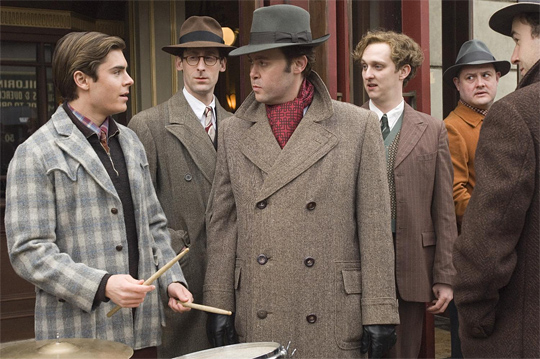
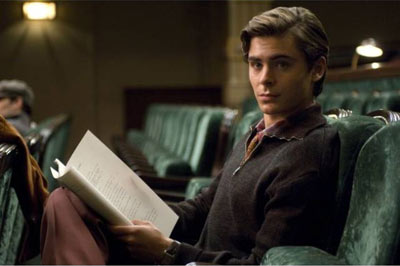
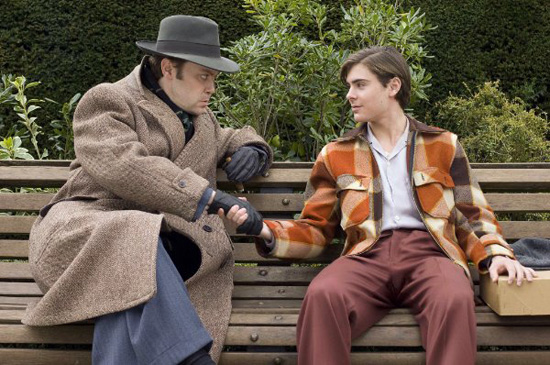
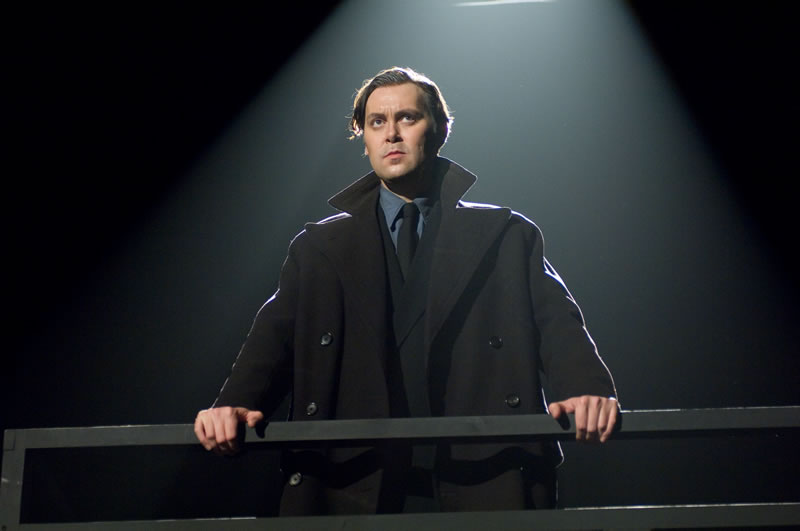
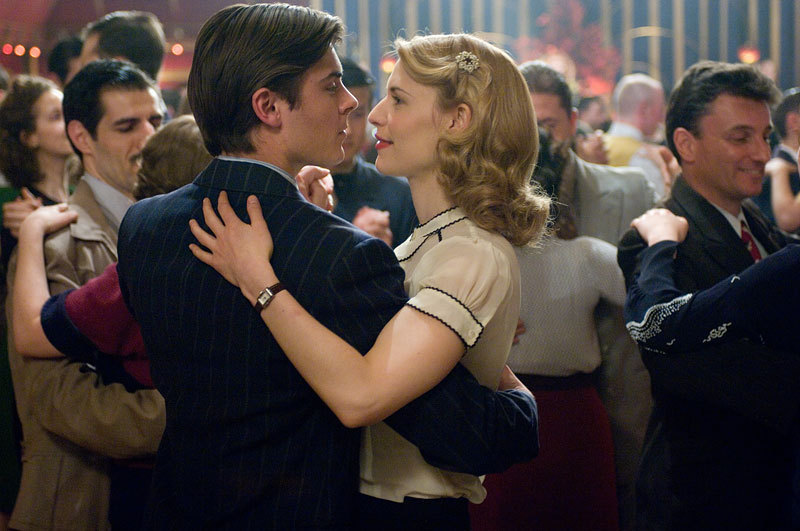
Young Richard Samuels (Zac Efron) is 17, "almost an actor," which puts him just a few hefty years (and worlds) behind the 22 year old Orson Welles (Christian McKay), who has established (by a shoestring) his Mercury Theater in New York, where he is in rehearsals for his modern-dress version of "Julius Caesar"—that is when he is not being whisked from studio to studio by ambulance to perform in various network radio shows, carrying on affairs with ballet dancers, associates, and "just met" women behind the aching back of his pregnant wife.*

Young Samuels manages to vocally pad his resume a bit and kibitzes with some of the players, just enough that
when Welles himself shows up to see the lighting of the big neon sign outside of "his" theater, he sees another bright, shiny object, and as he's about to fire a troublesome actor and "junior" can play the ukulele, Welles hires him on the spot...so he can fire the other kid. "He had a personality problem with Orson," says the Mercury's girl Friday Sonja Jones (Claire Danes). "Meaning he had a personality."

And that just wouldn't do. It's all about Orson, even when it isn'tThere's not that much difference between on-stage and off-stage because the star of it all is Orson Welles, manufacturing drama where there is none, generating excitement even needlessly, and making sure that the limelight is on him. He is the hero of it all and the villain with the best lines. He desires to be, as Alice Roosevelt said of her president-father, "the bride at every wedding and the corpse at every funeral." Life isn't enough, and art has to be stretched to accommodate him.
So do budgets. This fascist recreation of "Julius Caesar" is "modern dress" because there is no money for costumes, but nobody has to know that, it looks like a comment is being made and art is reflecting life au courant. Just like doing a "Voodoo" Macbeth means his all African-American cast is that much cheaper. It looks like a statement, but its merely the ones with a bottom line.
But it's a fine recreation, and if you're not interested in the details, it still makes a compelling story of getting what you need, whether you want it or not. For those who do know the history, it's particularly fun to see
Big Names tossed off: there's Joe (James Tupper), and Lloyd (Leo Bill) and Coulouris (Ben Chaplin) and Jack (Eddie Marsan).** McKay only slightly resembles Welles, and his voice is a timbre higher, but his phrasing, his articulation are spot-on....if the mannerisms seem to be those of the Welles that is familiar on-screenAnd if Zac Efron isn't entirely up to the task of playing his part, that's okay. His role is "Candide," trying to run with thoroughbreds, while he's still admiring the track, crushed with more experienced hoof-tracks. And Efron has just enough skill to do nothing when playing a kid who "doesn't know what he doesn't know." It's a boy's version of The Devil Wears Prada, but it's also The Stunt Man, where illusion is all and practiced and can dazzle the rubes. "J.H. (John Houseman) says everything about theater is bull-shit." says Sonja (which she explains is spelled with a "j" but pronounced with a "y"). But the trick is getting the bull-shit to flow in one direction and that's towards the audience, so they can't see the gears in the background, and the compromises, and the cat-fights and ego-clashes and the spit flying in the klieg-lights. It's new and they've never seen it before, and like the magician he was, Welles was good at deflection while making you never want to blink.

And director Linklater (Dazed and ConfusedA Scanner Darkly) suddenly seems to understand that. Where before he was content to trace his way through movies, now he's using it as a weapon to win over the audience rather than merely please himself. The big joke at the beginning of the film is a seemingly endless number of production companies that "present" Me and Orson Welles. Hell, the Isle of Man Film Commission is a producer and so is the special effects company that maintains the period illusions (they had me at the "Re-Elect Laguardia" bumper-sticker on the phone-booth), for like Welles, Linklater is trying to make his movie any way he can, and in one telling shot in the latter part of the movie, he shows how deep he knows his themes. He starts with a close-up of an orchestra singer, and she's nothing to look at. But as the camera moves back, back, back in the hall, soon all you hear is her voice and the spangling of her dress and at some point, it doesn't matter where—she's the most beautiful girl in the world and she can make you fall in love. It's a simple camera move, just a way-stop to what is important in the scene, but it speaks volumes about illusion and The Moment.

It's this trickery and the fascination with the curtain that distinguishes this little recreation of Welles' prestidigitation from Tim Robbins' hyper-serious (and more than a little dull) Cradle Will Rock. At times, it seems like Robbins was making a judgmental spoof rather than telling the story, which in its own way reveled in the incalculable effect of stirring theater.
And Linklater has a keen grasp of what makes Welles tick (not in his words, because "the official" Welles confounds biographers by telling different stories of his past), but by his actions. Welles had a fascination with the ephemeral, of the moment that could disappear in a flash and make you wonder if it was ever really there to begin with. Not wanting to be tied down, or set things in stone, he was finally confounded—not in the confused sense, but the frustrated sense—with film and its opening dates and burned-in images and permanent records. Change it, compress it, speed it up, keep everybody on their toes—they might see something up there—that was the Welles credo. Keep it fresh, or, at least play it fresh. Everything is fleeting, nothing is permanent, so you better move fast and enjoy it, or move past and forget it. "Ripeness is all." In that way, Me and Orson Welles is in the same radar zone with Up in the Air.
At a time when James Cameron is recycling his old stuff as futuristic, and trumpeting it as revolutionary at the top of his ego, the most amazing thing in this movie season is how two boy-filmmakers, Guy Ritchie and Richard Linklater, grew up to make stellar, fun and deep entertainments out of the past. Like Quentin Tarantino, these film-makers always gave off an air of being too hip for the screening room, but like Tarantino's Inglorious Basterds, Sherlock Holmes and Me and Orson Welles are smart, tough entertainments that may only appeal to the loges, but the fact that, given the materials, these directors can rise so magnificently to the occasion is the most eye-opening of movie-going experiences.
For awhile now, I've been peppered with little alerts about this movie on Welles-groups on the Internet and taking them with a grain of salt. There've been other movies about those wild early years, even a couple of TV-movies about "The Night That Panicked America," and "RKO 281" (about the making of Citizen Kane) and they've been tepid exercises that oftentimes embellished the facts. But, I think Welles would have enjoyed this one, and even roared with laughter a couple of times. But he would have had one problem with it.

That billing
.


72 Years difference: the NYT Hirschfeld cartoon for "Julius Caesar"

The 2009 cartoon of "Me and Orson Welles" in The New Yorker.


* The story is fiction based on fact: Author Robert Kaplow saw a photograph of the "Julius Caesar" production of Welles with a young man playing a lute, and decided to write a story about that young man. Except for the fact that his story is fictional, the rest if fairly accurate. Odd. Usually goes the other way.

** That would be Joseph Cotton, Norman Lloyd (who, like Cotton, worked with Hitchcock-becoming Hitchcock's Supervising Producer on "Alfred Hitchcock Presents" and starring as Dr. Auschlander on "St. Elsewhere," George Coulouris (who had a long, storied career on stage and in Hollywood), and John Houseman, who produced theater and films for many years and then, late in life, became a character actor, first in Seven Days in May, then became ubiquitous, first winning a Best Supporting Actor Award for his Professor Kingsfield in The Paper ChaseHe EARNED it).
Tuesday, November 13, 2018

Dr. Seuss' The Lorax

Written at the time of the film's release...

Geiselling Up the Wrong Tree
or
What the Dr. Ordered (What the Patient Thneeded)

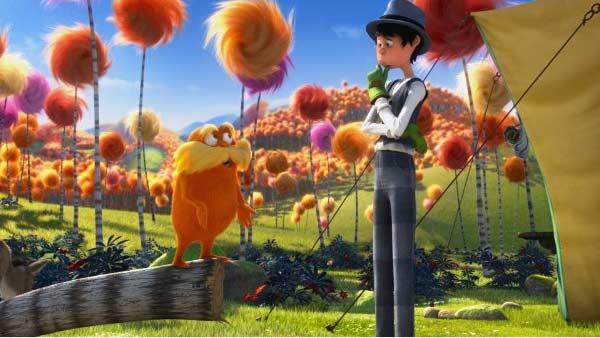
The Dr. Seuss library was getting a bad shake from the movies when they started. How the Grinch Stole Christmas (actually an expansion—and declination—of the excellent Chuck Jones Christmas special) was a live-action mess directed by Ron Howard. Then, the studio actually raised the ire of the estate (in the form of Geisel's widow, Audrey) with the live-action version of The Cat in the Hat. Then, someone had the brilliant idea of making them computer cartoons, starting with Horton Hears a Who (which did the book justice and stood out on its own as quite a good flick, being the closest representation of Seussian architecture, or lack thereof). Now, comes Suess' cautionary (and controversial) ecology tale The Lorax in the same format "from the creators of Despicable Me," Chris Renaud and his animation supervisor on that film, Kyle Balda.
And it's not bad. Despicable Me had a weird way of looking at the world all its own, and the creators have a tendency to take the "edge" off Seuss, (although preserving his architectural view of "no right angles") while still making a film that is lively, and with a comic timing that depends on the "ol' switcheroo" for laughs, not unlike a perpetual motion "Roadrunner" cartoon.
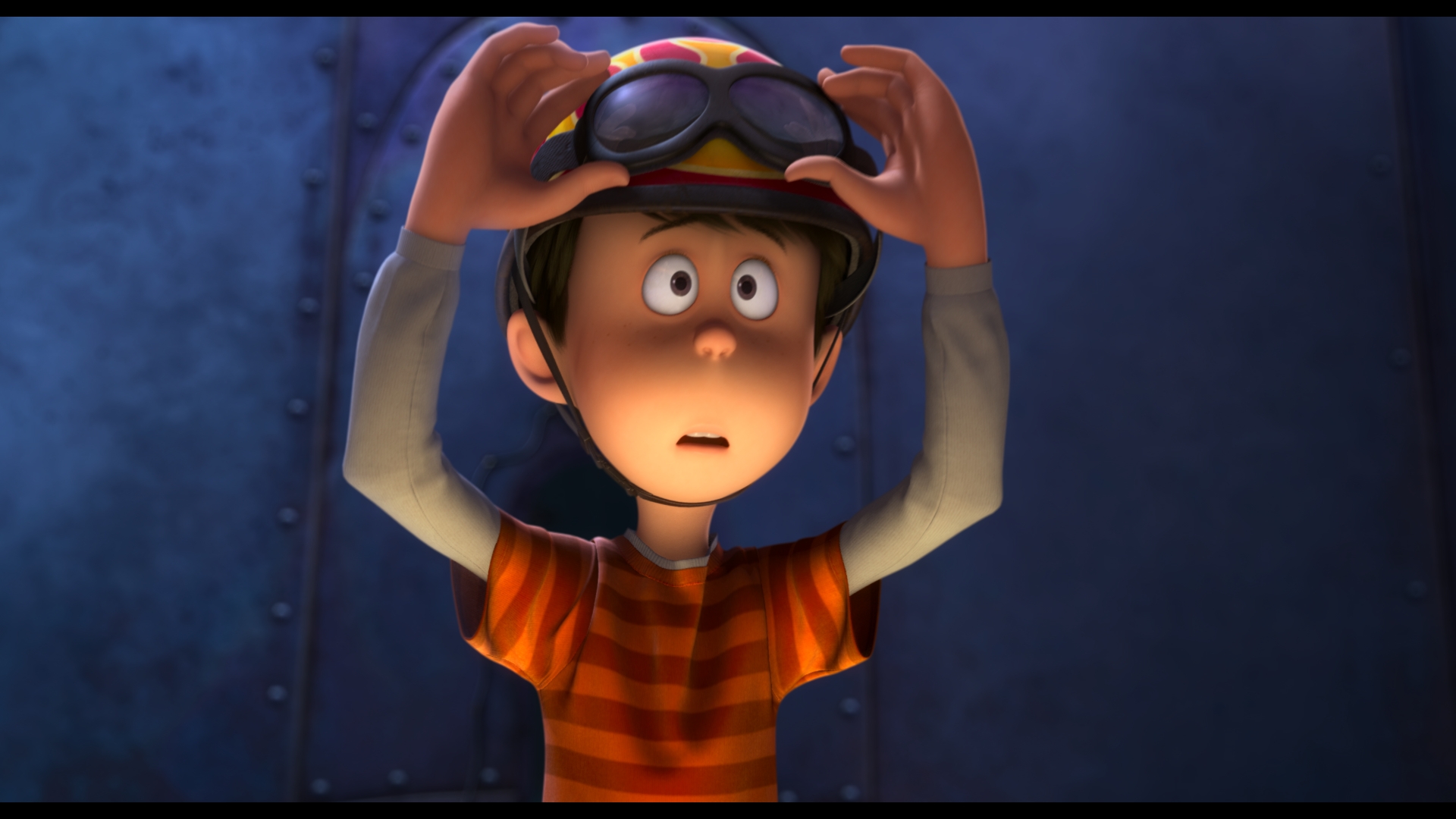
The expansion is interesting. Ted (Geissel's Christian name and voiced by Zac Efron) lives in a polluted plastic community of Thneedeville, run by a corporate overlord named O'Hare (Rob Riggle), who's a "zillionaire" from producing bottled air—a necessity since all the real trees have been cut done, owing to (and this where the book comes in) The Once-ler (voiced by Ed Helms) who used them all to make his fortune producing and selling Thneede's, which appear to be a scarf/sweater/hat contraption, which became a sensation. 
His initial tree-toppling leads to the appearance of The Lorax (cackled by Danny DeVito) who "speaks for the trees"—sarcastically, I might add—to try to set the young entrepreneur onto a more green-path when it comes to business (like that ever works without tax-breaks, cute woodsy animals be damned).
Ted, meanwhile, wants to grow a single, solitary tree for the woman of his dreams, Audrey (played by the woman of my nightmares, Taylor Swift, and despite my prejudices, she's quite good!) and the only way he can do that is to get by O'Hare, his burly security guards and escape Thneedville to find the Once-ler and let Nature take its course, Lorax or no Lorax.
It's not a bad translation of Seuss, story-wise. But one wishes that the visuals could be a little less plasticene looking, given the ecology story, which leads one to wonder if such a subject should even be rendered with pixels (and makes one cynical enough to note how much the End Title tune is auto-tuned to a semi-quaver of its unnatural life). Such thoughts should not be creeping into one's thoughts when one is watching a movie about how wonderful Nature's way is, and nature has nothing to do with it, no matter how "green" the movie declares itself to be.

Friday, December 8, 2017

The Disaster Artist

Cogito Ego Sum
or
"You're Deconstructing Me Apart, Lisa!"

Have you ever seen The Room? First off, (SPOILER ALERT), don't bother. The Room is a 2003 character drama conceived, written by, produced, directed, and starring Tommy Wiseau an actor-hyphenate of indeterminate origin and talent who has been known by a select few who have seen the film and regard the guy as something extraordinary. He is a bit like piano-playing cats in that he is extraordinary meme material. And to find out if somebody in your relative sphere is familiar with him, all you have to do is clench your fists to your face and with a pained expression on your face (the veins in your forehead have to look like they're ready to explode if you need a directing tip) cry out "You're Tearing Me Apart, Lisa!!"

Go ahead. I'll wait.


The Room is one of those movies that is so bad and amateurish that I haven't even bothered to post a review of it. It is almost surrealistically dumb and amateurish, a train-wreck with the interesting parts cut out, a relationship film where it is hard to follow if the characters are the same people from scene to scene. I would liken it to an Ed Wood-directed movie, but without aspirations, imagination, crew camaraderie, and ingenuity in coping with a small budget. Nobody looks like they're having a good time, so earnest are the cast-members in hitting their marks and making sure-that-they-are-getting-the-words-right. The only reason to see it is if one is in a really bad, vindictive mood and just feels the need to tear into something with malice. I wouldn't even suggest seeing it high, as it is disorienting enough that it might make you want to check into an emergency room (but it's not you, it's not the weed—it's the movie). I might even suggest it as a suicide preventive measure (even though—SPOILER!—the lead kills himself), as after seeing it, one might find something positive about themselves to keep on living—"Geez, even I could do better than that!" Somebody's parents are mighty proud (well, except for the sex scenes, of course), in the same charitably forgiving-Christmas-play kind of way. But, that's it. 

Okay, you don't believe me. Here is YouTube channel CinemaSins video of The Room (in which they broke the "Sins" meter). I'll wait:   

Well, it is legendarily bad. So much so that in Los Angeles (of course...) it is legend...regularly playing at midnight shows...enough to make back its six million dollar (yes, really) budget. A bewildered article in Entertainment Weekly appeared. The film became a staple of the podcast "How Did This Get Made?"—which features Los Angeles fringies back-biting projects that they or their friends were not involved with, and one episode ,featuring Wisseau's friend, co-star, and line-producer for The Room, Greg Sestero, kicked a thought-about a book on the film into high gear. 
The rest is history. James Franco's Disaster Artist (from the Sestero book, adapted by Scott Neustadter and Michael Weber, who did the, for various reasons, wonderful (500) Days of Summer, The Spectacular Now, and The Fault in Our Stars), do an extraordinary job in recreating the madness that went into the making of the film and its results (and, let's face it, Franco made it easy on himself choosing this subject—not exactly a high bar).* After a flurry of "witness" interviews—with Kristen Bell, Danny McBride, Keegan Michael-Keye, Adam Scott, J.J. Abrams, and Kevin Smith—talking about what an amazing thing The Room is, the film starts with the first meeting of Wiseau (Franco, James) and Greg Sestero (Franco, Dave) in an acting class (taught by Melanie Griffith, I should say) where Sestero is frozen by fear and Wiseau is alarmingly voluble and, frankly, a little bit freakish. Sestero is entranced, though, and asks Wiseau to do some scenes with him. After being initially skeptical, Wiseau relents and his positiveness—his "all things are possible" instinct—turns them into fast friends, eventually deciding to become room-mates in L.A. (Wiseau has apartments in both San Francisco and Los Angeles, sparking one of the mysteries of the guy—where does he get all this money?
Sestero is able to make some headway towards acting—he gets an agent (Sharon Stone), if not any work in particular. But, Wiseau comes up against a brick wall with acting coaches, agents, and all the niche-workers who think he'd make a good vampire, but that's about it. Wiseau becomes despondent until Sestero, trying to cheer him up, tells him, heck, let's make our own movie. Hey, Judy and Mickey did that! 
And so, they did. With a script by Wiseau—that is handed out scene by scene on a "need-to-know" basis like it was the latest Star Wars script, and it might be leaked to the media, they find a studio, buy (rather than rent) equipment, shoot in BOTH HD and 35 mm and shoot entirely inside the studio, even if, rather than shooting on an alley set, there's a perfectly fine alley right outside the stage door. Based on Sestero's reportage, it was a chaotic shoot, with a lot of bad behavior on Wiseau's part and an extraordinary number of takes when he was on-camera. Franco can't quite duplicate the deadness in Wiseau's eyes when he's on-camera, like he's one "z" away from falling asleep, but other than that, it is a freakishly accurate performance. It would remind one of Ed Wood, Tim Burton's tribute film to the worst director in Hollywood, if for the lack of any real acceptance of its subject actually having a "vision-thing." Burton celebrated Wood's "gee-whizery" about making movies. Franco does not have that luxury, as Wiseau has no vision other than what is of the moment.
One is reminded of the phrase that a good movie is something of a miracle—a good movie has ingeniousness, good planning as well as that indefinable something that cannot be explained or, by sheer rigor, has eliminated everything that can possibly stand in its way. Martin Scorsese said that every first assemblage of footage should make you want to throw up—it is only in the editing room that a good movie "finds itself" and is born from the raw material that is purged from the self-indulgence that created the movie. But, what if there is nothing there but self-indulgence...?
It does celebrate something in that only in America could a marginally talented person achieve his dreams as long as he has enough money (yes, I'm talking about Tommy Wiseau) and that, even though it may be totally garbage, it will still find an audience who will embrace it. America is that diverse—and capable of absorbing and creating enough self-rationalizing bullshit—that someone, somewhere will find value in it. 

* And, in apparent effort to either show off how exacting it was or just how bad the original is, in case no one believes it, Franco ends the film with side by side comparisons. Stick around for the end for the post-credit scene in which Wiseau plays a L.A. party-goer having a conversation with Franco's portrayal. Think that's odd? When the character of Greg goes to have a meeting with a talent agent (played by Sharon Stone) he is first interviewed by an assistant who is played by...wait for it...Greg Sesteros! Oh! It's like space and time folding in on its cinematic self!! (Although, not really).