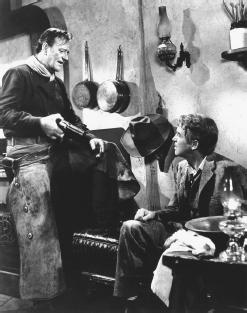
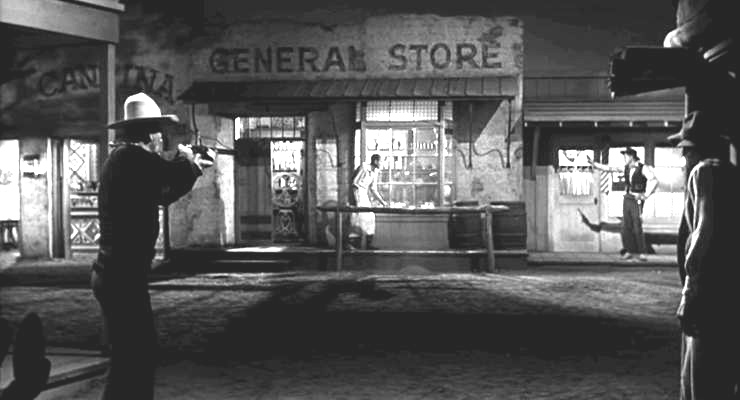
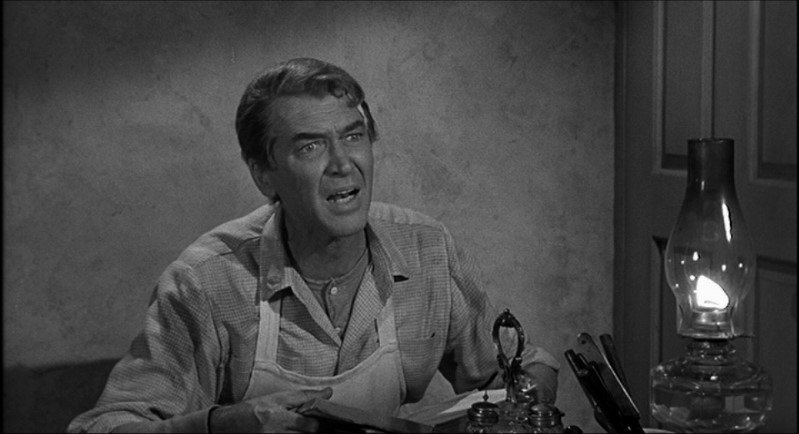
When Orson Welles was asked what movies he studied before embarking on directing Citizen Kane he replied, "I studied the Old Masters, by which I mean John Ford, John Ford, and John Ford."
Running parallel with our series about Akira Kurosawa ("Walking Kurosawa's Road"), we're running a series of pieces about the closest thing America has to Kurosawa in artistry—director John Ford. Ford rarely made films set in the present day, but (usually) made them about the past...and about America's past, specifically (when he wasn't fulfilling a passion for his Irish roots). In "The History of John Ford" we'll be gazing fondly at the work of this American Master, who started in the Silent Era, learning his craft, refining his director's eye, and continuing to work deep into the 1960's (and his 70's) to produce the greatest body of work of any American "picture-maker," America's storied film-maker, the irascible, painterly, domineering, sentimental puzzle that was John Ford, John Ford, and John Ford.
When the Founding Fathers decreed that "All men are created equal" in the Declaration of Independence, released 239 years ago, they weren't speaking of civil rights. They were actually refuting the divine right of Kings—that just because you're born in the house of Tudor, Stuart, Plantagenet or Windsor does not give the inherent or even god-given right to rule over other people, whatever their circumstances. That's what the slave-owners who wrote the Declaration meant. But, because that document and the Constitution deal with fundamental ideals of human rights—base-line ideals—on which this country and its governance are formed, they have become "living, breathing documents," and are just as subject to evolution as the species that came up with them, and cannot, in good conscience, remain inert without undergoing re-interpretation, as this country has seen in the last couple weeks. Things change and our laws and our practicing of them, must change, if they are to remain true to the spirit with which this Nation announced itself. The United States of America, that most hopeful of country names, is an experiment in whether a people can put aside their differences, their tribalism and their prejudices and govern themselves, not relying on some potentate given that position by birth. It's an experiment that hasn't been perfected yet—and given those mentioned factors of human beings—may never be perfect to everyone's liking. There are only two ways we, as a people, can only be truly equal—by either putting aside our prejudices and practicing what we preach or by dying. Evolution or extinction will make us all equal. Those are the only choices. But, progress, like evolution, slowly, inexorably gets changed. If anything has defined the history of the United States, it is the story of the African-American, brought over in slave-ships to be propertied labor, no better than cattle, and the Nation's waking up from its privileged slumber to realize that it was deluding itself to say "all men are created equal" in theory while violating it in the worst way in practice. That struggle is the struggle of the United States—to back up its high-minded words with action in everyday life.

Sergeant Rutledge (John Ford, 1960) "Mr. Lincoln said we're free. But that just ain't so."
So says Sergeant Braxton Rutledge (Woody Strode) in another in a series of lesser known films by master director John Ford. This is another—his last, in fact*—look at the U.S. Cavalry, but fills in one of the "gaps" in the "Western" era of the United States, post-Civil War—the era of the Buffalo Soldier, when men who were former slaves were allowed to join the Armed Forces in service to the country that had previously condoned, by inaction, their forced servitude. Sergeant Rutledge (the film) is John Ford's acknowledgment of that conundrum and the hypocritical attitude of the Nation towards the rights of slaves. It is one thing to free them. It is quite another to not keep them enslaved by treating them as second-tier citizens, not equal to the whites under the law. Ford always populated his films of American history with a varied populace—Swedes, Irish, Poles, Germans, Caucasians, mostly, but the occasional Latino, as well—but his films are remarkably free of immigrants of color. It was prescient of him to do Rutledge on the cusp of the Civil Rights era, and before Sidney Poitier broke the box-office color barrier.

Based on the novel "Captain Buffalo" (a title that Ford clearly preferred but was overruled when the studio proved to be white-knuckled about it) by author James Warner Bellah (who wrote the stories for Ford's "Cavalry trilogy" and the subsequent screenplay for The Man Who Shot Liberty Valance, it tackles the service of the Buffalo Soldiers, who, even while defending the Nation, were not equal under the law and not equal in the hearts and minds of the civilian populace they served. Sergeant Rutledge was far afield of the mainstream in its purpose of pointing out and condemning official and social prejudice. John Huston had tackled the same issue in a sub-plot of In This Our Life in 1946, when the word of a black man could not hold the weight against that of a prominent (or even a non-prominent) white in a court of law (And Rutledge appeared before a similarly themed book To Kill a Mockingbird was presented as film in 1961). White truth counts more than black truth. In fact, a white lie counts more than a black truth. The same applies in Sergeant Rutledge: Mr. Lincoln said they're free. But it just ain't so. Not as long as the color of one's skin is a consideration for justice...for anything... no matter the official platitudes saying otherwise.
.jpg)
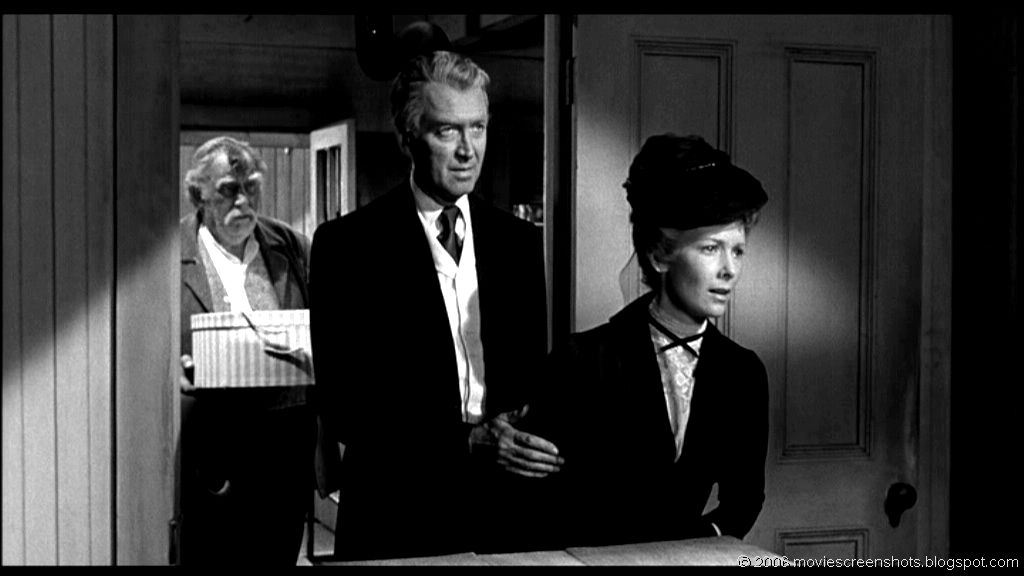
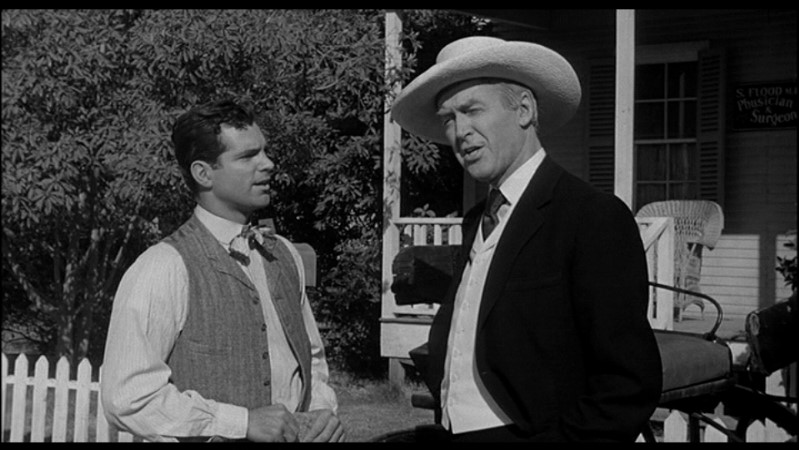
"They're laying it on a little thick for Sergeant Rutledge", says Lt. Tom Cantrell (Jeffrey Hunter, top-billed, although he has less screen-time than Strode, no doubt due to Warners' fears of effect on box-office revenues) and it applies to the tactics inside the film and that of the director. Ford toys with our prejudices in this one, pushing emotional buttons, challenging our own best intentions as an audience against established prejudices, which he pokes and prods, in images that provoke. Against that, he puts forth acts of character that should weigh more than the impressions those images inspire. Those images are informed (or mis-informed) by the testimony of the witnesses in a military court-martial and trial of the title character, and "character" is the chief concern of each attestant, for good or ill. Because of the differing impressions and opinions that are presented as fact, Sergeant Rutledge is Ford's version of Rasho-mon, a tip of the stetson to Japan's director Akira Kurosawa who had been, in turn, evoking Ford throughout his career.
 |
| Black man's hand against a white woman's face: images that provoke. |
It all revolves around what Rutledge calls "white woman trouble:" A girl (Toby Michaels) is found raped and murdered, and her father (who just happens to be in charge of the 9th Cavalry) is also found slain. Disapproving locals have seen Rutledge helping the headstrong Lucy Dabney—and their prejudices are as much against her as Rutledge—and when she ends up dead, accusing eyes immediately turn to him. Her father ends up dead, and Rutledge is nowhere to be found, deserted. His own 9th Cavalry is sent out to track him down, headed by Lt. Cantrell, who has come out to meet his love Mary Beecher (Constance Towers, so excellent in Ford's The Horse Soldiers from the previous year). Once caught, Rutledge proves too capable to hold on to and escapes. But, when the 9th is under peril from an ambush, he returns to warn them, his sense of duty overriding his surety that he would be incapable of facing a fair trial from the white military commanders sitting in judgement, or the townspeople who'd as soon lynch him as try him.
.jpg) |
| Lucy Dabney is found murdered—it is only the image that implies she's been violated. |
Cantrell, based on Rutledge's actions warning the troop, agrees to serve as defense attorney at his court-martial, but its an uphill struggle. The prosecutor (Carleton Young) bases his case on circumstantial evidence, as well as playing on the prejudices of the court and the spectators (which are not far afield from his own). Rutledge knows he will be damned, but stands trial anyway, lest the accusations besmirch the rest of the 9th. Like in previous Ford Cavalry pictures, the Corps is greater than any one man, or even the truth. The Corps must be preserved, whatever the cost.
 |
The symbolism doesn't get more obvious than this:
The lily-white gloved hand of the prosecutor accuses Rutledge. |
It's in the trial portion where Ford becomes his most expressive directing, using lighting and stage techniques to move us from the courtroom testimony to the flashbacks of the events of the witnesses' narratives. Naturalism, which has been prevalent from the beginning of the film, transitions as we move from present into the past of memory and perspective, splintering reality and truth, as the case for and against Rutledge is built. At the same time, Ford uses comedy to show the absurdity and irony of the court's officials charged with the heavy burden of judging a man's life, being far less. Those moments of farce (which disarm any protests of stereotyping as the whites get the brunt of it), especially in the form of Col. Otis Fosgate (Willis Bouchey, in a role that might have been played by Ward Bond, if he had chosen to participate) and his bickering with his harridan of a wife (played by Billie Burke), might seem out of a place if Ford 1) didn't want to break up the drama a bit—as was his wont, and 2) showing the foolishness of the officials raises the stakes (conversely) of the drama by making them less resolute and dependable as authority figures.

One of the great joys for me of Sergeant Rutledge is to see the lengthy performance of one of my favorite character actors, Woodrow Wilson Woolbine Strode, who was usually "tasked" with playing dialogue-less African princes and warriors (he would even play one for Stanley Kubrick this same year in Spartacus) who had a distinctive face that photographed well from any angle.
Strode's acting is varied in quality, stiff and a little too brittle on occasion, but in his break-down scene on the witness stand with Ford's camera bearing down on him, he cracks and suddenly you see an amazing performance, right from the umbraged tilt of Strode's head at the prosecution's veiled bigotry, to the crumbling of that stoic face as he must finally reveal himself, rather than keeping his counsel and expressing himself by example. Strode was always a better physical actor (the way Redford is, the way John Wayne is) and some of his most memorable performances (like in Spartacus the same year and Once Upon a Time in the West) he has no lines at all. And Ford, who got more out of actors with looks and gestures than from reams of dialogue, trusted the planes of the face to reveal thoughts and feelings that might move, and even terrify, an audience.

Folks dismiss Rutledge as one of Ford's "atonement" movies, never questioning why other directors didn't do something similar, nor considering why it was important for Ford to continue to tell the history of the States by filling in some of the less known gaps in "the taming of the West" (especially considering that television at the time was glutted with more typically conventional Western fare) or that market forces might not demand his reassessment of the Western saga. Certainly, the timing for Sergeant Rutledge to garner more attention might have been more appropriate for the later 60's, as opposed to when Ford made it...in 1960. I think Rutledge is brave, stirring, and damning, not just for its time but for ours, as well. We haven't yet reached the point where (as one sage put it) people can be judged by the content of the character and not by the color of their skin." "Mr. Lincoln said we're free. But it just ain't so." And the line continues: "Maybe some day. But not yet." And still not yet, past the time-setting of the film, or the day it was made. Some day we'll live up to our birthright: "all men are created equal." It's why we keep fighting...in the streets and in our hearts. Until we've beat ourselves color-blind.
 |
| Woody Strode, along with Jack Robinson, and Ken Washington when they played for UCLA |

* Well, he did do some Cavalry coverage in Cheyenne Autumn (which we'll take a look at soon), but the true focus of that film is The Trail of Tears from the First People's point-of-view.
** The publicity department at Warner Bros had to fight two battle to reach an audience: 1) the director was considered an "old codger" who, although he was the only director who'd won three Oscars, was thought a little "out of touch" for young audiences; 2) the story was about a black man in a time before the Civil Rights marches of the '60's. So, the question is this: how do you be ahead of your time for modern audiences but still be an "old codger" in the eyes of the studio? Makes no sense. Now, look at the posters for Rutledge from the Warner publicity department that downplay the story and Strode in favor of a more prominently positioned white. And Ford stalwarts John Wayne and Ward Bond chose not to participate in the film, except to lend their names to generically complimentary praise-plugs.


.jpg)

.jpg)